
The Saints
St Therese of Lisieux, the Little Flower
Who St Therese of Lisieux, the Little Flower, is, what she is patron of, a traditional St Therese prayer, and her feast day, from traditional Catholic sources.
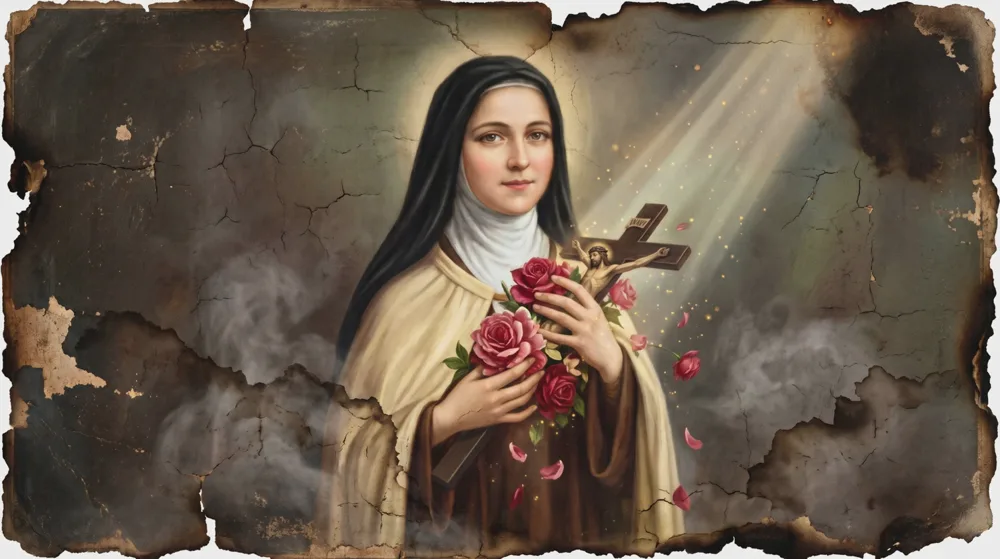
St Therese of Lisieux, called the Little Flower, was a Carmelite nun of the nineteenth century who died at twenty-four, leaving behind a "little way" of confidence and self-surrender that made her one of the most loved saints of the modern Church. She is patroness of the foreign missions and a secondary patroness of France, and her feast falls on the third of October. Below we set out who saint Therese is, what she is patron of, a traditional St Therese prayer, and her feast day, drawn from traditional sources.
Who St Therese of Lisieux is
St Teresa of the Child Jesus — to give her religious name in full, Teresa of the Child Jesus and of the Holy Face — was born at Alençon in Normandy on the second of January 1873, the youngest of the five surviving daughters of Louis Martin, a watchmaker, and Azélie-Marie Guérin. Her mother died in 1877, and the family then moved to Lisieux, where two of her sisters had already entered the Carmel (Butler, Lives of the Saints).
From her childhood Therese desired the cloister. After what she called her Christmas-eve conversion, and after a bold appeal to Pope Leo XIII for early admission during a pilgrimage to Rome, she was allowed to enter the Carmel of Lisieux at fifteen, on the ninth of April 1888. There she lived a hidden life of simplicity and perfection in small things — her "little way" of trust and self-surrender — and at the command of her superiors she wrote the account of her soul that the world would later know as her autobiography.
Struck by tuberculosis, she bore eighteen months of suffering and died on the thirtieth of September 1897 (Butler, Lives of the Saints). The same hidden fidelity under long suffering would mark, in the century that followed, Padre Pio of Pietrelcina, the Capuchin friar who bore the stigmata for fifty years.
She was canonized in 1925 by Pope Pius XI. What raised her up was not great deeds but the manner of small ones: the doctrine that a soul too weak to climb may yet reach God by abandoning itself wholly into His arms, doing the least things with great love. This is the heart of the Little Flower's teaching, and it stands squarely within the older Catholic tradition of holy childhood before God — the spirit of the Gospel word that unless we become as little children we shall not enter the kingdom of heaven (Matthew 18:3, Douay-Rheims).
Why she is called the Little Flower
The title "the Little Flower" comes from Therese's own image of herself. She wrote of being a small white flower in the garden of God, of no great account beside the lilies and the roses, yet planted and tended by Him for His own pleasure. The name took hold quickly after her death and has clung to her ever since. It is not a sentimentality but a doctrine: that God wills the hidden, the small, and the unremarkable soul as truly as the great one, and that holiness is open to those who have nothing to offer but their littleness and their love. The reader who wishes to understand her way more fully will find its roots in the ordinary disciplines of the spiritual life and in mental prayer, to which her whole religious vocation was given.
St Therese of Lisieux books
Those who look for St Therese of Lisieux books will find that the saint left one great work of her own, set down at the command of her superiors and published shortly after her death. In its first French editions it was given the title Histoire d'une âme — in English, The Story of a Soul — and it gathers the autobiographical manuscripts she wrote for her sisters, together with her last conversations and some of her letters and poems. It is from this book that the world learned of her childhood at Alençon and Lisieux, of her entrance into the Carmel, and above all of her "little way." Read in its older, integral form it remains the first and best source for her doctrine.
Beyond her own writing, the standard older accounts of her life are found in the works of devotion and hagiography that the Church has long relied upon. Butler's Lives of the Saints treats her under her religious name, Teresa of the Child Jesus; the lives and panegyrics published in the decades after her canonization in 1925 carry the same traditional reading of her sanctity. For the reader who wishes to go further, her letters and her last conversations (the Novissima verba) preserve, in her own words, the confidence and self-surrender that her autobiography teaches. We commend to that reader the older editions over the modern critical ones, for the older convey the devotion in which her cause was raised to the altars.
What St Therese is patron of
In 1927, two years after her canonization, Pope Pius XI named St Therese of the Child Jesus patroness of all foreign missions, together with St Francis Xavier (Butler, Lives of the Saints). It is a striking patronage for an enclosed nun who never left her convent and never set foot in mission lands: she is patroness of the missions not by travel but by prayer and sacrifice, which she offered without ceasing for priests and for the conversion of souls. Her companion in this office, St Francis Xavier, the great Jesuit apostle of the Indies and Japan, was himself declared official patron of foreign missions by Pope Pius X.
St Therese is honoured also as a secondary patroness of France, beside St Joan of Arc, of whom we write in St Joan of Arc. By long popular devotion she is further invoked as a patroness of florists and flower-growers, a patronage that grew naturally from her title of the Little Flower and from her promise to let fall, after her death, a shower of roses — that is, of graces and favours — upon those who asked her help. To those who pray to her she is invoked for missionaries, for priests, for the sick, and for the grace to do small things faithfully and with love.
In short, when we ask what St Therese of Lisieux is the patron saint of, the answer is:
- The foreign missions, declared by Pope Pius XI in 1927, jointly with St Francis Xavier.
- France, as a secondary patroness, beside St Joan of Arc.
- Florists and flower-growers, by popular devotion, from her title and her promised shower of roses.
- Missionaries, priests, and the sick, who are commended to her intercession.
- Aviators, a later devotional title, and those who suffer from illness, especially tuberculosis, the sickness she herself bore.
These last patronages rest on popular piety rather than on a formal decree; the two great patronages established by the Holy See are the foreign missions and France.
A traditional St Therese prayer
The most widely used St Therese prayer in the traditional devotion to the Little Flower is the following, which asks her intercession and her promised roses:
O Little Therese of the Child Jesus, please pick for me a rose from the heavenly garden and send it to me as a message of love. O Little Flower of Jesus, ask God today to grant the favours I now place with confidence in your hands. (Here mention your request.) St Therese, help me to always believe, as you did, in God's great love for me, so that I may imitate your "little way" each day. Amen.
A St Therese little flower prayer of this kind is rightly said within the order of Catholic prayer: we ask the saint not as one who grants of herself, but as a friend of God who pleads our cause before Him, that He may grant what is for our good and His glory. The same is true of every saint we name; the Church gathers their intercession in the Litany of the Saints. For the favours we seek through saint Therese we still address ourselves, in the end, to God alone, who is the giver of every good gift.
The Basilica of St Therese at Lisieux
The Basilica of St Therese at Lisieux is the great shrine raised in Normandy in her honour, on the hill of Lisieux not far from the Carmel where she lived and died. The building was begun after her canonization and consecrated in 1954, before the changes of the later twentieth century; it was blessed and given the rank of a minor basilica, and it became, after Lourdes, one of the most visited pilgrimage churches of France.
There the relics of the saint are venerated, and pilgrims come to ask her intercession and her promised roses. Near it stand the Carmel, where her body first rested, and the family home, Les Buissonnets, where she passed her childhood after the move from Alençon. To make the pilgrimage to Lisieux is to follow the hidden life of the Little Flower from her home to her cloister to her shrine.
Churches of St Therese in the Catholic Church
Because devotion to the Little Flower spread so swiftly after her canonization, a great number of parishes and chapels in the Catholic Church bear her name — the searches for a "St Therese of Lisieux Catholic church" or a "Saint Therese of Lisieux Roman Catholic church" most often seek one of these local parishes, found in nearly every country to which her cult was carried. This abundance of churches is itself a fruit of her patronage of the missions: where the faith was preached, her name and her little way followed. If you are seeking a particular parish dedicated to her, the diocese in which it stands will hold the surest record; what unites them all is the one saint they honour and the one Church in which she is venerated.
The feast day of St Therese
In the traditional Roman calendar the feast of St Teresa of the Child Jesus, Virgin, is kept on the third of October. (In some later reckonings her day was transferred to the first of October; the older and proper place of her feast is the third.) The Mass is of a virgin, in white vestments, the colour of her purity and of her childlike joy. Her death itself fell on the thirtieth of September 1897, and the Roman Martyrology commemorates her accordingly; but the feast by which the Church keeps her memory each year is the October feast.
To keep her feast is to be reminded that sanctity is not reserved to the strong or the great. The Little Flower reached the heights of the saints by a road open to every Christian: small acts of fidelity, patience in suffering, and unbounded trust in the mercy of God. Her example belongs with that of the other great women saints we treat, among them St Rita and St Anne.
Conclusion
St Therese of Lisieux teaches that the way to God is not closed to the weak. She offered to Him a hidden life and a perfect love in small things, and she promised to spend her heaven doing good upon earth. We do well to ask her prayers, to keep her feast on the third of October, and to walk, in our own measure, the little way she opened. St Thérèse of Lisieux takes her place among the saints of the year in our guide to the Catholic saints, listed by feast day.
Frequently Asked Questions
Who is St Therese of Lisieux?
St Therese of Lisieux, in religion Teresa of the Child Jesus and of the Holy Face, was a Carmelite nun born at Alençon in 1873 who entered the Carmel of Lisieux at fifteen and died at twenty-four in 1897. She left behind a "little way" of confidence and self-surrender that has made her one of the most loved saints of the modern Church. She was canonized in 1925 by Pope Pius XI.
Why is St Therese called the Little Flower?
The title comes from Therese's own image of herself as a small white flower in the garden of God, of no great account beside the lilies and the roses, yet planted and tended by Him for His own pleasure. It is not a sentimentality but a doctrine: that God wills the hidden and unremarkable soul as truly as the great one. The name took hold after her death and has clung to her ever since.
What is St Therese the patron saint of?
In 1927 Pope Pius XI named her patroness of all foreign missions, together with St Francis Xavier — a striking patronage for an enclosed nun who never left her convent, won not by travel but by prayer and sacrifice. She is also a secondary patroness of France beside St Joan of Arc, and by popular devotion a patroness of florists. She is invoked for missionaries, for priests, and for the sick.
When is the feast day of St Therese?
In the traditional Roman calendar the feast of St Teresa of the Child Jesus, Virgin, is kept on the third of October, with the Mass of a virgin in white vestments. (In some later reckonings her day was transferred to the first of October; the older and proper place of her feast is the third.) Her death itself fell on the thirtieth of September 1897.
What is the "little way" of St Therese?
The little way is the doctrine that a soul too weak to climb may yet reach God by abandoning itself wholly into His arms, doing the least things with great love. It stands squarely within the older Catholic tradition of holy childhood before God — the Gospel word that unless we become as little children we shall not enter the kingdom of heaven (Matthew 18:3, Douay-Rheims). It teaches that sanctity is not reserved to the strong or the great.
What books did St Therese of Lisieux write?
St Therese wrote one principal work, set down at the command of her superiors and published after her death under the title Histoire d'une âme — in English, The Story of a Soul. It gathers her autobiographical manuscripts, together with her letters, poems, and last conversations, and it is the first source for her life and her little way. The older accounts of her, such as Butler's Lives of the Saints, treat her under her religious name, Teresa of the Child Jesus.
Where is the Basilica of St Therese at Lisieux?
The Basilica of St Therese stands on a hill at Lisieux in Normandy, France, not far from the Carmel where she lived and died. It was begun after her canonization and consecrated in 1954, raised to the rank of a minor basilica, and it became one of the most visited pilgrimage churches of France. Her relics are venerated there, near the Carmel and the family home, Les Buissonnets.
The Iter Fidei app carries the prayers to the saints, the litanies, and the traditional calendar of feasts. Join early access here.
Sources. St Therese of Lisieux, The Story of a Soul (Histoire d'une âme); Butler, Lives of the Saints (St Teresa of the Child Jesus); the Roman Martyrology; the traditional Roman calendar (feast of 3 October); the Gospel according to St Matthew, Douay-Rheims version.