
The Last Things
What Is Purgatory? The Catholic Doctrine
Purgatory is the state of purification for souls who die in God's grace but still owe a temporal debt for sin. The Council of Trent defined it; we can help the holy souls by prayer, Mass, and indulgences.
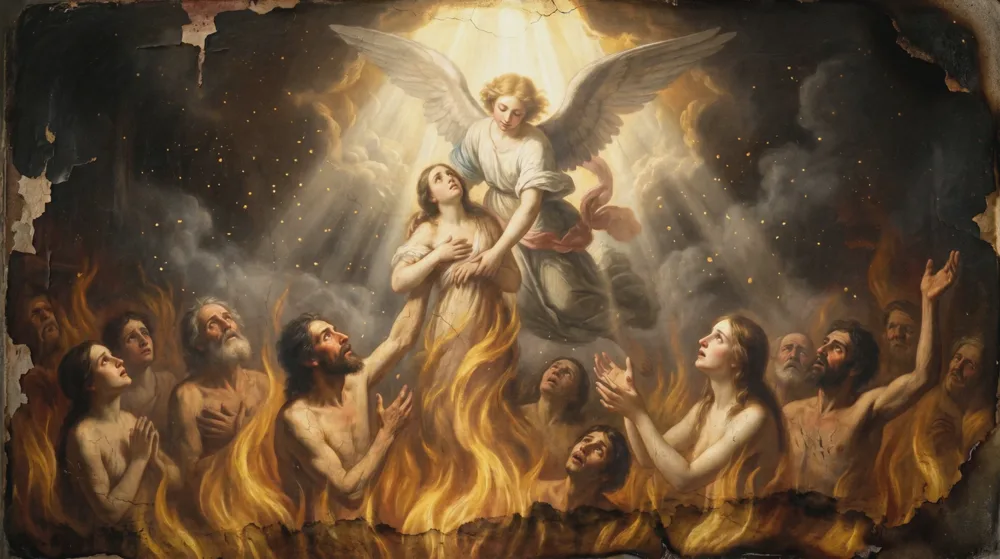
Purgatory is the state in which the souls of the just are purified after death before they are admitted to heaven. The Catechism of Trent teaches that there is "a hell where is the fire of Purgatory," in which "the souls of the just are purified in sufferings which last a determined time, until they be worthy to enter into the eternal Country, for nothing defiled can penetrate therein." This is the purgatory meaning the Church has always held: not a third final destiny beside heaven and hell, but a passage. Every soul in purgatory is saved and will reach heaven. What remains is to be cleansed of the debt that sin leaves behind.
What is the meaning of purgatory? Definition and origin of the word
The word purgatory comes from the Latin purgatorium, from purgare, "to cleanse" or "to purify." The plainest definition of purgatory is therefore drawn from the thing it names: a place or state of purification. It is not, as the popular ear sometimes takes it, a synonym for limbo, for a vague waiting-room, or for a "second chance" to be saved. The meaning is precise. Purgatory is the cleansing state of the souls who die in God's grace but are not yet wholly purified.
When we ask what a purgatory is, then, we are asking after a single defined thing, not a metaphor. The Catechism of Saint Pius X gives the definition in answer to a direct question — "Where do they go, the souls of the just who, when they die, have not yet entirely satisfied the justice of God?" — "They go to purgatory to satisfy there the justice of God and to be entirely purified." That is the whole definition in two clauses: to satisfy, and to be purified. Everything else the Church teaches about purgatory unfolds from those two words.
What is purgatory in Catholic teaching?
To understand what purgatory is, we must first see what sin leaves in the soul even after it is forgiven. The Catechism of Trent teaches that "sin draws after it two things, the stain and the penalty." Confession and the grace of God remit the guilt and the eternal punishment of sin. But, the Catechism continues, "it often happens, as the Council of Trent has declared, that God does not remit at the same time certain remnants of sin, and the temporal penalty that is due to it." A wound may be closed and still leave a scar that needs healing. So it is with the soul: the fault is pardoned, yet a temporal debt may remain to be paid.
That debt is paid in this life by penance — or, if it is not fully paid here, in the next. The Catechism of Saint Pius X states it plainly: after absolution, "there remains a temporal punishment to be paid in this world or in purgatory." Purgatory, then, is where the just satisfy what they did not satisfy on earth. Asked whether all the saved "go straight to paradise," the same Catechism answers: "No, they go to purgatory to satisfy there the justice of God and to be entirely purified." We say more on this in what happens after death and in our overview of the four last things.
Who goes to purgatory
Only those who die in the grace and friendship of God enter purgatory. No one is in purgatory who is not certain of heaven. The souls there are the souls of the just — those who departed this life loving God but not yet wholly cleansed, either because of venial sins not yet repaired, or because of a temporal punishment still owing for sins already forgiven. The Catechism of Trent names them "the souls of the just" precisely to distinguish them from the damned, who are in "a frightful and dark prison" of "perpetual fire which is never quenched." Purgatory is the opposite condition: a fire of purification, not of damnation, and its term is fixed. The soul leaves it for heaven; it never falls from it into hell.
This is why the Church never speaks of purgatory with the dread reserved for hell. Mgr de Ségur, writing on the eternity of hell's pains, sets that endless prison apart from every other state of the dead. The holy souls are not under that sentence. They are saved. What they lack is the vision of God, withheld for a time until the last debt is discharged, "for nothing defiled can penetrate" into heaven.
Is purgatory in the Bible?
Those who ask whether purgatory is in the Bible are right to ask, for the doctrine rests, the Catechism of Trent says, "upon the testimony of the Scriptures and upon apostolic tradition, at the same time that it is confirmed by the decrees of the holy Councils." The scriptural ground is not a single proof-text but a settled pattern of teaching.
First, Scripture shows that a temporal penalty can remain after a sin is forgiven. The Catechism of Trent points to "the 3rd chapter of Genesis, in the 12th and 22nd chapters of Numbers, and in many other passages," but calls the case of David "the most celebrated and the most striking." Through the prophet Nathan, God says: "The Lord hath taken away thy sin; thou shalt not die." The guilt is pardoned. Yet, the Catechism observes, "despite all the fervour of his prayers, the Lord did not fail to punish him" with real, temporal chastisements. If a debt can remain after pardon in this life, justice requires that it be paid in the next when it is not paid here.
Second, Scripture teaches a place of the dead that is neither heaven nor the hell of the damned. Expounding the article "He descended into hell," the Catechism of Trent explains that the word hell there "designateth those places, those hidden receptacles where are held prisoner the souls that have not yet obtained the heavenly beatitude" — and it names among them "another hell where is the fire of Purgatory." On this foundation of Scripture, tradition, and the Fathers, the doctrine stands.
What is purgatory like?
Those who ask what purgatory is like should hold to what the Church teaches and resist every invention beyond it. The sources tell us three sober things. It is a state of purification: the souls are "purified in sufferings." It is temporary: those sufferings "last a determined time." And it is ordered wholly to heaven: the term of purgatory is the moment a soul becomes "worthy to enter into the eternal Country." We will not paint the fire in colours the sources do not give.
What is certain is enough: it is real suffering, it is purifying, and it ends in the vision of God. The Catechism of Trent describes the soul that leaves this life in grace as continuing on its way "until at last it is reunited to our Saviour, and reposes in the bosom of Eternal Felicity." Purgatory is a stage on that road, not a detour from it. For what awaits the holy souls when it ends, see what is heaven.
What is purgatory in Christianity? Why some Christians reject it
Purgatory is a doctrine of the Catholic Church and of the ancient Eastern Churches; it is not held by the Protestant communities that broke from Rome in the sixteenth century. This is why the question "what is purgatory in Christianity?" has more than one answer depending on whom one asks — and why the Church defined the doctrine so carefully precisely at the time it was denied.
The Reformers rejected purgatory chiefly because they rejected the truth on which it rests: that a temporal punishment can remain after the guilt of sin is forgiven, and that this debt can be satisfied. Where one holds that the merits of Christ are simply imputed and that nothing remains to be paid, purgatory has no place. The Catholic answer is that Scripture itself shows a debt remaining after pardon — David, forgiven by Nathan, was still chastised — and that "nothing defiled" can enter heaven. The doctrine is therefore not a medieval invention but the conclusion the Church draws from what Scripture and the Fathers hand down. The Catechism of Trent notes that on this point the Church's "Doctrine has never varied."
It is worth adding what purgatory is not, against the caricatures: it is not a place where the damned might still be saved, it is not paid for with money, and an indulgence is not the purchase of forgiveness but the application of the Church's treasury of merit to a debt already incurred by a soul already saved. The abuse of indulgences was a real disorder the Church herself condemned; the doctrine of purgatory is untouched by it.
The Council of Trent and the doctrine of purgatory
The doctrine of purgatory is not a private opinion but a defined truth of the Faith. The Catechism of Trent, drawn up at the command of the same Council, twice anchors the teaching in conciliar authority: the temporal debt of sin is what "the Council of Trent has declared," and purgatory itself is "confirmed by the decrees of the holy Councils." On this point, the Catechism adds, the Church's "Doctrine has never varied." To hold purgatory is to hold what the Church has held from the beginning and defined against those who denied it.
How we can help the holy souls in purgatory
Here the doctrine turns from what purgatory is to what we owe the souls who are in it. Because we are one body in Christ — what the Creed calls the Communion of Saints — the satisfaction of one member can be applied to another. The Catechism of Trent teaches that God "has been willing to grant to us, so weak and so wretched, the power to satisfy one for another," so that "those who possess the divine Grace can, in the name of another, pay to God what is due to Him." The Catechism grounds this in the Creed itself: "no one among us could doubt of this truth, since we confess in the Symbol of the Apostles the communion of Saints."
The means are named exactly. The Catechism of Saint Pius X asks, "Can we relieve in their pains the souls in purgatory?" and answers: "Yes, the souls who are in purgatory can be relieved by prayers, almsgiving, all the other good works, by indulgences, and above all by the holy sacrifice of the Mass."
- Prayer. The Catechism of Trent calls it the most fitting of penances that we "pray for all the world, and above all for those who have died in the Lord." The St Gertrude prayer for the souls in purgatory, which offers the Precious Blood of Christ to the Eternal Father in union with the Masses of the day, is a beloved traditional form of this intercession.
- The Holy Mass. Among the four ends of the Mass, the Catechism of Saint Pius X names the propitiatory: it is offered "to appease Him, to give Him the satisfaction due for our sins, to relieve the souls in purgatory." The fruits of the Mass reach "either the living or the dead."
- Almsgiving and good works. These too are satisfactory and may be offered for the departed.
- Indulgences. The Church applies the merits of Christ and the saints to remit the temporal punishment that the holy souls are paying.
Penance done well in this life lightens what would otherwise be paid in purgatory; the Catechism of Saint Pius X teaches that the sacrament of Penance "changes the eternal punishment into temporal punishment, of which a part, greater or lesser according to one's dispositions, is even remitted." A good confession is a mercy to one's own soul against the day of death.
Frequently Asked Questions
What is purgatory?
Purgatory is the state in which the souls of the just are purified after death before they are admitted to heaven. The Catechism of Trent teaches that there the souls of the just "are purified in sufferings which last a determined time, until they be worthy to enter into the eternal Country, for nothing defiled can penetrate therein." It is not a third final destiny beside heaven and hell, but a passage: every soul in purgatory is already saved and will certainly reach heaven once the temporal debt of sin is paid.
What is the meaning and definition of purgatory?
The word comes from the Latin purgatorium, from purgare, "to cleanse." The definition follows the word: purgatory is the state of purification in which the souls of the just are cleansed after death before entering heaven. The Catechism of Saint Pius X puts it in two clauses — the just go to purgatory "to satisfy there the justice of God and to be entirely purified." It is not limbo, not a waiting-room, and not a second chance at salvation; every soul there is already saved.
What is purgatory in Christianity? Do all Christians believe it?
No. Purgatory is held by the Catholic Church and the ancient Eastern Churches but is rejected by the Protestant communities that separated from Rome in the sixteenth century. They denied it chiefly because they denied that a temporal debt can remain after sin is forgiven. The Catholic answer is that Scripture itself shows such a debt remaining — David was forgiven yet still chastised — and that "nothing defiled" can enter heaven, so the cleansing must be completed somewhere. On this point the Catechism of Trent says the Church's "Doctrine has never varied."
Why do Catholics believe in purgatory?
Because Scripture, apostolic tradition, and the decrees of the Councils teach it, and because the doctrine follows from two truths the Faith holds firmly. First, that a temporal penalty can remain even after a sin is forgiven — as with David, whose sin Nathan declared pardoned yet who was still chastised. Second, that "nothing defiled can penetrate" into heaven. If a debt remains unpaid at death, justice requires that it be paid before the soul beholds God. Purgatory is where that cleansing is completed.
Is purgatory in the Bible?
The doctrine rests, the Catechism of Trent says, "upon the testimony of the Scriptures and upon apostolic tradition." Scripture shows a temporal penalty remaining after a sin is forgiven (the case of David), and it teaches a state of the dead that is neither the heaven of the blessed nor the hell of the damned — the "hidden receptacles where are held prisoner the souls that have not yet obtained the heavenly beatitude." Catholics also point to 2 Maccabees, where Judas Maccabeus makes atonement for the dead "that they may be loosed from sins." It is not a single proof-text but a settled pattern of teaching.
What is purgatory like?
The Church teaches three sober things and forbids invention beyond them. It is a state of purification — the souls are "purified in sufferings"; it is temporary — those sufferings "last a determined time"; and it is ordered wholly to heaven — it ends the moment a soul becomes "worthy to enter into the eternal Country." It is real suffering, but it is the suffering of the saved, lit by certain hope, and it is never to be feared with the dread reserved for hell.
Do Catholics believe in purgatory, and does the Roman Catholic Church teach it?
Yes. Purgatory is not a private opinion but a defined truth of the Faith. The Catechism of Trent twice anchors it in conciliar authority, and notes that on this point the Church's "Doctrine has never varied." To hold purgatory is to hold what the Church has held from the beginning and defined against those who denied it.
How can we help the souls in purgatory?
Because we are one body in Christ — the Communion of Saints — the satisfaction of one member can be applied to another. The Catechism of Saint Pius X teaches that the holy souls "can be relieved by prayers, almsgiving, all the other good works, by indulgences, and above all by the holy sacrifice of the Mass." To pray for the dead, to give alms for them, and to have Mass offered for them is a duty of charity toward those who can no longer help themselves.
Purgatory is the mercy of God meeting the justice of God. He will not bring into His sight a soul still marked by the remnants of sin; He will not lose a soul that died loving Him. So He purifies for a time what He will then glorify forever, leaving us a duty of charity toward those who can no longer help themselves: to pray, to give, and to offer the Holy Sacrifice for the dead, until they reach the rest we ask for them.
To pray for the holy souls in purgatory — Mass intentions, the litanies, and the prayers for the faithful departed — you can keep the traditional devotions at hand with the Join early access here..
Sources. Catechism of Trent — Creed, Fifth Article ("He descended into hell": the fire of Purgatory; the receptacles of souls); Sacrament of Penance, On Satisfaction (the stain and the penalty; temporal debt; David and Nathan; satisfying one for another; prayer for those who died in the Lord); Ninth Article ("the Communion of Saints"). Catechism of Saint Pius X — Part IV, The Sacrament of Penance (temporal punishment in this world or in purgatory; the just go to purgatory to satisfy and be purified; relief by prayers, almsgiving, indulgences, and the Mass); Part IV, The Holy Sacrifice of the Mass (the propitiatory end; fruits applied to the living or the dead); Part V, The Last Things. Mgr de Ségur, Hell (the eternal pains of the damned, distinguished from the state of the holy souls).