
Prayer
The Angelus Prayer in Latin and English
The Angelus prayer in Latin and English, side by side: the full traditional text, a line-by-line translation, a pronunciation guide for the Latin, how and when to pray it at the bell, and the Regina Caeli of Eastertide.
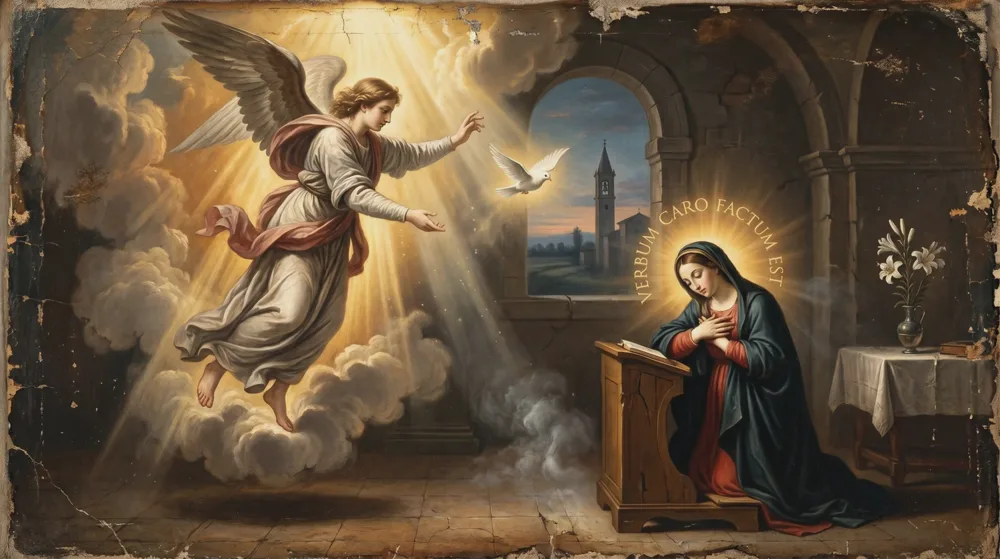
The Angelus is the Marian devotion of the Incarnation — the moment the Angel Gabriel announced to Mary that she would conceive the Son of God. It is traditionally prayed three times a day, at six in the morning, at noon, and at six in the evening, at the sound of the bell. It takes its name from its first Latin word, Angelus — "the Angel" — and for centuries Catholics have prayed it in the Church's own tongue. Below we give the whole prayer in English and in Latin, a line-by-line translation, a guide to pronouncing the Latin, and the customs that go with it.
What is the Angelus prayer?
The Angelus is a short devotion in honour of the Incarnation, made up of three Gospel versicles, three Hail Marys, and a closing prayer (collect). Each versicle recalls a moment of the Annunciation — the Angel's message, Our Lady's consent, and the Word made flesh — so that, three times a day, the faithful turn from their work to adore the mystery of God become man. It is not a long or complicated prayer: it takes about a minute, and its words are fixed and easily learned. The devotion took its present shape gradually through the Middle Ages, growing from the evening Ave rung at the bell into the threefold form the Church has kept ever since.
The Angelus prayer in English (full text)
The Angelus is prayed kneeling (on Sundays and on Saturday evening, standing). It is made of three versicles, each followed by a Hail Mary, and a closing prayer.
V. The Angel of the Lord declared unto Mary.
R. And she conceived of the Holy Ghost.
Hail Mary…V. Behold the handmaid of the Lord.
R. Be it done unto me according to thy word.
Hail Mary…V. And the Word was made Flesh.
R. And dwelt among us.
Hail Mary…V. Pray for us, O holy Mother of God.
R. That we may be made worthy of the promises of Christ.Let us pray: Pour forth, we beseech Thee, O Lord, Thy grace into our hearts; that we, to whom the Incarnation of Christ Thy Son was made known by the message of an Angel, may by His Passion and Cross be brought to the glory of His Resurrection. Through the same Christ our Lord. Amen.
The Hail Mary said after each versicle is the ordinary Angelic Salutation; its full English text and meaning are in our page on the Hail Mary.
The Angelus in Latin
Here is the traditional Latin Angelus, Angelus Domini, exactly as it stands in the older manuals of prayer, with the same versicles, responses and collect as the English above:
V. Angelus Domini nuntiavit Mariæ.
R. Et concepit de Spiritu Sancto.
Ave Maria…V. Ecce ancilla Domini.
R. Fiat mihi secundum verbum tuum.
Ave Maria…V. Et Verbum caro factum est.
R. Et habitavit in nobis.
Ave Maria…V. Ora pro nobis, sancta Dei Genetrix.
R. Ut digni efficiamur promissionibus Christi.Oremus: Gratiam tuam, quæsumus, Domine, mentibus nostris infunde; ut qui, Angelo nuntiante, Christi Filii tui incarnationem cognovimus, per passionem ejus et crucem, ad resurrectionis gloriam perducamur. Per eumdem Christum Dominum nostrum. Amen.
The Ave Maria in Latin
Those who pray the Latin Angelus say the Hail Mary in Latin too. This is the Ave Maria said after each of the three versicles:
Ave Maria, gratia plena, Dominus tecum.
Benedicta tu in mulieribus, et benedictus fructus ventris tui, Jesus.
Sancta Maria, Mater Dei, ora pro nobis peccatoribus, nunc et in hora mortis nostræ. Amen.
The Angelus in Latin and English, line by line
For those learning the Latin, this table sets each line beside its English, so the meaning of every word is clear while you pray.
| Latin | English |
|---|---|
| Angelus Domini nuntiavit Mariæ. | The Angel of the Lord declared unto Mary. |
| Et concepit de Spiritu Sancto. | And she conceived of the Holy Ghost. |
| Ecce ancilla Domini. | Behold the handmaid of the Lord. |
| Fiat mihi secundum verbum tuum. | Be it done unto me according to thy word. |
| Et Verbum caro factum est. | And the Word was made Flesh. |
| Et habitavit in nobis. | And dwelt among us. |
| Ora pro nobis, sancta Dei Genetrix. | Pray for us, O holy Mother of God. |
| Ut digni efficiamur promissionibus Christi. | That we may be made worthy of the promises of Christ. |
| Oremus. | Let us pray. |
| Gratiam tuam, quæsumus, Domine, mentibus nostris infunde… | Pour forth, we beseech Thee, O Lord, Thy grace into our hearts… |
The English is not a loose paraphrase: Ecce ancilla Domini and Fiat mihi secundum verbum tuum are Our Lady's own words in St Luke, and Et Verbum caro factum est, et habitavit in nobis is the Prologue of St John, word for word. The collect is older than the Angelus itself: it is the Postcommunion of the feast of the Annunciation on 25 March in the Roman Missal, and in Advent the Breviary sets the same prayer, with the versicle Angelus Domini, after the antiphon Alma Redemptoris Mater at the close of Compline. When we pray the Angelus, then, we borrow the very words of the Mass and the Divine Office.
How to pronounce the Latin Angelus
The Angelus is prayed in the Church's Latin, which follows the Roman (Italianate) pronunciation, not the classical one taught in some schools. A few rules carry you through the whole prayer:
- c before e, i or æ sounds like "ch": concepit is "con-CHEH-peet", efficiamur is "ef-fee-chee-AH-moor".
- g before e or i is soft, as in "gentle": Angelus is "AHN-jeh-loos", Genetrix is "jeh-NEH-treeks".
- ti before a vowel sounds like "tsee": nuntiavit is "noon-tsee-AH-veet", gratiam is "GRAH-tsee-ahm", incarnationem is "een-car-nah-tsee-OH-nem".
- æ sounds like the "e" in "met": Mariæ is "mah-REE-eh", quæsumus is "KWEH-soo-moos".
- h is silent (habitavit, "ah-bee-TAH-veet"), except in mihi, said "MEE-kee".
- j is said like an English "y": ejus is "EH-yoos", Jesus is "YEH-soos".
- gn is said like the "ny" in "canyon": digni is "DEE-nyee".
- Every vowel is pure and every syllable is sounded: Spiritu Sancto is "SPEE-ree-too SAHNK-toh", Domini is "DOH-mee-nee", Christi is "KREE-stee".
Said slowly, with the stress where it is marked above, the Latin Angelus soon comes as easily as the English. Many begin by praying the Latin versicles and responses while keeping the Hail Mary in their own tongue, and add the Ave Maria and the collect once the sounds are familiar. Either may be prayed aloud or in a group, one voice leading the versicle and the rest answering.
How and when to pray the Angelus
The Angelus is said three times a day — morning (around 6 a.m.), noon, and evening (around 6 p.m.) — traditionally at the ringing of the Angelus bell from the parish church.
To pray it: one person (or the one leading) says each versicle, and the others answer with the response, then all say the Hail Mary together. After the third Hail Mary come the final versicle and the closing prayer. It need take only a minute, and it turns the day three times toward the mystery of the Incarnation: God made man for our salvation.
The morning Angelus follows naturally on the Morning Offering, by which the whole day of prayer, work and suffering is given to God at its first hour; the noon Angelus may join the grace before meals said at the midday table; and the evening Angelus closes the working day before night prayer. By long custom one kneels — except on Sundays and on Saturday evening, when it is prayed standing in honour of the Resurrection. The older rule required both the kneeling posture and the sound of the bell; later legislation allowed these to be dispensed with for a sufficient reason, so long as the prayer is said at about the proper hours.
In Eastertide: the Regina Caeli
By a disposition of Pope Benedict XIV in 1742, throughout Paschal time the Angelus gives way to the Regina Caeli, the joyful Easter antiphon to Our Lady — Regina caeli, laetare, alleluia, "Queen of Heaven, rejoice." It is prayed at the same three hours, standing, with its own versicle and collect of the Resurrection, from noon on Holy Saturday until the Saturday after Pentecost, the eve of Trinity Sunday. Then the Angelus returns at the bell.
The meaning of the Angelus
The Angelus fixes the day on the central event of the Faith. Its three versicles trace the Annunciation as the Gospel records it: the Angel's greeting, "Hail, full of grace, the Lord is with thee" (Luke 1:28, Douay-Rheims); Our Lady's fiat, "Behold the handmaid of the Lord; be it done to me according to thy word" (Luke 1:38); and the fruit of her consent, "And the Word was made flesh, and dwelt among us" (John 1:14).
The "Angel of the Lord" of the first versicle is St Gabriel, "sent from God into a city of Galilee, called Nazareth, to a virgin" (Luke 1:26-27). The Church honours him as the angel of the Annunciation, and those who pray the Angelus often grow into a friendship with him; his traditional prayers are gathered in the Novena to St Gabriel the Archangel. The same mystery is kept at greater length before its feast on 25 March in the Annunciation Novena.
At the words "And the Word was made Flesh" — Et Verbum caro factum est — it is the ancient and pious custom to bow the head, or even to genuflect, for here the whole of the Gospel turns: the eternal God takes our nature in the womb of the Virgin. To pray the Angelus is to keep that wonder before our eyes morning, noon, and night.
Like the Rosary, which also rests on the Hail Mary and opens with the same mystery in its first Joyful Mystery, the Angelus keeps the Incarnation before the soul; but where the Rosary asks a quarter of an hour, the Angelus asks only a minute, three times a day, and so it reaches the busiest life.
A short history of the Angelus
The Angelus grew slowly, one hour at a time. Its oldest part is the evening prayer: in the time of St Bonaventure (1263 or 1269) a Franciscan decree directed preachers to encourage the people to say Hail Marys when the Compline bell rang at nightfall. By the early fourteenth century the custom of three Hail Marys at the evening bell was common across Europe, and it was recommended and indulgenced by Pope John XXII in 1318 and 1327. A morning bell for the same prayer is recorded at Parma in 1318, and a midday bell rang at Prague in 1386 and at Mainz in 1423, though at first only on Fridays. Little by little the three moments joined, and the versicles were added to the Hail Marys.
Pope Benedict XIII, on 14 September 1724, granted an indulgence for each devout recitation, with a plenary indulgence once a month, and Leo XIII revised the conditions on 3 April 1884. Benedict XIV, in 1742, gave the Regina Caeli to Eastertide, and the rubrics came to prescribe the standing posture on Saturday evening and Sunday. The prayer we say today is the one our forefathers said in the fields and in the cities long before any of us was born.
The Angelus in Latin and English (PDF and printable card)
Because the Angelus is meant to be prayed at fixed hours, it helps to have the text ready to hand — pinned near a desk, kept in a missal, or carried as a small card. The full text above, in English and in Latin with the line-by-line table, prints as it is: a single page holding the three versicles, their responses, and the closing prayer is enough to pray it anywhere when the noon hour comes, and to teach it to children, who learn its short fixed lines quickly.
Better than a loose printout, install Join early access here.: it gives the Angelus each day in Latin and in English, rings a reminder at the hour you choose, and works offline, with the Regina Caeli served in its place throughout Eastertide.
The Angelus painting by Jean-François Millet
The most famous picture of this devotion is The Angelus (L'Angélus, 1857–1859) by the French painter Jean-François Millet, which shows two peasants in a field pausing at evening, heads bowed, as the bell of a distant church tower calls them to prayer. The basket of potatoes between them and the spire on the horizon tell the whole story: ordinary work stopped, for a moment, to honour the Incarnation. The painting is a witness to how deeply the Angelus was woven into Catholic life — that a labourer in a field would lay down his fork at the sound of the bell. The canvas hangs today in the Musée d'Orsay in Paris.
Frequently Asked Questions
What does "Angelus" mean in Latin?
Angelus is the Latin for "angel", from the Greek angelos, "messenger". The prayer is named from its opening words, Angelus Domini, "the Angel of the Lord", that is, St Gabriel bringing his message to Mary.
Who wrote the Angelus prayer?
No single author. Its versicles are the words of St Luke and St John, the Hail Mary is the Church's own, and the collect Gratiam tuam is the Postcommunion of the Annunciation in the Roman Missal. The devotion was gathered together slowly, from the thirteenth century onward, by the piety of the faithful and the encouragement of the Popes.
Why is the Angelus prayed three times a day?
To sanctify the whole day — morning, midday, and evening — by recalling the Incarnation. The three hours grew up separately, the evening first, and were joined into one devotion over the later Middle Ages.
When does the Regina Caeli replace the Angelus?
Throughout Paschal time, from noon on Holy Saturday until the Saturday after Pentecost, following the disposition of Benedict XIV in 1742. For most of the faithful the first Regina Caeli is the one said on Easter morning.
What is the difference between the Angelus and the Regina Caeli?
The Angelus contemplates the Incarnation and is said kneeling; the Regina Caeli rejoices in the Resurrection and is always said standing. The Regina Caeli is said instead of the Angelus in Paschal time, not after it: the two are never said one after the other.
Can I pray the Angelus in Latin if I do not know Latin?
Yes. The words are few and fixed, and the meaning is given line by line above. Many pray the Latin versicles and responses and keep the Hail Mary in English until the Ave Maria is learned.
Why do we bow at "Et Verbum caro factum est"?
Because at those words we confess the very heart of the Faith — the Incarnation. Bowing the head (or genuflecting) is an act of reverence before the mystery of God made man, the same reverence shown at these words in the Last Gospel of the traditional Mass.
Iter Fidei gives you the Angelus and the Regina Caeli each day, in Latin and English, with a reminder at the hour of the bell. Join early access here.
Sources. Luke 1:26-38 and John 1:14 (Douay-Rheims); the Angelus and Regina Caeli as given in the Raccolta; Missale Romanum 1962 (Postcommunion of the Annunciation, 25 March); Breviarium Romanum 1962 (antiphon Alma Redemptoris Mater at Compline); Benedict XIII, grant of indulgence of 14 September 1724; Benedict XIV, disposition of 1742 on the Regina Caeli in Paschal time; Leo XIII, decree of 3 April 1884.