
Prayer
The Memorare
The Memorare — the great prayer of confidence to the Blessed Virgin Mary, in English and Latin, with its meaning and its origin in St Bernard.
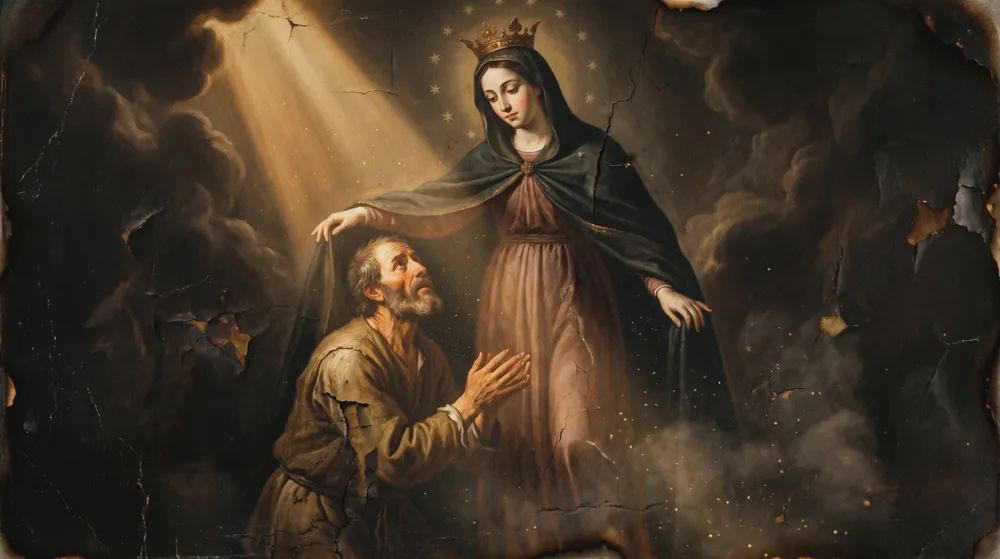
The Memorare is one of the best-loved Marian prayers: a prayer of complete confidence in the intercession of the Blessed Virgin, founded on the truth that no one who sought her help was ever left unaided. It takes its name from its first Latin word, Memorare — "Remember." Here is the prayer in full, in English and Latin, with its meaning, its origin in St Bernard, and how and when to pray it.
The Memorare prayer text (English)
Remember, O most gracious Virgin Mary, that never was it known that anyone who fled to thy protection, implored thy help, or sought thy intercession, was left unaided. Inspired with this confidence, I fly unto thee, O Virgin of virgins, my Mother; to thee do I come; before thee I stand, sinful and sorrowful. O Mother of the Word Incarnate, despise not my petitions, but in thy mercy hear and answer me. Amen.
This is the traditional English form. The opening words — "Remember, O most gracious Virgin Mary" — are the line most Catholics know by heart, and the prayer is sometimes simply called the "Remember, O most gracious" after them.
The Memorare in Latin
Memorare, O piissima Virgo Maria, non esse auditum a saeculo, quemquam ad tua currentem praesidia, tua implorantem auxilia, tua petentem suffragia, esse derelictum. Ego tali animatus confidentia, ad te, Virgo Virginum, Mater, curro; ad te venio, coram te gemens peccator assisto. Noli, Mater Verbi, verba mea despicere; sed audi propitia et exaudi. Amen.
The Latin is brief and rhythmic, built around the three verbs currentem... implorantem... petentem — running to, imploring, seeking — that name the three ways a soul turns to Our Lady. It is short enough to be learned by heart and prayed anywhere.
The Memorare to Mary
The Memorare is, first and properly, a prayer to Mary — addressed to the Blessed Virgin under the title Virgin of virgins and Mother of the Word Incarnate. When the faithful speak of "the Memorare to Mary" or simply "the Memorare prayer to the Blessed Virgin Mary," it is this original Marian form they mean, given above in English and Latin. The later form addressed to St Joseph (below) is modelled on it. So the Memorare is, by its nature, a Marian prayer of confidence; the Josephite version is a devout imitation of the same pattern.
The Memorare in Spanish (en español)
For Spanish-speaking households, the traditional form (el Acordaos) reads:
Acordaos, oh piadosísima Virgen María, que jamás se ha oído decir que ninguno de los que han acudido a tu protección, implorado tu asistencia y reclamado tu socorro, haya sido abandonado de ti. Animado por esta confianza, a ti también acudo, oh Madre, Virgen de las vírgenes; a ti vengo y, gimiendo bajo el peso de mis pecados, me atrevo a comparecer ante tu presencia soberana. No deseches mis súplicas, oh Madre del Verbo divino, antes bien, escúchalas y acógelas benignamente. Amén.
It is the same prayer, word for word, in the language of the great Spanish Marian tradition.
What the Memorare means
The Memorare is built on a single act of confidence. It "reminds" Our Lady — and the one praying — of a truth: that her intercession has never failed. From this the prayer draws its boldness. The soul comes "sinful and sorrowful," with nothing to offer, and asks only to be heard, because she is the Mother of the Word made Flesh and the Mother of those He redeemed.
The prayer unfolds in two movements. First it states the ground of trust: never was it known that anyone... was left unaided. Then it acts upon that trust: inspired with this confidence, I fly unto thee. This is the logic of all true devotion to Mary — we take her at her word and run to her as children run to a mother. Her power to help is never her own apart from her Son; she is the Mother of the Word Incarnate, and her intercession draws everything from Him. At the wedding of Cana, her one instruction to us is to obey Him: "Whatsoever he shall say to you, do ye" (St John 2:5). The Memorare is simply that confidence put into prayer.
It is, above all, a prayer for moments of need — when one has run out of one's own resources and flies to the Mother of God. For this reason it has been a favourite of saints and of the faithful in distress, illness, temptation, and trial.
Where the Memorare comes from: St Bernard
The Memorare is traditionally attributed to St Bernard of Clairvaux (1090–1153), the great Doctor of Marian devotion, whose writings and sermons on Our Lady — "the Mellifluous Doctor" — gave the Western Church much of its language of confident appeal to Mary. The prayer breathes his spirit: bold, tender, and entirely trusting in her intercession.
In its present form the prayer was popularised in the seventeenth century by Fr Claude Bernard (1588–1641), the "poor priest" of Paris, who used it in his work with prisoners and the condemned and printed it by the thousands. The similarity of names may explain the attribution to St Bernard of Clairvaux, which no writing of his confirms. The prayer was indulgenced by the Church and has been carried in countless prayer books ever since.
How and when to pray the Memorare
The Memorare needs no special setting. Because it is short and easily memorised, it can be prayed:
- In sudden need or distress — as a quick, fervent appeal when one has run out of one's own strength.
- As a daily Marian prayer — alongside the Hail Mary and the Rosary, as part of one's morning or evening prayers.
- In intercession for others — for the sick, the dying, the tempted, or a particular intention entrusted to Our Lady's care.
- As a closing prayer — at the end of the Rosary, a litany, or a visit to a Marian shrine or altar.
No particular gesture is required, though many pray it kneeling, or with eyes raised to an image of Our Lady. What matters is the disposition the prayer itself names: confidence. To learn more about why the faithful turn to her in this way, see Why do Catholics pray to Mary?
Praying the Memorare as a novena
A traditional way to pray the Memorare is as a novena — saying it nine times, whether over nine days or, in pressing need, nine times in succession (the "flash novena", which St Teresa of Calcutta made famous as the flying novena, with a tenth Memorare in thanksgiving). The repetition is not a formula but an act of persevering confidence, taking Our Lady at her word: that none who sought her help was ever left unaided.
This makes it a natural companion to the longer Marian devotions: the Rosary, the Litany of the Blessed Virgin Mary, and the various Marian novenas. (On the form and meaning of novenas generally, see What is a novena?)
The Memorare to St Joseph
A well-known form of the prayer is addressed to St Joseph, following the same pattern of confident appeal to the foster-father of Our Lord:
Remember, O most pure spouse of the Blessed Virgin Mary, my sweet protector Saint Joseph, that never was it known that anyone who invoked your protection and sought your aid was left unassisted. Filled therefore with confidence in your goodness, I come before you and humbly implore you. Despise not my petitions, foster-father of the Redeemer, but graciously receive them. Amen.
In Latin it is the Memorare ad Sanctum Ioseph:
Memorare, o castissime sponse Virginis Mariae, dulcis protector mi, sancte Ioseph, non esse auditum a saeculo, quemquam ad tua currentem praesidia, tua implorantem auxilia, esse derelictum. Ego tali animatus confidentia ad te venio, tibique fervide me commendo. Noli, quaeso, o Pater putative Redemptoris, verba mea despicere, sed audi propitius et exaudi. Amen.
Like the Marian Memorare, it rests on a single confidence: that the intercession of so great a protector has never failed those who sought it. For more on devotion to him, see Prayer to St Joseph and the Novena to St Joseph.
The Memorare chaplet
A Memorare chaplet is a devotional way of praying the Memorare on beads, much as one prays a chaplet of any short prayer. The most common form follows the pattern of a novena multiplied: the Memorare is said a fixed number of times — often nine, sometimes more — on the beads, with a particular intention held throughout. There is no single mandated structure; the strength of the devotion lies, as always, in the repeated act of confidence rather than in the count. Those who pray it often add the Hail Mary and a closing aspiration. (For the shape of chaplets in general, see How to pray a chaplet.)
The Memorare as the concluding prayer of the Rosary
In many prayer books and parish customs the Memorare is said at the conclusion of the Rosary, after the closing Hail Holy Queen (Salve Regina) and its versicle and prayer. Placed there, it gathers the whole Rosary into one final act of confidence in Our Lady before one rises from prayer. It is not strictly part of the Rosary's fixed structure, but it is among the most widespread of the prayers added at its end, alongside the Memorare to St Joseph and prayers for the Church. See How to pray the Rosary for the full order.
The Memorare as a prayer card and printable text
Because it is short and complete in itself, the Memorare is one of the most common prayers printed on holy cards and devotional cards — often with an image of Our Lady on the reverse — and carried in a missal, wallet, or prayer book. Many keep it as a printable text to memorise or to share with the sick and the grieving. The English and Latin forms given at the top of this page may be copied freely for such use; the prayer has been carried in this way, on cards and in pocket manuals, for centuries.
The Memorare in Catholic prayer books
The Memorare is so universally received that it appears in nearly every Catholic prayer collection. It is among the prayers commonly said by the Knights of Columbus and other Catholic fraternal and devotional bodies. Its presence in such collections is simply a sign of how thoroughly the Church has made this prayer her own; the text is everywhere one and the same, the form attributed to St Bernard of Clairvaux given above.
Frequently Asked Questions
Who wrote the Memorare prayer?
The Memorare is traditionally attributed to St Bernard of Clairvaux (12th century), the great Doctor of Marian devotion. In its present form it was spread widely in the seventeenth century by Fr Claude Bernard of Paris, whose similar name may explain the attribution to St Bernard of Clairvaux, which no writing of his confirms.
What does "Memorare" mean?
Memorare is the first Latin word of the prayer and means "Remember." The prayer "reminds" Our Lady — and the one praying — of a truth: that no one who fled to her protection was ever left unaided. From this remembrance it draws its confidence.
Is the Memorare in the Bible?
No — the Memorare is a composed devotional prayer, not a passage of Scripture. But its spirit is thoroughly biblical: it rests on Mary's role as Mother of the Word Incarnate and on her intercession, seen at the wedding of Cana, where she tells us, "Whatsoever he shall say to you, do ye" (St John 2:5).
When should I pray the Memorare?
The Memorare is especially prayed in moments of need or distress, when one flies to Our Lady for help. Because it is short, it can also be said daily alongside the Rosary and the Hail Mary, as a closing prayer after a litany, or repeated as a nine-fold novena for a particular intention.
What is the "flash" Memorare novena?
The "flash" or "express" novena is the practice of praying the Memorare nine times in immediate succession, rather than over nine days — used in pressing need. The nine-fold repetition is an act of persevering trust, holding Our Lady to her promise that none who sought her help was ever forsaken.
Is the Memorare a prayer to Mary or to St Joseph?
The Memorare is, in its original and proper form, a prayer to the Blessed Virgin Mary — it begins "Remember, O most gracious Virgin Mary." A second, well-loved form addresses St Joseph in the same pattern of confident appeal. Both are given above. The Marian Memorare is the older and primary one; the Josephite version is modelled on it.
What is the Memorare chaplet?
The Memorare chaplet is a way of praying the Memorare on beads — saying it a fixed number of times (often nine, as in a novena) for a particular intention, sometimes with added Hail Marys. There is no single official structure; its purpose is the repeated act of confidence in Our Lady's intercession.
Is there a Memorare in Spanish?
Yes. In Spanish the prayer is known as el Acordaos — "Acordaos, oh piadosísima Virgen María..." It is the same prayer translated word for word, given in full in the section above.
(Iter Fidei serves the Memorare — to Our Lady and to St Joseph — in Latin and English with audio, in the app.) Join early access here.
Sources. The Memorare, attributed to St Bernard of Clairvaux; popularised by Fr Claude Bernard (17th c.); Scripture in the Douay-Rheims version (St John 2:5); the Marian tradition of the Roman Church.