
Novenas
What Is a Novena? Nine Days of Prayer in the Catholic Tradition
A novena is nine consecutive days of prayer for a particular grace — a form rooted in the nine days Our Lady and the Apostles prayed in the Upper Room before Pentecost. The novena meaning, the kinds, how to pray one, and the great traditional novenas.
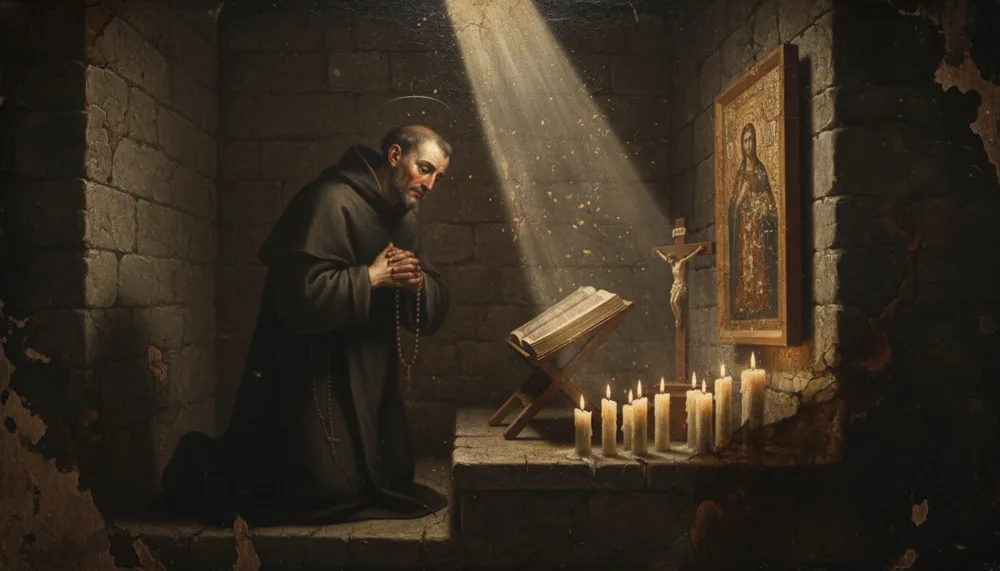
A novena is nine consecutive days of prayer offered for a particular grace, in honour of Our Lord, His Mother, or a saint, and in confident expectation of being heard. That is the whole novena meaning: novem, nine, days of unbroken prayer with one settled intention. A Catholic novena is not a magic formula but ordered, persevering prayer — the raising of the mind to God to adore Him, to thank Him, and to ask of Him what we need (Catechism of St Pius X, On Prayer in General), held to for nine days that it may be heard.
What is a novena, and where it comes from
The novena has its origin not in invention but in obedience. Before He ascended, Our Lord commanded the Apostles to wait in Jerusalem for the promise of the Father (Acts 1:4). They obeyed: "All these were persevering with one mind in prayer, with the women, and Mary the mother of Jesus, and with his brethren" (Acts 1:14).
From the Ascension to the descent of the Holy Ghost ran nine days, and on the tenth the Spirit came down in tongues of fire and the Church was born. Those nine days of prayer in the Upper Room — Our Lady and the Apostles gathered with one mind — are the first novena, prayed by command of Christ Himself and answered at Pentecost. Every novena since is a return to that Upper Room: the soul waits, as the Apostles waited, for the gift God has promised.
The Church counsels such prayer but does not command it. There is no precept binding a man to nine days; the merit lies in the perseverance, which Our Lord taught when He bade us pray always and not faint (Luke 18:1), and in the humble confidence that God, who is most merciful and most faithful, will give the graces we need (Catechism of St Pius X, On Prayer in General). The novena is that perseverance given a shape: a fixed intention, a fixed number of days, a fixed prayer, so the will does not waver and the mind is freed to pray.
Novena meaning: the kinds of novena
Tradition knows three kinds, by the end to which they are ordered.
Novenas of mourning are prayed for the dead — nine days of suffrage that the soul may be loosed from its debt and brought to rest. The Church has long kept such nine-day mournings, and the novendiale of prayer for the departed is of ancient use. They answer the duty of the living toward the dead, and the Novena for the Dead gives this office a fixed form; on the state of the departed we treat in what happens after death and Purgatory.
Novenas of preparation make ready for a feast. They count the nine days before a solemnity and dispose the soul to receive its grace — the Pentecost novena before Pentecost in honour of the Holy Ghost, the novena before Christmas, the novenas before the feasts of Our Lady and the great saints. These follow the calendar and close on the feast itself.
Novenas of petition are prayed in any need, at any time — for healing, for guidance, for a grace of soul or body, for another in trouble. They are the most common, and the most personal: a settled cry kept up for nine days until the soul has either obtained what it asked or learned to want what God wills instead. For God hears every prayer, though not always in the thing we named, since "very often our prayers are not heard, either because we ask for things that are not suitable for our eternal salvation, or because we do not pray as we ought" (Catechism of St Pius X, On Prayer in General).
How to pray a novena
A novena needs no priest and no special place. Its essence is four things kept together for nine days.
One intention. Name plainly the grace you seek, and keep to it the whole nine days. Do not change the petition midway; the perseverance is in the holding.
Nine consecutive days. Pray each day without breaking the chain, at a fixed hour if you can, so the prayer becomes a settled appointment with God. If a day is missed through forgetfulness, no rule of the Church binds you: a novena is a private devotion. Simply take it up again where you left off; starting over from the first day is a pious practice some choose, not an obligation.
A fixed prayer. Most novenas have a set form — an opening invocation, the day's particular prayer, a closing petition, often with the Our Father, Hail Mary, and Glory be told between. Where there is no fixed form, the soul may compose its own, keeping the same words each day.
The right dispositions. The Catechism requires of all prayer humility, confidence, perseverance, and resignation to the will of God (Catechism of St Pius X, On Prayer in General). It is not the number nine that obtains the grace, but the faith and submission of the one who prays.
A plain order serving for almost any Catholic novena:
In the name of the Father, and of the Son, and of the Holy Ghost. Amen.
Opening (each day): Come, Holy Ghost, fill the hearts of Thy faithful, and kindle in them the fire of Thy love.
Then name your one intention before God, plainly and briefly.
The particular prayer of the novena (the same words each of the nine days), followed by:
Our Father… Hail Mary… Glory be to the Father…Closing: O God, who didst instruct the hearts of the faithful by the light of the Holy Ghost, grant us by the same Spirit to be truly wise, and ever to rejoice in His consolation. Through Christ our Lord. Amen.
The Pentecost novena of preparation takes its proper hymn from the Church's own liturgy, the Veni Creator, by which she calls down the Spirit and His sevenfold gifts; a fitting close to it is the Litany of the Holy Ghost.
The great traditional novenas
Among the many, a handful stand out, grounded in the mysteries of the faith. Their texts are mostly devotional compositions of the last centuries, not liturgical texts; the Church's own prayer for each feast is the collect of its Mass.
The Novena to the Sacred Heart answers the Heart of Our Lord with reparation and confidence, prayed in the nine days before the feast in June and well joined to the First Fridays and the Litany of the Sacred Heart. Its watchword is Sacred Heart of Jesus, I place my trust in Thee.
The Novena to the Immaculate Heart of Mary commends the soul to the Heart of the Mother, the refuge promised and the surest road to her Son, prayed before the feast of the Immaculate Heart and dear to those who keep the message of Our Lady of Fatima.
The Novena to St Joseph seeks the patronage of the foster-father of Our Lord, guardian of the Church, patron of a holy death and of every honest need — the most powerful of intercessors after Our Lady, whom we treat further in St Joseph and his litany.
The Novena to St Raphael the Archangel, inspired by the Book of Tobias, brings to God's healing the sick, the traveller, the betrothed, and all who seek the spouse God wills — fitting before his feast on 24 October; on the archangel himself see St Raphael the Archangel.
The Novena to St Michael the Archangel invokes the prince of the heavenly host against the powers of darkness and for the protection of the Church, prayed before his feast on 29 September. It is well joined to the Chaplet of St Michael with its nine choirs of angels, the great prayer to St Michael, and the prayer to one's own Guardian Angel.
Others answer a particular need of soul or circumstance: the surrender novena, a twentieth-century devotion from Don Dolindo Ruotolo (d. 1970), whose single prayer casts every worry upon Christ — Jesus, I surrender myself to You, take care of everything; the novena to Our Lady, Undoer of Knots, a recent devotion, which brings the tangled difficulties of a life to the Mother who unties them; and the novena to St Charbel, the Maronite monk sought for the healing of body and soul.
These are the best-known petitions. Many another saint has a novena of his own — the Novena to St Joseph treated above, and lesser-counted devotions to the great intercessors such as St Francis of Assisi, St Anthony of Padua, St Jude, St Thérèse of Lisieux, St Gemma, and St Januarius, whose blood liquefies at Naples.
Among Marian devotions of the wider tradition are the novena to Our Lady of Charity, patroness of Cuba, and the novena to Mary, the Virgin of Revelation. Beside the novenas stand the older and shorter counted devotions, the chaplets, of which we have written separately; on the difference between a novena's nine days and a chaplet's counted beads, see what is a chaplet, and on the wider body of the Church's piety, Catholic devotions and the Catholic litanies.
When, and how often
There is no obligation to pray a novena, and no merit in heaping up many badly. One held well — nine days of humble, confident prayer with a single intention — does more for a soul than a dozen begun and dropped. Pray a novena of preparation as its feast approaches; a novena of petition when need presses; a novena of mourning for the dead you owe. And pray it as the Apostles prayed in the Upper Room: with one mind, beside Our Lady, waiting for the gift the Father has promised. That is the pattern of every true Catholic prayer, and the novena is only nine days of holding fast to it.
To keep the nine days without losing count, our novena app sets each day's prayers before you and reminds you at the hour you choose.
All our novenas, by devotion
To Our Lord and the Holy Spirit
- Blessed Sacrament Novena
- Novena to the Divine Infant Jesus (Divino Niño)
- Novena to the Most Precious Blood of Jesus
- The Christmas Novena
- The Divine Infant King Novena
- The Divine Mercy Novena
- The Efficacious Novena to the Sacred Heart of Jesus
- The Epiphany Holy Magi Novena
- The Holy Face Novena
- The Holy Family Novena
- The Infant Of Prague Novena
- The Pentecost Novena to the Holy Ghost
To the Blessed Virgin Mary
- Novena to Mary, Undoer of Knots
- Novena to Our Lady Of Charity
- Novena to Our Lady Of Fatima
- Novena to Our Lady Of Good Counsel
- Novena to Our Lady Of Good Health
- Novena to Our Lady Of Good Remedy
- Novena to Our Lady Of Good Success
- Novena to Our Lady Of Graces
- Novena to Our Lady Of Guadalupe
- Novena to Our Lady Of La Leche
- Novena to Our Lady Of Lasalette
- Novena to Our Lady Of Lourdes
- Novena to Our Lady Of Mt Carmel
- Novena to Our Lady Of Peace
- Novena to Our Lady of Perpetual Help
- Novena to Our Lady Of Sorrows
- Novena to Our Lady Of The Rosary
- Novena to the Immaculate Heart of Mary
- Our Lady of the Snows Novena
- The 54 Day Rosary Novena
- The Annunciation Novena
- The Flying Novena (the Memorare novena)
- The Assumption Novena
- The Immaculate Conception Novena
- The Mary Help Of Christians Novena
- The Mary The Virgin Of Revelation Novena
- The Miraculous Medal Novena
- The Presentation Of The Blessed Virgin Mary Novena
- The Queenship Of Mary Novena
- The Three Hail Marys Novena
To the angels and saints
- Novena to Pope St John Paul II
- Novena to Santa Barbara, Virgin and Martyr
- Novena to St Alphonsus Liguori
- Novena to St Andrew Avellino
- Novena to St Andrew The Apostle
- Novena to St Anne
- Novena to St Anthony
- Novena to St Augustine
- Novena to St Benedict
- Novena to St Bernadette
- Novena to St Brigid Of Ireland
- Novena to St Cajetan
- Novena to St Carlo Acutis
- Novena to St Catherine Of Alexandria
- Novena to St Cecilia
- Novena to St Charbel
- Novena to St Christopher
- Novena to St Clare Of Assisi
- Novena to St Dymphna
- Novena to St Elizabeth
- Novena to St Elizabeth of the Trinity
- Novena to St Expeditus
- Novena to St Faustina
- Novena to St Frances Xavier Cabrini
- Novena to St Francis De Sales
- Novena to St Francis Of Assisi
- Novena to St Francis Xavier
- Novena to St Gabriel Of Our Lady Of Sorrows
- Novena to St Gabriel the Archangel
- Novena to St Gemma
- Novena to St Gerard Majella
- Novena to St Gertrude The Great
- Novena to St Gianna Beretta Molla
- Novena to St Homobonus
- Novena to St Ignatius Loyola
- Novena to St Januarius
- Novena to St John Bosco
- Novena to St John Of God
- Novena to St John The Apostle
- Novena to St John The Baptist
- Novena to St John Vianney
- Novena to St Josemaria Escriva
- Novena to St Joseph of Cupertino
- Novena to St Joseph the Worker
- Novena to St Jude
- Novena to St Lucy
- Novena to St Lydwine
- Novena to St Maria Goretti
- Novena to St Martha Of Bethany
- Novena to St Martin De Porres
- Novena to St Martin Of Tours
- Novena to St Mary Magdalene
- Novena to St Matthew
- Novena to St Matthias Apostle
- Novena to St Michael the Archangel
- Novena to St Monica
- Novena to St Patrick
- Novena to St Paul of the Cross
- Novena to St Peregrine
- Novena to St Peter Chanel
- Novena to St Peter Damian
- Novena to St Philomena
- Novena to St Raphael the Archangel
- Novena to St Rita of Cascia
- Novena to St Rocco
- Novena to St Scholastica
- Novena to St Teresa Of Avila
- Novena to St Teresa Of Calcutta
- Novena to St Therese Of Lisieux
- Novena to St Thomas Aquinas
- Novena to St Thomas More
- Novena to St Valentine
- Novena to St Vincent De Paul
- Novena to Sts Cosmas And Damian
- Novena to Sts Joachim And Anne
- Novena to Your Guardian Angel
- St Agatha Novena
- St Blaise Novena for Throats
- St Bonaventure Novena
- St Bridget Novena
- St George Novena
- St James Novena
- St Lawrence Novena
- St Luke Novena for Healing
- St Rose of Lima Novena
- St Sebastian Novena
- The Cardinal Burke Our Lady Of Guadalupe Novena
- The Novena to St Joseph That Never Fails
- The Padre Pio Novena
- The Solanus Casey Novena
- The St Andrew Christmas Novena
Novenas for a particular intention
- St Joseph Novena to Sell a House
- Novena to St Joseph for a Job
- Novena for a Safe Pregnancy and Delivery
- Novena for Financial Help
For other intentions
- A Novena for the Dead (the Holy Souls in Purgatory)
- The Gratitude Novena
- The Novena for Fertility to Conceive a Baby
- The Novena for the Repose of the Pope and for a New Pope
- The Respect Life Novena
- The Surrender Novena
Frequently Asked Questions
What is a novena in the Catholic Church?
A novena is nine consecutive days of prayer offered for a particular grace, in honour of Our Lord, His Mother, or a saint, and in confident expectation of being heard. The word comes from the Latin novem, "nine." It is ordered, persevering prayer, and its model is the first novena: the nine days Our Lady and the Apostles prayed with one mind in the Upper Room, from the Ascension to the descent of the Holy Ghost at Pentecost.
How do you pray a novena?
Keep four things together for nine days. One intention — name the grace you seek and hold to it the whole nine days. Nine consecutive days — pray each day without breaking the chain, at a fixed hour if you can; if a day is missed, simply take it up again where you left off — starting over from day one is a pious practice, not an obligation. A fixed prayer — most novenas have a set form, said in the same words each day, often with the Our Father, Hail Mary, and Glory be. The right dispositions — humility, confidence, perseverance, and resignation to the will of God, which the Catechism requires of all prayer.
Where does the novena come from?
From obedience, not invention. Before He ascended, Our Lord commanded the Apostles to wait in Jerusalem for the promise of the Father (Acts 1:4). They obeyed, "persevering with one mind in prayer, with the women, and Mary the mother of Jesus" (Acts 1:14). From the Ascension to Pentecost ran nine days, and on the tenth the Holy Ghost came down. Those nine days are the first novena, prayed by command of Christ Himself; every novena since is a return to that Upper Room.
What are the kinds of novena?
Tradition knows three, by the end to which they are ordered. Novenas of mourning are prayed for the dead, that the soul may be loosed from its debt — as in the Novena for the Dead. Novenas of preparation make ready for a feast, counting the nine days before it — as the Pentecost novena or the novena before Christmas. Novenas of petition are prayed in any need, at any time, for healing, guidance, or any grace of soul or body.
Is praying a novena required?
No. The Church counsels such prayer but does not command it; there is no precept binding a man to nine days. The merit lies in the perseverance Our Lord taught when He bade us "pray always and not faint" (Luke 18:1), and in the humble confidence that God will give the graces we need. God hears every prayer, though not always in the thing we named, granting instead what is better for our salvation.
The Iter Fidei app carries the novenas, chaplets, litanies, and prayers in Latin and your own language, with audio. Join early access here.
Sources. Catechism of St Pius X (1908): On Prayer in General. Scripture (Douay-Rheims): Acts 1:4, 14; Luke 18:1; the Book of Tobias. The novenas of the Sacred Heart, the Immaculate Heart of Mary, St Joseph, and St Raphael the Archangel; the Veni Creator Spiritus and the prayer of the Pentecost novena as kept in the Roman liturgy.