
Our Lady
The Immaculate Heart of Mary
The Immaculate Heart of Mary — what the devotion means, why the Church honours Our Lady's heart, and how consecration to the Immaculate Heart is made.
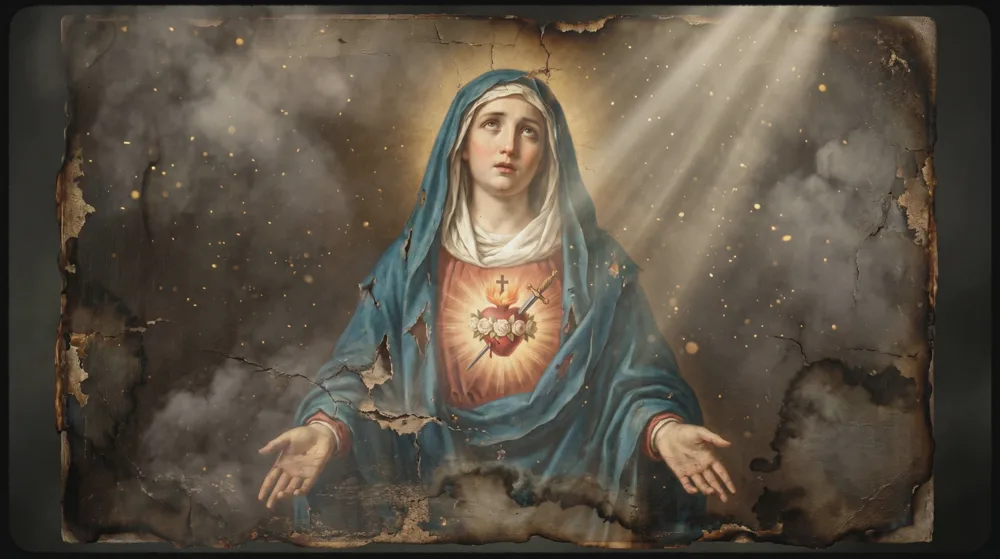
The Immaculate Heart of Mary is the heart of the Mother of God, honoured by the Church as the seat of her love for God and for us, and never touched by sin. Devotion to the Immaculate Heart is the Church's way of venerating, under the figure of her heart, the whole inward life of Our Lady — her charity, her purity, her sorrows, and her perfect union with her Son. It is to Mary what devotion to the Sacred Heart of Jesus is to Christ: a love directed to the Person, signified by the heart.
The meaning of the Immaculate Heart of Mary
The heart, in Scripture and in the language of the Church, stands for the inmost self — the place of love, of thought, of will. To honour the Immaculate Heart of Mary is therefore to honour everything that Our Lady is interiorly: her love of God above all things, her tenderness toward sinners, and the consent by which she received the Word made flesh. Saint Luke twice records this inner life: Mary kept all these words, pondering them in her heart (Luke 2, 19).
The word immaculate names what is most proper to this heart. Alone among the children of Adam, Mary was preserved from all stain of sin from the first instant of her existence. This is the dogma of the Immaculate Conception, defined in 1854: she was conceived without original sin. Her heart is therefore called immaculate because it was never, for an instant, divided against God by sin. The Catechism of Saint Pius X teaches that in saluting Mary we recall the singular gifts and privileges with which God favoured her in preference to all other creatures (Catechism of Saint Pius X, Part II, ch. 3). The chief of these gifts is the grace that kept her heart spotless.
Why the Church honours a created heart
Some object that to honour the heart of a creature comes close to the worship owed to God alone. The Church has always distinguished the two. To God we render adoration; to Mary and the saints we render veneration — honour, not worship. We honour the Immaculate Heart not because it is divine, but because it is the heart of her who is the Mother of God. Since the Blessed Virgin could truly and properly be called Mother of God (Catechism of the Council of Trent, on the Third Article), every honour given to her is in truth referred to her Son, of whom she is the Mother.
Devotion to the Immaculate Heart
Devotion to the Immaculate Heart means more than an image or a feeling. It is the deliberate love and imitation of Our Lady's interior dispositions, joined to confident recourse to her intercession. The Catechism of Saint Pius X sets out plainly why we turn to her: the Most Blessed Virgin is our most powerful Advocate with Jesus Christ, and she is so powerful because she is the Mother of God, and it is impossible that He should not hear her (Catechism of Saint Pius X, Part II, ch. 3).
The saints, the same catechism teaches, hold that Mary's true devotees are loved by her, that she protects them with the love of the most tender of Mothers, and that through her they are certain to find Jesus and to obtain heaven (Catechism of Saint Pius X, Part II, ch. 3). Devotion to the Immaculate Heart is one form of this filial recourse, fixing our eyes on the love that beat in her heart from the Annunciation to Calvary.
The Rosary and the Hail Mary
Among Marian devotions, the Church recommends one above the rest. The devotion that the Church recommends in a most special way in honour of the Most Blessed Virgin is the recitation of the holy Rosary (Catechism of Saint Pius X, Part II, ch. 3). The Rosary is itself a devotion of the heart: in repeating the Hail Mary we rejoice with Our Lady in her privileges and ask her protection during this life and especially at the hour of death, when we shall have the greatest need of it (Catechism of Saint Pius X, Part II, ch. 3). To pray the Rosary well is already to honour the Immaculate Heart, for it places before us the mysteries that Mary pondered in her heart.
The Hail Mary itself names the source of all her holiness. Hail, full of grace, the Lord is with thee — the words of the Archangel Gabriel, spoken when he came to announce the mystery of the Incarnation (Catechism of Saint Pius X, Part II, ch. 3). The fulness of grace that filled her at that moment is what keeps her heart immaculate.
A prayer to the Immaculate Heart of Mary
Many of the faithful keep a short prayer of recourse to the Immaculate Heart, said each morning or in time of need. A simple one, a modern devotional composition with no liturgical text, is the following:
O Immaculate Heart of Mary, refuge of sinners, we entrust ourselves to thy maternal care. Keep our hearts pure as thine was kept pure; lead us to thy Son Jesus; and be our help and our protection now and at the hour of our death. Amen.
A still shorter aspiration, easily repeated through the day, is the prayer Sweet Heart of Mary, be my salvation (Cor Mariæ dulcissimum, esto mihi salus). Such brief prayers are not magic formulas — they are acts of trust in Our Lady's intercession, and they bear fruit only when joined to a life of grace.
The Sacred Heart of Jesus and the Immaculate Heart of Mary
The two hearts are honoured together by ancient custom, for they were united from the first moment of the Incarnation. The Heart of Jesus is the Heart of God made man, worthy of adoration; the Heart of Mary is the heart of a creature, worthy of veneration. They are not equal, but they are inseparable: the Council of Trent teaches that the body of Christ was formed of the most pure blood of the Virgin His mother (Catechism of the Council of Trent, on the Third Article), so that the very Heart we adore in the Son was nourished by the heart we venerate in the Mother.
Devotion to the Sacred Heart of Jesus and to the Immaculate Heart of Mary therefore belong together as the love of the Son and the love of His Mother. To honour both is to keep the right order: all honour given to Mary's heart is referred to her Son, of whom she is the Mother (Catechism of the Council of Trent, on the Third Article). The faithful often consecrate themselves to the Sacred Heart and the Immaculate Heart in one act, going to Jesus through Mary.
Consecration to the Immaculate Heart
To consecrate oneself to the Immaculate Heart is to give oneself wholly to Jesus through Mary — to place one's whole life, soul and body, under her maternal care, that she may form us in the love of her Son. Consecration adds nothing to the rights God already has over us; it is the free act by which we entrust to Mary what is already God's, asking her to guard and present it to Him. Because she is our most powerful Advocate, the soul consecrated to her heart is, as the saints teach, certain to find Jesus and to obtain heaven (Catechism of Saint Pius X, Part II, ch. 3).
Such a consecration is not a substitute for the worship of God or for the sacraments. It is a means within the ordinary Christian life: the consecrated soul still goes to Mass, still goes to Confession, still keeps the commandments. Mary leads always to her Son. As the Council of Trent teaches, the body of Christ was formed of the most pure blood of the Virgin His mother (Catechism of the Council of Trent, on the Third Article); she gave Him to the world once, and through devotion to her heart she gives Him to each soul that comes to her.
A novena to the Immaculate Heart of Mary
A novena is nine days of prayer, made in preparation for a feast or in some particular need. To make a novena to the Immaculate Heart of Mary is simply to turn to her heart for nine days running, with confidence and perseverance. There is no single fixed formula required; the faithful commonly join a decade of the Rosary to a short prayer of consecration, repeated each day. A suitable daily prayer for such a novena is:
Immaculate Heart of Mary, full of love for God and for us, we come to thee in our need. By thy heart, kept spotless from all sin, obtain for us from thy Son the grace we ask [here name the request], if it be for the good of our souls; and above all obtain for us pure hearts, true sorrow for our sins, and final perseverance. Amen.
The novena bears fruit not by counting the days but by the trust and conversion they work in the soul. Whatever is asked is asked through Mary and granted by God, and only what is for the salvation of the one who prays.
Images of the Immaculate Heart of Mary
The Church gives the faithful holy images so that the eye may help the heart to pray. In the traditional picture, the Immaculate Heart of Mary is shown encircled by roses or white lilies — the lily for her purity — and pierced by a sword, recalling the prophecy of the aged Simeon: thy own soul a sword shall pierce (Luke 2, 35). Often a flame rises from the heart, signifying her burning love of God. Such images are not idols and are not worshipped; they are reminders, drawing the mind to the truths the heart of Mary contains.
These pictures are frequently set beside an image of the Sacred Heart of Jesus, the two hearts together, to teach at a glance the order of the devotion: the Son adored, the Mother venerated, and both loved as one. A holy image rightly used is an aid to prayer, never a substitute for it.
A devotion rooted in tradition
Devotion to the Immaculate Heart is no novelty. It flows from what the Church has always believed about Our Lady — her divine maternity, her freedom from sin, her power as advocate — truths set down in the catechisms of Trent and of Saint Pius X. The 1854 definition of the Immaculate Conception, and the dogma of the Assumption of Mary, only made explicit the honour the Church owed her heart from the beginning. To love the Immaculate Heart is to hold fast to that received faith.
What the devotion asks of us
The Immaculate Heart of Mary asks of us what every true devotion asks: not sentiment, but conversion. To honour her heart is to imitate it — to keep our own hearts pure, to ponder the mysteries of Christ as she did, to flee sin, and to have recourse to her in every need, above all at the hour of death. He who entrusts himself to the Mother of God entrusts himself to the surest road to her Son. Those who love her Immaculate Heart may also entrust their cares to her under another of her titles, in the novena to Our Lady of Peace.
Frequently Asked Questions
What is the Immaculate Heart of Mary?
The Immaculate Heart of Mary is the heart of the Mother of God, honoured by the Church as the seat of her inmost self — her love of God above all, her purity, her sorrows, and her perfect union with her Son. It is to Mary what devotion to the Sacred Heart of Jesus is to Christ: a love directed to the Person, signified under the figure of the heart.
What does "Immaculate Heart of Mary" mean?
The word immaculate means "without stain." Alone among the children of Adam, Mary was preserved from all stain of sin from the first instant of her existence — the dogma of the Immaculate Conception, defined in 1854. Her heart is called immaculate because it was never, for an instant, divided against God by sin, but kept whole in His love from the beginning.
What is consecration to the Immaculate Heart of Mary?
To consecrate oneself to the Immaculate Heart is to give oneself wholly to Jesus through Mary — to place one's whole life, soul and body, under her maternal care, that she may form us in the love of her Son. It adds nothing to the rights God already has over us; it is the free act by which we entrust to Mary what is already God's. It is no substitute for the Mass, Confession, or the commandments, but a means within the ordinary Christian life.
Why does the Church honour the heart of a creature?
To God we render adoration; to Mary and the saints we render veneration — honour, not worship. We honour the Immaculate Heart not because it is divine, but because it is the heart of her who is the Mother of God. Every honour given to her is in truth referred to her Son, of whom she is the Mother.
How do you honour the Immaculate Heart of Mary?
Chiefly through the prayers the Church gives: the Rosary, which she recommends above all other Marian devotions, the Hail Mary, and the Litany of the Immaculate Heart. Beyond words, the devotion asks for the imitation of Our Lady's interior dispositions — purity of heart, recourse to her in every need, and confidence in her intercession at the hour of death.
What is a good prayer to the Immaculate Heart of Mary?
A simple devotional prayer (a modern composition, with no liturgical text) is: O Immaculate Heart of Mary, refuge of sinners, we entrust ourselves to thy maternal care. Keep our hearts pure as thine was kept pure; lead us to thy Son Jesus; and be our help and our protection now and at the hour of our death. Amen. A short aspiration often repeated through the day is Sweet Heart of Mary, be my salvation. These are acts of trust in Our Lady's intercession, joined to a life of grace.
How do you make a novena to the Immaculate Heart of Mary?
A novena is nine days of prayer made in some need or in preparation for a feast. To make a novena to the Immaculate Heart, turn to her each day for nine days running, commonly joining a decade of the Rosary to a short prayer of consecration and request. The fruit comes not from counting the days but from the trust and conversion they work; whatever is asked is granted by God through Mary, and only what is for the good of the soul.
What is the difference between the Sacred Heart of Jesus and the Immaculate Heart of Mary?
The Heart of Jesus is the Heart of God made man and is worthy of adoration; the Immaculate Heart of Mary is the heart of a creature and is worthy of veneration — honour, not worship. The two are inseparable, for the body of Christ was formed of the most pure blood of the Virgin His mother (Catechism of the Council of Trent, on the Third Article). The faithful often honour both hearts together, going to Jesus through Mary.
For more on the companion devotion, see the Sacred Heart of Jesus.
The Iter Fidei app carries the prayers, the catechism, and a guide to the Faith — including the Rosary and the Hail Mary, free to pray. Join early access here.
Sources. Catechism of Saint Pius X, Part II, Chapter 3 (The Hail Mary); Catechism of the Council of Trent, Part I, on the Third Article of the Creed (conceived by the Holy Ghost, born of the Virgin Mary); the Holy Gospel according to Saint Luke (Douay-Rheims), chapter 2.