
Our Lady
Our Lady of Fatima
The story of the Our Lady of Fatima apparition of 1917: the three shepherd children, the call to the Rosary and penance, the miracle of the sun, and the three secrets.
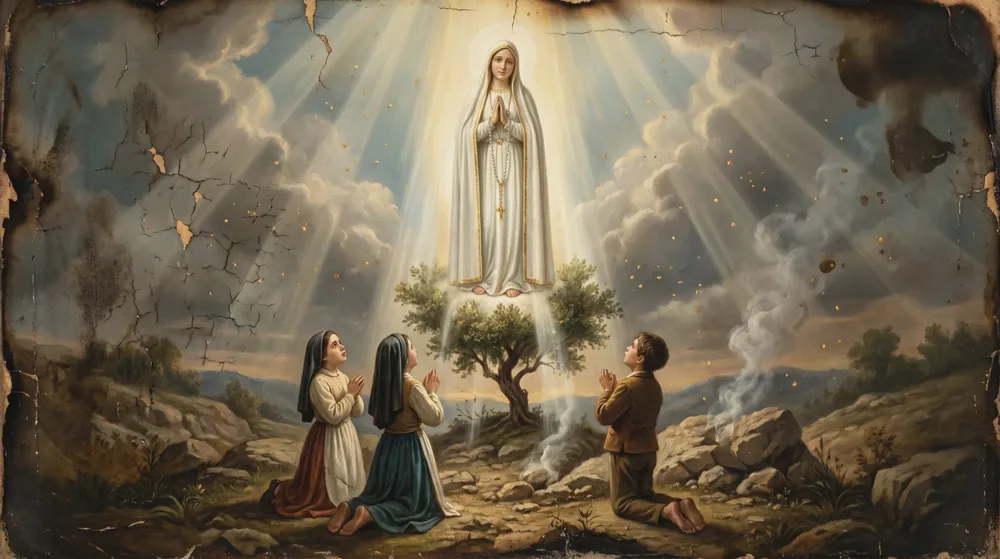
Our Lady of Fatima is the title given to the Blessed Virgin Mary as she appeared, six times in the year 1917, to three shepherd children in the parish of Fatima, in Portugal. The Fatima apparition called for the daily Rosary, for penance, and for devotion to her Immaculate Heart, and it was confirmed before a crowd of many thousands by the prodigy commonly called the miracle of the sun.
We tell the story of Our Lady of Fatima soberly here, as the Church received it, and draw from it only what the Church has always taught: that conversion, prayer, and reparation are the means of salvation.
The three shepherd children
The three to whom our Lady appeared were Lucia dos Santos, then ten years old, and her two younger cousins, Francisco and Jacinta Marto. They were ordinary children of a poor farming district, sent out each day to mind the family flocks on the rough pastureland around the hamlet of Aljustrel.
The children later recounted that in 1916, before the apparitions of our Lady, they were prepared by three visits of an angel, who taught them to adore the Blessed Sacrament and to offer acts of reparation for the sins by which God is offended. Francisco and Jacinta died young, within a few years, carried off in the influenza that swept Europe at the end of the war. Lucia lived on, became a religious, and it is chiefly through her written recollections that the account of Fatima has come down to us.
The Fatima apparition of 1917
On the thirteenth day of May, 1917, while the children kept their sheep at a place called the Cova da Iria, they saw above a small holm-oak a Lady, as they said, brighter than the sun, who told them to return to the same spot on the thirteenth of each month. She asked them whether they were willing to accept whatever God might send, in suffering and in reparation for the sins of men. She asked, above all, that they pray the Rosary every day.
So they returned, month by month. On each visit the Lady renewed the same requests: the daily Rosary for peace and for the conversion of sinners, penance, and amendment of life. She asked that men cease to offend God, who is already too much offended. The message of Fatima is therefore nothing new or strange. It is the perennial preaching of the Gospel — repentance, prayer, reparation — set before a generation in the midst of a terrible war.
The call to the Rosary, penance, and the Immaculate Heart
Three things stand at the centre of what the children reported.
First, the Rosary. At nearly every apparition our Lady asked for its daily recitation. This is no novelty: the Church has commended the Rosary for centuries as a summary of the Gospel in Mary's company, and the traditional popes returned to it again and again as the prayer of the household and the weapon of the faithful. We have set out the manner of saying it in our guide to how to pray the Rosary.
Second, penance. The children understood themselves called to small daily mortifications offered for the conversion of sinners — bearing heat and thirst, giving up small comforts, accepting hardship without complaint. This is the ordinary Christian discipline of self-denial, which no age may set aside, by which a soul makes reparation and is purified.
Third, the Immaculate Heart of Mary. The children reported that our Lady asked that men be consecrated to her Immaculate Heart, and that this devotion be established in the world. Devotion to the Heart of Mary is ancient in its roots and was fostered in a particular way by St John Eudes in the seventeenth century; Pope Pius VII granted a feast of the Pure Heart of Mary in 1805.
The words attributed to our Lady at Fatima had a very strong influence in spreading this devotion, and on the 31st of October, 1942, Pope Pius XII consecrated the whole world to her Immaculate Heart, directing on the 4th of May, 1944, that the feast be kept throughout the Western Church on the octave day of the Assumption. We treat this devotion at greater length in our article on the Immaculate Heart of Mary, and the practice of reparation that flows from it in our piece on the First Fridays.
The miracle of the sun
At the apparition of July, the Lady had foretold that in October she would work a sign, that all might believe. On the thirteenth of October, 1917, a great crowd — many thousands, by every account — gathered at the Cova da Iria in heavy rain.
After the children reported that our Lady had spoken to them for the last time, the rain ceased, the clouds parted, and the multitude saw the sun appear as a spinning disc that could be looked upon without hurt, throwing off colours over the land, and seeming to plunge toward the earth before returning to its place. The rain-soaked ground and clothing of the crowd were found dry. This event, witnessed by believers and unbelievers alike, is what is meant by the miracle of the sun. We report it as the crowd reported it, and as the Church weighed it, without adding to it.
The three secrets of Fatima
Lucia later wrote of a confidence entrusted to the children in July, 1917, which came to be spoken of as the three secrets of Fatima.
We are careful here. The Church distinguishes always between the public Revelation, closed with the death of the last Apostle, which every Catholic must believe, and private revelations, which even when approved bind no one to faith and add nothing to the deposit. According to Lucia's accounts, the first part of the secret was a vision concerning the punishment of sin; the second concerned devotion to the Immaculate Heart and a prayer for the conversion of nations; the third she committed to writing and gave to the Church to be kept. Of the substance of that third part the Church made no public pronouncement, and we will not anticipate what she did not declare. What the secrets press upon the faithful is no secret at all: penance, the Rosary, conversion, and reparation to the Immaculate Heart.
The message and the devotion
The whole of Fatima may be gathered into a single line: men must turn from sin to God, and the means are prayer and penance. Nothing in it is owed our belief as the articles of the Creed are owed; private revelation neither adds to nor alters the faith. Yet the Church, having weighed the events, permitted the devotion and honoured the place, and the traditional popes did not disdain it. We hold the message, then, in its right proportion: not as a new gospel, but as a summons to the old one, spoken in our own century.
The devotion that has grown from Fatima is therefore wholly traditional in its substance — the daily Rosary, the practice of penance, consecration to the Immaculate Heart, and acts of reparation for the sins by which God is offended. These were old in the Church long before 1917, and they remain the road by which a soul is saved.
Our Lady of the Rosary of Fatima
The title most proper to the apparition is Our Lady of the Rosary. At the last of the apparitions, on the thirteenth of October, 1917, the children reported that the Lady named herself thus, saying that she was the Lady of the Rosary and asking that a chapel be built in her honour.
This is why she is so often called Our Lady of the Rosary of Fatima, and why her feast falls within the same devotional family as the older feast of Our Lady of the Rosary kept on the seventh of October — instituted by Pope St Pius V in thanksgiving for the victory of Lepanto in 1571. The name itself fixes the heart of the message: the chief thing our Lady asked at Fatima was the daily Rosary, and under no other title did she choose to be known there.
A prayer to Our Lady of Fatima
The simplest prayer at Fatima is the one our Lady herself is reported to have taught the children, to be said after each decade of the Rosary — the first of the Fatima prayers, which we give in full elsewhere with the Angel's prayers and the sacrifice prayer:
O my Jesus, forgive us our sins, save us from the fires of hell, and lead all souls to Heaven, especially those most in need of thy mercy.
To this we may add a short invocation drawn from the traditional devotion to our Lady under this title:
O Most Holy Virgin Mary, Queen of the most holy Rosary, who at Fatima didst deign to reveal to the three shepherd children the treasures of grace hidden in the recitation of the Rosary, obtain for us the grace to imitate their virtues, that we may, like them, be made worthy to contemplate God and to praise Him for ever. Amen.
We commend the daily Rosary itself as the proper and complete prayer of Fatima; the manner of saying it is set out in our guide on how to pray the Rosary.
The statue, images, and pictures of Our Lady of Fatima
She is most often shown standing, robed and veiled in white, with a cord or rosary in her joined hands, sometimes with a crown and a star upon the hem of her mantle, after the description the children gave — a Lady brighter than the sun, all of light. The best-known image, the Pilgrim Virgin statue carved to Sister Lucia's own directions and kept at the shrine, has been carried in procession through many countries.
We honour such statues and pictures as the Church has always honoured sacred images: not for any power in the wood or paint, but as helps that lift the mind to the person represented and to her Son. The Second Council of Nicaea (787) taught that the honour given to an image passes to its prototype; we venerate the image of our Lady, never worship it, and shun every superstition that would treat a statue as a charm.
The shrine, sanctuary, and basilica at Fatima
A chapel was first raised over the place of the apparitions at the Cova da Iria, in obedience to what the children reported our Lady to have asked; from this grew the great sanctuary of Fatima, with its basilica, to which pilgrims come from across the world. Many churches and shrines elsewhere bear the same title in her honour — among them the Blue Army shrine in the United States and other national shrines and basilicas dedicated to Our Lady of Fatima.
The Church permitted the devotion and honoured the place after weighing the events; a pilgrimage to such a shrine is an act of the same old religion of penance and prayer, and not the pursuit of marvels. What sanctifies a pilgrim is not the ground he treads but the conversion of his heart and the Rosary on his lips.
Frequently Asked Questions
Who is Our Lady of Fatima?
Our Lady of Fatima is the Blessed Virgin Mary under the title given her from the place where she appeared six times in 1917, to three shepherd children near Fatima in Portugal. She is not another Lady but the one Mother of God, honoured here for what she asked at the Cova da Iria: the daily Rosary, penance, and devotion to her Immaculate Heart. The apparition was confirmed before many thousands by the prodigy called the miracle of the sun.
Who is Our Lady of Fatima from Portugal?
She is the same Blessed Virgin Mary, called Our Lady of Fatima because the apparitions took place at the Cova da Iria in the parish of Fatima, in Portugal, in the year 1917. The title marks the place, not a different person; the Church honours one Mother of God under many such names drawn from her shrines and graces.
Where is Our Lady of Fatima in Portugal?
The apparitions took place at a spot called the Cova da Iria, near the hamlet of Aljustrel in the parish of Fatima, a poor farming district in central Portugal. It was there, above a small holm-oak, that the children kept their sheep and reported the Lady brighter than the sun, and there that the great crowd gathered for the miracle of the sun on the thirteenth of October, 1917.
What are the 3 secrets of Our Lady of Fatima?
Sister Lucia wrote of a single confidence entrusted to the children in July 1917, spoken of in three parts: the first, a vision of the punishment of sin; the second, a call to devotion to the Immaculate Heart and prayer for the conversion of nations; the third she set down in writing and committed to the Church to be kept. The Church made no public pronouncement on the substance of that third part, and we do not anticipate what she did not declare. What the secrets press upon us is no secret at all: penance, the Rosary, conversion, and reparation to the Immaculate Heart.
When is the feast of Our Lady of Fatima?
The feast of Our Lady of Fatima is kept on the thirteenth of May, the day of the first apparition at the Cova da Iria in 1917, in Portugal and where it was granted; it is not in the universal calendar of 1962 (where 13 May is the feast of St Robert Bellarmine) and entered the general calendar only in 2002. It is to be distinguished from the feast of the Immaculate Heart of Mary, which Pope Pius XII fixed for the whole Western Church on the octave day of the Assumption, the twenty-second of August.
What did Our Lady of Fatima ask for?
At nearly every apparition she asked, above all, for the daily Rosary, prayed for peace and for the conversion of sinners. She asked also for penance — small daily mortifications offered in reparation — and that men cease to offend God, who is already too much offended, and be consecrated to her Immaculate Heart. The message of Fatima is therefore no new gospel, but the perennial call of the old one: repentance, prayer, and reparation.
What was the miracle of the sun at Fatima?
On the thirteenth of October, 1917, after the children reported the Lady's last words, the rain ceased and a great crowd saw the sun appear as a spinning disc that could be looked upon without hurt, throwing off colours and seeming to plunge toward the earth before returning to its place; the rain-soaked ground and clothing were found dry. Witnessed by believers and unbelievers alike, this is what is meant by the miracle of the sun. We report it as the crowd reported it, and as the Church weighed it, without adding to it.
What is the prayer to Our Lady of Fatima?
The prayer most proper to Fatima is the short invocation the children reported our Lady taught them, to be said after each decade of the Rosary: O my Jesus, forgive us our sins, save us from the fires of hell, and lead all souls to Heaven, especially those most in need of thy mercy. The complete prayer of Fatima, however, is the daily Rosary itself, which our Lady asked for at nearly every apparition. Any invocation to her under this title should lead back to that.
What is the story of Our Lady of Fatima?
In 1917, at the Cova da Iria near Fatima in Portugal, the Blessed Virgin Mary appeared six times, on the thirteenth of each month from May to October, to three shepherd children — Lucia dos Santos and her cousins Francisco and Jacinta Marto. She asked for the daily Rosary, for penance in reparation for sin, and for devotion to her Immaculate Heart. The apparitions ended with the prodigy called the miracle of the sun, seen by a crowd of many thousands on the thirteenth of October. The Church weighed these events and permitted the devotion, while teaching that, as a private revelation, it adds nothing to the faith.
Why is she called Our Lady of the Rosary of Fatima?
Because at the final apparition the children reported that the Lady named herself the Lady of the Rosary and asked that a chapel be built in her honour. The title fixes the heart of the message — the daily Rosary, which she requested above all else — and joins the Fatima devotion to the older feast of Our Lady of the Rosary, kept on the seventh of October.
What does the statue of Our Lady of Fatima look like?
She is shown standing, robed and veiled in white, often with a rosary in her joined hands, a crown, and a star upon the hem of her mantle, after the children's description of a Lady all of light, brighter than the sun. We honour such statues and images as the Church has always honoured sacred art: the veneration passes to the person represented, never to the wood or paint, and we shun any superstition that would treat a statue as a charm.
The Iter Fidei app carries the prayers to the saints, the litanies, and the traditional calendar of feasts. Join early access here.
Sources. Alban Butler, The Lives of the Saints (notices on the feast of the Immaculate Heart of Mary, on the feast of Our Lady of the Rosary instituted by Pope St Pius V after Lepanto, 1571, and on the consecration of the world by Pope Pius XII, 31 October 1942, with the institution of the feast, 4 May 1944); Pope Pius XII, consecration of the world to the Immaculate Heart of Mary (1942) and decree establishing the feast (1944); on the veneration of sacred images, the Second Council of Nicaea (787); on the nature of private revelation, St Thomas Aquinas, Summa Theologiae II-II, q. 174; The Catechism of the Council of Trent (1566), on prayer and on the Hail Mary.