
Devotions
The Nine First Fridays Devotion
The Nine First Fridays devotion is the practice of receiving Holy Communion on the first Friday of nine consecutive months, in honour of the Sacred Heart and in reparation for sin — tied to the Great Promise made to St Margaret Mary touching final perseverance.
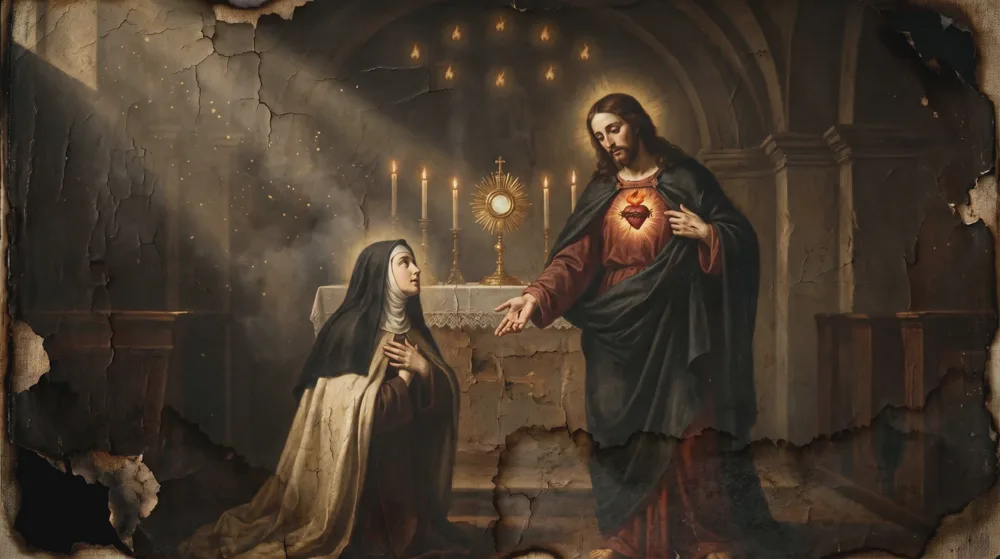
The Nine First Fridays is the practice of receiving Holy Communion on the first Friday of nine consecutive months, in honour of the Sacred Heart of Jesus and in reparation for the sins by which that Heart is outraged. The first Friday devotion is bound up with what is commonly called the Great Promise, made to St Margaret Mary Alacoque, touching the grace of final perseverance for those who keep it faithfully. It is a Eucharistic devotion before it is anything else: its substance is nine worthy Communions, made in the state of grace, out of love and reparation.
What the Nine First Fridays are
The nine first Fridays are not a magic formula but an ordered exercise of the two acts in which devotion to the Sacred Heart consists: love and reparation. Tanquerey teaches that for this devotion to bear its fruit it must consist in these two essential acts — love, which unites us to the Heart of Jesus and makes us share His virtues; and reparation, which makes us share His sufferings and stirs our fervour (The Spiritual Life, no. 1259, 1261). The first Friday devotion takes those two acts and fixes them to the Eucharist, on the day of the week the Church has long joined to the Passion.
The devotion grew out of the revelations made to St Margaret Mary in the seventeenth century, in which the divine Heart made known its desire to be loved and repaired: Behold this Heart which has so loved men. We hold this with the Church's own prudence. The feast of the Sacred Heart was approved long after those revelations, and for motives independent of them (Tanquerey, no. 1547); the doctrine stands on its own, and the private revelation calls us to a love that is wholly in keeping with the Faith — not to a novelty.
How the first Friday Mass and Communion are made
The heart of the practice is the first Friday Mass and Communion, repeated on nine consecutive first Fridays without interruption. Three things are asked.
Holy Communion in the state of grace
A Communion profits us only when it is received with the necessary dispositions. The Catechism of St Pius X is exact: to make a good Communion one must be in the state of grace — that is, to have one's conscience pure of all mortal sin (Catechism of St Pius X, On the Eucharist). The Eucharist, the Roman Catechism teaches, was not instituted to restore life to the soul but to preserve it; as natural food is useless to the dead, so the holy Mysteries are useless to him who has not the life of the soul (Catechism of the Council of Trent, On Communion). Where mortal sin is present, the remedy is the confessional before the altar, not the altar without the confessional.
Reparation and love
The Communion is offered in reparation — that is, to make amends for our own sins and the sins of others against the Heart of Jesus — and out of love, which Tanquerey calls the first and principal of the two duties of this devotion (no. 1260). This is why the first Fridays are not mere attendance.
The Roman Catechism asks of the communicant a real preparation: to reflect in silence how unworthy we are of so great a benefit, repeating with the Centurion, Lord, I am not worthy that Thou shouldst enter under my roof (On Communion). The act of self-gift may be made in the words of Blessed John Eudes: O my Saviour, I give myself to Thee, that I may be united with the eternal, immense and infinite love which Thou bearest to Thy Father (Tanquerey, no. 1255).
Nine consecutive months
The Communions are made on nine consecutive first Fridays, one in each of nine successive months. The number nine and the unbroken sequence belong to the form of the devotion as it was received. What the form protects is constancy — that the soul does not approach once in fervour and then fall away, but binds itself to a sustained practice. This is the spirit Scupoli sets at the head of the spiritual combat: among the conditions of victory, perseverance must be reckoned, for the disordered passions never die so long as we are upon earth, and spring up unceasingly like evil weeds (The Spiritual Combat, ch. on perseverance).
The Great Promise and final perseverance
The Great Promise attached to this devotion concerns the grace of final perseverance: that those who receive Holy Communion on nine consecutive first Fridays will not die without the grace of God and the sacraments, the divine Heart making itself their secure refuge at the last hour. We state plainly what this is and what it is not.
Final perseverance is, in the language of the theologians, the grace of graces. Tanquerey teaches that to die in the state of grace, despite all the temptations that assail us at the last moment, is a special and a great gift, which one cannot strictly merit, but which one can obtain by prayer and by faithful cooperation with grace (The Spiritual Life, no. 127). The Great Promise is therefore wholly in keeping with sound doctrine: it does not make final perseverance a thing we earn, but a gift God grants to a love that prays and perseveres. The promise is a promise of mercy, not a guarantee that dispenses with conversion.
For this reason the devotion gives no licence to presume. A Communion received without the state of grace profits nothing, however many Fridays are counted; and one who would lean on the Promise while clinging to mortal sin has not understood it. The Eucharist itself, the Roman Catechism teaches, preserves us from sin, weakens the assaults of temptation, and serves as a heavenly antidote against the venom of evil passions (On Communion) — but it does so in the soul that comes worthily and means to amend. The Great Promise crowns a life of love and reparation; it does not replace one.
Why Friday, why the Eucharist
Friday is the day of the Cross, and so the day fitted to reparation for the love that men refuse. The Eucharist is the natural matter of this devotion because it is the Heart of Jesus given to us under the sacramental veil. The same Catechism of St Pius X names among its effects that it preserves and increases the life of grace, remits venial sins and preserves from mortal sin, weakens our passions and quenches the fire of concupiscence, and gives us a pledge of future glory and of the resurrection of the body (On the Eucharist). It is right, then, that a devotion ordered to perseverance should be built upon the Sacrament that preserves the life of the soul.
Frequent Communion is not a private fervour but the Church's own desire: it is very good to communicate often, and even every day, provided one does so with the required dispositions (Catechism of St Pius X, On the Eucharist). The first Fridays are one settled way of answering that desire, and they draw the soul on toward the deeper devotion to the Sacred Heart of Jesus of which they are the practical school.
How to begin the 9 First Fridays
To begin the 9 First Fridays is simply to begin: on the next first Friday of the month, go to Mass, receive Holy Communion worthily, and intend to do the same on the eight first Fridays that follow. No enrolment, no fee, and no special permission is needed; the devotion is open to any baptised Catholic who can receive Communion. What is asked is constancy of intention from the start — that one undertakes the nine as one undertaking, not as nine unrelated visits.
A short rule helps keep the count. Before the first of the nine, it is fitting to make a brief act of intention: O Sacred Heart of Jesus, I begin these nine first Fridays in love of Thee and in reparation for my sins and the sins of men; grant me to persevere to the end. The intention need not be repeated in those words each month, but the soul should renew it interiorly, lest the practice slide into mere routine. Tanquerey reminds us that love and reparation are the two acts that give the devotion its worth (no. 1259, 1261); the count is only the frame in which those acts are made.
A short prayer for the first Friday Communion
After receiving on the first Friday, a brief act of self-gift gathers up the two duties of the devotion. The communicant may pray in the words Blessed John Eudes gives, which Tanquerey commends: O my Saviour, I give myself to Thee, that I may be united with the eternal, immense and infinite love which Thou bearest to Thy Father (no. 1255). To this may be joined a simple act of reparation:
Sweetest Jesus, whose overflowing charity for men is repaid with forgetfulness and contempt, behold us prostrate before Thee; we make amends, so far as in us lies, for the ingratitude and outrages with which Thy loving Heart is everywhere wounded. Most Sacred Heart of Jesus, make our hearts like unto Thine.
The substance of the prayer matters more than its length. The Roman Catechism asks the communicant to dwell, in silence, on the greatness of the gift and his own unworthiness, repeating with the Centurion, Lord, I am not worthy that Thou shouldst enter under my roof (On Communion). A few minutes of thanksgiving after each first Friday Communion are worth more than many words said in haste.
What if the chain of First Fridays is broken
If a first Friday is missed — through forgetfulness, illness, or any cause — the nine are no longer consecutive, and the soul begins the count again. This is not a punishment but the plain meaning of the form: the devotion as received asks for nine unbroken months. There is no sin in having broken the sequence, and no reason for scruple; one simply resumes at the next first Friday and begins anew toward nine.
We add a word of moderation against two errors. The first is presumption — to treat the completed nine as a ticket that secures heaven whatever one's life. The Great Promise concerns final perseverance, which Tanquerey calls a gift one cannot strictly merit but can obtain by prayer and faithful cooperation with grace (no. 127); it crowns a life of love, it does not dispense from conversion. The second error is anxious scruple — to fear that a missed Friday or an imperfect disposition has ruined everything. Neither fits the spirit of the Heart of Jesus. The devotion is begun again in peace, and the soul keeps to it for love, not for fear.
First Fridays and devotion to the Sacred Heart
The 9 First Fridays are the practical school of a wider devotion. Whoever keeps them is drawn toward the other exercises by which the Church honours the Heart of Jesus: the Litany of the Sacred Heart, the Chaplet of the Sacred Heart, the Novena to the Sacred Heart, and the consecration of self, family, and home to that Heart. These are not added burdens but the natural unfolding of the same love.
Among them the act of consecration holds a special place. To consecrate oneself to the Sacred Heart is to give Him all that one is and has, that He may reign in us. Such an act may be renewed on each first Friday, and is fittingly made on the feast of the Sacred Heart itself. The first Fridays prepare the soul for it, for one who has learned to come to the Heart of Jesus in worthy Communion has already begun to give himself to that Heart.
First Fridays and First Saturdays
The first Friday devotion to the Sacred Heart has a sister in the first Saturdays devotion to the Immaculate Heart of Mary. The two are easily confused and are best understood together. The first Fridays are nine consecutive months of worthy Communion in honour of the Heart of Jesus, in reparation and for the grace of final perseverance. The first Saturdays are five consecutive months of Communion, Confession, the Rosary, and meditation, in reparation to the Heart of Mary. Many keep both, the one flowing into the other, for the Heart of the Son and the Heart of the Mother are not rivals but one love. Each is a Eucharistic devotion at its core, and each asks the same thing first: a Communion received in the state of grace.
Frequently Asked Questions
What are First Fridays?
The Nine First Fridays is the practice of receiving Holy Communion on the first Friday of nine consecutive months, in honour of the Sacred Heart of Jesus and in reparation for sin. The devotion arose from the revelations made to St Margaret Mary Alacoque and rests on two acts — love and reparation — fixed to the Eucharist. It is, before anything else, a Eucharistic devotion: nine worthy Communions made in the state of grace.
What is the Great Promise of the First Fridays?
The Great Promise attached to this devotion concerns the grace of final perseverance: that those who receive Holy Communion on nine consecutive first Fridays will not die without the grace of God and the sacraments, the divine Heart making itself their secure refuge at the last hour. It is a promise of mercy, not a guarantee that dispenses with conversion — it crowns a life of love and reparation; it does not replace one, and it gives no licence to presume while clinging to mortal sin.
Do the nine First Fridays have to be consecutive?
Yes. The Communions are made on nine consecutive first Fridays, one in each of nine successive months, without interruption. The unbroken sequence belongs to the form of the devotion as it was received, and what it protects is constancy — that the soul does not approach once in fervour and then fall away, but binds itself to a sustained practice.
What is required to make a First Friday Communion?
Three things: that the Communion be received in the state of grace, with one's conscience pure of all mortal sin; that it be offered in reparation and out of love for the Heart of Jesus; and that it be made on nine consecutive months without a break. Where mortal sin is present, the remedy is the confessional before the altar, for a Communion received unworthily profits nothing, however many Fridays are counted.
How do I start the 9 First Fridays?
You simply begin: on the next first Friday of the month, go to Mass, receive Holy Communion worthily, and intend to do the same on the eight first Fridays that follow. No enrolment, fee, or special permission is required — the devotion is open to any baptised Catholic able to receive Communion. What matters is that you undertake the nine as a single, sustained practice from the start, made in love and reparation.
What happens if I miss a First Friday?
If a first Friday is missed, the nine are no longer consecutive and the count begins again at the next first Friday. There is no sin in this and no cause for scruple; the form of the devotion simply asks for nine unbroken months. Resume in peace and begin anew toward nine.
Is there a prayer to say on First Fridays?
A short act of self-gift and reparation after Communion suffices. One may pray with Blessed John Eudes, O my Saviour, I give myself to Thee, that I may be united with the eternal, immense and infinite love which Thou bearest to Thy Father, and add an act of reparation to the Sacred Heart. The substance — love and amends — matters more than the length, and a few minutes of silent thanksgiving are worth more than many hurried words.
What is the difference between First Fridays and First Saturdays?
The first Fridays are nine consecutive months of worthy Communion in honour of the Sacred Heart of Jesus, for reparation and the grace of final perseverance. The first Saturdays are five consecutive months of Communion, Confession, the Rosary, and meditation in reparation to the Immaculate Heart of Mary. The two are sisters, often kept together, and each is at its core a Eucharistic devotion asking first a Communion received in the state of grace.
The Nine First Fridays are nine worthy Communions, made in the state of grace, out of love and reparation, on nine unbroken months. Kept in that spirit — and not as a tally claimed against an unconverted life — they answer the desire of the Heart of Jesus and open the soul to the grace of graces, a holy death.
The Iter Fidei app carries the prayers, devotions, and a guide to the spiritual life, including those proper to the first Fridays. Join early access here.
Sources. Catechism of the Council of Trent (1566), On Communion and the Sacrifice of the Mass. Catechism of St Pius X (1908), On the Eucharist. A. Tanquerey, The Spiritual Life (nos. 127, 1255, 1259, 1260, 1261, 1547). L. Scupoli, The Spiritual Combat, on perseverance and Holy Communion.