
Novenas
A Novena for the Dead (the Holy Souls in Purgatory)
A nine-day novena for the dead and for the holy souls in purgatory — the De profundis, the Eternal Rest, and the Masses and indulgences offered to bring a departed soul to eternal rest.
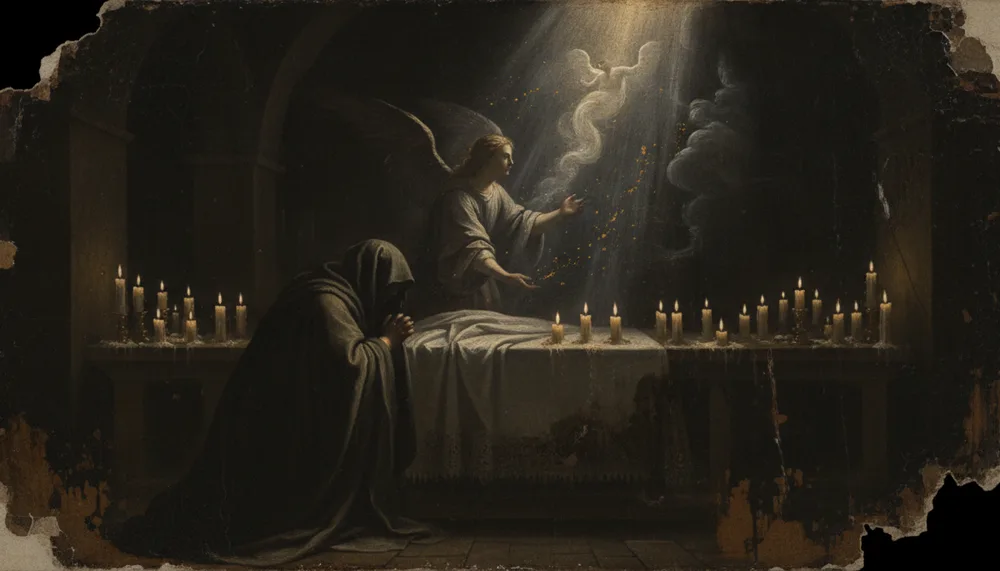
A novena for the dead is nine consecutive days of prayer begging God's mercy on a departed soul, or on all the holy souls in purgatory, that they may be loosed from their debt and brought to eternal rest. It is the Church's oldest work of mercy toward the deceased: the De profundis, the Requiem aeternam, and above all the Holy Sacrifice of the Mass, offered nine days running for a soul that can no longer help itself. This is the surest novena for the holy souls, and one of the truest acts of charity a Christian can perform for someone he loves.
Why we pray a novena for the dead
We pray for the dead because the dead can still be helped. The Catechism of the Council of Trent teaches that beyond hell "there is another hell where is the fire of Purgatory," in which "the souls of the just are purified... until they be worthy to enter into the eternal Country, for nothing defiled can penetrate therein." Many who die in the grace of God still carry some stain to wash away and some debt to pay, and so they go to be purified by the fire of purgatory. They are saved — but not yet home. They are not the damned, of whom we treat in does hell exist and what does God say about hell; they are the Church Suffering.
That they can be helped by us is the doctrine of the Communion of Saints. The Catechism of St Pius X teaches that "the Communion of Saints extends also to heaven and to purgatory, because charity unites the three Churches: Triumphant, Suffering, and Militant," and that therefore "we can relieve the souls in purgatory by applying in their favour Masses, alms, indulgences, and other good works."
The holy souls can no longer merit for themselves; their time of meriting ended at death, of which we write in what happens after death and the four last things. But we who are still in the fight can offer for them. Scripture commands it: of Judas Machabeus we read that "it is therefore a holy and wholesome thought to pray for the dead, that they may be loosed from sins" (2 Machabees 12:46). To pray for the dead is not sentiment but obedience, and a debt of love we owe our own family.
The structure of a nine-day novena for the deceased
A novena is nine consecutive days of prayer for one settled intention. A novena for the dead bends that form to one soul — or, through November, to all the faithful departed at once. Its essence is four things kept together for nine days.
One intention. Name the soul plainly — for the soul of N. — or, for the whole Church Suffering, for all the faithful departed. Keep to it the nine days.
Nine consecutive days. Pray each day without breaking the chain. The custom is to begin at a death, at a burial, on an anniversary, or on 1 November so that the ninth day falls within the octave of All Souls' Day.
A fixed prayer. Each day we pray the De profundis (Psalm 129) and the Eternal Rest, with the Our Father and Hail Mary. The words are given below.
The right dispositions. The Catechism requires of all prayer humility, confidence, perseverance, and resignation to the will of God (Catechism of St Pius X, On Prayer in General). It is not the number nine that obtains the grace, but the faith and submission of the one who prays.
The De profundis (Psalm 129)
The chief of all prayers for the dead is the De profundis, Psalm 129, which the Church places on the lips of the dying and over the open grave. It is named from its first Latin words, De profundis clamavi ad te, Domine — Out of the depths I have cried to thee, O Lord.
Out of the depths I have cried to thee, O Lord: Lord, hear my voice.
Let thy ears be attentive to the voice of my supplication.
If thou, O Lord, wilt mark iniquities: Lord, who shall stand it?
For with thee there is merciful forgiveness: and by reason of thy law, I have waited for thee, O Lord.
My soul hath relied on his word: my soul hath hoped in the Lord.
From the morning watch even until night, let Israel hope in the Lord.
Because with the Lord there is mercy: and with him plentiful redemption.
And he shall redeem Israel from all his iniquities.
The psalm is itself a cry for the dead: a soul in the depths, owning its debt, casting itself on the plentiful redemption of the Lord.
The Eternal Rest (Requiem aeternam)
After the De profundis we say the Eternal Rest, which opens the Introit of the Requiem Mass and gives that Mass its name.
Eternal rest grant unto them, O Lord,
and let perpetual light shine upon them.
May they rest in peace. Amen.
For one soul, the words change to the singular: Eternal rest grant unto him (or her), O Lord. In Latin: Requiem aeternam dona ei, Domine, et lux perpetua luceat ei. Requiescat in pace. Amen. The two halves name exactly what these souls lack — rest, because they are still in suffering, and perpetual light, the vision of God they were made for and do not yet possess.
The daily order of the novena
Each of the nine days, pray this:
In the name of the Father, and of the Son, and of the Holy Ghost. Amen.
Psalm 129, the De profundis (the full text above).
Our Father… Hail Mary…
V. Eternal rest grant unto them (him/her), O Lord.
R. And let perpetual light shine upon them (him/her).
V. May they (he/she) rest in peace.
R. Amen.Let us pray. O God, the Creator and Redeemer of all the faithful, grant to the souls of Thy servants departed the remission of all their sins, that through pious supplications they may obtain the pardon they have always desired. Who livest and reignest world without end. Amen.
This is the whole novena: simple, ancient, and within the reach of any Catholic. Where the soul wishes to add to it, the Litany of the Poor Souls in Purgatory is fitting, as is the Rosary offered for the dead; the De profundis and the Requiem remain the heart. It belongs to the wider body of Catholic prayers and devotions the Church offers for the departed.
The Mass and the indulgences for the dead
A novena of words is good; a novena of Masses is greater. The highest help we can give a departed soul is the Holy Sacrifice of the Mass. The Catechism of St Pius X teaches that the Mass is offered "to relieve the souls in purgatory," and that those for whom it is applied "may be either the living or the dead." Having Mass offered for a soul is the greatest of all suffrages, because it applies to him the very sacrifice of Christ. The old and best counsel is to ask a priest for a novena of Masses — nine Masses offered for the soul — and to join our daily De profundis to them.
After the Mass come the indulgences. An indulgence is the remission, granted by the Church out of the treasury of Christ's merits, of the temporal punishment still due to forgiven sin; those applicable to the dead are among the surest reliefs of the holy souls. The Church attaches such indulgences to the De profundis and the Eternal Rest, to the pious visiting of a cemetery, and above all to the days around All Souls' Day. To gain them for a soul is to lay the merits of the whole Church at his feet.
Here a common misreading must be corrected. Many speak of a novena for the dead as if it settled accounts on our terms — nine days and the soul is freed. It does not. We do not command God; we beg Him. We do not know the day a soul enters glory, and must not presume it. Nor may we canonize our dead, declaring them already in heaven and so needing no prayers, for presumption robs the very soul we love of the suffrages it needs. We pray in humility, leaving the hour to God, trusting that no prayer offered in charity is wasted — if the soul is already at rest, the Church teaches, our suffrages turn to other souls or to our own account.
When to pray a novena for the holy souls
We pray a novena for the dead whenever the duty of charity presses:
- At a death or burial, beginning the nine days for the soul just departed.
- On the anniversary of a parent's, spouse's, or friend's death.
- Through November, the month of the holy souls, above all from 1 November so that the novena spans All Souls' Day (2 November).
- Whenever a soul is laid on the heart — the forgotten dead, those who have no one to pray for them.
This last is the perfection of the devotion: to pray not only for our own dead but for the most abandoned souls, those whom no one remembers. The charity that drives such prayer is the same treated in how to love God and what does God say about love — for love does not end at the grave.
A novena for the holy souls is not a heavy thing. Nine days of the De profundis and the Eternal Rest, a Mass asked of a priest, an indulgence gained at a graveside — and a soul is helped toward the light. What we ask for them today, others will one day ask for us. That is the Communion of Saints, and the novena for the dead is its plainest and most faithful expression.
Frequently Asked Questions
What is a novena for the dead?
A novena for the dead is nine consecutive days of prayer begging God's mercy on a departed soul, or on all the holy souls in purgatory, that they may be loosed from their debt and brought to eternal rest. Its heart is the De profundis (Psalm 129) and the Eternal Rest, prayed each day, and above all the Holy Sacrifice of the Mass offered for the soul. It is one of the oldest works of mercy the Church performs for the deceased.
Can our prayers really help the dead?
Yes. The Church teaches that the souls in purgatory can be relieved by our prayers, almsgiving, indulgences, and above all by the Mass, because charity unites the three states of the Church — those in heaven, those in purgatory, and those still on earth — in one Communion of Saints. Scripture itself commands it: "It is therefore a holy and wholesome thought to pray for the dead, that they may be loosed from sins" (2 Machabees 12:46). The holy souls can no longer merit for themselves, but we who are still living can offer for them.
When should you pray a novena for the dead?
Whenever charity for the departed presses: at a death or burial, beginning the nine days for the soul just departed; on the anniversary of a death; and above all through November, the month of the holy souls, beginning on 1 November so that the novena spans All Souls' Day (2 November). It is fitting too for the most abandoned souls, those whom no one else remembers.
What happens to the body and soul after death?
At death the soul separates from the body and goes at once to its particular judgment — to heaven, to purgatory, or to hell. The body returns to the earth, awaiting the resurrection on the last day, when soul and body shall be reunited. The souls in purgatory are saved, but not yet home: they are being purified of the debt of forgiven sin before they may enter heaven, "for nothing defiled can penetrate therein." It is these souls our novena helps. We treat the question more fully in what happens after death and the four last things.
Is there a printable PDF of the novena for the dead?
Yes. The full text of this novena, with the De profundis, the Eternal Rest and the daily order of the nine days, is available as a free PDF, ready to print: the novena for the dead PDF.
The Iter Fidei app carries the Douay-Rheims Bible, the catechism, the prayers and devotions in Latin and your own language, with audio to pray along. Join early access here.
Sources. Scripture (Douay-Rheims): Psalm 129 (the De profundis); 2 Machabees 12:46. Catechism of the Council of Trent (1566): on the Fifth Article of the Creed (the fire of purgatory; nothing defiled enters heaven) and on the Holy Sacrifice of the Mass. Catechism of St Pius X (1908): on the Ninth Article of the Creed (the Church Triumphant, Suffering, and Militant; relieving the souls in purgatory by Masses, alms, and indulgences); on the Holy Sacrifice of the Mass (the Mass applied for the dead); on Indulgences; on Prayer in General (the dispositions of prayer). The Requiem aeternam and the collect for the dead as kept in the Roman liturgy.