
Devotions
Catholic Devotions: The Traditional Practices of Piety
What Catholic devotions are: the Church's approved practices of piety beyond the liturgy — the Sacred Heart and First Fridays, the Rosary and the Scapular, the Stations, the sacramentals, and the daily and monthly devotions.
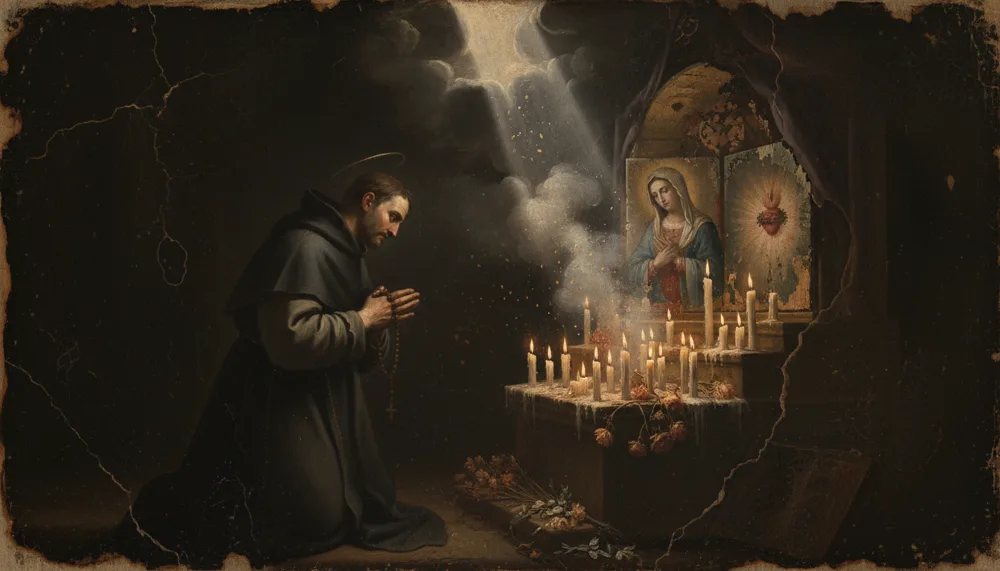
Catholic devotions are the approved practices of piety by which a soul honours God, His Mother, and His saints beyond the public liturgy — the Rosary, the Sacred Heart, the Scapular, the Stations of the Cross, the sacramentals, and the rest. A Roman Catholic devotion is not a substitute for the Mass and the sacraments but their overflow into daily life: the Church holds a whole treasury of such exercises, counselling the faithful to add to the duties of religion their own settled acts of love. The Catechism of St Pius X sets them out plainly, naming the Mass, a visit to the Blessed Sacrament, and the Rosary among the practices of piety the Christian ought, if he can, to perform each day (Catechism of St Pius X, On the Pious Exercises Counselled to the Christian).
What a devotion is
A devotion, in the strict sense, is a readiness of will to give oneself promptly to the things of God. In common usage a "devotion" is a particular practice — a fixed prayer, an exercise, a wearing of a blessed object — by which that readiness is fed and expressed. These practices are not of equal rank with the Mass and the sacraments, which Christ instituted; they are means the Church has approved, blessed, and enriched over the centuries because they lead souls to the same end.
The faithful are free in their choice among them, but not free to despise them: they are the ordinary armoury of the interior life, and the Church counsels them precisely because experience has shown they keep the soul near to God. Our Catholic prayers are the matter from which most of these devotions are built.
We make one distinction at the outset. Most devotions are directed to Our Lord, to Our Lady, or to the saints — and what we offer differs. We pray to God as the author of grace, that He may give us good and deliver us from evil; we pray to the saints that they may obtain these things for us by their intercession (Catechism of St Pius X, On the Invocation of the Saints). Honour to Mary and the saints never rivals the worship due to God alone; it is ordered to Him.
Devotions to Our Lord
The first place belongs to the devotions directed to Christ Himself. Chief among them is the Sacred Heart of Jesus, which honours the Heart of Our Lord as the symbol and the source of His love for men, and answers that love with reparation for the sins by which it is outraged. From this devotion flows the First Friday devotion: Holy Communion on the first Friday of nine consecutive months, in honour of the Sacred Heart and in reparation, with the Great Promise touching final perseverance attached to it. The proper prayer of the devotion, the Litany of the Sacred Heart, gathers its acts of love into a single supplication.
All of this is ordered to the Blessed Sacrament, for the Heart of Jesus is given to us under the sacramental veils. Hence Eucharistic adoration — the worship of Our Lord truly present in the Host, the holy hour before the tabernacle, and the rite of Benediction — is the most exalted of the devotions to Our Lord, because its object is no image or memory but Christ Himself. The Catechism counts the visit to the Most Blessed Sacrament among the daily exercises of a good Christian (Catechism of St Pius X, On the Pious Exercises Counselled to the Christian).
Catholic devotion to Mary
After Our Lord, the Catholic devotion to Mary holds the next place, for she is the Mother of God and our mother in the order of grace. The Church has always taught that it is very useful to have recourse to the Blessed Virgin's intercession, and every Christian ought to do so (Catechism of St Pius X, On the Invocation of the Saints). The Marian devotions give that recourse its settled forms.
The first is the Holy Rosary, which the Catechism names among the daily practices of piety. To learn it, see how to pray the Rosary and the mysteries of the Rosary, in which we meditate the joys, sorrows, and glories of Our Lord and His Mother on the beads.
Beside the Rosary stand the devotions tied to a blessed object: the Brown Scapular of Our Lady of Mount Carmel, worn as a habit and a pledge of her protection; and the Miraculous Medal of the Immaculate Conception, struck after the apparition to St Catherine Labouré and bearing the prayer O Mary conceived without sin, pray for us who have recourse to thee. Last comes the Immaculate Heart of Mary, the Marian counterpart of the Sacred Heart, honouring Our Lady's heart and answered by the consecration to it and the First Saturdays of reparation — the Marian echo of the First Fridays.
The Stations of the Cross
The Stations of the Cross, or Way of the Cross, are a devotion of meditation rather than of a single fixed prayer: fourteen stations following Our Lord from His condemnation to His burial, walked from image to image, with a meditation and a prayer at each. The devotion places before the soul the Passion in its stages, that we may grieve over our sins and be moved to love by what they cost. It is a devotion of the whole Church — the stations are erected in countless churches and richly indulgenced — and it belongs especially to Lent and to every Friday, the weekly memorial of the Cross.
The First Saturday devotions
The Marian counterpart of the First Fridays is the First Saturday devotion, which Our Lady asked at Fatima in reparation to her Immaculate Heart. The practice has four acts, to be performed on the first Saturday of five consecutive months, all offered in reparation for the sins committed against the Immaculate Heart of Mary: to go to confession, to receive Holy Communion, to recite five decades of the Rosary, and to keep Our Lady company for a quarter of an hour by meditating on the mysteries of the Rosary.
The confession may be made within the eight days before or after, provided the soul is in the state of grace at Communion. Like the First Fridays, this is a devotion of reparation and perseverance, and it pairs naturally with the consecration to the Immaculate Heart of Mary. The reparatory intention is essential: it is what distinguishes the devotion from a merely habitual Saturday Communion.
A daily devotional reading
Many of the faithful join to their fixed prayers a short daily devotional — a Scripture verse, a brief meditation, and a prayer for the day — read each morning to set the soul toward God. Such a reading is a true help, and the tradition is old: the saints counselled a little spiritual reading every day, lectio enough to feed the mind with one thought of God before the world crowds in. We would only set the order rightly.
The daily devotional is not the devotion; it is the kindling. What the Catechism asks first is the rule of life itself — the morning offering, the Pater and Ave, the visit to the Blessed Sacrament, the Rosary, the night examen — and a devotional reading serves best when it leads back to these and to the sacraments, not when it stands alone as a substitute for them. Read for living faith, then close the book and pray.
Catholic devotions for women
There is no separate class of devotions "for women" in the Church; the Rosary, the Sacred Heart, the Scapular, and the rest are the common patrimony of all the faithful. What is true is that certain devotions have long been especially dear to Christian women and bound up with the duties of their state. The Blessed Virgin Mary is the first model — and Marian devotion, the Rosary above all, has ever been the heart of women's piety.
Mothers have a particular charge of the household's prayer: it is largely through them that the Rosary, the morning offering, grace at meals, and the family's blessed images are kept alive in the home, so that the domestic church is in great part their work. To these many add a devotion to St Anne, the mother of Our Lady, and to St Monica, the mother of St Augustine and patroness of mothers who pray for their children. The principle holds for every state of life: the devotions are the same, but each soul takes up those that best sanctify the duties God has given it.
The sacramentals
Many devotions make use of the sacramentals — sacred signs instituted by the Church which, in some imitation of the sacraments, signify and obtain spiritual effects, chiefly through her prayer. They differ from the seven sacraments in that they do not confer grace of their own power but dispose us to receive it and move us to devotion. The chief of them is the Sign of the Cross, which the Catechism sets at the very head of the Christian's day: on awakening he ought to make the sign of the Cross and offer his heart to God (On the Pious Exercises Counselled to the Christian). It is at once a short profession of faith in the Holy Trinity and in the Cross of Christ.
Closely joined to it is holy water — water blessed by the Church, with which we sign ourselves on entering the church and in our homes, asking God's protection and recalling our baptism. To these belong also blessed medals, crucifixes, and images: the Catechism bids the Christian kneel, if he can, before some pious image at his morning prayer (On the Pious Exercises Counselled to the Christian). Such objects are not charms; their power is the Church's prayer and the devotion they stir in the one who uses them with faith.
Indulgences attached to devotions
Many devotions carry an indulgence — the remission of the temporal punishment due to sins already pardoned as to their guilt, which the Church grants outside the sacrament of Penance by applying to us the superabundant satisfactions of Christ, of the Blessed Virgin, and of the saints, the treasury of the Church (Catechism of St Pius X, On Indulgences). An indulgence is plenary when it remits the whole of that punishment, partial when it remits a part. We ought to make a very great account of indulgences, the Catechism says, because by them we satisfy the justice of God and obtain heaven more quickly and more easily; and they can be applied to the souls in purgatory.
This is why the approved devotions are so often enriched with indulgences — the Stations, the Rosary, the use of blessed beads and medals, the invocations to the Sacred Heart. The indulgence is not the motive of the devotion; charity is. But it shows the mind of the Church, which attaches her treasury to the practices she most desires her children to keep, and turns a daily act of piety into a work of satisfaction for the living and the dead.
Daily and monthly devotions
A Catholic daily devotional is not a book so much as a rule of life. The Catechism gives the pattern: on rising, the sign of the Cross and the morning offering, then the Pater, the Ave, the Creed, and the acts of Faith, Hope, and Charity; in the course of the day, if he can, the Christian should assist at holy Mass, make a visit to the Blessed Sacrament, and recite the Rosary; and at night, the examination of conscience and an act of contrition (On the Pious Exercises Counselled to the Christian). A few fixed prayers, kept every day, do more for a soul than great fervours that do not last.
Beyond the day, the Church has long kept a calendar of monthly dedications, each month consecrated to a mystery or a devotion: March to St Joseph, May to Our Lady, June to the Sacred Heart, July to the Precious Blood, October to the Holy Rosary, November to the Holy Souls. These traditional Catholic monthly devotions are not of obligation, but they give the year a rhythm of piety, drawing the faithful to one object of love after another and binding the devotions we have named into the turning of the seasons. To follow them is to let the whole year become a school of prayer.
All our devotions, by theme
Devotions to Our Lord
- The Sacred Heart of Jesus
- The Nine First Fridays
- Eucharistic Adoration and Benediction
- The Holy Face of Jesus
- The Holy Name of Jesus
- The Stations of the Cross
Devotions to Our Lady
- The First Saturdays devotion
- The Five First Saturdays
- The Brown Scapular
- The Miraculous Medal
Chaplets
- What is a chaplet?
- Chaplet of the Holy Ghost
- Chaplet of the Sacred Heart
- Chaplet of the Five Wounds
- Chaplet of the Holy Face
- Chaplet of the Precious Blood
- The Seven Sorrows Chaplet
- The Divine Mercy Chaplet
Sacramentals and indulgences
- What are sacramentals?
- The Sign of the Cross
- Holy water
- The St Benedict Medal
- Indulgences
Frequently Asked Questions
What are catholic devotions?
Catholic devotions are the Church's approved practices of piety by which a soul honours God, His Mother, and the saints beyond the public liturgy — the Rosary, the Sacred Heart and First Fridays, the Brown Scapular, the Stations of the Cross, the sacramentals, and the like. They are not substitutes for the Mass and the sacraments but their overflow into daily life. The Catechism of St Pius X names the Mass, a visit to the Blessed Sacrament, and the Rosary among the exercises the Christian ought, if he can, to perform each day.
What are devotions in the Catholic Church?
In the strict sense a devotion is a readiness of will to give oneself promptly to the things of God; in common usage it is a particular practice — a fixed prayer, an exercise, or the wearing of a blessed object — by which that readiness is fed. These practices are not of equal rank with the sacraments Christ instituted, but means the Church has approved, blessed, and enriched because they lead souls to the same end. The faithful are free in their choice among them, yet not free to despise them, for they are the ordinary armoury of the interior life.
What is the difference between a devotion and a sacrament?
The seven sacraments were instituted by Christ and confer grace of their own power (ex opere operato) on those who place no obstacle. Devotions and sacramentals are instituted by the Church and do not confer grace of themselves; they dispose us to receive it and move us to devotion, chiefly through the Church's prayer (Catechism of St Pius X). For this reason a devotion can never rival or replace the Mass and the sacraments, but is ordered to them.
Which devotion is the most important?
The first place belongs to the worship of Our Lord truly present in the Blessed Sacrament — Eucharistic adoration, the holy hour, and Benediction — because its object is no image or memory but Christ Himself. After this come the devotions to the Sacred Heart and to Our Lady, chief among the Marian devotions being the Holy Rosary. The Catechism of St Pius X counts both the visit to the Most Blessed Sacrament and the Rosary among the daily exercises of a good Christian.
What is a Catholic daily devotional?
A Catholic daily devotional is less a book than a rule of life. The Catechism gives the pattern: on rising, the sign of the Cross and the morning offering, then the Pater, Ave, Creed, and the acts of Faith, Hope, and Charity; during the day, if he can, Mass, a visit to the Blessed Sacrament, and the Rosary; and at night the examination of conscience and an act of contrition. A few fixed prayers kept every day do more for a soul than great fervours that do not last.
What are the monthly Catholic devotions?
The Church has long kept a calendar of monthly dedications, each month consecrated to a mystery or devotion: March to St Joseph, May to Our Lady, June to the Sacred Heart, July to the Precious Blood, October to the Holy Rosary, and November to the Holy Souls. They are not of obligation, but they give the year a rhythm of piety, drawing the faithful from one object of love to the next.
Are sacramentals like holy water and medals magic charms?
No. Sacramentals such as holy water, blessed medals, crucifixes, and the Brown Scapular are not charms, and they have no power of their own. Their power is the Church's prayer and the devotion they stir in the one who uses them with faith. Used in this spirit, they dispose the soul to grace and recall it to God; used as charms, they are abused.
What are the First Saturday devotions?
The First Saturday devotion is the Marian counterpart of the First Fridays, asked by Our Lady at Fatima in reparation to her Immaculate Heart. On the first Saturday of five consecutive months the faithful perform four acts, all offered in reparation: confession (which may be made within eight days before or after), Holy Communion, five decades of the Rosary, and fifteen minutes meditating on the mysteries to keep Our Lady company. The reparatory intention is essential and is what distinguishes the devotion from a merely habitual Saturday Communion.
Is there a Catholic daily devotional for living faith?
A daily devotional — a verse, a short meditation, and a prayer for the day — is a genuine help for keeping faith alive, and a little spiritual reading each day is an old counsel of the saints. But the reading is the kindling, not the fire. The Catechism asks first for a rule of life: the morning offering, the Pater and Ave, the visit to the Blessed Sacrament, the Rosary, and the night examen. A devotional reading serves best when it leads back to these and to the sacraments, never when it stands alone in their place.
Are there special Catholic devotions for women?
There is no separate class of devotions reserved to women; the Rosary, the Sacred Heart, and the Scapular are the common patrimony of all the faithful. Certain devotions have long been especially dear to Christian women and bound up with the duties of their state — Marian devotion above all, since the Blessed Virgin is their first model, and the devotions to St Anne and St Monica, patroness of mothers who pray for their children. Mothers in particular keep the prayer of the household alive, so that the domestic church is in great part their work.
Why are devotions enriched with indulgences?
An indulgence is the remission of the temporal punishment due to sins already pardoned as to their guilt, granted by the Church from the treasury of the merits of Christ and the saints (Catechism of St Pius X). The Church attaches indulgences to the devotions she most desires her children to keep — the Stations, the Rosary, blessed beads and medals — turning a daily act of piety into a work of satisfaction for the living and the dead. The indulgence is never the motive of the devotion; charity is.
Catholic devotions are the practices of piety by which the life of grace, received in the sacraments, is carried into every day and every month of the year. Kept with faith and humility — never as charms, never as rivals to the Mass — they are the ordinary road by which souls grow near to the Heart of Jesus and the heart of His Mother.
The Iter Fidei app carries these devotions, in Latin and your own language, with audio. Join early access here.
Sources. Catechism of St Pius X (1908): On the Pious Exercises Counselled to the Christian for Each Day; On the Invocation of the Saints; On Penance, §10 Indulgences. Catechism of the Council of Trent (1566), On Penance and On Communion.