
The Faith
The Seven Gifts of the Holy Ghost (and the Fruits)
The seven gifts of the Holy Ghost — wisdom, understanding, counsel, fortitude, knowledge, piety, and fear of the Lord — given in their fullness at Confirmation, with the twelve fruits that follow.
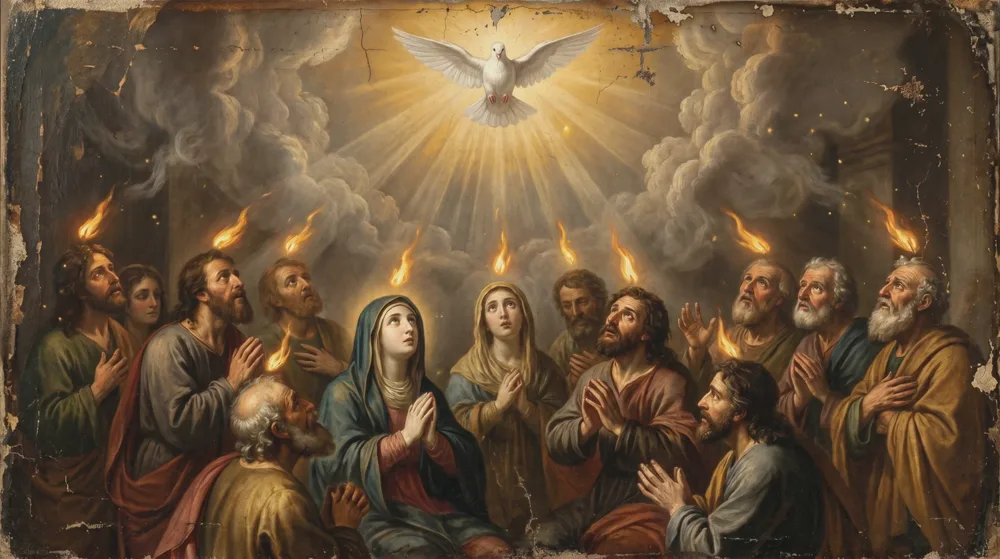
The gifts of the Holy Ghost are seven: wisdom, understanding, counsel, fortitude, knowledge, piety, and the fear of the Lord. They are supernatural dispositions infused into the soul with sanctifying grace, and they are given in their fullness in the Sacrament of Confirmation. The Roman Catechism of Trent calls Confirmation the moment in which we receive "the Grace and the seven Gifts of the Holy Ghost." Distinct from these gifts are their fruits — the savoury acts of virtue that follow when a soul lets the Holy Ghost govern it.
What are the seven gifts of the Holy Spirit
The Catechism of Saint Pius X states plainly that "there are seven gifts of the Holy Ghost": the gift of Wisdom, of Understanding, of Counsel, of Fortitude, of Knowledge, of Piety, and of the Fear of God. They are not the same thing as the virtues. The same catechism teaches their purpose: "The gifts of the Holy Ghost serve to confirm us in Faith, Hope, and Charity; and to make us prompt in the acts of virtue necessary to acquire the Christian life."
The number is not arbitrary. It is drawn from the prophet Isaias, who foretold of the Messias that there should rest upon Him "the spirit of wisdom and of understanding, the spirit of counsel and of fortitude, the spirit of knowledge and of godliness," and that He should be "filled with the spirit of the fear of the Lord" (Isaias 11:2-3, Douay-Rheims). What rested in fullness upon Christ the Head is communicated, by the Holy Ghost, to His members.
The seven gifts, one by one
We follow here the definitions of the Catechism of Saint Pius X.
- Wisdom is the gift by which, "raising our mind above earthly and fragile things, we contemplate eternal things, that is to say, the Truth which is God, in whom we take our delight and whom we love as our sovereign Good."
- Understanding is the gift by which "the understanding of the Faith and of the divine mysteries, which we cannot know by the natural light of our mind, is made easy for us, as far as is possible for mortal man."
- Counsel is the gift by which, "in the doubts and uncertainties of human life, we know what contributes most to the glory of God, to our salvation, and to that of our neighbour."
- Fortitude is the gift "which inspires us with energy and courage to observe faithfully the holy law of God and of the Church, overcoming all obstacles and all the assaults of our enemies."
- Knowledge is the gift by which "we rightly esteem created things, and we know the manner of using them well and of directing them to their last end, which is God."
- Piety is the gift by which "we venerate and love God and the Saints, and have sentiments of mercy and benevolence towards our neighbour for the love of God."
- The Fear of the Lord is the gift "which makes us respect God and fear to offend His divine Majesty, and which turns us away from evil by leading us to good." This is not the fear of a slave dreading punishment, but the reverence of a son who dreads to wound a Father he loves.
Seven gifts, not nine
Some searchers ask for the "nine gifts of the Holy Ghost." The number nine is not a Catholic enumeration of the gifts. It comes from a different list altogether: the nine charisms Saint Paul names in his first Epistle to the Corinthians — "the word of wisdom… the word of knowledge… faith… the grace of healing… the working of miracles… prophecy… the discerning of spirits… diverse kinds of tongues… interpretation of speeches" (1 Corinthians 12:8-10). These are charisms, gratuitous graces (gratiae gratis datae) given for the good of others, not the sanctifying gifts infused into every soul in the state of grace. The gifts that perfect the Christian soul, drawn from Isaias 11:2-3, are seven and have always been numbered seven by the Church.
How the gifts differ from the virtues
The virtues are powers by which we act; the gifts are dispositions by which we are made docile to the motion of the Holy Ghost Himself. Tanquerey explains that the fruits are "distinguished from the virtues and the gifts as the act is distinguished from the faculty." The virtues let us act under our own reason aided by grace; the gifts make the soul pliant under God's direct impulse, so that it is moved by Him with promptness and ease. They are bestowed with sanctifying grace and grow with it, which is why the life of grace and the life of the gifts rise and fall together. To understand the supernatural life into which they are poured, see our article on sanctifying grace.
The gifts and Confirmation
The seven gifts belong to every soul in the state of grace, but the Church teaches that they are given in their fullness in Confirmation. The Roman Catechism describes the holy Chrism, by "the mingling of the different elements which compose it," as showing "the diversity of the gifts of the Holy Ghost communicated to the confirmed."
Confirmation does not give us a new God; it perfects what Baptism began. "By Baptism men are begotten unto a new life," teaches the Catechism of Trent; "by Confirmation, on the contrary, having been already begotten, they become full-grown men." Pope Melchiades, cited in the same catechism, sharpens the contrast: "In Baptism man is enrolled in the warfare; and in Confirmation he is armed for the battle… In the one we are washed; in the other we are strengthened." The gifts are precisely those arms. They are the Holy Ghost equipping the soldier of Christ for a combat he could not sustain on his own strength — the spiritual combat against the flesh, the world, and the devil.
The pattern was set at Pentecost. The Catechism of Trent recalls that the Apostles, before the descent of the Holy Ghost, were so timid that Peter denied his Master at the voice of a servant girl; after Pentecost "they are so filled with the virtue of the Holy Ghost that they set themselves to preach boldly… not only to the Jews, but to the whole universe." The same Spirit who descended in tongues of fire is the same Spirit, the third Person of the Holy Trinity, who descends in Confirmation.
The fruits of the Holy Ghost
If the gifts and fruits of the Holy Spirit are easily confused, the difference is this: the gifts are dispositions, the fruits are the ripened acts that flow from them. Tanquerey defines the fruits as "acts of virtue arrived at a certain perfection and filling the soul with a holy joy." At the outset, he notes, acts of virtue "often require much effort, and sometimes have a certain harshness, like an unripe fruit"; but with long exercise the soul performs them "without painful effort, and even with pleasure." Then they deserve the name of fruits.
Saint Paul names them in his Epistle to the Galatians. In the Vulgate, which the Douay-Rheims follows, the fruits of the Holy Ghost are twelve: "charity, joy, peace, patience, benignity, goodness, longanimity, mildness, faith, modesty, continency, chastity" (Galatians 5:22-23). Tanquerey observes that Saint Paul "did not intend to draw up a complete list," and cites Saint Thomas, who teaches that this number is symbolic and "in reality denotes all the acts of virtue in which the soul finds a spiritual consolation." The fruits, then, are not a closed inventory but the savour of a soul that has let itself be governed by God.
It is by cultivating the virtues and the gifts, Tanquerey concludes, that one obtains the fruits, "and through them the beatitudes, the prelude to eternal happiness." On that further crown, see the Beatitudes.
A prayer for the seven gifts of the Holy Ghost
The Church has long taught the faithful to beg these gifts by name, especially around Pentecost and Confirmation. The prayer below, a devotional prayer of the prayer-books (not a liturgical text), opens with the antiphon Veni, Sancte Spiritus and asks for each of the seven in turn:
Come, O Holy Ghost, fill the hearts of Thy faithful and enkindle in them the fire of Thy love.
Grant me, O Holy Spirit, the gift of Wisdom, that I may esteem rightly the things of heaven and despise the things of earth.
Grant me the gift of Understanding, that I may know the mysteries of faith as far as is granted to mortal man.
Grant me the gift of Counsel, that in all my doubts I may choose what is most pleasing to God and most profitable to my salvation.
Grant me the gift of Fortitude, that I may bear my cross with courage and overcome all the assaults of my enemies.
Grant me the gift of Knowledge, that I may use created things only to draw nearer to Thee.
Grant me the gift of Piety, that I may love and serve Thee, and be tender and merciful toward my neighbour for Thy sake.
Grant me the gift of the Fear of the Lord, that I may dread to offend Thy divine Majesty and turn always away from sin. Amen.
To this may be added the ancient versicle and oration of the Veni Creator: V. Send forth Thy Spirit, and they shall be created; R. And Thou shalt renew the face of the earth. Let us pray. O God, who didst instruct the hearts of the faithful by the light of the Holy Ghost, grant us by the same Spirit to be truly wise, and ever to rejoice in His consolation. Through Christ our Lord. Amen.
This is not a charm or a formula to be repeated mechanically; the gifts are not extorted by counting words. It is the prayer of a soul that already possesses the gifts in seed by grace, asking that they be stirred into act. For more devotions to the third Person, see the Litany of the Holy Ghost and the Chaplet of the Holy Ghost.
Why the gifts matter
The gifts are not extraordinary favours reserved for the cloister. They are the ordinary furniture of a soul in grace, the means by which a Christian is made docile enough to be led by God where his own prudence would never reach. They are received at Confirmation and kept, lost, and recovered with sanctifying grace. To neglect them is, as the Catechism of Trent warns of Confirmation itself, to let "this great benefit of God" be bestowed upon us in vain.
Frequently Asked Questions
What are the gifts of the Holy Ghost?
The gifts of the Holy Ghost are seven: wisdom, understanding, counsel, fortitude, knowledge, piety, and the fear of the Lord. The Catechism of Saint Pius X states plainly that "there are seven gifts of the Holy Ghost," drawn from the prophecy of Isaias 11:2-3 concerning the Messias. They are supernatural dispositions infused into the soul with sanctifying grace, by which we are made docile to the direct motion of the Holy Ghost Himself.
What is the difference between the gifts and the fruits of the Holy Ghost?
The gifts are dispositions infused into the soul; the fruits are the ripened acts that flow from them. Tanquerey distinguishes them "as the act is distinguished from the faculty," defining the fruits as "acts of virtue arrived at a certain perfection and filling the soul with a holy joy." Saint Paul names the fruits in Galatians 5:22-23.
What are the twelve fruits of the Holy Ghost?
In the Vulgate, which the Douay-Rheims follows, the fruits are twelve: charity, joy, peace, patience, benignity, goodness, longanimity, mildness, faith, modesty, continency, and chastity (Galatians 5:22-23). Saint Thomas teaches that this number is symbolic and "in reality denotes all the acts of virtue in which the soul finds a spiritual consolation."
When do we receive the gifts of the Holy Ghost?
The seven gifts belong to every soul in the state of grace, but the Church teaches they are given in their fullness in the Sacrament of Confirmation. The Roman Catechism of Trent calls Confirmation the moment in which we receive "the Grace and the seven Gifts of the Holy Ghost," likening the confirmed soul to a soldier "armed for the battle."
How do the gifts of the Holy Ghost differ from the virtues?
The virtues are powers by which we act under our own reason aided by grace; the gifts make the soul pliant under God's direct impulse, so that it is moved by Him with promptness and ease. The Catechism of Saint Pius X teaches that the gifts "serve to confirm us in Faith, Hope, and Charity; and to make us prompt in the acts of virtue necessary to acquire the Christian life." They are bestowed with sanctifying grace and grow with it.
Is there a prayer for the seven gifts of the Holy Ghost?
Yes. A devotional prayer of the prayer-books begins "Come, O Holy Ghost, fill the hearts of Thy faithful," and then asks for each of the seven gifts by name — wisdom, understanding, counsel, fortitude, knowledge, piety, and the fear of the Lord — often joined to the versicle and oration of the Veni Creator. The full text is given above. It is rightly prayed during the novena before Pentecost and in preparation for Confirmation.
Are there seven gifts or nine gifts of the Holy Ghost?
The gifts of the Holy Ghost are seven, drawn from Isaias 11:2-3 and infused into every soul in the state of grace. The "nine gifts" some look for are not these: they are the nine charisms of 1 Corinthians 12:8-10 — such as healing, miracles, prophecy, and tongues — which are gratuitous graces given for the good of others, not the sanctifying gifts of the interior life. The Church numbers the sanctifying gifts as seven.
What is the gift of the fear of the Lord?
The fear of the Lord is the gift "which makes us respect God and fear to offend His divine Majesty, and which turns us away from evil by leading us to good." This is not the fear of a slave dreading punishment, but the reverence of a son who dreads to wound a Father he loves.
The Iter Fidei app carries the prayers, devotions, and a guide to the spiritual life — free to taste, should you wish to draw nearer to the Holy Ghost in daily practice. Join early access here.
Sources. Catechism of Saint Pius X, Part V, ch. 2, "The Gifts of the Holy Ghost." Roman Catechism (Catechism of the Council of Trent), Part II, ch. 17, "On the Sacrament of Confirmation." A. Tanquerey, The Spiritual Life (Précis de théologie ascétique et mystique), nn. 1359-1360, on the fruits of the Holy Ghost, citing St. Thomas Aquinas. Holy Scripture: Isaias 11:2-3; Galatians 5:22-23; 1 Corinthians 12:8-10 (Douay-Rheims). Veni Sancte Spiritus / Veni Creator versicle and oration from the Roman Missal and the Rituale Romanum.