
The Saints
St Peter: The Apostle and First Pope
St Peter, the fisherman whom Christ made the rock of His Church, was the first Pope. We give his call, his confession, the keys, his denial and repentance, and his martyrdom in Rome, grounded in the Douay-Rheims and the catechisms.
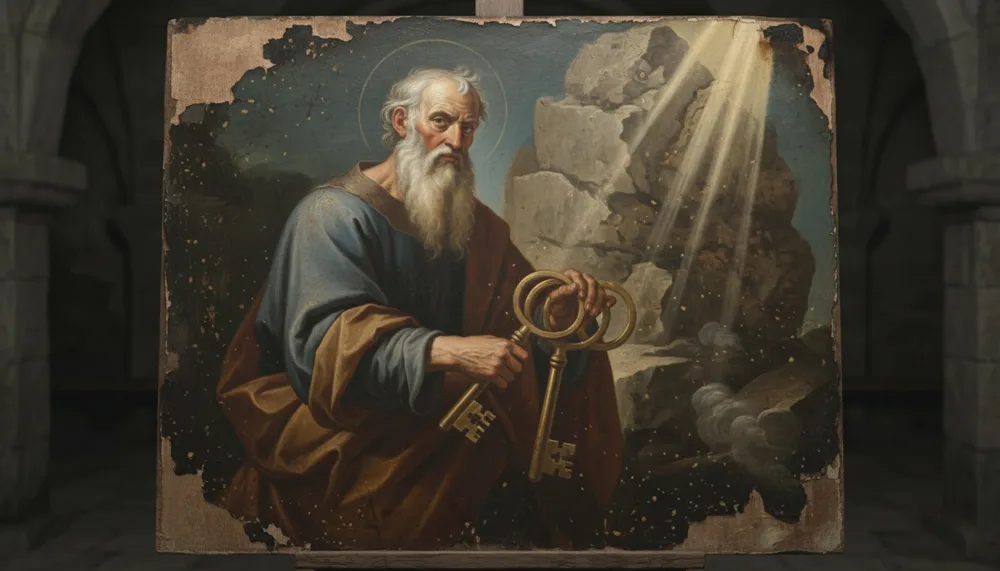
Was Peter the first Pope? Yes. St Peter the Apostle — Simon the fisherman of Galilee, whom Christ named the rock of His Church and gave the keys of the kingdom of heaven — was the first Pope, the first Bishop of Rome, and the first in that line of successors at whose head the Church is governed to this day. The Catechism of St. Pius X says it without qualification, naming "St. Peter, the first Pope," and resting his office on the words of Our Lord: "Thou art Peter, and upon this rock I will build my Church." Saint Peter is therefore not merely one Apostle among the Twelve but their head, the prince of the Apostles, and the rock on which Christ chose to build.
The call of Simon the fisherman
Saint Peter was a fisherman of Galilee, a married man (his mother-in-law is healed in the Gospel), brother of Saint Andrew, who first brought him to Christ. His given name was Simon. When Andrew led him to the Lord, Our Lord at once foretold the new name that would carry his office: "Thou art Simon the son of Jona. Thou shalt be called Cephas, which is interpreted Peter" (John 1:42). Cephas is the rock; Peter is its Greek.
The formal call came by the lakeside. Walking by the Sea of Galilee, Christ "saw two brethren, Simon who is called Peter, and Andrew his brother, casting a net into the sea (for they were fishers). And he saith to them: Come ye after me, and I will make you to be fishers of men. And they immediately leaving their nets, followed him" (Matthew 4:18-20). From the first, Simon answers without delay.
"Thou art the Christ" — the confession at Caesarea Philippi
Peter is the one who speaks for the Twelve. When Our Lord asked at Caesarea Philippi, "whom do you say that I am?" it was Simon Peter who answered: "Thou art Christ, the Son of the living God" (Matthew 16:16). To this confession Christ replied that flesh and blood had not revealed it, but His Father in heaven — and then turned the confession into a commission:
And I say to thee: That thou art Peter; and upon this rock I will build my church, and the gates of hell shall not prevail against it. And I will give to thee the keys of the kingdom of heaven. And whatsoever thou shalt bind upon earth, it shall be bound also in heaven: and whatsoever thou shalt loose on earth, it shall be loosed also in heaven. (Matthew 16:18-19)
These are the words on which the papacy stands. Christ does not promise a leaderless Church; He names a man, confers on him the name already foretold, and makes him the rock and the keeper of the keys. We treat this verse and the objections to it at length in Thou Art Peter, and the Church it founds in What Is the Catholic Church?.
Peter's primacy among the Apostles
Saint Peter holds a place no other Apostle holds. The Gospels name him first in every list of the Twelve; he speaks for them, walks on the water toward Christ, is taken with James and John to the Transfiguration. To him alone are the keys given. And after the Resurrection the charge is renewed by the lakeside, three times, in answer to the threefold denial: "Feed my lambs… Feed my sheep" (John 21:15-17). To Peter alone is the whole flock committed.
The Catechism of St. Pius X draws the conclusion plainly: "The Pope is the successor of St. Peter, Prince of the Apostles." His office is not honour only but jurisdiction, "supreme and immediate power over all and each of the Pastors and of the faithful." This is why, of all the Apostles whose deaths we recount in How Did the Apostles Die?, Peter's place is set apart: the rest are successors of the Apostles, but the Bishop of Rome is successor of Peter, head of the whole. In the fifth century Pope St Leo the Great taught the same in the sermons on the anniversary of his consecration: it is Peter who still governs in his see.
The denial and the repentance
The Gospels do not hide Peter's fall, and neither do we. On the night of the Passion, after boasting that he would die with his Master, Peter denied Him three times in the high priest's courtyard, even with an oath — "I know not the man" (Matthew 26:72) — and at the third denial the cock crew, and "the Lord turning looked on Peter… And Peter going out, wept bitterly" (Luke 22:61-62). The first of the Apostles was also the one who failed most openly.
Yet his fall was foreseen and his recovery secured by Christ's own prayer. Our Lord had warned him: "Simon, Simon, behold Satan hath desired to have you, that he may sift you as wheat. But I have prayed for thee, that thy faith fail not: and thou, being once converted, confirm thy brethren" (Luke 22:31-32). Peter's repentance was not the end of his commission but its proving; the man who wept was the man sent to confirm the rest. His sin was grave and his contrition real — the very pattern the Church holds out to every penitent, of which we write in The Passion of Jesus Christ.
Peter's preaching and the first days of the Church
After the Ascension it is Peter who acts as head. He stands up to fill the place of Judas among the Twelve (Acts 1:15). On Pentecost it is Peter who "standing up with the eleven, lifted up his voice" and preached the first sermon of the Church, so that "there were added in that day about three thousand souls" (Acts 2:14, 2:41). He works the first miracle at the Temple gate, defends the Faith before the council, opens the door to the Gentiles, and speaks with decisive authority at the council of Jerusalem (Acts 15:7-11). From the first day the Church looks to Peter to speak and to govern. He laboured at last at Rome, where, as the Catechism of St. Pius X teaches, "by divine disposition he established his Seat at Rome, and there died."
The martyrdom of St Peter in Rome
Saint Peter was crucified in Rome under the persecution of Nero, in the years around 64 to 67. The ancient and constant tradition — attested by Origen as preserved in Eusebius — is that he asked to be crucified head downward, judging himself unworthy to die in the same posture as his Master. His martyrdom at Rome is among the best-attested of all the Apostles, and over his tomb the great basilica was raised. Nor did the persecutions end with Nero: two centuries later another Roman soldier, St Sebastian of the Praetorian Guard, gave his blood in the same city under Diocletian, shot with arrows and beaten to death for the same confession.
His death in that city is no mere fact of geography; it is the ground of the Roman primacy. The Catechism of St. Pius X explains why the Pope is the successor of Peter and no other: "St. Peter united in his own person the dignity of Bishop of Rome and that of Head of the Church; by divine disposition he established his Seat at Rome, and there died; hence, whosoever is elected Bishop of Rome is also heir to all his authority."
So the true Church is called the Roman Church, "because the four marks of Unity, Sanctity, Catholicity and Apostolicity are found in that Church alone which acknowledges as Head the Bishop of Rome, the Successor of St. Peter." Peter died at Rome that Rome might keep the chair he held. When that chair falls vacant at a Pope's death, the faithful pray both for the repose of his soul and for the man God will raise up next, as in the novena for the repose of the Pope and the election of a new Pope.
Was Peter really the first Pope?
He was. The objection is sometimes raised that the word "Pope" is later than the Apostles, and that Peter never bore the title — true of the word, but not of the thing. The office of the Pope is the office Christ gave Peter: the keys, the charge to feed the flock, the prayer that his faith fail not so that he might confirm his brethren.
The Catechism of St. Pius X names him "the first Pope" because he held what every Pope holds — the place of the visible head of the Church, "the Vicar of Jesus Christ on earth." The title grew; the office is from Christ. And because the Church endures, the office is handed on: "whosoever is elected Bishop of Rome is also heir to all his authority." Peter is the first of a line, not a solitary figure left behind. The labours of his great companion in martyrdom we recount in Saint Paul.
Saint Peter is the fisherman Christ made the rock, the Apostle who confessed Him, denied Him, wept, and was restored, the preacher of the first Pentecost and the martyr of Rome — and the first Pope, at the head of the line against which the gates of hell shall not prevail. His feast, with Saint Paul, the Church keeps on the twenty-ninth of June.
St Peter, Prince of the Apostles
The title "Prince of the Apostles" is the Church's own. The Catechism of St. Pius X uses it directly: "The Pope is the successor of St. Peter, Prince of the Apostles." It does not mean that Peter ceased to be one of the Twelve, but that among the Twelve he was first — not in time only, but in office. He is named first in every Gospel list; he speaks for the rest; he alone receives the keys; to him alone the whole flock is committed at the lakeside.
A prince, in the old sense, is the chief and head of a body, and that is what Peter is to the apostolic college: its head while he lived, and its head still in the person of his successor at Rome. When the Church calls a parish or a feast "St Peter, Prince of the Apostles," she is naming this primacy — Peter set over the Apostles by Christ Himself.
Sts Peter and Paul: the two princes of the Roman Church
Why are Peter and Paul so constantly joined — in feast, in art, in the dedication of countless churches as "Sts Peter and Paul"? Because they are the two pillars on whom, under Christ, the Roman Church was raised, and both gave their blood in Rome under Nero. Yet the Church does not confuse their roles. Peter is the rock and the visible head, the first Pope, who governs the whole flock; Paul is the chosen vessel, the Apostle to the Gentiles, the great preacher and writer of the Epistles.
The one holds the keys; the other ran the race to the ends of the earth. The Church keeps their common feast on the twenty-ninth of June, and on the thirtieth the Commemoration of St Paul. By ancient tradition Peter was crucified and Paul, as a Roman citizen, beheaded — the same city, the same persecution, two crowns. We recount Paul's labours and death in Saint Paul, and the deaths of the rest in How Did the Apostles Die?.
Other saints named Peter
The Apostle is far from the only Peter the Church honours. Parishes dedicated to "St Peter" sometimes bear the name of one of these later saints rather than the Apostle, and it is worth keeping them distinct.
St Peter Claver
St Peter Claver (1580–1654) was a Spanish Jesuit who laboured for nearly forty years at Cartagena, in what is now Colombia, among the enslaved Africans brought across the Atlantic. He called himself "the slave of the slaves forever," meeting the ships at the harbour to tend, baptize, and instruct those aboard, and is said to have baptized many thousands. He was canonized by Leo XIII in 1888, who later named him patron of the missions among the African peoples. His feast, kept on the ninth of September, belongs to the calendars of particular places and religious orders: it is not in the universal calendar of 1962 (it entered the general calendar only with the reform of 1969).
St Peter Damian
St Peter Damian (c. 1007–1072) was a Benedictine monk, cardinal-bishop of Ostia, and a Doctor of the Church. A reformer of the clergy and of monastic life in the eleventh century, he wrote forcefully against the abuses of his age and laboured for the purity and discipline of the priesthood. He is counted among the Doctors of the Church for the weight and orthodoxy of his teaching. His feast is kept on the twenty-third of February.
St Peter Chanel
St Peter Chanel (1803–1841) was a French priest of the Society of Mary (the Marists) and the first martyr of Oceania. Sent to the island of Futuna in the Pacific, he was put to death there out of hatred for the Faith as his preaching began to bear fruit; soon after his death the whole island was converted. He was beatified by Leo XIII in 1889 and canonized by Pius XII in 1954. His feast on the twenty-eighth of April is kept in particular places (in the universal calendar of 1962 that day belongs to St Paul of the Cross); it entered the general calendar only with the reform of 1969. St Peter takes his place among the saints of the year in our guide to the Catholic saints, listed by feast day.
Frequently Asked Questions
How did the Apostle Peter die?
St Peter was crucified in Rome under the persecution of Nero. The ancient and constant tradition — attested by Origen as preserved in Eusebius — is that he asked to be crucified head downward, judging himself unworthy to die in the same posture as his Master. His martyrdom at Rome is among the best-attested of all the Apostles, and over his tomb the great basilica was raised.
When did the Apostle Peter die?
St Peter was martyred at Rome under Nero, in the years around 64 to 67. His death in that city is no mere fact of geography; it is the ground of the Roman primacy, for the Pope is the successor of St Peter precisely because Peter established his see at Rome and there died.
Was Peter the first Pope?
Yes. St Peter was the first Pope, the first Bishop of Rome, and the first in the line of successors at whose head the Church is governed. The Catechism of St. Pius X names him "the first Pope," resting his office on the words of Christ: "Thou art Peter, and upon this rock I will build my Church" (Matthew 16:18). The objection that the word "Pope" is later than the Apostles is true of the word but not of the thing: Peter held what every Pope holds — the keys, the charge to feed the flock, and the place of the visible head of the Church.
What does "Thou art Peter" mean?
At Caesarea Philippi, after Peter confessed "Thou art Christ, the Son of the living God," Our Lord replied: "Thou art Peter; and upon this rock I will build my church… And I will give to thee the keys of the kingdom of heaven" (Matthew 16:18-19). Christ names a man as the rock of His Church and the keeper of the keys — the words on which the papacy stands.
When is the feast of St Peter?
The Church keeps the feast of Sts Peter and Paul on the twenty-ninth of June, honouring together the two princes of the Apostles who founded the Roman Church in their blood — Peter the rock and head of the whole flock, Paul the chosen vessel to the Gentiles.
Why is St Peter called the Prince of the Apostles?
Because Christ set him at the head of the Twelve. He is named first in every Gospel list, speaks for the rest, alone receives the keys, and alone is given charge of the whole flock ("Feed my sheep"). The Catechism of St. Pius X calls him "Prince of the Apostles" — prince meaning chief and head — and teaches that the Pope is the successor of St Peter precisely in that primacy.
Is St Peter the Apostle the same as St Peter Claver or St Peter Chanel?
No. The Apostle is St Peter, the fisherman of Galilee and first Pope. St Peter Claver (1580–1654) was a Spanish Jesuit who served the enslaved Africans at Cartagena; St Peter Chanel (1803–1841) was a Marist priest and the first martyr of Oceania; St Peter Damian (c. 1007–1072) was a Benedictine cardinal and Doctor of the Church. Parishes named "St Peter" may honour any of these, so it is worth checking which Peter a given church is dedicated to.
Who was St Peter Claver?
St Peter Claver was a Spanish Jesuit (1580–1654) who spent nearly forty years at Cartagena ministering to the enslaved Africans brought across the Atlantic, calling himself "the slave of the slaves forever." He was canonized in 1888 and is a patron of missions among the African peoples; his feast, the ninth of September, is kept in particular places, not in the universal calendar of 1962.
Who was St Peter Damian?
St Peter Damian (c. 1007–1072) was a Benedictine monk, cardinal-bishop of Ostia, and a Doctor of the Church — an eleventh-century reformer who wrote against the abuses of his age and laboured for the purity and discipline of the clergy. His feast is the twenty-third of February.
The Iter Fidei app carries the Douay-Rheims Bible, the catechism, and the prayers of the Church. Join early access here.
Sources. Holy Bible, Douay-Rheims (Rheims New Testament 1582; Challoner revision) — John 1:42; Matthew 4:18-20; Matthew 16:16-19; John 21:15-17; Matthew 26:69-75; Luke 22:31-34, 22:54-62; Acts 1:15-26; 2:14-41; 15:7-11. Catechism of St. Pius X (1908), On the Ninth Article of the Creed ("St. Peter, the first Pope"; "Thou art Peter… upon this rock I will build my Church"; the four marks and the Roman Church; the Pope the successor of St. Peter, Vicar of Jesus Christ, visible head, with supreme and immediate power; St. Peter united in his own person the dignity of Bishop of Rome and that of Head of the Church, established his Seat at Rome and there died; "Prince of the Apostles"). Catechism of the Council of Trent (1566), On the Ninth Article (Christ the invisible Head and the visible Head, the lawful successor of St. Peter on the see of Rome). Early witnesses to the martyrdom as preserved in the ancient tradition (Eusebius, Ecclesiastical History, citing Origen). On the other saints named Peter: the Roman Martyrology and the traditional lives of the saints — St Peter Claver, S.J. (1580–1654, canonized 1888, feast 9 September in particular places); St Peter Damian, O.S.B., Doctor of the Church (c. 1007–1072, feast 23 February); St Peter Chanel, S.M., first martyr of Oceania (1803–1841, beatified 1889, canonized 1954, feast 28 April in particular places).