
The Saints
Catholic Saints: Their Lives, Patronage, and Prayers
Who the saints are, how they are canonized, the great patrons by need, the Doctors of the Church, the archangels, and how to keep the saint of the day — the hub of the whole cluster.
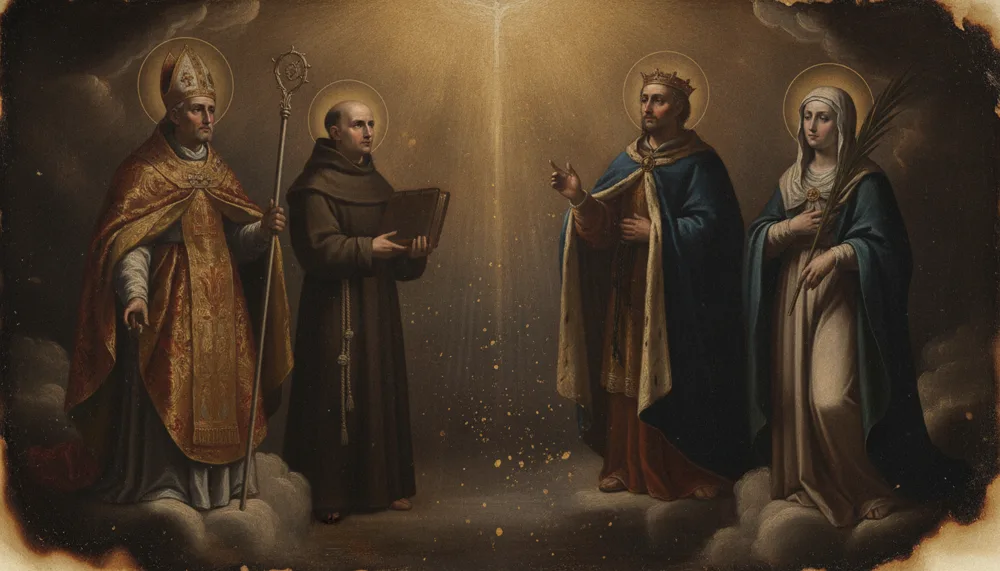
The Catholic saints are the holy men and women whom the Church, with certainty, holds up for veneration and asks us to invoke — souls now reigning with God in heaven, whose lives prove that grace can make a creature holy and whose prayers still help us below. We honour them not as gods but as friends of God: we pray to the saints, the Catechism of St Pius X teaches, "in order that they may intercede for us as our advocates with God." This page is the doorway to the whole company — what makes a saint, the patrons for every need, the Doctors of the Church, the archangels, the Marian apparitions, and how to keep the saint of the day.
What makes a saint
A saint, in the strict sense the Church canonizes, is a person who has died, whose soul is in heaven, and whom the Church — after long examination of life, virtue, and miracles, and sometimes of wonders as striking as the incorruption of the body — declares to be there with public certainty. Canonization is the solemn act by which the Roman Pontiff inscribes a name in the calendar of the saints and permits their public veneration throughout the Church. It is not the making of a saint but the recognition of one: God sanctifies; the Church discerns and proclaims.
Behind this stands an older and wider truth, the ninth article of the Creed: the Communion of Saints. The Roman Catechism explains that the Church is "like a family, which is governed by one only, the Father of the family, and in which all the spiritual goods are common." The members of this one Body — the faithful on earth, the souls in purgatory, and the blessed in heaven — share a single life of grace, so that the merits and prayers of the holy belong, in charity, to all.
This is why we may ask the saints to pray for us: they are not the distant dead but living members of the same Body, nearer to the Head than we are. We explain this doctrine, and what it asks of us, in the Communion of Saints, and the Church gathers the whole heavenly court in one great prayer, the Litany of the Saints.
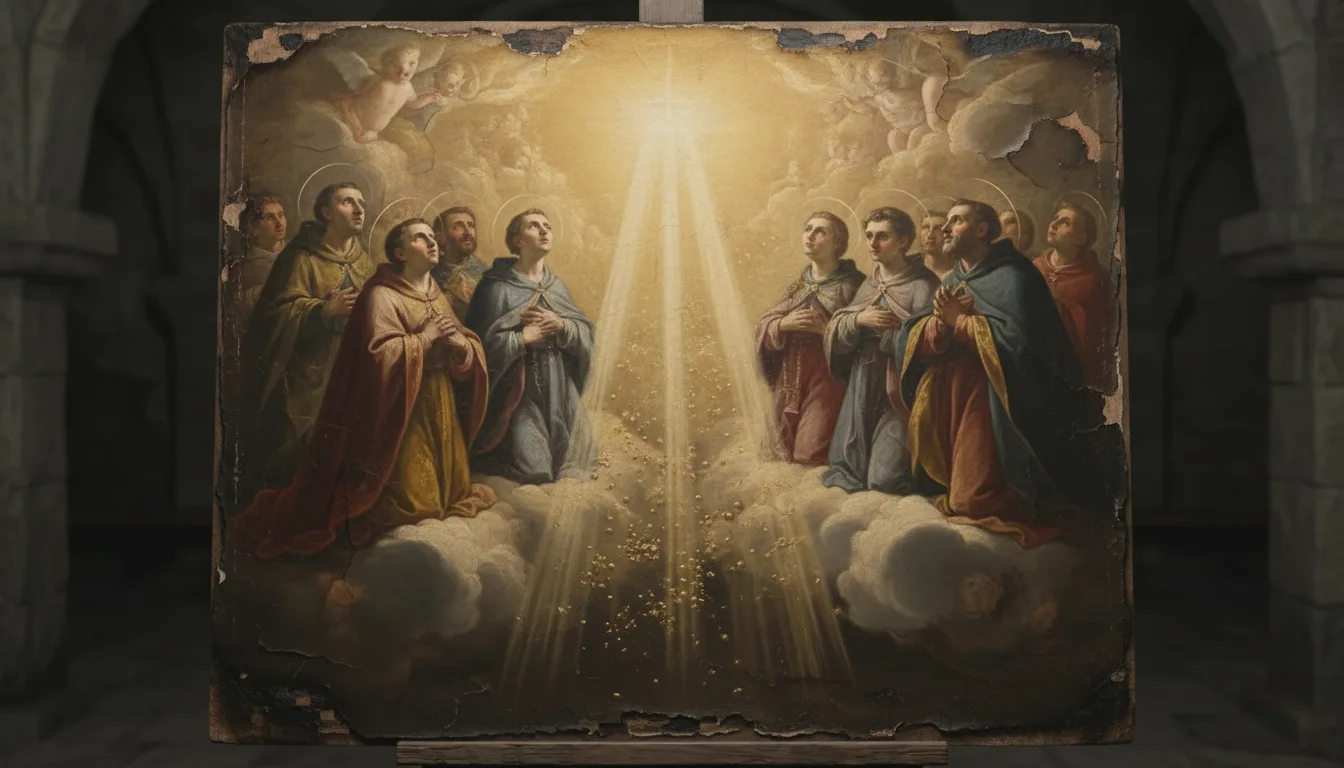
Veneration of the saints is not adoration. Adoration (latria) is owed to God alone; the saints receive only honour (dulia), and the Blessed Virgin a higher honour (hyperdulia) as Mother of God. To pray to a saint is simply to ask a friend in heaven to carry our petition to the throne where all grace is given.
Patron saints by need
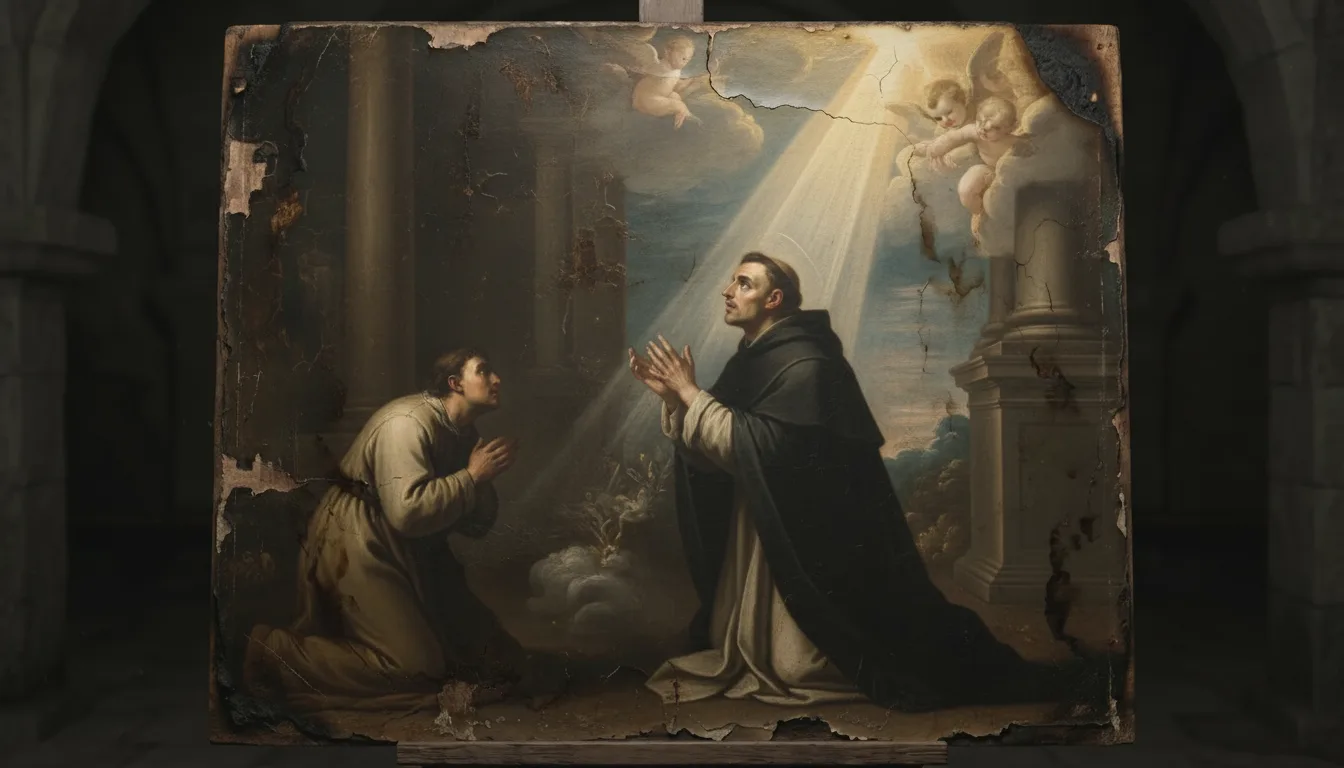
A patron saint is a heavenly protector assigned to a person, place, trade, or need — chosen because of their life, their death, or a long tradition of answered prayer. The Catechism of St Pius X commends praying "particularly to our Guardian Angels, to Saint Joseph, Patron of the Church, to the holy Apostles, to the Saints whose name we bear, and to the holy Protectors of the diocese and of the parish." Above the patrons stands St Joseph, Patron of the Universal Church and of a holy death.
When a cause seems lost, the faithful turn to St Jude, the apostle invoked as patron of desperate and hopeless cases — and the Church has long carried his cause in a proper prayer to St Jude. For things lost — keys, papers, even faith itself — generations have called on St Anthony of Padua, and the well-worn prayer to St Anthony is said for every lost thing. The anxious and those afflicted in mind have a tender advocate in St Dymphna, patroness of nervous and mental suffering. The sick, and especially those who carry the cross of cancer, are entrusted to St Peregrine, healed of a tumour at the foot of the crucifix.
Expectant mothers and their children find a friend in St Gerard. For diseases of the throat the Church blesses with the candles of St Blaise. The impossible and the wounded marriage are the province of St Rita, saint of impossible causes; and travellers have long worn the medal of St Christopher, who bore the Christ-Child across the river. Above them all the Church sets St Joseph her Patron, honoured in the litany of St Joseph, the novena to St Joseph, and the daily prayer to St Joseph. Each of these we treat in full — life, patronage, and the proper prayer — on its own page.
List of saints and their patronages
The faithful who search for a list of saints and what they protect will find below the great patrons treated on this site — the saint names, the need entrusted to each, and the feast day as the traditional calendar keeps it. Such a table is a doorway, not a census: the Communion of Saints is beyond counting, and every name here opens onto its own page with the life, the patronage, and the proper prayer.
| Saint | Patronage — what they protect | Traditional feast day |
|---|---|---|
| St Joseph | The Universal Church, fathers, workers, a happy death | 19 March |
| St Anthony of Padua | Lost things, the poor | 13 June |
| St Jude | Desperate and hopeless causes | 28 October |
| St Rita | Impossible causes, wounded marriages | 22 May |
| St Christopher | Travellers | 25 July |
| St Michael the Archangel | Protection against evil, the Church, soldiers | 29 September |
| St Raphael the Archangel | Travellers, the sick, happy meetings | 24 October |
| St Dymphna | Nervous and mental affliction, anxiety | 15 May |
| St Peregrine | Those suffering from cancer | 1 May |
| St Gerard | Expectant mothers and their children | 16 October |
| St Blaise | Diseases of the throat | 3 February |
| St Anne | Mothers and grandmothers | 26 July |
| St Monica | Mothers of wayward children, converts | 4 May |
| St Benedict | Europe, protection against poison and evil | 21 March |
| St Patrick | Ireland | 17 March |
| St Joan of Arc | France, soldiers | 30 May |
| St Cecilia | Sacred music, musicians | 22 November |
| St Thérèse of Lisieux | The missions, souls in little things | 3 October |
| St Thomas Aquinas | Students, Catholic schools | 7 March |
| St Francis of Assisi | The poor, animals | 4 October |
Four needs come back so often that we gather all their patrons on a single page:
- The patron saints of hopeless cases
- The patron saint of lost causes
- The patron saints of students
- The patron saint of travelers
For the fuller roll of saint names called in the Church's own order, the Litany of the Saints remains the Church's own list of saints; and the calendar assigns each of these feasts its place in the year, as we explain below.
The Doctors of the Church
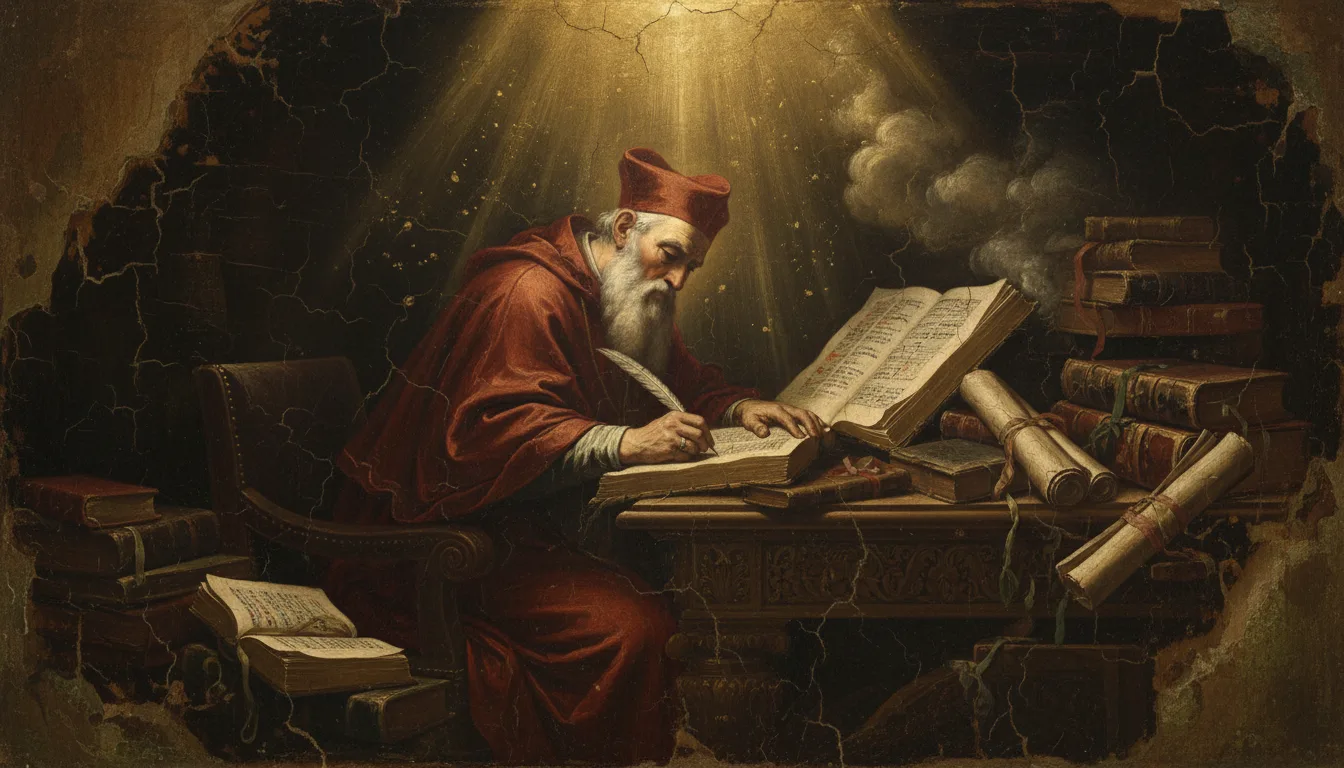
A Doctor of the Church is a saint whose writing the Church has formally recognized as a sure guide to her doctrine — eminent learning joined to eminent holiness. Their works stand high in our source hierarchy: after Scripture and the councils come the Doctors.
St Thomas Aquinas, the Angelic Doctor, gave the Church her clearest and most ordered theology in the Summa; Leo XIII set him as the master of Catholic schools. St Augustine, the Doctor of Grace, whose Confessions and City of God shaped the whole West, is quoted on nearly every page of the Roman Catechism. From the Carmelite reform come two great mystical teachers: St Teresa of Avila, who mapped the interior castle of prayer (declared a Doctor of the Church only in 1970), and St John of the Cross, Doctor of the dark night and the ascent of the soul to God.
And St Catherine of Siena, who recalled the Pope to Rome, teaches that the road to heaven is itself heaven, for Christ said, "I am the Way." In the East, St Athanasius of Alexandria held the faith of Nicaea against the Arians through five exiles. Among the reforming saints raised to the same rank is St Peter Damian, the hermit and cardinal whose writings scourged the corruption of his age. These are masters to be read, not merely admired.
The archangels
The Church venerates three archangels by name, each charged with a mission in the history of salvation. St Michael — Quis ut Deus, "Who is like God" — is the prince of the heavenly host who cast down the dragon (Apocalypse 12:7), defender of the Church against the powers of darkness; we give his combat prayer in full, and his nine days of intercession in the novena to St Michael the Archangel. St Gabriel, "the strength of God," is the messenger who announced the Incarnation to Our Lady at the Annunciation (Luke 1:26). St Raphael, "God heals," is the companion of Tobias and patron of travellers and the sick (Tobias 12), invoked in the novena to St Raphael. With them stands every man's own guardian angel, set by God to keep us in all our ways.
The Marian apparitions
Among the saints the Blessed Virgin Mary holds the first place, Queen of all the saints and of angels. She is the Mother of God, conceived without sin in the Immaculate Conception, ever-virgin, and at the end of her course taken body and soul to heaven in the Assumption; her sinless love is honoured in the devotion to her Immaculate Heart. In her mercy she has come to her children in approved apparitions, each with its own feast and devotion.
At Lourdes, she named herself to St Bernadette as the Immaculate Conception and opened the healing spring. At Fatima, she called for penance, the Rosary, and devotion to her Immaculate Heart. To St Juan Diego at Tepeyac she left her own image as Our Lady of Guadalupe, Patroness of the Americas. And as Our Lady of Mount Carmel she gave the brown scapular, the garment of her protection, as she gave the Miraculous Medal to St Catherine Labouré. These are not new revelations but calls to the old fidelity: prayer, penance, and the Rosary.
The great company: apostles, martyrs, virgins, and confessors
The calendar of the saints is a whole army of God, ranked by the manner of their holiness. At its head stand the Apostles, the twelve foundation-stones of the Church: St Peter, the rock to whom the keys were given, and St Paul, the apostle to the nations whose epistles fill the New Testament, and St Andrew, the first-called, who brought his brother Peter to Christ. With them the Church remembers Mary Magdalene, the first witness of the Resurrection, called the apostle to the apostles.
Among the great founders and confessors are St Benedict, father of Western monasticism (named patron of Europe by Paul VI in 1964), and St Francis of Assisi, the Poverello who bore the wounds of Christ; and among the great missionaries, the Dominican St Hyacinth, Apostle of the North.
The Church honours her holy mothers and patrons of nations: St Anne, grandmother of Our Lord; St Monica, whose tears won the conversion of her son Augustine; St Patrick, apostle of Ireland; St Boniface, apostle of Germany; and St Joan of Arc, the Maid who saved France and died a martyr. Among the virgins shine St Cecilia, patroness of sacred music, and St Thérèse of Lisieux, the Little Flower whose "little way" of spiritual childhood has drawn countless souls. Each keeps her own feast, and each has her page here — life, patronage, and prayer.
Female catholic saints
The Church's calendar is filled with female saints — holy women raised to the altars as virgins, martyrs, widows, mothers, mystics, and Doctors. Foremost among them is the Blessed Virgin Mary, Queen of all saints; after her, a great company. Since 1970, women have also been named Doctors of the Church (none had been before the 1962 books): St Teresa of Avila, reformer of Carmel and mistress of prayer, and St Catherine of Siena, who recalled the Pope to Rome. Among the virgin-martyrs of the Roman canon shine St Cecilia, patroness of sacred music, St Agnes, St Lucy, and St Agatha. The holy mothers and intercessors include St Anne, mother of Our Lady; St Monica, who wept her son Augustine into the Church; and St Rita, patroness of impossible causes.
Among holy widows, St Elizabeth of Hungary gave a queen's fortune to the poor; among the virgin martyrs of the East, St Catherine of Alexandria and St Barbara are counted with the Fourteen Holy Helpers. France gave St Joan of Arc, the warrior-maid and martyr, and the modern Church St Thérèse of Lisieux, the Little Flower of the "little way." For the anxious and afflicted in mind the Church gives St Dymphna; for the seer of Lourdes, St Bernadette; and first witness of the Resurrection, Mary Magdalene. Each of these women has her own page here, with her life, her patronage, and her prayer.
Popular and famous catholic saints
The most popular and famous catholic saints are those whose patronage answers a universal need, and the faithful turn to them again and again. St Joseph, Patron of the Universal Church and of a happy death, stands first among the patrons. St Anthony of Padua is invoked the world over for things lost; St Jude for hopeless and desperate causes; St Christopher for safe travel; St Michael the Archangel for protection against the powers of darkness. St Francis of Assisi, the Poverello who bore the wounds of Christ, and St Thérèse of Lisieux, the Little Flower, are among the best-loved of all. St Thomas Aquinas is the master of Catholic theology, St Patrick the apostle of Ireland, and St Peter and St Paul the pillars of the Church. A saint becomes "popular" not by sentiment but by a long history of answered prayer — the proof that intercession is real.
The catholic calendar of saints and feast days
The Catholic calendar of saints and feast days is the framework of the whole liturgical year: every day carries the feast of one or more saints, ranked by dignity. In the traditional calendar these ranks run from the great Doubles of the First Class — the Apostles, the chief martyrs, the principal feasts of Our Lady — down through Doubles, Semidoubles, and Simples to the Commemorations.
A saint's feast day is normally the dies natalis, the day of his death, which the Church keeps as his true birthday into eternal life. So St Joseph is honoured on 19 March, St Peter and St Paul on 29 June, the Assumption on 15 August, St Michael on 29 September, and All Saints on 1 November. The calendar is not a museum but a school: by keeping the feasts in order, the faithful walk a year-long pilgrimage in the company of the saints.
Saints by feast day (1962 calendar)
Every saint with a page on this site, month by month, at the date the traditional Roman calendar of 1962 assigns to the feast. Where a saint has no feast in the general calendar of 1962, because he is kept only in certain places, named only in the Roman Martyrology, or was canonized after 1958, the line says so.
January
- St Hilary of Poitiers — 14 January: bishop and Doctor, the "Athanasius of the West," exiled for the faith of Nicaea.
- St Paul the Hermit — 15 January: the first hermit of the Egyptian desert, fed by a raven, whom St Antony buried.
- St Anthony the Great — 17 January: the hermit of Egypt and father of monks, whose life St Athanasius wrote.
- St Sebastian — 20 January: the Roman soldier martyred under Diocletian, kept with St Fabian.
- St Agnes — 21 January, and 28 January (commemoration): the child virgin martyr of Rome, named in the Canon of the Mass.
- St Vincent of Saragossa — 22 January, with St Anastasius: the deacon of Spain martyred at Valencia under Diocletian.
- St Raymond of Penafort — 23 January: the Dominican canonist who compiled the Decretals of Gregory IX.
- St Timothy — 24 January: disciple of St Paul and first bishop of Ephesus, martyr.
- The Conversion of St Paul — 25 January: the persecutor struck down on the road to Damascus and made the Apostle of the Gentiles.
- St Polycarp — 26 January: bishop of Smyrna, disciple of St John, burned in the stadium at eighty-six.
- St John Chrysostom — 27 January: archbishop of Constantinople and Doctor, the "Golden Mouth," who died in exile.
- St Peter Nolasco — 28 January: founder of the Mercedarians, the Order of Our Lady of Ransom for the redemption of captives.
- St Francis de Sales — 29 January: bishop of Geneva and Doctor, the gentle master of the devout life.
- St John Bosco — 31 January: the priest of Turin who gave his life to poor boys.
February
- St Ignatius of Antioch — 1 February: bishop and martyr, the "wheat of God" thrown to the beasts at Rome.
- St Blaise — 3 February (commemoration): bishop of Sebaste, invoked for the throat.
- St Agatha — 5 February: virgin martyr of Sicily, named in the Canon of the Mass.
- St Titus — 6 February: disciple of St Paul and first bishop of Crete, to whom the Apostle wrote his Epistle.
- St Romuald — 7 February: the nobleman of Ravenna turned abbot, founder of Camaldoli and its hermits.
- St Josephine Bakhita — 8 February: the Sudanese slave who became a Canossian sister; canonized in 2000, after the 1962 calendar.
- St Cyril of Alexandria — 9 February: bishop and Doctor, who defended the title Mother of God at Ephesus.
- St Scholastica — 10 February: virgin, sister of St Benedict, whose tears won the storm of their last meeting.
- St Valentine — 14 February (commemoration): priest and martyr of Rome.
- The Chair of St Peter — 22 February: the feast of the authority Christ gave to Peter and his successors.
- St Peter Damian — 23 February: hermit of Fonte Avellana, cardinal-bishop of Ostia and Doctor, scourge of simony.
- St Matthias — 24 February (25 February in leap years): the apostle chosen by lot to take the place of Judas.
- St Gabriel of Our Lady of Sorrows — 27 February (28 February in leap years): the young Passionist of Isola del Gran Sasso, patron of youth.
March
- St Thomas Aquinas — 7 March: the Angelic Doctor, patron of Catholic schools.
- St John of God — 8 March: the Portuguese soldier turned nurse of Granada, founder of the Brothers Hospitallers and patron of the sick and of hospitals.
- St Frances of Rome — 9 March: the Roman wife, mother and widow who founded the Oblates of Tor de' Specchi.
- St Gregory the Great — 12 March: pope and Doctor, who sent St Augustine and his monks to convert the English and wrote the Pastoral Rule.
- St Patrick — 17 March: the apostle of Ireland.
- St Cyril of Jerusalem — 18 March: bishop and Doctor, author of the Catecheses for the newly baptized.
- St Joseph — 19 March: spouse of the Blessed Virgin and patron of the Universal Church.
- St Benedict — 21 March: father of Western monks and author of the Rule.
- St Gabriel the Archangel — 24 March: the angel of the Annunciation.
- St John Damascene — 27 March: monk of St Sabas near Jerusalem and Doctor, defender of holy images against the Iconoclasts.
- St John of Capistrano — 28 March: the Franciscan preacher who helped break the Turkish siege of Belgrade in 1456.
April
- St Francis of Paola — 2 April: the hermit of Calabria who founded the Minims, bound to keep the fare of Lent all the year round.
- St Mary of Egypt — 2 April, in the Roman Martyrology: the great penitent of the desert beyond the Jordan; not on the 1962 universal calendar.
- St Vincent Ferrer — 5 April: the Dominican of Valencia who walked the roads of Europe preaching penance and the Last Judgment.
- St Leo the Great — 11 April: pope and Doctor, who defined the two natures of Christ and turned back Attila.
- St Gemma Galgani — 11 April, the day of her death: the mystic of Lucca, canonized in 1940; not in the 1962 general calendar.
- St Justin Martyr — 14 April: the philosopher beheaded at Rome, whose First Apology gives one of the earliest descriptions of the Holy Eucharist.
- St Bernadette — 16 April, in the Roman Martyrology: the seer of Lourdes; not in the 1962 general calendar.
- St Expedite — 19 April, in the Roman Martyrology: martyr of Melitene, invoked in urgent causes; no feast in the 1962 general calendar.
- St Anselm — 21 April: abbot of Bec, archbishop of Canterbury and Doctor, author of the Proslogion and Cur Deus Homo.
- St George — 23 April (commemoration): the soldier martyr, patron of England.
- St Fidelis of Sigmaringen — 24 April: the Capuchin killed at Seewis in 1622, first martyr of the Congregation de Propaganda Fide.
- St Mark the Evangelist — 25 April: author of the second Gospel, disciple of St Peter, martyr of Alexandria.
- St Peter Canisius — 27 April: the Jesuit Doctor and catechist, called the second apostle of Germany.
- St Paul of the Cross — 28 April: the mission preacher and mystic of the Cross who founded the Passionists.
- St Peter of Verona — 29 April, as St Peter Martyr: the Dominican preacher murdered on the road from Como to Milan, dying with the Creed on his lips.
- St Catherine of Siena — 30 April: the Dominican virgin who recalled the Pope to Rome.
May
- St Peregrine — 1 May, in the Roman Martyrology: the Servite of Forlì invoked by those with cancer; no feast in the 1962 general calendar.
- St Athanasius — 2 May: bishop of Alexandria and Doctor, defender of Nicaea through five exiles.
- St Monica — 4 May: the mother whose tears won the conversion of St Augustine.
- St Dominic Savio — 6 May, a feast kept in some places: the boy saint of Don Bosco's Oratory.
- St Dymphna — 15 May, in the Roman Martyrology: virgin martyr of Gheel, invoked for the afflicted in mind; no feast in the 1962 general calendar.
- St Rita — 22 May, a feast kept in some places: the widow of Cascia, patroness of impossible causes.
- St Philip Neri — 26 May: the joyful apostle of Rome and founder of the Oratory.
- St Joan of Arc — 30 May, a feast of France and some other places: the Maid who saved France and died at Rouen.
June
- St Boniface — 5 June: bishop and martyr, apostle of Germany.
- St Columba — 9 June, a feast of Ireland and Scotland: abbot of Iona and apostle of the Picts; not on the 1962 universal calendar.
- St Barnabas — 11 June: the apostle who brought St Paul to the Church and went with him to the nations.
- St Anthony of Padua — 13 June: Franciscan preacher and Doctor, invoked for things lost.
- St John the Baptist — 24 June, his Nativity (and 29 August, his beheading): the Precursor of the Lord.
- St Peter — 29 June: the Prince of the Apostles and first Pope.
- St Paul — 29 June, with St Peter, and 30 June, his commemoration: the Apostle of the Gentiles.
July
- St Junipero Serra — 1 July in the reformed calendar: the Franciscan apostle of California; canonized in 2015, after the 1962 calendar.
- St Irenaeus — 3 July: bishop of Lyons and martyr, disciple of St Polycarp, who wrote Against Heresies.
- Pier Giorgio Frassati — 4 July: the young man of Turin, canonized in 2025, long after the 1962 calendar.
- Sts Cyril and Methodius — 7 July: the brothers of Thessalonica, apostles of the Slavs.
- St Bonaventure — 14 July: Franciscan minister general and cardinal, the Seraphic Doctor.
- St Camillus de Lellis — 18 July: founder of an order for the service of the sick.
- St Vincent de Paul — 19 July: the priest of the poor, founder of the Congregation of the Mission and of the Daughters of Charity.
- St Mary Magdalene — 22 July: the penitent and first witness of the Resurrection.
- Who Was Mary Magdalene? — 22 July: what the Gospels and the tradition of the Church tell us of her.
- St Christopher — 25 July (commemoration): the "Christ-bearer," patron of travellers.
- St Anne — 26 July: mother of the Blessed Virgin Mary.
- St Martha — 29 July: the hostess of Bethany, who served the Lord in her house.
- St Ignatius of Loyola — 31 July: founder of the Society of Jesus and author of the Spiritual Exercises.
August
- St John Vianney — 8 August: the Curé of Ars, patron of parish priests.
- St Lawrence — 10 August: the Roman deacon martyred on the gridiron.
- St Philomena — 11 August: the virgin martyr of the catacombs, whose feast was removed from the calendar in 1961.
- St Maximilian Kolbe — 14 August: the Franciscan who gave his life at Auschwitz; canonized in 1982, after the 1962 calendar.
- St Hyacinth — 17 August: the Dominican apostle of the North.
- St Augustine — 28 August: bishop of Hippo and Doctor of Grace.
- St Rose of Lima — 30 August: the Dominican tertiary of Lima, first saint of the New World.
September
- St Hildegard of Bingen — 17 September, in the Roman Martyrology: the abbess and seer of the Rhineland; no feast in the 1962 general calendar.
- St Pio of Pietrelcina (Padre Pio) — 23 September: the Capuchin of Pietrelcina who bore the stigmata; canonized in 2002, after the 1962 calendar.
- St Michael the Archangel — 29 September, Michaelmas, the Dedication of St Michael (first class): prince of the heavenly host and protector of the Church.
- The Archangels — 29 September (St Michael), 24 March (St Gabriel) and 24 October (St Raphael) in the calendar of 1962: the three angels the Church names.
- St Jerome — 30 September: the Doctor who gave the Church the Latin Vulgate.
October
- St Thérèse of Lisieux — 3 October: the Little Flower of the "little way."
- St Francis of Assisi — 4 October: the Poverello who bore the wounds of Christ.
- St Faustina — 5 October: the Polish nun of the Divine Mercy; canonized in 2000, after the 1962 calendar.
- St Teresa of Avila — 15 October: reformer of Carmel and mistress of prayer.
- St Hedwig — 16 October: Duchess of Silesia, mother and widow, who ended her days among the Cistercian nuns of Trebnitz.
- St Gerard Majella — 16 October: the Redemptorist lay brother invoked by mothers, with his prayer for expectant mothers; not in the 1962 general calendar.
- St Luke the Evangelist — 18 October: author of the third Gospel and of the Acts, the beloved physician.
- St Peter of Alcantara — 19 October: the Franciscan reformer of great penance, counsellor of St Teresa.
- St John Cantius — 20 October: the priest and professor of Cracow, famed for his charity to the poor.
- St Ursula — 21 October (commemoration): leader of the virgin martyrs of Cologne.
- St Anthony Mary Claret — 23 October: missionary, Archbishop of Santiago de Cuba and founder of the Claretians.
- St Raphael the Archangel — 24 October: the companion of Tobias, "God heals."
- St Jude — 28 October, with St Simon: the Apostle of desperate cases.
November
- St Martin de Porres — 3 November: the Dominican lay brother of Lima, canonized in May 1962 and not yet in that year's general calendar.
- St Andrew Avellino — 10 November: the Theatine priest invoked against a sudden and unprovided death.
- St Didacus — 13 November: the Franciscan lay brother of Alcalá, missionary of the Canaries and servant of the sick.
- St Josaphat — 14 November: archbishop of Polotsk, martyr for the unity of the Ruthenians with Rome.
- St Gertrude the Great — 16 November: the Benedictine mystic of Helfta, whose prayer for the souls in purgatory is said the world over.
- St Elizabeth of Hungary — 19 November: the queen who gave her fortune to the poor.
- St Cecilia — 22 November: Roman virgin martyr, patroness of sacred music.
- Pope St Clement I — 23 November: third successor of St Peter and martyr, author of the Letter to the Corinthians.
- St John of the Cross — 24 November: the Carmelite Doctor of the dark night.
- St Catherine of Alexandria — 25 November: the learned virgin martyr of the wheel.
- St Andrew the Apostle — 30 November: the first-called, brother of St Peter.
December
- St Bibiana — 2 December: virgin martyr of Rome, whose basilica stands on the Esquiline.
- St Peter Chrysologus — 4 December: archbishop of Ravenna and Doctor, the preacher of golden words.
- St Barbara — 4 December (commemoration): virgin martyr, one of the Fourteen Holy Helpers.
- St Nicholas — 6 December: bishop of Myra, the giver in secret.
- St Ambrose — 7 December: bishop of Milan and Doctor, who baptized St Augustine.
- St Lucy — 13 December: virgin martyr of Syracuse, named in the Canon of the Mass.
- St Thomas the Apostle — 21 December: the "twin" who confessed "My Lord and my God", apostle of India.
A list of catholic saints and the meaning of their names
The names of the saints carry meanings, and Catholic parents have long given a child a saint's name so that the saint becomes patron and model for life. A few of the great names and what they mean: Peter (Greek petros), "rock" — the foundation on which Christ built His Church; Michael (Hebrew), "Who is like God," the war-cry of the archangel against the dragon; Gabriel, "the strength of God," the messenger of the Annunciation; Raphael, "God heals," the companion of Tobias; Teresa, often read as "harvester"; Anne (Hebrew Hannah), "grace," the mother of Our Lady; John, "the Lord is gracious"; Thomas (Aramaic), "twin"; Catherine, traditionally "pure." A fuller list of catholic saints is gathered in the Litany of the Saints, where the Church calls each by name. To bear a saint's name is to be entrusted to his prayers.
Saint of the day and how many saints
The Church keeps a saint of the day because her calendar is built around the saints. Every day of the year carries one or more feasts, so that the year itself becomes a procession of holy lives — apostles, martyrs, virgins, confessors, Doctors — each set before us as a model and an intercessor. To keep the saint of the day is to walk the liturgical year in their company, learning from one life each morning.
How many Catholic saints are there? No exact number can be given. The canonized saints — those formally inscribed in the Church's calendar across the centuries — are counted in the thousands. But the Communion of Saints is far wider than any list: it includes the countless souls in heaven whose names God alone knows, the martyrs without record, the hidden faithful. This is why the Church keeps the feast of All Saints' Day — to honour, on one day, the whole multitude "which no man could number" (Apocalypse 7:9) — and on the morrow All Souls' Day, when the living turn in prayer to the holy souls still being purified. A list of Catholic saints will always be a window onto a company beyond counting.
The saints are not relics of a finished past. They are living advocates, given to us by God for every need of body and soul, and the proof that the same grace which made them holy is offered to us. From this hub, follow each name to its own page — the life, the patronage, the prayer.
Frequently Asked Questions
How Many Catholic Saints Are There?
No exact number can be given. The saints formally canonized and inscribed in the Church's calendar across the centuries are counted in the thousands. But the Communion of Saints is far wider than any list, for it embraces the countless blessed in heaven whose names God alone knows — the multitude "which no man could number" (Apocalypse 7:9) honoured on the feast of All Saints.
How Many Saints Are There In The Catholic Faith?
There is no fixed total. The canonized saints — those the Church has solemnly declared to be in heaven and inscribed in her calendar — number in the thousands across two millennia. Yet the saints of the Catholic faith are beyond counting, for the Church teaches in the ninth article of the Creed that the Communion of Saints includes every soul reigning with God, the martyrs without record and the hidden faithful whose names are written only in heaven.
Do Roman Catholics Pray To Saints?
Yes. We ask the saints to intercede for us, as the Catechism of St Pius X teaches, "in order that they may intercede for us as our advocates with God." This is not adoration, which is owed to God alone, but the asking of friends in heaven to carry our petitions to His throne. We treat this fully in why Catholics pray to saints.
Are All Saints Catholic?
In the strict sense in which the Church canonizes — a public, certain declaration that a soul reigns in heaven — every such saint is recognized by the Catholic Church, which alone exercises this judgment. Yet the holy in heaven are far more than the canonized few, and we trust that God's grace has sanctified many whose names are written only in heaven.
When Is All Saints' Day?
All Saints' Day is kept on 1 November, a holy day of obligation on which the Church honours, on one day, the whole multitude of the blessed in heaven "which no man could number" (Apocalypse 7:9) — including the countless saints who have no feast of their own. It is followed on 2 November by All Souls' Day, when the living turn in prayer to the holy souls still being purified. We treat the feast in full in All Saints' Day.
Why Does The Catholic Church Believe In Saints?
Because of the ninth article of the Creed, the Communion of Saints: the Church is, in the words of the Roman Catechism, "like a family" in which "all the spiritual goods are common." The blessed in heaven are not the distant dead but living members of the one Body of Christ, nearer to the Head than we are, whose prayers and merits belong in charity to all. We set out this doctrine in the Communion of Saints.
Who Are The Most Popular Catholic Saints?
Among the best-loved are St Joseph, Patron of the Universal Church; St Anthony of Padua, invoked for things lost; St Jude for hopeless causes; St Thérèse of Lisieux, the Little Flower; St Francis of Assisi; and St Michael the Archangel. A saint becomes popular through a long history of answered prayer, not mere sentiment.
Who Are The Great Female Catholic Saints?
After the Blessed Virgin Mary, Queen of all saints, the Church honours St Teresa of Avila and St Catherine of Siena (both declared Doctors of the Church in 1970), together with the virgin-martyrs St Cecilia, St Agnes, St Lucy, and St Agatha, the holy mothers St Anne and St Monica, and St Joan of Arc, St Thérèse of Lisieux, and St Rita.
How Are Catholic Saints Listed In The Calendar?
The Church's calendar of saints and feast days assigns to nearly every day the feast of one or more saints, ranked by dignity. A saint's feast is usually his dies natalis, the day of his death, kept as his birthday into heaven — so St Joseph on 19 March, St Peter and St Paul on 29 June, and All Saints on 1 November.
The Iter Fidei app carries these prayers — the lives and prayers of the saints, in Latin and in your own language, in your pocket. Join early access here.
Sources. Catechism of St Pius X, The Invocation of the Saints (intercession of the saints, the saints as advocates, St Joseph Patron of the Church); Roman Catechism (Catechism of the Council of Trent, 1566), Article IX, On the Holy Catholic Church and the Communion of Saints; Holy Scripture, Douay-Rheims (Apocalypse 7:9; 12:7; Luke 1:26; Tobias 12).