
Our Lady
The Immaculate Conception
The Immaculate Conception is the dogma that the Blessed Virgin Mary, from the first instant of her conception, was preserved free from all stain of original sin by a singular grace of God.
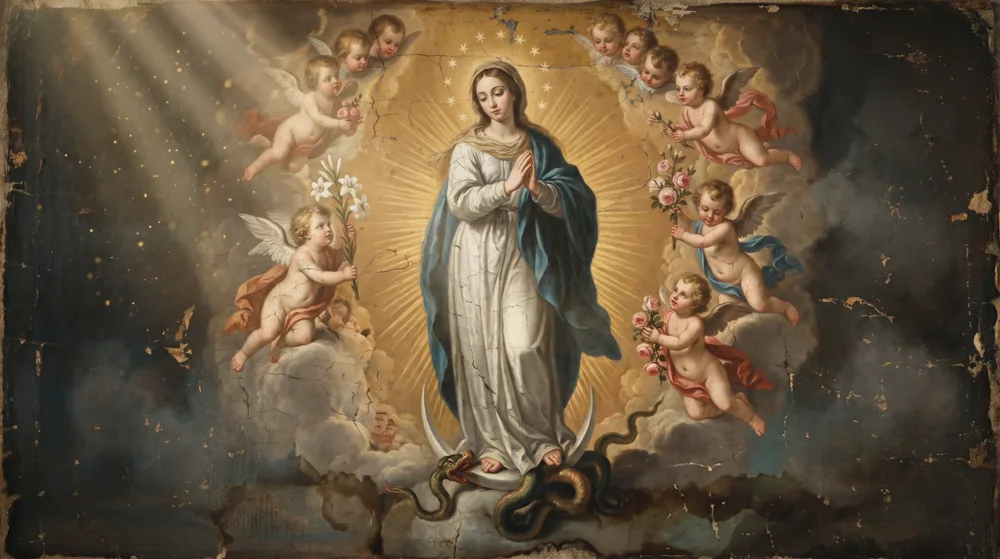
The Immaculate Conception is the dogma that the Blessed Virgin Mary, in the first instant of her conception, was preserved free from all stain of original sin by a singular grace of Almighty God, in view of the merits of Jesus Christ. It does not refer to the conception of Christ but to the conception of His Mother in the womb of Saint Anne. Pope Pius IX defined it as a divinely revealed dogma on 8 December 1854, in the Bull Ineffabilis Deus.
What is the Immaculate Conception?
To grasp the meaning of the Immaculate Conception we must first hold two things the Church teaches about the human race. Every descendant of Adam contracts original sin: the Catechism of Saint Pius X teaches that original sin "passes into all men because, God having conferred upon the human race, in Adam, sanctifying grace and other gifts," Adam by his sin lost them for himself and for all his descendants, so that "human nature is transmitted to all the descendants of Adam in a state of rebellion against God and deprived of divine grace." We come into existence already wanting the grace God meant us to have, and Baptism is given precisely to blot out that original sin.
The Immaculate Conception is the one exception God willed. Mary too was a daughter of Adam and stood in need of redemption; but she was redeemed in a more excellent way — not cleansed after contracting the stain, but preserved from ever contracting it. The exact words of the definition are these: the Blessed Virgin Mary was, "in the first instant of her conception, by a singular grace and privilege of Almighty God, in view of the merits of Jesus Christ, Saviour of the human race, preserved intact from all stain of original sin."
Every phrase carries weight. First instant of her conception — not at her birth, not at the Annunciation, but at the very beginning of her existence. Singular grace and privilege — granted to her alone among mere creatures. In view of the merits of Jesus Christ — she is no less saved by her Son than we are; she is the first and most perfectly redeemed of all the redeemed.
Immaculate Conception meaning: not the virgin birth
The most common confusion is to mistake the Immaculate Conception for the conception of Jesus. They are distinct truths and must not be merged.
The virgin birth concerns Our Lord. It is the truth that the Son of God took flesh in the womb of the Virgin "not after the manner of other men, humanly, but by a supernatural operation," conceived by the power of the Holy Ghost without a human father, as the Catechism of the Council of Trent explains on the third article of the Creed. There the Virgin is the one conceiving; the miracle is in the manner of Christ's conception. We treat that mystery, and Mary's title as Mother of God, elsewhere.
The Immaculate Conception concerns Our Lady herself, and there she is the one conceived. It says nothing about virginity and nothing about the manner of her conception, which was the ordinary conception of any child of Joachim and Anne. What is extraordinary is the state of her soul from its first moment: free from the original sin that every other child of Adam inherits. The virgin birth is about how Christ came into the world; the Immaculate Conception is about the grace given to His Mother before He came. Hold the two apart and the dogma is clear.
What the Immaculate Conception means for the Catholic faith
The Immaculate Conception is not an isolated marvel but the foundation of all Mary's other privileges, and it stands behind the words the faithful say most often to her. When we greet her in the Hail Mary with the Angel's salutation, "Hail, full of grace, the Lord is with thee," we confess what the dogma declares: a soul never for one instant emptied of grace by sin.
The Catechism of Saint Pius X teaches that in saluting her with the Archangel's words we recall "the singular gifts and privileges with which God favoured her in preference to all other creatures." The fullness of grace acknowledged at the Annunciation has its root in the grace given at her conception. The devotion of our own age speaks the same language: the Fatima prayers taught by Our Lady and the Angel offer reparation to her Immaculate Heart — the heart never for one instant touched by sin.
From this first grace the rest follows in due order. Because she was conceived without sin and remained without sin, she is fittingly called the all-holy Mother of God. And because she was wholly the Lord's, body and soul, the Church holds that at the end of her earthly life she was taken up into heaven — the truth we treat under the Assumption of Mary. The same dogmatic decree of 1950 that defined the Assumption names her in the very act of definition "the Immaculate Mother of God, Mary ever Virgin," joining the two privileges in one breath. The Immaculate Conception is the beginning of the line; the Assumption is its crown.
Was this an innovation in 1854?
No. The objection that the Church invented a new doctrine in 1854 mistakes definition for invention. To define a dogma is not to create a truth but to declare solemnly what God has revealed and what the Church has always believed, settling it beyond dispute. Pius IX defined the doctrine as "revealed by God" and therefore to be "firmly and constantly believed by all the faithful." The act of 1854 fixed in precise terms the faith the Church had long professed in her honour of Mary's holiness — it did not begin that faith. This is the ordinary way the Church proceeds: she defines under pressure of error what was already held, so that what was believed may no longer be denied.
Feast or solemnity of the Immaculate Conception?
Both words are used of 8 December, and the difference is one of rank, not of subject. Feast is the broad word for any liturgical celebration of a mystery or a saint. Solemnity, in the current ranking of the Roman calendar, is the highest grade of feast, kept with the greatest honour — with the Gloria and Creed at Mass and, where the calendar permits, a vigil.
In the Roman calendar of 1962 the day is a feast of the first class (before 1955 a double of the first class with an octave); the calendar reformed in 1969 renamed the top grade "solemnity," but the celebration it names is the same. So "the feast of the Immaculate Conception" and "the solemnity of the Immaculate Conception" point to the one and same 8 December, the difference being only the technical name for how high it stands among the Church's days.
Ineffabilis Deus: the Bull that defined the dogma
The dogma was defined in the Apostolic Constitution Ineffabilis Deus, issued by Pope Pius IX on 8 December 1854. The Latin title means "the ineffable God," from its opening words, and it remains the charter document of the doctrine. The Bull does three things. It rehearses the long witness of Scripture, the Fathers, and the liturgy to Mary's holiness; it answers the objection that this would exempt her from redemption, teaching that she was redeemed more perfectly, by preservation rather than cleansing; and it pronounces the definition itself in the words quoted above, binding the doctrine on the conscience of every Catholic.
Whoever should "presume to think in his heart otherwise than has been defined by Us," the Bull declares, has "made shipwreck concerning the faith." The text is appended in many editions to the Catechism of the Council of Trent and is the source from which every later statement of the dogma is drawn.
The National Shrine and Basilica of the Immaculate Conception
The Immaculate Conception is the patronal title of the United States: the bishops of the country placed the young nation under Mary's patronage under this title in 1846, eight years before the dogma was defined. The great church raised in her honour, the Basilica of the National Shrine of the Immaculate Conception in Washington, is the largest Roman Catholic church in North America and one of the largest in the world.
Its existence flows directly from the doctrine treated here: it is the dogma turned into stone and dedicated worship, the visible sign of a nation entrusted to the Mother conceived without sin. Many cathedrals and parish churches across the English-speaking world bear the same dedication — "the Immaculate Conception" or "Saint Mary of the Immaculate Conception" — for the same reason: the title honours the first grace of Our Lady's soul.
The Marians of the Immaculate Conception
Among the religious families that take their name from this mystery, the Marians of the Immaculate Conception are the best known. Founded in the seventeenth century by the Venerable Stanislaus Papczyński, they were the first men's congregation dedicated to honouring and spreading the doctrine of the Immaculate Conception, long before it was solemnly defined. To bear the name is to take the dogma as a rule of life: to imitate Mary's purity and to make her preservation from sin known and loved. Their existence is a reminder that the Immaculate Conception is not only a truth to be confessed but a holiness to be sought.
The Immaculate Conception in the Eastern Catholic Churches
The dogma binds the whole Catholic Church, not the Latin rite alone. Many Eastern Catholic parishes — Ukrainian, Ruthenian, and others in full communion with Rome — are dedicated to the Immaculate Conception and keep the feast. The East has from ancient times sung of the Mother of God as Panagia, the All-Holy, and as the one "more honourable than the Cherubim," language wholly in harmony with the truth that she was never for one instant touched by sin. The Byzantine feast of the Conception of Saint Anne, kept on 9 December, honours the same conception of Mary in her mother's womb. Where an Eastern Catholic church bears the Western title "Immaculate Conception," it confesses in its own venerable tradition the one faith of the universal Church.
Conclusion
The Immaculate Conception is the dogma that Mary, alone among the children of Adam, was conceived without original sin, preserved by the foreseen merits of her Son and Saviour. It is not the virgin birth of Christ but the first grace of His Mother, and it is the ground of all that the Church says in her praise.
Frequently Asked Questions
What is the Immaculate Conception?
The Immaculate Conception is the dogma that the Blessed Virgin Mary, in the first instant of her conception, was preserved free from all stain of original sin by a singular grace of God, in view of the merits of Jesus Christ. It refers to Mary's own conception in the womb of Saint Anne, not to the conception of Christ. Pope Pius IX defined it as a divinely revealed dogma on 8 December 1854 in the Bull Ineffabilis Deus.
What is the feast of the Immaculate Conception?
The feast of the Immaculate Conception is the day on which the Church honours the dogma that Mary was preserved from all stain of original sin from the first instant of her conception. It is a feast of the highest rank, kept with special solemnity since long before Pius IX defined the dogma in 1854, and it is the patronal feast of many nations. The Mass and Office of the day apply to Our Lady the words of Scripture, "Thou art all fair, O my love, and there is not a spot in thee" (Canticles 4:7).
When is the Immaculate Conception?
The feast is kept every year on 8 December, nine months before the Nativity of Our Lady on 8 September. It falls within the season of Advent, when the Church prepares for the coming of the Saviour whom this Immaculate Mother was to bear.
Is the Immaculate Conception a holy day of obligation?
Yes. The feast of 8 December is one of the holy days of obligation on which the faithful are bound to assist at Mass and to abstain from servile work, as on a Sunday. The obligation is the same every year, falling on the fixed date of 8 December. We treat the full list and what the obligation means under holy days of obligation.
What is the difference between the feast and the solemnity of the Immaculate Conception?
There is no difference in what is celebrated. "Solemnity" is simply the name of the highest rank of feast in the current Roman calendar, while "feast" is the broad word for any liturgical celebration. The day of 8 December is kept at that highest rank; in the books of 1962 it is a feast of the first class (before 1955, a double of the first class with an octave). Both terms name the same celebration of the same dogma on the same date.
What is Ineffabilis Deus?
Ineffabilis Deus is the Apostolic Constitution by which Pope Pius IX defined the Immaculate Conception as a dogma on 8 December 1854. Its Latin title, "the ineffable God," comes from its opening words. The Bull sets out the witness of Scripture, the Fathers, and the liturgy, answers the objection that the dogma would exempt Mary from redemption, and pronounces the binding definition itself.
What is the National Shrine of the Immaculate Conception?
The Basilica of the National Shrine of the Immaculate Conception in Washington is the largest Catholic church in North America, raised in honour of the patroness of the United States. The bishops placed the nation under Mary's patronage under the title of the Immaculate Conception in 1846, and the shrine is the visible expression of that dedication.
Who are the Marians of the Immaculate Conception?
The Marians of the Immaculate Conception are a religious congregation founded in the seventeenth century by the Venerable Stanislaus Papczyński. They were the first men's congregation dedicated to honouring and spreading the doctrine of the Immaculate Conception, well before its solemn definition in 1854.
The Iter Fidei app carries the prayers, the catechism, and a guide to the Faith — a free taste of the Catholic tradition you can keep in your pocket. Join early access here.
Sources. Bull Ineffabilis Deus, Pius IX, 8 December 1854 (text of the definition, appendix to the Catechism of the Council of Trent); Catechism of the Council of Trent, On the Third Article of the Creed (the conception of Christ by the Holy Ghost and the virgin birth), On Baptism (original sin); Catechism of Saint Pius X, First Article of the Creed (original sin transmitted to all the descendants of Adam) and On the Hail Mary (the Angelic Salutation and Mary's singular privileges); Apostolic Constitution Munificentissimus Deus, 1950 (naming Mary "the Immaculate Mother of God"); Acts of the Sixth Provincial Council of Baltimore, 1846 (the United States placed under the patronage of the Immaculate Conception); the Byzantine Menaion, Conception of Saint Anne (9 December).