
The Saints
St Lucy of Syracuse, Patroness of the Eyes
St Lucy, virgin martyr of Syracuse (d. 304), named daily in the Canon of the Mass — her life, the legend of her eyes, a traditional prayer and novena, and her feast on December 13.
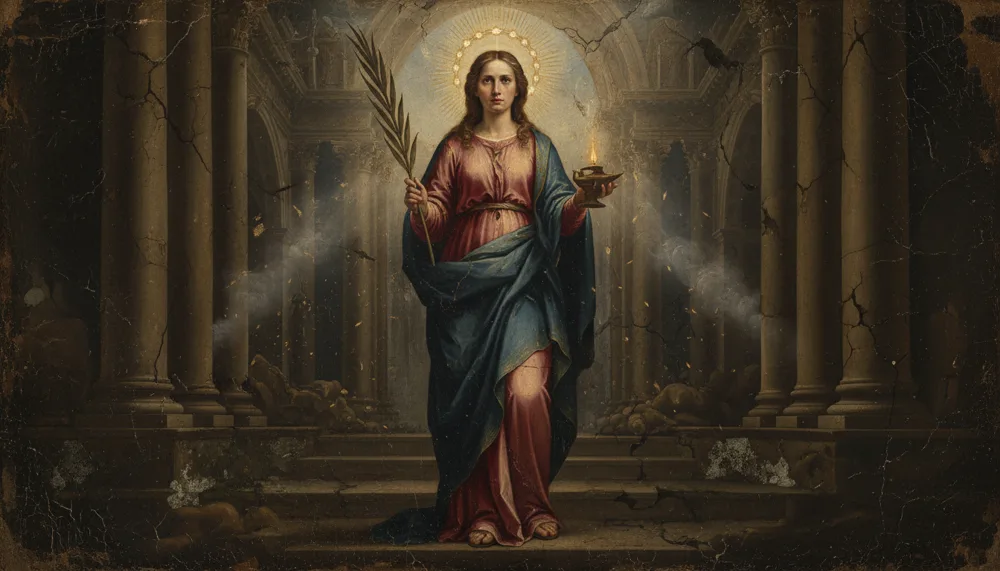
St Lucy is a virgin martyr of Syracuse in Sicily, put to death in the year 304 under the persecution of Diocletian. She is one of the seven women named daily in the Canon of the Mass, she is honoured as the patroness of the eyes and of the blind, and her feast — St Lucy's Day — is kept on the 13th of December, as the Roman Martyrology records. Her name — Lucia, from lux, light — stood in the Roman Canon by the sixth century.
Who St Lucy was
Lucy was born at Syracuse of a noble family and consecrated her virginity to God in secret. Her mother Eutychia, ignorant of the vow, had promised her in marriage to a young pagan. When Eutychia had long suffered an issue of blood, Lucy led her on pilgrimage to the tomb of St Agatha at Catania, where she was cured; and Agatha, appearing to Lucy in her sleep, is said to have addressed her: "Sister Lucy, virgin dedicated to God, why dost thou ask of me what thou canst thyself obtain for thy mother?"
Lucy then obtained her mother's leave to remain unmarried and to give her dowry to the poor. Her suitor, seeing the fortune he had counted on dispersed among beggars, denounced her as a Christian to Paschasius, the consular of Sicily, under the edicts of Diocletian. The acts of her martyrdom relate that when Paschasius ordered her dragged to a house of shame, the Holy Ghost fixed her in her place, so that neither ropes nor a team of oxen could move her; fire left her unharmed; she was at last dispatched by a sword thrust into her throat. To her judge she had answered that no violence done against the will can stain the soul — the teaching St Augustine defends in the first book of The City of God. Her relics rest today at Venice.
St Lucy in the Canon of the Mass
Lucy's rank in the Church's worship is not a matter of legend but of the liturgy itself. In the prayer Nobis quoque peccatoribus of the Canon of the Mass, the priest names seven holy women — Felicity, Perpetua, Agatha, Lucy, Agnes, Cecilia, Anastasia — asking that we sinners be granted some part and fellowship with them. With St Cecilia and the others, Lucy has thus been named at the altar daily for some fourteen centuries wherever the traditional Mass is offered. She is likewise invoked in the Litany of the Saints, in the small company of virgins chosen from among all the saints of the Church.
How St Lucy lost her eyes
The famous image of St Lucy — the virgin bearing her own eyes upon a dish — does not come from the earliest acts of her martyrdom, which say nothing of it. It belongs to a later medieval tradition: her eyes were torn out by her persecutors, or she plucked them out and sent them to the suitor who admired them, and God restored them more beautiful than before.
The Church receives this as pious tradition, not as an article of faith. Its hold on the faithful owes as much to her name as to the story: Lucia means light, and a martyr whose very name is light was fittingly given the patronage of bodily sight. On this ground she is invoked as patroness of the eyes and of the blind — a patronage that asks nothing of the legend, but points the sufferer to the intercession of a real martyr before God.
The prayer of the Church to St Lucy
The Church's own prayer to God through her merits is the Collect of her feast in the Roman Missal:
Hear us, O God our Saviour, that as we rejoice in the feast of blessed Lucy, Thy Virgin and Martyr, so we may be taught the spirit of loving devotion. Through our Lord Jesus Christ Thy Son, who liveth and reigneth with Thee in the unity of the Holy Ghost, God, world without end. Amen.
For those who suffer in their sight, one may join this Collect to a petition in one's own words, naming the affliction of the eyes and asking her intercession for its cure, if it be God's will. The shortest invocation is that of the Litany of the Saints: Sancta Lucia, ora pro nobis, "Saint Lucy, pray for us." The request is never that Lucy heal in God's place, but that she carry the petition to Him who alone heals — the order that governs every traditional prayer for healing.
The novena to St Lucy
A novena is nine successive days of prayer for a single intention, in imitation of the nine days the Apostles and Our Lady spent in prayer between the Ascension and Pentecost. The novena to St Lucy is most often begun on the 4th of December, ending on the 12th, the eve of her feast; but it may be made at any season, above all for diseases of the eyes, for failing sight, or for the interior light to see and follow the will of God.
No elaborate form is required: on each of the nine days one says the Collect of her feast, with the Our Father, the Hail Mary, and the Glory Be, closing with the invocation and the naming of the intention. The nine days do not compel heaven by repetition; they school the soul in the perseverance by which Lucy herself stood immovable.
St Lucy's Day and the Sankta Lucia customs
The feast of St Lucy — St Lucy's Day — falls on the 13th of December. Under the Julian calendar this date lay close to the winter solstice, and the feast of the light-bearing martyr came to mark the turning of darkness toward the light of Christmas; Guéranger, in The Liturgical Year, sets her among the virgin martyrs whom the Church raises up as torches along the road of Advent: before her come the Roman virgin St Bibiana on 2 December and St Barbara on the 4th.
From this grew the customs of the North. In Sweden and throughout Scandinavia, Sankta Lucia is kept on December 13 with processions in which a girl robed in white, a crown of candles on her head, leads singers through the winter dark. The custom has its root in the Catholic centuries of Scandinavia: the crown of light is her name made visible.
She died rather than surrender her faith or her virginity; the Church has answered by naming her at the altar daily for fourteen centuries. That is the measure of St Lucy, whatever is made of the legends.
Frequently Asked Questions
How did St Lucy lose her eyes?
The earliest acts of her martyrdom do not mention her eyes; she died by the sword at Syracuse in 304. A later medieval tradition relates that her eyes were torn out in her passion, or that she plucked them out and sent them to a suitor, and that God restored them. The Church receives this as pious tradition, not as an article of faith.
Is there a prayer to St Lucy for eye problems?
The traditional practice is to say the Collect of her feast, joining to it a petition naming the affliction of the eyes and asking her intercession for a cure if it be God's will. The prayer asks God to heal through the intercession of the patroness of the eyes, not the saint to heal in His place.
How do you pray the novena to St Lucy?
The novena is nine days of prayer, usually from December 4 to December 12, the eve of her feast. On each day one says the Collect of her feast with an Our Father, a Hail Mary, and a Glory Be, closing with the invocation and the intention.
When is St Lucy's Day?
St Lucy's Day is the 13th of December, the date the Roman Martyrology gives for her martyrdom at Syracuse in 304. Under the Julian calendar this fell close to the winter solstice, which is why her feast became a feast of light in the darkest days of the year.
What is St Lucia Day in Sweden?
Sankta Lucia, kept on December 13, is the Scandinavian observance of St Lucy's feast: a girl robed in white with a crown of candles leads a procession of singers through the winter dark. The custom descends from the Catholic centuries of Scandinavia and honours the Syracusan martyr whose name means light.
The Iter Fidei app carries the prayers to the saints, the litanies, and the traditional calendar with the feast of St Lucy on December 13. Join early access here.
Sources. Roman Martyrology, 13 December (entry for St Lucy, virgin and martyr). Alban Butler, The Lives of the Fathers, Martyrs, and Other Principal Saints, under 13 December, St Lucy. Dom Prosper Guéranger, The Liturgical Year, Advent, December 13. Canon of the Mass, Nobis quoque peccatoribus, Roman Missal. St Augustine, The City of God, Book I.