
Prayer
The Litany of the Saints
The Litany of the Saints — the most ancient of the Church's litanies, used in her solemn liturgy — its place, the communion of saints it invokes, and how it is prayed.
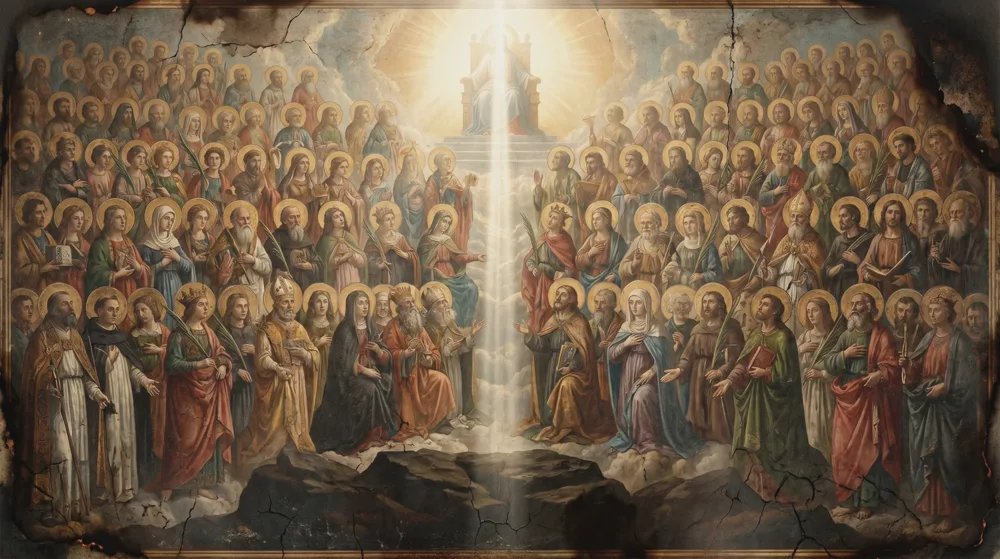
The Litany of the Saints is the most ancient and most solemn of the Church's litanies. In it the whole Church on earth turns to the whole Church in heaven, calling on Our Lady, the angels, and the saints by name to intercede with God — and then asking, through their prayers, for deliverance and for grace. It is the prayer of the communion of saints made audible.
The Litany of the Saints
This is the traditional text of the Roman Ritual (Tit. X, typical edition of 1925), the form we serve in the app.
Kyrie, eleison.
Christe, eleison.
Kyrie, eleison.
Christ, hear us.
Christ, graciously hear us.God, the Father of heaven, have mercy on us.
God, the Son, the Redeemer of the world,
God, the Holy Ghost,
Holy Trinity, one God,Holy Mary, pray for us.
Holy Mother of God,
Holy Virgin of virgins,
Saint Michael,
Saint Gabriel,
Saint Raphael,All ye holy Angels and Archangels, pray for us.
All ye holy orders of blessed Spirits,Saint John the Baptist, pray for us.
Saint Joseph,All you holy Patriarchs and Prophets, pray for us.
Saint Peter, pray for us.
Saint Paul,
Saint Andrew,
Saint James (the Greater),
Saint John,
Saint Thomas,
Saint James (the Less),
Saint Philip,
Saint Bartholomew,
Saint Matthew,
Saint Simon,
Saint Thaddeus,
Saint Matthias,
Saint Barnabas,
Saint Luke,
Saint Mark,All ye holy Apostles and Evangelists, pray for us.
All ye holy Disciples of the Lord,
All ye holy Innocents,Saint Stephen, pray for us.
Saint Lawrence,
Saint Vincent,Saints Fabian and Sebastian, pray for us.
Saints John and Paul,
Saints Cosmas and Damian,
Saints Gervase and Protase,
All ye holy Martyrs,Saint Sylvester, pray for us.
Saint Gregory,
Saint Ambrose,
Saint Augustine,
Saint Jerome,
Saint Martin,
Saint Nicholas,All ye holy Popes and Confessors, pray for us.
All ye Holy Doctors,Saint Anthony, pray for us.
Saint Benedict,
Saint Bernard,
Saint Dominic,
Saint Francis,All ye holy Priests and Levites, pray for us.
All ye holy Monks and Hermits,Saint Mary Magdalen, pray for us.
Saint Agatha,
Saint Lucy,
Saint Agnes,
Saint Cecilia,
Saint Catherine,
Saint Anastasia,All ye holy Virgins and Widows, pray for us.
All ye holy men and women, Saints of God, intercede for us.
℣. Be merciful.
℟. spare us, O Lord.℣. Be merciful.
℟. graciously hear us, O Lord.From all evil, deliver us, O Lord.
From all sin,
From Thy wrath,
From sudden and unprovided death,
From the snares of the devil,
From anger, hatred, and all ill-will,
From the spirit of fornication,
From lightning and tempest,
From the scourge of earthquake,
From plague, famine and war,
From everlasting death,
Through the mystery of Thy holy Incarnation,
Through Thy coming,
Through Thy nativity,
Through Thy Baptism and holy fasting,
Through Thy Cross and Passion,
Through Thy Death and Burial,
Through Thy Holy Resurrection,
Through Thy wondrous Ascension,
Through the coming of the Holy Ghost, the Paraclete,
In the day of judgment,We sinners, we beseech Thee, hear us.
That Thou wouldst spare us,
That Thou wouldst pardon us,
That Thou wouldst bring us to true repentance,
That Thou wouldst govern and preserve Thy Holy Church,
That Thou wouldst vouchsafe to preserve our Apostolic Prelate, and all ecclesiastical orders in holy religion,
That Thou wouldst humble the enemies of Holy Church,
That Thou wouldst grant peace and true concord to Christian kings and princes,
That Thou wouldst grant peace and unity to all Christian people,
That Thou wouldst call back to the unity of the Church all who have strayed from her fold, and to guide all unbelievers into the light of the Gospel,
That Thou wouldst confirm and preserve us in Thy holy service,
That Thou wouldst lift up our minds to heavenly desires,
That Thou wouldst render eternal blessing to all our benefactors,
That Thou wouldst deliver our souls and the souls of our brethren, relations and benefactors from eternal damnation,
That Thou wouldst grant and preserve the fruits of the earth,
That Thou wouldst grant eternal rest to all the faithful departed,
That Thou wouldst graciously hear us,
Son of God,℣. Lamb of God, who takest away the sins of the world.
℟. spare us, O Lord.℣. Lamb of God, who takest away the sins of the world.
℟. graciously hear us, O Lord.℣. Lamb of God, who takest away the sins of the world.
℟. have mercy on us.Christ, hear us.
Christ, graciously hear us.
Kyrie, eleison.
Christe, eleison.
Kyrie, eleison.Our Father, silently, as far as:
℣. And lead us not into temptation.
℟. But deliver us from evil.Psalm 69
O God, come to my assistance: O Lord, make haste to help me.
Let them be confounded and ashamed: those who seek my life.
Let them be rebuffed and disgraced: those who wish me evil.
Let them be turned away blushing for shame: those who say unto me: Aha! Aha!
Let all those who seek Thee rejoice and be glad in Thee: and may they that love Thy salvation say always: The Lord be magnified.
But I am afflicted and poor: O God, help me.
Thou art my helper and deliverer: O Lord, do not delay.
Glory be to the Father, and to the Son, and to the Holy Ghost. As it was in the beginning, is now, and ever shall be, world without end. Amen.℣. Save Thy servants.
℟. My God, who hope in Thee.℣. Be unto us, O Lord, a tower of strength.
℟. In the face of the enemy.℣. Let not the enemy prevail against us.
℟. Nor the son of iniquity have power to harm us.℣. O Lord, deal not with us according to our sins.
℟. Nor render unto us according to our sins.℣. Let us pray for our Sovereign Pontiff N.
℟. The Lord preserve him and give him life, and make him blessed upon the earth, and deliver him not up to the will of his enemies.℣. Let us pray for our benefactors.
℟. Deign to grant, O Lord, for the sake of Thy Name, eternal life to all those who do good to us.℣. Let us pray for the faithful departed.
℟. Eternal rest grant unto them, O Lord: and let perpetual light shine upon them.℣. May they rest in peace.
℟. Amen.℣. For our absent brethren.
℟. Save Thy servants who hope in Thee, O my God.℣. Send them help, O Lord, from Thy holy place.
℟. And from Sion protect them.℣. O Lord, hear my prayer.
℟. And let my cry come unto Thee.℣. The Lord be with you.
℟. And with thy spirit.Let us pray.
O God, Whose property is always to have mercy and to spare, receive our petition; that we and all Thy servants who are bound by the chain of sin may, by the compassion of Thy goodness mercifully be absolved.
Graciously hear, we beseech Thee, O Lord, the prayers of Thy supplicants and pardon the sins of those who confess to Thee: that in Thy bounty Thou mayest grant us both pardon and peace.
In Thy clemency, O Lord, show unto us Thine ineffable mercy; that Thou mayest both free us from sins and deliver us from the punishments which we deserve for them.
O God, who by sin art offended, and by penance appeased, mercifully regard the prayers of Thy people making supplication to Thee; and turn away the scourges of Thy wrath which we deserve for our sins.
Almighty and everlasting God, have mercy upon Thy servant, N., our Sovereign Pontiff: and direct him according to Thy clemency into the way of everlasting salvation: that, by Thy grace, he may desire those things which are pleasing to Thee, and accomplish them with all his strength.
O God, from Whom are holy desires, right counsels, and just works: grant to Thy servants the peace which the world cannot give; that our hearts may be devoted to the keeping of Thy commandments, and that, being removed from the fear of our enemies, our times may be peaceful through Thy protection.
Inflame, O Lord, with the fire of the Holy Ghost, our hearts and our desires; that we may serve Thee with a chaste body and please Thee with a clean heart.
O God, the Creator and redeemer of all the faithful, grant to the souls of Thy departed servants the remission of all their sins; that through pious supplications they may obtain the pardon they have always desired.
Direct, we beseech Thee, O Lord, our actions by Thy holy inspirations and carry them on by Thy gracious assistance; that every prayer and work of ours may always begin with Thee and through Thee be happily ended.
Almighty and everlasting God, Who hast dominion over the living and the dead, and art merciful to all whom Thou foreknowest shall be Thine by faith and good works: we humbly beseech Thee; that they for whom we intend to pour forth our prayers, whether this present world still detains them in the flesh, or the world to come has already received them out of their bodies, may, through the intercession of all Thy Saints, and in Thy compassionate goodness, obtain the pardon of all their sins. Through Christ our Lord, Thy Son, Who liveth and reigneth with Thee in the unity of the Holy Ghost, God, world without end. Amen.
℣. O Lord, hear my prayer.
℟. And let my cry come unto Thee.℣. May the almighty and most merciful Lord graciously hear us.
℟. And may He always keep us. Amen.℣. May the souls of the faithful, through the mercy of God, rest in peace.
℟. Amen.
What the litany invokes
The litany unfolds in movements. It begins by calling on God — Father, Son, and Holy Ghost. It then invokes Our Lady under her chief titles, the holy angels, and the long roll of the saints: St John the Baptist and St Joseph with all the patriarchs and prophets, the apostles and evangelists, the Holy Innocents and the martyrs, the bishops, confessors and doctors, the monks and hermits, and the holy virgins and widows — each answered, pray for us. After the saints, the Church asks God, through their intercession, to be merciful and to grant the goods of soul and body, closing with the Agnus Dei and a series of petitions.
It is, in effect, the family of God assembled: those still on earth asking the prayers of those already crowned.
The Litany of the Saints in Latin
The litany is, in its native form, a Latin text of the Roman Church, and it is in Latin that it is sung in the solemn liturgy. The opening and the chief responses run as follows:
Kýrie, eléison. Christe, eléison. Kýrie, eléison.
Christe, audi nos. Christe, exáudi nos.Pater de cælis, Deus, miserére nobis.
Fili, Redémptor mundi, Deus,
Spíritus Sancte, Deus,
Sancta Trínitas, unus Deus,Sancta María, ora pro nobis.
Sancta Dei Génitrix,
Sancta Virgo vírginum,
Sancte Míchaël,
Sancte Gábriel,
Sancte Ráphaël,
Omnes sancti Angeli et Archángeli, oráte pro nobis.
Sancte Joánnes Baptísta, ora pro nobis.
Sancte Joseph,
Sancte Petre,
Sancte Paule,
Omnes sancti Apóstoli et Evangelístæ, oráte pro nobis.
Omnes Sancti et Sanctæ Dei, intercédite pro nobis.
The three answers carry the whole prayer: ora pro nobis ("pray for us") to a single saint, oráte pro nobis ("pray for us") to a group, and intercédite pro nobis ("intercede for us") to all the saints together. To God the responses are miserére nobis ("have mercy on us"), líbera nos, Dómine ("deliver us, O Lord"), and te rogámus, audi nos ("we beseech Thee, hear us"). Learning these few Latin responses is enough to follow and answer the sung litany from beginning to end.
The Litany of the Saints in English
In English the structure is identical, only the language of the responses changes: pray for us, deliver us, O Lord, we beseech Thee, hear us, and, to all the saints, intercede for us. The full English text is given at the head of this page. When the litany is prayed privately or in a parish where Latin is not used, this is the form heard; in the solemn liturgy the Latin is normative, and many sing the invocations in Latin while keeping the petitions and collects in the vernacular.
A list of the saints invoked
One reason the litany is so often searched for as a "list" is that it is, quite literally, an ordered roll of the friends of God. The saints are not named at random but by rank in the household of heaven:
- Our Lady — Holy Mary, Mother of God, Virgin of virgins.
- The angels — Michael, Gabriel, Raphael, and all the holy angels and archangels.
- The Forerunner and the Guardian — St John the Baptist and St Joseph, then all ye holy Patriarchs and Prophets.
- Apostles and evangelists — Peter, Paul, Andrew, James, John, Thomas, James, Philip, Bartholomew, Matthew, Simon, Thaddeus, Matthias, Barnabas, Luke and Mark, with all the disciples of the Lord and the Holy Innocents.
- Martyrs — Stephen, Lawrence, Vincent, Fabian and Sebastian, John and Paul, Cosmas and Damian, Gervase and Protase, and all the holy martyrs.
- Bishops and confessors — Sylvester, Gregory, Ambrose, Augustine, Jerome, Martin, Nicholas, with all holy bishops, confessors and doctors.
- Monks and hermits — Anthony, Benedict, Bernard, Dominic, Francis, with all holy priests and levites, monks and hermits.
- Holy women — Mary Magdalen, Agatha, Lucy, Agnes, Cecilia, Catherine, Anastasia, and all holy virgins and widows.
The roll is short and ancient: most of the names are those of the Roman Canon and of the early Church. Many saints dear to later centuries are not named in it; they are included in all ye holy men and women, Saints of God, and some of them are venerated among the incorrupt saints.
The order is itself a teaching: it mirrors the orders of the heavenly Jerusalem and the history of grace, from the Mother of God down through every age of the Church.
Where it is used
Unlike most litanies, the Litany of the Saints belongs to the Church's solemn public liturgy. It is sung or said:
- At the Easter Vigil, in two parts on either side of the blessing of the baptismal water.
- At ordinations and at the consecration of virgins, while the candidates lie prostrate.
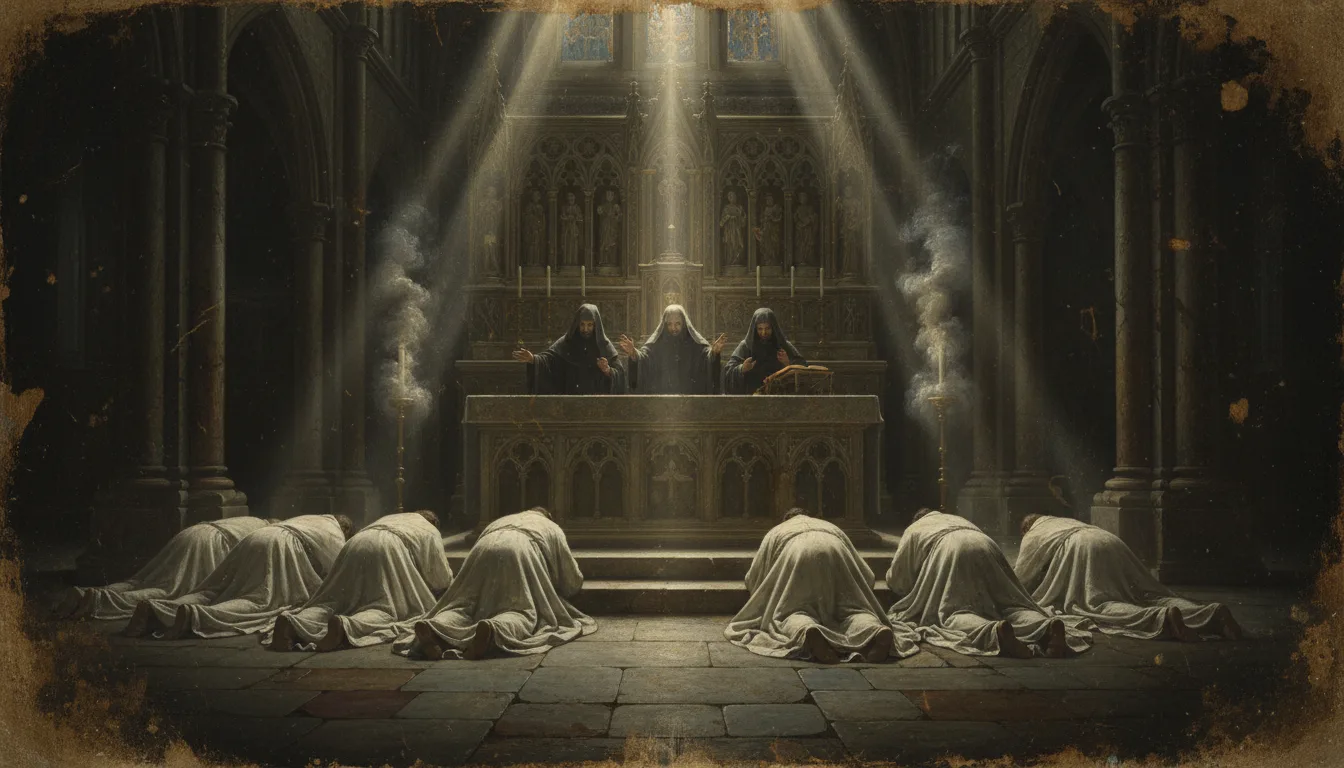
- On the Rogation Days, in the procession for the harvest and the needs of the Church; the Greater Litanies are sung on 25 April, the feast of St Mark the Evangelist.
- In times of public need, in the processions of the Roman Ritual, and in a shortened form in the prayers for the dying.
Its antiquity reaches back to the early centuries; it is among the oldest continuously prayed texts of the Roman Church.
How it is prayed
The Litany of the Saints is a prayer for two voices: a cantor or priest sings each invocation, and the people answer. Prayed in full it is long, for the communion of saints is vast; but that is its lesson — that the Christian never prays alone, but in the company of all the friends of God.
It is one of the traditional Catholic litanies prayed by the Church, standing among the few litanies approved for public recitation — a rank not shared by modern private compositions such as the Litany of Trust.
The traditional Litany of the Saints
The traditional form of the litany — the one prayed in the traditional books and reproduced at the head of this page — keeps the full ancient roll of saints together with the petitions, the Agnus Dei, Psalm 69, the versicles, and the collects. It is sometimes called the Litany of All Saints, because it does not stop at a chosen few but gathers the whole of heaven: every order of the blessed, and at the close all ye holy men and women, Saints of God.
This is the litany used at the Easter Vigil and the Rogation Days, and it is the form we serve in Latin and English. The edition revised after 1969 changed the petitions and added many more recent saints; the text above is the one of the Roman Ritual in force in 1962.
The sung Litany of the Saints
The litany was made to be sung. In its proper chant the cantor intones each invocation on a simple recitative and the people answer on a falling phrase — a form so old that it is among the first things many Catholics learn to sing in Latin. Recordings of the chanted Latin litany are widely available, including on YouTube, and they are the surest way to learn the melody and the responses before joining it in the liturgy.
A modern hymn setting by John Becker (copyright 1987), often heard at the Easter Vigil and at ordinations in many parishes, has made the litany familiar to a wide audience. It is a modern composition and not the traditional Roman chant; it abridges and rearranges the roll of saints to fit a refrain. It can serve devotion well, but those who wish to pray the litany as the Church has prayed it for a thousand years should seek out the traditional Gregorian chant of the full text rather than the modern paraphrase.
The Litany of the Saints and the Rosary
The litany is sometimes prayed in connection with the Rosary, as an appended devotion, since both are prayers of intercession that lean on Our Lady and the saints. They are distinct, however: the Rosary meditates on the mysteries of Christ's life with the Hail Mary, while the Litany of the Saints calls each saint by name. Where a litany is joined to the Rosary in private devotion it is more commonly the Litany of Loreto, the litany of Our Lady; but the Litany of the Saints, with its vast company of heaven, is a fitting close to the beads on great feasts and in times of need.
A printable Litany of the Saints (PDF)
Because the full litany is long, many prefer a printed copy to follow along or to keep in a missal. The complete traditional text — Latin and English, with the petitions and collects — is given on this page and can be printed directly. We also serve it, formatted and with audio, in the Join early access here..
Frequently Asked Questions
What is the Litany of the Saints?
The Litany of the Saints is the most ancient and most solemn of the Church's litanies, a prayer in which the Church on earth calls upon Our Lady, the angels, and the saints by name to intercede with God. After invoking the saints, it asks God, through their prayers, for mercy, for deliverance from evil, and for the goods of soul and body. It is the prayer of the communion of saints made audible.
Why do we ask the saints to pray for us?
Because the saints in heaven are alive in Christ and joined to us in the one Body of the Church, the communion of saints. Asking their intercession is not worship but the same charity by which we ask a friend on earth to pray for us — only the saints, beholding God, pray with greater purity and power. We adore God alone; the saints we honor and entreat as His friends who plead our cause before Him.
When is the Litany of the Saints used?
Unlike most litanies, it belongs to the Church's solemn public liturgy rather than to private devotion. It is sung at the Easter Vigil around the blessing of the baptismal water, at ordinations and the consecration of virgins while the candidates lie prostrate, on 25 April and the Rogation Days, in times of public need, and, shortened, in the prayers for the dying.
How is the Litany of the Saints prayed?
It is a prayer for two voices: a cantor or priest sings or says each invocation, and the people answer — pray for us, deliver us, O Lord, we beseech Thee, hear us. Prayed in full it is long, for the communion of saints is vast, but that length is its lesson: the Christian never prays alone, but in the company of all the friends of God.
How old is the Litany of the Saints?
Its antiquity reaches back to the early centuries of the Church, and it is among the oldest continuously prayed texts of the Roman liturgy. The form prayed today preserves the ancient roll of patriarchs, apostles, martyrs, doctors, and holy women that the Church has invoked for well over a thousand years.
What is the order of the saints in the litany?
The litany unfolds in movements. It begins with God — Father, Son, and Holy Ghost — then calls on Our Lady, the holy angels, St John the Baptist and St Joseph, and the long roll of the saints in order: the patriarchs and prophets, the apostles and evangelists, the martyrs, the bishops, confessors and doctors, the monks and hermits, and the holy virgins and widows. After the saints, the Church begs God through their intercession, closing with the Agnus Dei, the petitions, and the collects.
What is the Latin of the Litany of the Saints?
The litany is a Latin text of the Roman Church. Its three saintly responses are ora pro nobis ("pray for us") to one saint, oráte pro nobis to a group, and intercédite pro nobis ("intercede for us") to all the saints together; to God the answers are miserére nobis ("have mercy on us"), líbera nos, Dómine ("deliver us, O Lord"), and te rogámus, audi nos ("we beseech Thee, hear us"). The Latin is the form sung in the solemn liturgy; the full Latin and English text is given above.
Is the Litany of the Saints the same as the Litany of All Saints?
Yes — the two names refer to the same prayer. It is called the Litany of All Saints because it does not invoke a chosen few but gathers the whole of heaven, every order of the blessed, closing with all ye holy men and women, Saints of God.
Is the Becker Litany of the Saints the traditional one?
No. The setting by John Becker (copyright 1987), widely sung at the Easter Vigil and at ordinations, is a modern hymn composition, not the traditional Roman chant. It abridges and rearranges the roll of saints to fit a refrain. It is a modern setting; those who wish to pray the litany as the Church has prayed it for over a thousand years should seek out the traditional Gregorian chant of the full text.
(Iter Fidei serves the full Litany of the Saints, in Latin and English with audio, in the app.) Join early access here.
Sources. Rituale Romanum, Tit. X, Litaniae Sanctorum (typical edition, 1925); the Roman Missal and Pontifical for its use at the Easter Vigil, ordinations and the Rogation Days.