
Prayer
Prayer for the Dead
Traditional Catholic prayers for the dead: the Eternal Rest, the De profundis (Psalm 129) and the De Profundis for the holy souls, with the meaning of Catholic suffrage for the faithful departed.
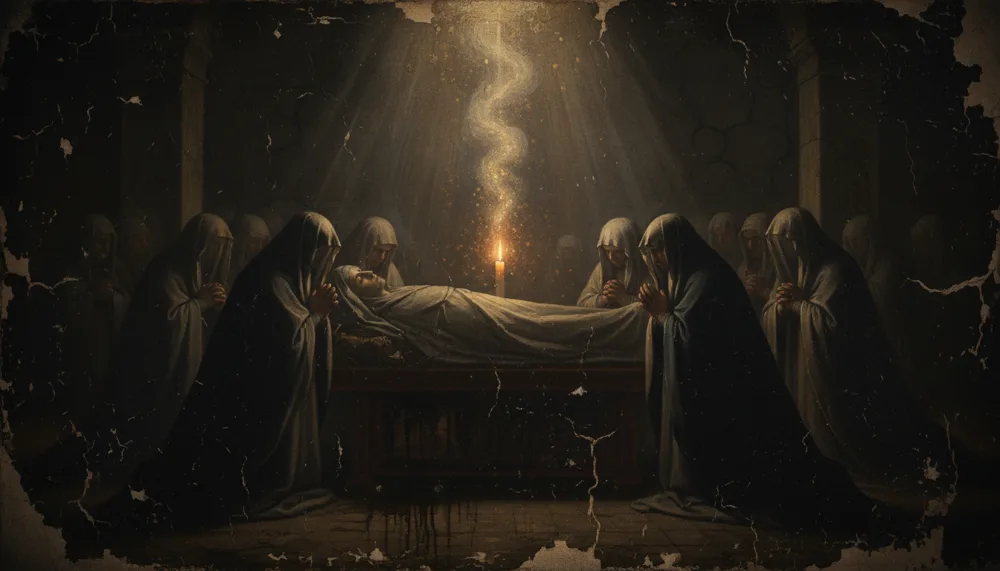
When someone we love dies, the most useful thing we can do is not to speak about them but to pray for them. The Catholic prayer for the dead is an act of charity that reaches a soul we can no longer touch. The Church gives us short, ancient prayers for exactly this — so that we may begin to pray at once, at the graveside, at home, or at the moment grief breaks over us. Here are the traditional texts.
The Eternal Rest
This is the Church's simplest prayer for the dead. Say it for one person, for a whole family, for everyone you have lost.
Eternal rest grant unto them, O Lord,
and let perpetual light shine upon them.
May they rest in peace. Amen.
For a single soul: Eternal rest grant unto him (or her), O Lord, and let perpetual light shine upon him. May he rest in peace. Amen. In Latin it is the Requiem aeternam that opens the Mass for the dead. The Raccolta, the official collection of indulgenced prayers, grants 300 days' indulgence for it, applicable only to the holy souls (no. 536).
De profundis: Psalm 129
The De profundis — Psalm 129 in the Douay-Rheims numbering (130 in the Hebrew) — is the great penitential prayer for the dead. The Church has prayed it over her departed for centuries because it cries to God from the depths and rests entirely on His mercy.
Out of the depths I have cried to thee, O Lord:
Lord, hear my voice.
Let thy ears be attentive to the voice of my supplication.
If thou, O Lord, wilt mark iniquities: Lord, who shall stand it?
For with thee there is merciful forgiveness:
and by reason of thy law, I have waited for thee, O Lord.
My soul hath relied on his word: my soul hath hoped in the Lord.
From the morning watch even until night, let Israel hope in the Lord.
Because with the Lord there is mercy: and with him plentiful redemption.
And he shall redeem Israel from all his iniquities.
(Psalm 129, Douay-Rheims)
It is traditionally closed with the Eternal Rest as a versicle: Eternal rest grant unto them, O Lord. / And let perpetual light shine upon them.
Why we pray for the dead
Praying for the dead is one of the oldest practices of the faith, and Scripture is explicit about it. In the Second Book of Maccabees we read of Judas Maccabeus sending an offering for soldiers fallen in battle, "thinking well and religiously concerning the resurrection." The sacred writer concludes:
It is therefore a holy and wholesome thought to pray for the dead, that they may be loosed from sins.
(2 Maccabees 12:46, Douay-Rheims)
The dead can be "loosed from sins" only if there is a state of purification after death — what the Church calls purgatory, explained in our article What Is Purgatory? The Catholic Doctrine. The Council of Trent teaches (Session XXV, 1563) "that there is a purgatory, and that the souls there detained are helped by the suffrages of the faithful, but principally by the acceptable sacrifice of the altar." Our prayers, Masses, almsgiving and sacrifices are credited to the holy souls who can no longer merit for themselves. This exchange of help across death is the Communion of Saints: we on earth, the souls being purified, and the saints in glory remain one family in Christ.
Suffrage, not spiritism
A word of caution. Catholic prayer for the dead is suffrage — we offer our prayers to God for the soul, asking His mercy on them. We do not summon the dead, speak with them, or seek messages from them. That is spiritism, which the Church forbids. The difference is everything: suffrage is an act of humble charity directed to God; spiritism is an attempt to command the unseen, and it is a form of superstition. We pray for the departed and we may ask them to pray for us, but we leave them entirely in the hands of God, in confidence and abandonment, never in anxiety or magic.
A short, powerful prayer for the dead
When you have only a moment, this is enough:
May the souls of the faithful departed, through the mercy of God, rest in peace. Amen.
It is the versicle that closes the Hours of the Divine Office and the grace after meals (Fidelium animae per misericordiam Dei requiescant in pace), and it gathers all the dead into one act of love.
A prayer for a specific person
For someone you have just lost, name them. This is the collect of the Roman Missal for one departed man (for a woman, say handmaid and her):
Incline, O Lord, thine ear to our prayers, wherein we humbly beseech thy mercy: that thou wouldst place in the region of peace and light the soul of thy servant N., which thou hast commanded to depart out of this world, and bid it to be a partaker with thy saints. Through Christ our Lord. Amen.
It may be said on the day of death, at the funeral, on the anniversary, and in the days that follow.
A prayer for a departed mother or father
The Church has long encouraged children to pray for their parents; the Missal and the Office of the Dead give this collect:
O God, who hast commanded us to honour father and mother: mercifully have pity on the souls of my father and mother, and forgive them their sins; and make me to see them in the joy of everlasting brightness. Through our Lord. Amen.
In Latin: Deus, qui nos patrem et matrem honorare praecepisti: miserere clementer animabus patris et matris meae, eorumque peccata dimitte; meque eos in aeternae claritatis gaudio fac videre.
A prayer for someone who passed away
When word comes that someone has passed away, do not wait for the funeral to pray. The Roman Ritual gives the prayer said at the very moment the soul has left the body:
To thee, O Lord, we commend the soul of thy servant N., that, dead to the world, he may live to thee: and the sins that he has committed through the frailty of human living, do thou wipe away by the pardon of thy most merciful goodness. Through Christ our Lord. Amen.
Said for a loved one who has passed away — a grandparent, a friend, a neighbour — it entrusts the soul to God in the very first hours, when our own words fail us.
A prayer for all the faithful departed
The faithful departed are all who died in the grace of God and are still being purified before entering heaven. On All Souls' Day the Missal of 1962 gathers them into one collect, which any of the faithful may make their own:
O God, the Creator and Redeemer of all the faithful, grant to the souls of thy servants and handmaids the remission of all their sins: that through pious supplications they may obtain the pardon which they have always desired. Who livest and reignest world without end. Amen.
The Office of the Dead adds its versicles:
V. From the gate of hell. R. Deliver their souls, O Lord.
V. May they rest in peace. R. Amen.
Praying for the departed in general — including the forgotten souls for whom no one else prays — is a traditional work of mercy. The Eternal Rest said in the plural, the De profundis, and the St Gertrude prayer for the souls in purgatory all reach the faithful departed at once. That last prayer is loved, but its attribution to St Gertrude is late and unproven, it is not among the indulgenced prayers of the Raccolta, and the promise of "1,000 souls released" attached to it has no approval from the Church: say it as an offering of the Precious Blood, not as a guarantee.
A short goodbye prayer for the dead
At the bedside of the dying, the Roman Ritual has the priest (or, in his absence, those present) say the great prayer of farewell, the Proficiscere, as the soul departs. It begins:
Go forth, Christian soul, out of this world, in the name of God the Father almighty, who created thee; in the name of Jesus Christ, Son of the living God, who suffered for thee; in the name of the Holy Ghost, who was poured out upon thee; […] this day let thy place be in peace, and thy dwelling in holy Sion. Through the same Christ our Lord. Amen.
At the graveside, the simplest goodbye is the Church's own: May he (she) rest in peace. Amen. And as the body is carried from the church she sings the In paradisum: May the angels lead thee into paradise. For the dying themselves, see our prayer for the dying and prayer for a happy death.
Holy water and the blessing of the dead
The liturgical blessing of the body and the grave — the sprinkling, the incensing, the absolution at the bier — belongs to the priest, according to the Roman Ritual. The laity may sprinkle the body with holy water at the wake, making the sign of the cross, and say the Church's words:
Eternal rest grant unto him (her), O Lord, and let perpetual light shine upon him (her). May he (she) rest in peace. Amen.
May his (her) soul and the souls of all the faithful departed, through the mercy of God, rest in peace. Amen.
A novena prayer for the dead
When grief is fresh, praying over nine days gives sorrow somewhere to go. The simplest novena joins, each day, the Eternal Rest, the De profundis and the collect Incline, O Lord given above, said with the name of the departed. The Raccolta grants to those who pray for the dead for seven or nine successive days an indulgence of three years each day and a plenary indulgence at the end, on the usual conditions (no. 542). We have laid out the full nine days, with a meditation and prayer for each, in our novena for the dead.
Prayer for the dead in other traditions
People searching for a "Jewish prayer for the dead," an "Orthodox prayer for the dead," an "Islamic prayer for the dead," or an "Irish prayer for the dead" are often looking for the same comfort by different names. It helps to be clear about the differences, and to do so charitably and accurately.
- Jewish / Hebrew prayer for the dead. The best-known is the Mourner's Kaddish, recited by mourners; it is a doxology praising God and does not mention death directly. The El Malei Rachamim ("God, full of mercy") is the Jewish memorial prayer asking rest for the soul. Catholics share with Israel the conviction, drawn from 2 Maccabees, that it is good to pray for the dead.
- Orthodox prayer for the dead. The Eastern Orthodox pray the Memory Eternal (Vichnaya Pamyat) and offer Panikhida memorial services, very close in spirit to our own suffrages; the Catholic Church and the Christian East both pray for the departed and offer the Holy Sacrifice for them.
- Islamic prayer for the dead. Muslims pray the Salat al-Janazah, a funeral prayer asking God's mercy on the deceased. This is a different religion with a different theology, but the human instinct to commend the dead to God is one we recognise.
- Irish prayer for the dead. This often means the popular Irish blessing May the road rise up to meet you… and until we meet again, may God hold you in the palm of His hand — a folk blessing for the living rather than a prayer for the dead. Ireland's Catholic culture keeps the real thing: the wake, the rosary for the dead, the Eternal Rest, and the Month's Mind Mass.
For a Catholic, the proper prayer for the dead remains the Eternal Rest, the De profundis and the Holy Mass.
How to keep praying for the dead
Grief does not end in a day, and neither should our prayers. Three traditional ways carry us through:
- Have Masses offered. The Mass is the highest prayer for the dead. To have a Requiem Mass said for a soul is the greatest gift you can give.
- Pray a novena. Our novena for the dead prays for a soul over nine days — useful in the first days of mourning.
- Gain indulgences for them. Many indulgences can be applied to the holy souls, especially around All Souls' Day (2 November). Under the Raccolta (English edition of 1943, the grants in force until the reform of indulgences in 1968), a plenary indulgence applicable only to the dead could be gained toties quoties on 2 November, at each visit to a church with six Our Fathers, Hail Marys and Glory Bes for the Pope's intentions, after confession and Communion (no. 544); and a plenary indulgence each day of the octave of All Souls for visiting a cemetery and praying for the dead (no. 546). Since 1915 every priest may also say three Masses on All Souls' Day (Benedict XV, Incruentum altaris).
You may also pray the Litany for the Poor Souls in Purgatory, read what happens after death according to Catholic teaching, or choose readings among our Bible verses for funerals.
Frequently Asked Questions
What does the Bible say about praying for the dead?
Scripture commends it directly. Second Maccabees 12:46 calls it "a holy and wholesome thought to pray for the dead, that they may be loosed from sins." The very fact that the dead can be loosed from sin implies a purification after death, and the practice is woven through the Church's worship from the earliest centuries.
Why do Catholics pray for the dead?
Because charity does not stop at the grave. Souls being purified before they enter heaven can no longer help themselves, but our prayers, Masses and sacrifices can be offered for them. We pray for the dead out of love and out of hope, trusting in the "plentiful redemption" of God (Psalm 129:7).
What is the best prayer for the dead?
The Eternal Rest is the simplest and most universal; the De profundis (Psalm 129) is the great penitential prayer for the departed. The very greatest prayer for the dead is to have the Holy Mass offered for the soul.
When should I pray for the dead?
At the moment of death, at the funeral, on the anniversary, and whenever the person comes to mind. The Church sets aside the whole month of November, and especially All Souls' Day, for the faithful departed — but no day is closed to this prayer.
What prayer do you say when someone has just died?
Begin with the Eternal Rest: Eternal rest grant unto him (her), O Lord, and let perpetual light shine upon him. May he rest in peace. Amen. It can be said the moment you hear the news, and repeated as often as the person comes to mind. When you have more time, add the De profundis and the prayer To thee, O Lord, we commend given above — and arrange, if you can, for a Mass to be offered for the soul.
What does the Bible say about talking to the dead?
It forbids it. Deuteronomy 18:11 condemns "any one that consulteth pythonic spirits, or fortune tellers, or that seeketh the truth from the dead," and King Saul consulting the witch of Endor (1 Kings 28 in the Douay-Rheims, 1 Samuel 28 in Hebrew-based Bibles) is held up as a warning. We pray for the dead; we do not consult them.
Is there a short prayer to say goodbye to someone who has died?
Yes. The shortest is simply, May he (she) rest in peace. Amen. A fuller farewell is the Church's own commendation of the departing soul: Go forth, Christian soul, out of this world… this day let thy place be in peace. The sung antiphon May the angels lead you into paradise (In paradisum) is the traditional goodbye as the body leaves the church.
Iter Fidei serves traditional prayers, the psalms, the Office of the Dead and the liturgical calendar of 1962, in Latin and English with audio. Join early access here.
Sources. Douay-Rheims Bible (Psalm 129; 2 Maccabees 12:43-46; Deuteronomy 18:11; 1 Kings 28); Council of Trent, Session XXV, decree on purgatory (1563); Roman Missal of 1962 (All Souls' Day, Masses for the dead); Roman Ritual (commendation of the departing soul, rite of burial, Office of the Dead); The Raccolta (Benziger, 1943), nos. 536-546; Benedict XV, apostolic constitution Incruentum altaris (1915).