
Prayer
The Litany for the Poor Souls in Purgatory
The traditional litany for the poor souls in purgatory — the full text, begging God's mercy on the faithful departed, with the doctrine of purgatory and eternal rest behind it.
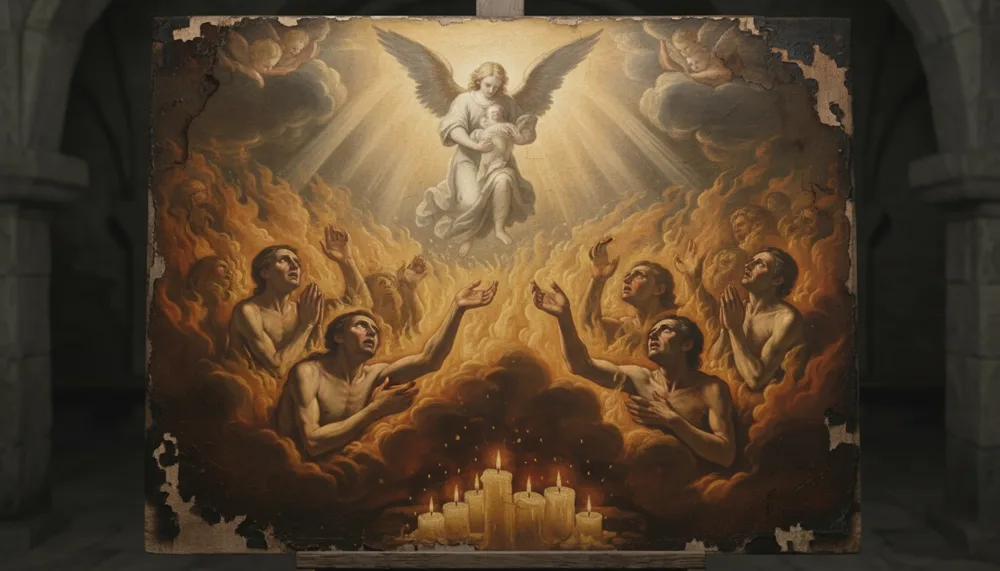
The litany for the poor souls in purgatory is a traditional Catholic prayer that begs God's mercy upon the faithful departed who are still being purified before they may enter heaven. It opens with the cry the whole Church makes for her dead: "Lord, have mercy on them" — and it rests on a word of Scripture that commands this charity. Of those who pray for the dead the Douay-Rheims says:
It is therefore a holy and wholesome thought to pray for the dead, that they may be loosed from sins. (2 Machabees 12:46)
This is the ground of the poor souls litany and of every one of our prayers for the dead: the souls in purgatory are real members of the Church, near to glory, and unable to hasten it themselves. We can. To leave them unprayed-for is to forget our own family.
The traditional litany for the holy souls in purgatory
The litany is prayed as litanies always are — one voice calls, the rest answer with the fixed response. Here the chief response is "Lord, have mercy on them" through the opening petitions, then "Deliver them, O Lord", and at the close the response of the Litany of the Saints, "We beseech Thee, hear us."
Lord, have mercy on them. Christ, have mercy on them. Lord, have mercy on them.
God the Father of heaven, have mercy on them.
God the Son, Redeemer of the world, have mercy on them.
God the Holy Ghost, have mercy on them.
Holy Trinity, one God, have mercy on them.Holy Mary, pray for them.
Holy Mother of God, pray for them.
Holy Virgin of virgins, pray for them.
All ye holy Angels and Archangels, pray for them.
All ye holy Patriarchs and Prophets, pray for them.
All ye holy Apostles and Evangelists, pray for them.
All ye holy Martyrs, Confessors, and Virgins, pray for them.
All ye Saints of God, pray for them.From the gates of hell, deliver them, O Lord.
From all suffering, deliver them, O Lord.
By Thy Cross and Passion, deliver them, O Lord.
By Thy precious Death, deliver them, O Lord.
By Thy glorious Resurrection, deliver them, O Lord.
We sinners, we beseech Thee, hear us.
That Thou wouldst be pleased to grant rest and peace to the souls of the faithful departed, we beseech Thee, hear us.
That Thou wouldst deliver them from their pains, we beseech Thee, hear us.
That Thou wouldst admit them into the company of the Saints, we beseech Thee, hear us.
That Thou wouldst lead them into the light of Thy face, we beseech Thee, hear us.
Son of God, we beseech Thee, hear us.Lamb of God, who takest away the sins of the world, grant them rest, O Lord.
Lamb of God, who takest away the sins of the world, grant them rest, O Lord.
Lamb of God, who takest away the sins of the world, grant them everlasting rest.
It closes with the Church's own prayer for the dead, the Eternal Rest, and the collect for the faithful departed:
Eternal rest grant unto them, O Lord, and let perpetual light shine upon them. May they rest in peace. Amen.
V. From the gates of hell.
R. Deliver their souls, O Lord.
V. May they rest in peace.
R. Amen.Let us pray. O God, the Creator and Redeemer of all the faithful, grant to the souls of Thy servants departed the remission of all their sins, that, through the help of our pious supplications, they may obtain the pardon they have always desired. Who livest and reignest world without end. Amen.
Why we pray a litany for the faithful departed
We pray because the dead in purgatory can no longer pray for themselves. Their time of meriting ended at death. What they could not finish on earth — the satisfaction owed for sins already forgiven — they finish there, and only we, the living, can lighten it. This is not sentiment but justice and mercy together.
Behind the litany stands the whole doctrine of purgatory. The Catechism of Trent teaches that beyond the hell of the damned "there is another hell where is the fire of Purgatory," in which "the souls of the just" who "have some stain to wash away and some debt to pay" go "to purify themselves." Every soul in purgatory is saved; what remains is to be cleansed, "for nothing defiled can penetrate" into heaven. The poor souls are the Church Suffering — one of the four last things the Church bids us keep before our eyes.
The litany names exactly what these souls lack and asks God to supply it. The two great petitions — grant them rest and lead them into the light of Thy face — are the two halves of the Eternal Rest prayer: rest (requiem), because they are still in suffering, and perpetual light (lux perpetua), the vision of God they were made for and do not yet possess.
Is praying for the dead in the Bible?
It is, and the Church has never read it otherwise. The Catechism of Trent rests the doctrine "upon the testimony of the Scriptures and upon apostolic tradition." The plainest text is the one already given: Judas Machabeus, finding that his fallen soldiers had died with a fault upon them, sent money to the Temple for sacrifice, "making a remembrance to pray for the dead, that they may be loosed from sins." The Holy Ghost calls this "a holy and wholesome thought." If the dead could not be helped, the prayer would be useless and the praise of it false.
Some, departing from the Church, cut these books out of their Bibles and then deny that Scripture commands prayer for the dead. We hold the canon the Church has always held, and with it the practice the Apostles handed down. On where the lines fall between us, see Catholic vs Protestant and whether Catholics are Christian.
How a litany helps the holy souls
A litany is one of the great Catholic litanies: a chain of invocations, each answered, that carries the soul through a whole mystery — here, the mercy of God toward His dead. But the litany is one help among several, and not the highest. The Catechism of St Pius X asks, "Can we relieve in their pains the souls in purgatory?" and answers: "Yes, the souls who are in purgatory can be relieved by prayers, almsgiving, all the other good works, by indulgences, and above all by the holy sacrifice of the Mass."
So the order of charity for the dead is plain:
- The Holy Mass, first and highest, for it applies to the soul the very Sacrifice of Christ.
- Prayer — this litany, the De profundis, the Rosary, the St Gertrude prayer, the Eternal Rest.
- Almsgiving and good works, offered on their behalf.
- Indulgences, by which the Church applies the merits of Christ and the saints.
This works because of the Communion of Saints, which the Catechism of St Pius X teaches "extends also to heaven and to purgatory, because charity unites the three Churches: Triumphant, Suffering, and Militant." One charity binds the living and the dead; our prayer reaches across that frontier.
When to pray the poor souls litany
We pray it whenever the dead are brought to mind — but above all in November, the month of the holy souls, and on All Souls' Day, 2 November, when the whole Church prays for her dead. It is fitting too on the anniversary of a death, when visiting a grave, and as a fixed habit added to one's Catholic prayers or said at the end of the Rosary.
The labour for the holy souls is one of the surest works of the spiritual life, because it asks for nothing in return: those we relieve cannot thank us in this world. Yet they do not forget. What we ask for them today, others will one day ask for us.
To beg God's mercy on the faithful departed is to do what Scripture calls holy and wholesome. We pray the litany not in dread but in hope, knowing that every soul we name is saved already and waits only for the gates to open: Eternal rest grant unto them, O Lord, and let perpetual light shine upon them.
Frequently Asked Questions
What is the litany for the poor souls in purgatory?
It is a traditional Catholic prayer that begs God's mercy upon the faithful departed who are still being purified before they may enter heaven. Like every litany it is prayed by call and response — "Lord, have mercy on them," then "Deliver them, O Lord," and at the close "We beseech Thee, hear us" — and it ends with the Eternal Rest and the collect for the dead.
Is praying for the dead in the Bible?
It is. The plainest text is 2 Machabees 12:46 in the Douay-Rheims: "It is therefore a holy and wholesome thought to pray for the dead, that they may be loosed from sins." Judas Machabeus sent money to the Temple for sacrifice on behalf of his fallen soldiers, and the Holy Ghost calls the deed holy and wholesome. If the dead could not be helped, the prayer would be useless.
How can we help the souls in purgatory?
The Catechism of St Pius X teaches that the souls in purgatory can be relieved "by prayers, almsgiving, all the other good works, by indulgences, and above all by the holy sacrifice of the Mass." The Mass is first and highest, for it applies to the soul the very Sacrifice of Christ; then prayer, almsgiving, and indulgences.
When should the poor souls litany be prayed?
Whenever the dead are brought to mind, but above all in November, the month of the holy souls, and on All Souls' Day, 2 November. It is fitting too on the anniversary of a death, when visiting a grave, and as a fixed habit added to one's prayers or said at the end of the Rosary.
Why can the souls in purgatory not pray for themselves?
Their time of meriting ended at death. What they could not finish on earth — the satisfaction owed for sins already forgiven — they finish in purgatory, and only the living can lighten it. Every soul there is already saved; what remains is to be cleansed, for nothing defiled can enter heaven.
The Iter Fidei app carries the Douay-Rheims Bible, the prayers and litanies, in Latin and your own language. Download it here.
Sources. Holy Scripture, Douay-Rheims version — 2 Machabees 12:46 ("a holy and wholesome thought to pray for the dead"). Catechism of the Council of Trent (1566), Fifth Article of the Creed ("He descended into hell": the fire of Purgatory; the souls of the just), and Ninth Article (the Communion of Saints). Catechism of St Pius X (1908), Ninth Article of the Creed (the Church Triumphant, Suffering, and Militant) and the Sacrament of Penance (relieving the souls in purgatory by prayers, almsgiving, indulgences, and above all the Holy Sacrifice of the Mass). The traditional litany for the faithful departed and the collect Fidelium Deus omnium conditor, with the Requiem aeternam, from the traditional Roman liturgical books.