
Novenas
St Lawrence Novena: The Nine Days in Full
The traditional St Lawrence novena prayer in full: the nine days to the deacon and martyr of Rome, the daily invocation, the proper petitions and the Missal collect, prayed from 2 to 10 August.
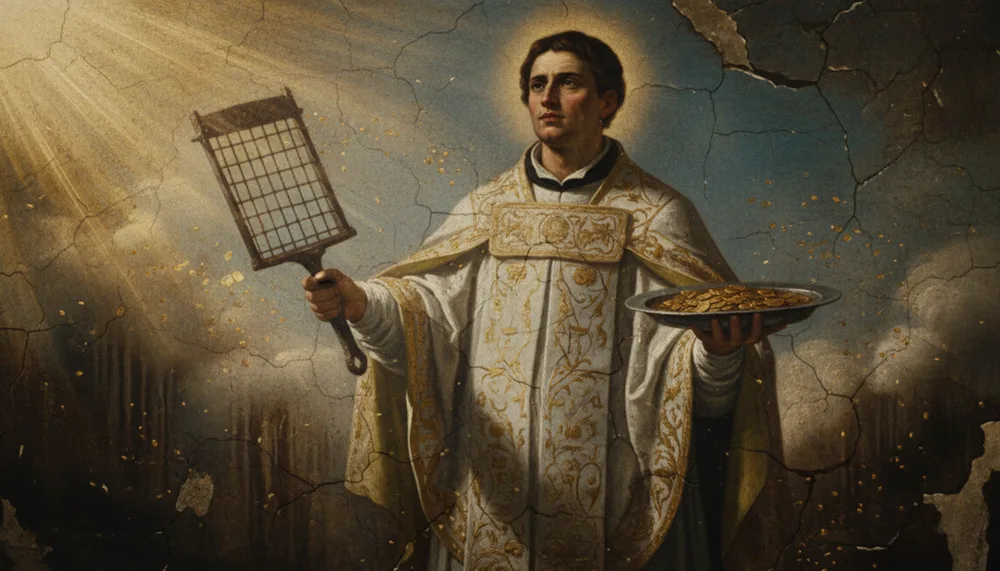
The novena to St Lawrence is the nine-day prayer offered to the deacon of Rome who gave the Church's gold to the poor and then died on a bed of fire rather than deny Christ. We come to him for the love of the needy, for courage to confess the faith before a hostile world, and for protection against the fire that destroys the body — and above all against the eternal fire of sin. It is traditionally begun on 2 August and ended on 10 August, his feast, though it may be prayed at any time a pressing need demands it.
Below is the full novena as the Iter Fidei app prays it: the daily invocation said on all nine days, the nine meditations with their proper petitions, and the closing versicle and collect from the Roman Missal. If this form of prayer is new to you, see our guide to what a novena is and our overview of the Church's traditional devotions.
The daily prayer, said on each of the nine days
Begin with the Sign of the Cross.
In the name of the Father,
and of the Son,
and of the Holy Ghost.
Amen.
Recollect thyself a moment in silence, then say the daily invocation, which is recited on each of the nine days before the meditation proper to the day.
St Lawrence, faithful deacon and valiant martyr, thou who didst distribute to the poor the treasures of the Church and who, in the midst of the flames, didst not deny Christ, obtain for us of God the love of the needy and the courage to confess the faith. Guard us from the fire that destroys the body, and above all from the eternal fire; and grant that we may turn the perishable goods to the laying up of an imperishable treasure in heaven. I earnestly beseech thee also to obtain for me, if it please God and if it be good for my soul, the grace I ask in this novena.
Here name, simply and plainly, the intention thou entrustest to St Lawrence — the same throughout the nine days.
St Lawrence, patron of the poor, pray for us. Amen.
Day 1 — The deacon of Rome
Lawrence lived in the third century and was one of the seven deacons of the Roman Church, the first among them, in the service of Pope St Sixtus II. The deacon of the early Church served not only at the altar: he administered the goods of the community and distributed alms to the poor, the widows, and the orphans. To this office, humble and holy, Lawrence gave himself wholly, serving God in the least of His brethren.
St Lawrence, faithful deacon in the service of the Pope and of the Church, thou didst make of thy office a road to holiness: obtain for us to love and serve Our Lord in the place where Providence hath set us, in the humility and fidelity of every day.
Our Father, who art in heaven,
hallowed be Thy name.
Thy kingdom come.
Thy will be done
on earth as it is in heaven.
Give us this day
our daily bread.
And forgive us our trespasses,
as we forgive
those who trespass against us.
And lead us not into temptation,
but deliver us from evil.
Amen.
Three times:
Hail Mary, full of grace ;
the Lord is with thee.
Blessed art thou amongst women,
and blessed is the fruit of thy womb, Jesus.
Holy Mary, Mother of God,
pray for us sinners,
now and at the hour of our death.
Amen.
Glory be to the Father, and to the Son,
and to the Holy Ghost.
As it was in the beginning,
is now, and ever shall be,
world without end.
Amen.
Day 2 — The keeper of the Church's goods
Because he was a deacon, Lawrence was also the treasurer of the Roman Church: to him were entrusted the sacred vessels and the offerings of the faithful, not to keep them apart, but to pour them out into the hands of the needy. Day after day he visited the sick, succoured the widows, and fed the hungry, learning that nothing given to God through the poor is ever lost.
St Lawrence, thou didst hold the goods of the Church as a trust laid up for the poor, never keeping them for thyself: obtain for us a heart detached from riches and the wisdom to use the goods of this world according to the will of God, for the good of souls and the relief of the wretched.
Then the Our Father, three Hail Marys and the Glory Be, as on the first day.
Day 3 — The treasures of the Church are the poor
The whole life of Lawrence is held in a single word. Bidden to hand over the riches of the Church, he gathered the needy, the sick, and the lame, presented them to the magistrate, and declared: "Behold the treasures of the Church." He had understood the Gospel to its depth: the only treasure that does not perish, the one laid up in heaven, is won by mercy toward the poor, and not by the gold that rust devours.
St Lawrence, thou didst name the poor the true treasures of the Church, seeing in them the very face of Christ: obtain for us eyes of faith to recognize Our Lord in those who suffer, and a heart wide enough to share with them all that we have received.
Then the Our Father, three Hail Marys and the Glory Be, as on the first day.
Day 4 — The arrest under Valerian
Under the reign of the Emperor Valerian, in the year 258, persecution fell upon the Church of Rome. Pope St Sixtus II was seized and beheaded with several of his deacons. Tradition tells that, as he was led to death, the Pope foretold to Lawrence that he would soon follow him in martyrdom. The magistrate, learning that the deacon kept the treasures of the Church, at once demanded them.
St Lawrence, thou didst not tremble when persecution came to strike the Church and bore away thy shepherd: obtain for us firmness in trial, fidelity to the Vicar of Christ, and the courage to confess our faith before the world, whatever the cost.
Then the Our Father, three Hail Marys and the Glory Be, as on the first day.
Day 5 — The three days
Lawrence asked the magistrate for three days to gather the treasures of the Church. They were granted him, for they thought to seize a rich spoil. But in those three days the deacon went through Rome and distributed to the poor the whole patrimony of the Church, down to the last sacred vessel, keeping nothing for himself. What the world called riches he passed into the hands of the needy, sending it before him where neither rust nor thief can reach.
St Lawrence, in three days thou didst give all, stripping the Church of her gold to clothe the poor and to lay up a treasure in heaven: obtain for us detachment from perishable goods and the boldness to give without counting, sure that nothing is lost of what is handed over to God.
Then the Our Father, three Hail Marys and the Glory Be, as on the first day.
Day 6 — Before the prefect
When the third day came, Lawrence presented himself to the prefect with neither gold nor silver, but followed by a throng of the poor, the sick, the blind, and the lame whom he had gathered. "Behold the treasures of the Church," he said; they are imperishable, for they bear Christ within them. At this sight the prefect fell into a great fury, feeling himself mocked, and swore to put the deacon to death by a slow fire, that his death might be a long torment.
St Lawrence, thou didst proclaim before the mighty the truth of the Gospel, fearing neither his wrath nor his threats: obtain for us the frankness of the saints, who fear nothing but God, and the strength to love the poor to the end, even when that choice costs us dear.
Then the Our Father, three Hail Marys and the Glory Be, as on the first day.
Day 7 — The iron gridiron
Lawrence was condemned not to the sword but to the fire. According to the ancient tradition told by St Ambrose and sung by the poet Prudentius, he was stretched upon an iron gridiron set over burning coals. There, in a pain that nothing could soothe, the deacon kept a supernatural peace and even mirth: he is said to have told his executioners to turn him over, for this side was done. Thus his suffering wrung from him neither complaint nor denial, but only the witness of a soul stronger than the fire.
St Lawrence, stretched upon the burning gridiron, thou didst bear the pain with a serenity and a joy that were not of this world: obtain for us patience in suffering, victory over the fire of our passions, and the grace to bear our cross without complaint, our eyes fixed on Christ crucified.
Then the Our Father, three Hail Marys and the Glory Be, as on the first day.
Day 8 — Constancy and holy mirth
In the midst of his torment, Lawrence did not cease to pray; tradition holds that he besought God for the conversion of Rome, until he gave up his soul. His constancy shook men's hearts, and many pagans, it is said, believed in Christ because of him. Thus was fulfilled in him the word of the Lord: unless the grain of wheat fall into the ground and die, it remains alone; but if it die, it brings forth much fruit.
St Lawrence, to thy last breath thou didst pray for thy executioners and for the conversion of the city that put thee to death: obtain for us to persevere in good unto the end, to love those who do us harm, and to become, like the grain of wheat, fruitful by the gift of ourselves.
Then the Our Father, three Hail Marys and the Glory Be, as on the first day.
Day 9 — Patron of the poor and of Rome
Lawrence died at Rome on 10 August 258. His cult spread at once through all Christendom; over his tomb was raised the basilica of St Lawrence outside the Walls, one of the seven great churches of the City, and his name was set in the Roman Canon, spoken each day at the altar. He is invoked as patron of the poor, of deacons, of cooks, and of all who face the fire. At the end of this novena he awaits us as an elder brother who has passed through the flames and shows us the way to heaven.
St Lawrence, glorious martyr crowned in the fire and honoured by the whole Church, cast a look of kindness upon us who pray to thee: obtain for us love of the poor, courage in the faith, and protection against the fire that destroys, and above all against the eternal fire; and vouchsafe to present to the Lord the grace we entrust to thee in this novena.
Then the Our Father, three Hail Marys and the Glory Be, as on the first day.
The closing prayers
Each day ends with the versicle and the collect of the Mass of St Lawrence, martyr, from the Roman Missal.
V. Pray for us, O holy Lawrence.
R. That we may be made worthy of the promises of Christ.
Let us pray.
Grant us, we beseech Thee, almighty God, to quench the flames of our vices, Who didst give unto blessed Lawrence to overcome the fires of his torment. Through Our Lord Jesus Christ, Thy Son, who liveth and reigneth with Thee in the unity of the Holy Ghost, God, world without end.
Amen.
The Latin, as it stands in the Missal for 10 August:
Da nobis, quaesumus, omnipotens Deus: vitiorum nostrorum flammas exstinguere; qui beato Laurentio tribuisti tormentorum suorum incendia superare. Per Dominum nostrum Iesum Christum Filium tuum, qui tecum vivit et regnat in unitate Spiritus Sancti Deus, per omnia saecula saeculorum.
Close as you began:
In the name of the Father,
and of the Son,
and of the Holy Ghost.
Amen.
How to pray the novena: dates, order, intention
Count backwards from the feast: begin on 2 August and the ninth day falls on 10 August, the feast of St Lawrence, martyr — a feast kept in the 1962 calendar with its own vigil on 9 August, a mark of the rank it has held in Rome since antiquity. Some prefer to end on the eve and keep the feast itself free for Mass; either reckoning is legitimate, but the older Roman habit is to let the ninth day be the feast, so that the novena empties into the liturgy rather than stopping short of it. See our traditional Latin Mass calendar for how the day falls in the year.
The order is the same every day and takes five to ten minutes: Sign of the Cross, a moment of silence, the daily invocation with your intention named, the meditation of the day, that day's petition, then the Our Father, three Hail Marys and the Glory Be, and the closing versicle and collect. Name one intention and keep it unchanged for the nine days — the point of a novena is not to cover ground but to persevere in a single asking.
Nothing in it is mechanical. A novena is not a device that extracts a result from God by repetition; it is nine days of confidence, and God answers in His hour and according to what is good for the soul. If a day is missed, simply pick up where you left off; the count is a discipline of the will, not a spell that breaks. Praying it in a state of grace makes the asking a friend's, not a stranger's — our guide to how to go to confession may help before you begin.
For a particular intention
St Lawrence's patronage is not vague. Bring him what belongs to him: a family in real want, a debt, the duty of almsgiving you have been avoiding; the courage to say what you believe at work or in your own household; a burn victim, a firefighter, a house threatened by fire; a deacon or seminarian; and — the intention the daily prayer itself names first — deliverance from the fire of the passions, which is the fire he is asked to quench in the Missal's own words. Cooks and those who feed others have claimed him too, on account of his gridiron and his joke. For sheer hopelessness the Church sends us elsewhere: to the novena to St Jude, patron of desperate cases.
A short form, and printing it
There is no separate "short novena" of St Lawrence in the tradition, and none is needed: if time is against you, say the daily invocation with your intention, the day's petition, and one Our Father — that is a true day of the novena. To carry it with you, print this page (your browser's print view gives a clean nine-day sheet) or use the app, which keeps the day-by-day text offline without a PDF to lose.
Other novenas to a "St Lawrence"
Three distinct things travel under this name, and searchers regularly land on the wrong one.
St Lawrence of Brindisi (1559-1619) is a different saint entirely — a Capuchin, a Doctor of the Church, feast 21 July in the 1962 calendar — and his novena is a novena to a preacher and theologian, not to the deacon-martyr of Rome. If you were sent here for him, this is not his page.
The Attur novena refers to the shrine of St Lawrence at Attur, near Karkala in Karnataka, India, where the deacon is honoured with great fervour by the Mangalorean Catholics and where the novena is commonly sung in Konkani before the January feast kept there. The text below is the Roman one, in English; the Konkani devotion is the same saint and the same substance, in another tongue.
The Lovasik booklets — the pocket novena collections compiled by Fr Lawrence G. Lovasik, SVD — are named for their author, not for St Lawrence. His anthologies contain many novenas; the one to the martyr of Rome is what you will find on this page.
The life of St Lawrence, in the traditional account
Here is what is certain, and Butler's Lives is blunt about how little it is. Lawrence was one of the seven deacons of the Roman Church, an office of great trust carrying the care of the Church's goods and the distribution of her alms. Valerian published his edicts against the Christians in 257; Pope St Sixtus II was arrested and put to death in 258; on the fourth day after, Lawrence followed him to martyrdom. That is all that is known for certain of his life and death.
Everything else — the exchange with the prefect, the parade of the poor, the gridiron, the words about being turned over — comes from St Ambrose, from the poet Prudentius, and from a set of "acts" of poor quality. Butler's admits regretfully that good reasons have been given for doubting the historical reliability of these moving incidents; serious scholars — Franchi de' Cavalieri and Delehaye among them — reject the gridiron tradition altogether, though, as Butler's is careful to add, it still finds defenders.
What weighs on the other side is that St Ambrose, writing in the fourth century and a Roman himself, plainly believed the martyr was roasted to death, and so did other Fathers. We record this honestly: the fact of the martyrdom is beyond question, its manner is not, and no one is obliged to hold the gridiron as history. It is possible to venerate a martyr and still not know how he died.
The rest is solid ground. He was buried in the cemetery of Cyriaca in agro Verano on the Via Tiburtina, where Constantine raised the first chapel — the site of the present basilica of St Lawrence-outside-the-Walls, one of the great patriarchal churches of Rome. His cult is attested from the fourth century and is among the most fervent the City has known; St Augustine testifies to miracles worked at Rome through his intercession, and Prudentius, writing around 403, credits the martyr's dying prayer with the conversion of the City and describes senators converted on the spot at his death. His name stands in the Canon of the traditional Latin Mass, said at every altar of the Roman rite — a distinction shared with only a handful of saints, and the surest measure of what Rome thought of him.
His patronage follows the story rather than a committee's decision: the poor and deacons because of his office, cooks and the burned because of the gridiron, Rome because he is hers. Rome's regard for him is legible in the calendar we keep: of the many vigils the Missal once had, the decree Cum nostra hac aetate of 23 March 1955 retained only seven, and the Vigil of St Lawrence on 9 August is among them — the sole vigil of any martyr save the Apostles Peter and Paul. The same decree reduced the octaves to three, so the octave he had long enjoyed is no longer kept; but the vigil that survived tells the same tale.
Frequently Asked Questions
What is the St Lawrence novena?
It is a nine-day prayer to St Lawrence, deacon and martyr of Rome (died 258), asking his intercession for the love of the poor, courage in confessing the faith, and protection from fire — bodily, and above all the fire of sin and of hell. Each day has its own meditation and petition, framed by a daily invocation and the collect of his Mass.
When should I pray the novena to St Lawrence?
Traditionally from 2 to 10 August, ending on his feast. It may be prayed at any time of the year when a need presses — the nine days are what matters, not the calendar.
Is there a St Lawrence novena prayer in Konkani?
Yes. The devotion is deeply rooted among Mangalorean Catholics, and the novena is prayed and sung in Konkani, especially at the shrine of Attur. The text on this page is the Roman novena in English; the Konkani novena honours the same deacon-martyr and asks the same things of him.
What is the St Lawrence Attur novena?
Attur, near Karkala in Karnataka, is home to a much-frequented shrine of St Lawrence where the novena precedes the local feast, celebrated there in January rather than August. It is the same saint of Rome, honoured by an Indian Catholic community with its own feast date and its own Konkani hymnody.
Is this the same as the St Lawrence of Brindisi novena?
No. St Lawrence of Brindisi is a Capuchin Doctor of the Church (1559-1619) whose feast is 21 July. The novena on this page is to St Lawrence the deacon, martyred at Rome in 258, whose feast is 10 August.
What is St Lawrence the patron saint of?
The poor, deacons, the city of Rome, cooks, those threatened by fire and by burns, and — from the words of his own collect — those fighting the fire of the passions. He is also invoked for a joyful courage in suffering.
Was St Lawrence really killed on a gridiron?
The tradition, told by St Ambrose and sung by Prudentius, says he was, and Butler's Lives follows it in the main. But Butler's also admits that good reasons have been given for doubting it: a number of serious hagiographers reject the gridiron outright, while others still defend it, and St Ambrose — a Roman writing in the fourth century — plainly believed the martyr was roasted to death. The martyrdom itself is certain; its manner is not, and the Church has never required belief in the gridiron.
Can I pray this novena if I miss a day?
Yes. Resume where you left off and complete the nine days. Perseverance, not an unbroken chain, is what the Church asks; the novena is an act of confidence in God, never a mechanism.
Pray the nine days with day-by-day reminders and audio in the Iter Fidei app. Download it here.
Sources. Holy Scripture (Douay-Rheims); Butler's Lives of the Saints, 10 August; the Roman Missal, Mass of St Lawrence, Martyr (10 August) and the Roman Canon; the Roman Martyrology; St Ambrose, De Officiis; Prudentius, Peristephanon.