
Novenas
St James Novena: Nine Days with the Apostle
The traditional St James novena — the full nine-day prayer to St James the Greater, first Apostle to be martyred, with his life from Butler, the Missal collect, and how to pray it before his 25 July feast.
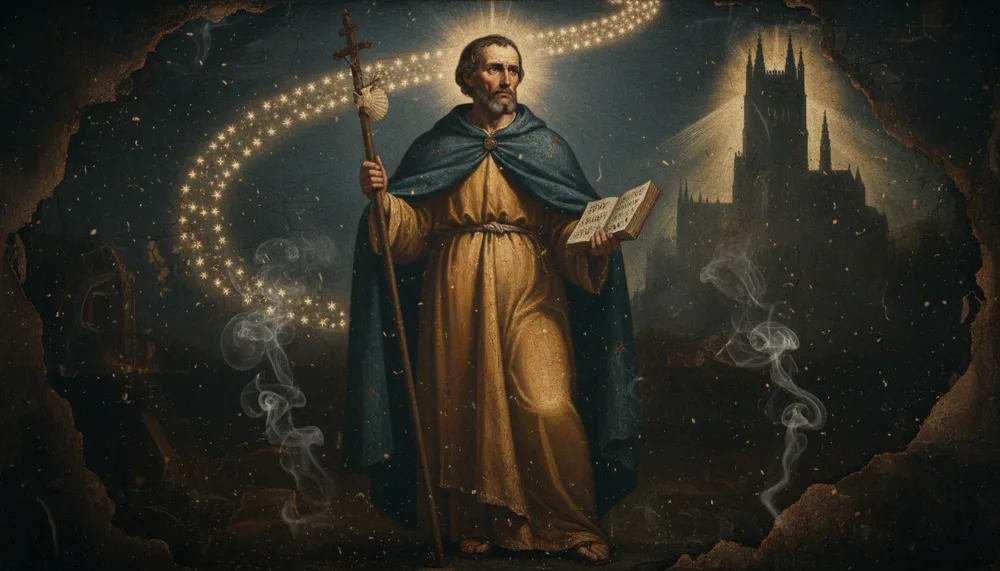
The St James novena is a nine-day prayer to St James the Greater, the fisherman of Galilee whom Our Lord called from his nets, admitted to the Transfiguration and the Agony, and who was the first of the Twelve to die for Him. We ask his intercession for courage under trial, for a prompt and generous answer to God's call, and for all who take the road — pilgrims, travellers, and those who wait for them at home. It is traditionally begun on 17 July and closed on 25 July, his feast in the 1962 calendar, though it may be prayed at any time, and especially before a departure, a pilgrimage, or a trial that must be borne.
Below is the full novena as the Iter Fidei app prays it: the daily invocation, the nine proper meditations and petitions, and the closing versicle and collect from the Roman Missal. If this form of prayer is new to you, see our guide to what a novena is and where the nine days come from.
The full novena to St James the Greater
Each of the nine days follows the same shape: the Sign of the Cross, a moment of silence, the daily invocation with your intention named, then the meditation and petition proper to the day, and finally the Our Father, three Hail Marys, and the Glory Be. The intention stays the same all nine days — name it plainly and do not change it.
The daily prayer, said on each of the nine days
In the name of the Father,
and of the Son,
and of the Holy Ghost.
Amen.
Recollect thyself a moment in silence, then say the daily invocation, which is recited on each of the nine days before the meditation proper to the day.
Glorious Apostle St James, who didst leave all to follow the Lord and didst follow Him even unto martyrdom, I trust in thy powerful intercession before God. Thou who didst walk the roads of the earth to preach the Gospel, obtain for me to run without turning aside toward the fatherland of Heaven; and I earnestly beseech thee to obtain for me also, if it please God and if it be good for my soul, the grace I so ardently ask in this novena.
Here name, simply and plainly, the intention thou entrustest to St James — the same throughout the nine days.
St James, Apostle of the Lord, pray for us. Amen.
Day 1 — The fisherman, son of Zebedee
James was the son of Zebedee and Salome, and brother of St John the Evangelist. With his father and his brother he earned his living on the lake of Gennesaret, mending his nets and drawing the boat to shore. There, in obscure toil and the weariness of every day, God was preparing him to become a fisher of men; for He often chooses, for the highest callings, those who were faithful in the humblest tasks.
St James, who didst sanctify the fisherman's labour before being called to the tasks of an apostle, obtain for us to fulfil with fidelity and love the duties of our state, knowing that God prepares, in hidden toil, the souls He destines for great things.
Our Father, who art in heaven,
hallowed be Thy name.
Thy kingdom come.
Thy will be done
on earth as it is in heaven.
Give us this day
our daily bread.
And forgive us our trespasses,
as we forgive
those who trespass against us.
And lead us not into temptation,
but deliver us from evil.
Amen.
Then three times:
Hail Mary, full of grace;
the Lord is with thee.
Blessed art thou amongst women,
and blessed is the fruit of thy womb, Jesus.
Holy Mary, Mother of God,
pray for us sinners,
now and at the hour of our death.
Amen.
Glory be to the Father, and to the Son,
and to the Holy Ghost.
As it was in the beginning,
is now, and ever shall be,
world without end.
Amen.
Day 2 — The call by the lake
As Jesus passed along by the sea of Galilee, He saw James and John, who, in the boat with Zebedee their father, were mending their nets; and He called them. Straightway, leaving the boat and their father, they followed Him (Matthew 4:21-22). They asked neither whither they went nor what was promised them: one word of the Lord was enough, and they set out on the instant, wholly given to Him who called them.
St James, thou didst answer without delay or bargaining the call of Christ, leaving all in that very instant: obtain for us a prompt and generous heart, that never puts off obedience to the voice of God nor haggles over the gift of self.
Then the Our Father, three Hail Marys, and the Glory Be, as on the first day.
Day 3 — The son of thunder
The Lord gave James and John the surname Boanerges, that is, sons of thunder (Mark 3:17). That ardour which moved them to wish to call down fire from heaven upon a village that refused Christ, Jesus did not quench: He purified it. The untamed zeal of the fisherman became, under the Master's hand, the fire of an apostle burning for the glory of God.
St James, whose ardour the Lord did not quench but purified to make of it the fire of His love, obtain for us to put at God's service what is impetuous in us, that our zeal, purified by charity, may seek nothing but His glory.
Then the Our Father, three Hail Marys, and the Glory Be, as on the first day.
Day 4 — Witness of the Transfiguration
Jesus took with Him Peter, James, and John, and led them apart upon a high mountain. There He was transfigured before them: His face shone as the sun and His garments became white as the light. James beheld for an instant the hidden glory of his Master, and heard from the cloud the voice of the Father: This is My beloved Son, hear ye Him. That vision was to sustain him later, in the hour of trial.
St James, admitted to behold on Tabor the glory of the Son of God, obtain for us, in our moments of light and consolation, to keep in our hearts the remembrance of God's presence, that it may sustain us in the dark hours when His glory is veiled.
Then the Our Father, three Hail Marys, and the Glory Be, as on the first day.
Day 5 — Witness of the Agony in Gethsemane
On the evening of Holy Thursday, Jesus again took with Him Peter, James, and John, and led them into the garden of Olives. He began to feel sorrow and dread, and said to them: My soul is sorrowful even unto death; stay here and watch with Me. Those who had seen His glory on the mountain now saw Him prostrate on the ground, in a sweat of blood. James, alas, fell asleep; yet the Lord cast him not off for it, and made of him later a witness of the strength that prayer bestows.
St James, who didst watch beside the Lord in His agony, and whose weakness was raised up by His mercy, obtain for us to watch and pray with Christ in our trials, and never to despair when the sleep of our cowardice betrays us.
Then the Our Father, three Hail Marys, and the Glory Be, as on the first day.
Day 6 — Can you drink the chalice?
The mother of James and John came to ask Jesus that her two sons might sit, one at His right, the other at His left, in His kingdom. The Lord answered: You know not what you ask. Can you drink the chalice that I am about to drink? They said: We can. And Jesus: My chalice indeed you shall drink (Matthew 20:20-23). It was no seat of honour He promised them, but a share in His Passion: the true greatness of a disciple.
St James, who didst promise the Lord to drink His chalice and didst drink it in truth by martyrdom, obtain for us to understand that a Christian's greatness lies not in the first places, but in sharing the Cross, and give us the strength to accept the portion of suffering that God appoints us.
Then the Our Father, three Hail Marys, and the Glory Be, as on the first day.
Day 7 — The first martyr among the Apostles
About the year 44, King Herod Agrippa, to please the enemies of the Church, laid hands on certain of her members to afflict them; and he killed James, the brother of John, with the sword (Acts 12:1-2). Thus he to whom the Lord had foretold that he would drink His chalice was the first of the Twelve to seal his witness in blood. Tradition relates that his accuser, moved by his constancy, was converted and went to death together with him.
St James, first of the Apostles to die for Christ, whose constancy converted even thine accuser, obtain for us the grace of a courageous faith that never denies its Lord, and the witness of a life so upright that it draws others to the truth.
Then the Our Father, three Hail Marys, and the Glory Be, as on the first day.
Day 8 — The Way of St James
An ancient tradition attaches to St James the first preaching of the Gospel in Spain, and venerates his tomb at Compostela. Since the Middle Ages, countless multitudes have taken the road to his shrine, across mountain and plain, to honour the Apostle: the Way of St James became one of the great paths of penance and prayer of Christendom. The pilgrim who walks toward Compostela figures the soul on its way to the heavenly fatherland, the shell on his hat and the staff in his hand.
St James, toward whom so many pilgrims have journeyed across the ages, protect all who take the road, travellers and those who wait for them; and make of our life a straight pilgrimage toward God, letting us not be turned aside from the path that leads to the fatherland of Heaven.
Then the Our Father, three Hail Marys, and the Glory Be, as on the first day.
Day 9 — Our petition to the Apostle
At the close of this novena, we turn with confidence to him whom Christ called by the lake, admitted to His glory and His agony, and crowned the first with martyrdom. St James gave all: his nets, his father, his very life; and he reigns today beside the Lord whom he followed to the end. His powerful intercession fails not those who call on him with faith, for God is pleased to honour His Apostles by granting the prayers of those who have recourse to them.
St James the Greater, Apostle and martyr, I entrust to thee again, on this last day, the intention of my novena. Present it to the Lord with the fervour that was thine, and obtain for me, if it please God and if it be good for my soul, the grace I ask; but above all the grace to follow Him faithfully, even to drinking in my turn, without drawing back, the chalice He shall hold out to me. Amen.
Then the Our Father, three Hail Marys, and the Glory Be, as on the first day.
The closing of the novena
V. Pray for us, O holy James.
R. That we may be made worthy of the promises of Christ.
Let us pray.
Be Thou, O Lord, the sanctifier and keeper of Thy people: that, defended by the aid of Thine Apostle James, it may both please Thee by its manner of life and serve Thee with a mind at peace. Through Our Lord Jesus Christ, Thy Son, who liveth and reigneth with Thee in the unity of the Holy Ghost, God, world without end.
Amen.
This is the collect of the Mass of St James, 25 July, in the Roman Missal — the Church's own prayer for his feast.
In the name of the Father,
and of the Son,
and of the Holy Ghost.
Amen.
How to pray the St James novena
Start on 17 July to end on the 25th, his feast, so that the ninth day falls on the day the whole Church honours him at the altar. Count backwards from any other date the same way if you are praying it outside July: nine days, the last one landing on the day of the need — the morning of a departure, a surgery, an examination, a decision.
Say it once a day, at whatever hour you can keep faithfully; the same hour each day is better than a better hour kept badly. Name one intention and hold to it for all nine days: a novena is not a list. If you miss a day, do not scruple and do not start over — simply take up the next day and continue.
Prepare the ninth day well. Where you can, hear Mass on the feast and go to Holy Communion; if it is far from you, offer the day's work for the intention instead. St James obtains, he does not compel: the novena is a prayer of confidence, not a device. God answers always, in His hour and according to what is good for the soul — which is sometimes not the answer we drew up in advance.
The novena to St James for anger
One request comes up again and again, and it is not accidental: people pray the St James novena for anger. It is well aimed. Christ named James and his brother Boanerges, sons of thunder, and Butler is blunt about why — "an impetuous spirit and fiery temper." When a Samaritan village refused to receive the Lord, it was these two who proposed calling down fire from heaven, and were told: "You know not of what spirit you are" (Luke 9:55).
What follows is the whole point. Our Lord did not extinguish that temper; He converted it. The same fire that wanted to burn a village became the fire that carried James first among the Twelve to the sword. So the man to ask about a temper you cannot govern is a man who had one. Day 3 is the day to weight if this is your intention — read it slowly, name the occasion of your own anger in the daily invocation, and ask not to be made cold but to be made zealous for the right thing. On the sins of the tongue and the heart, our article on what God says about anger sets out the Scriptures.
For travellers, pilgrims and those setting out
St James is the patron of travellers with St Christopher and St Raphael, on account of the roads that lead to Compostela. Many pray this novena in the nine days before a journey or a pilgrimage, ending on the eve of departure; others pray it for someone else who is on the road, naming him each day. For a shorter form on the day itself, see our prayer for safe travel.
A shorter form, and praying it as a family
If nine full days of meditation are beyond you, keep the frame and shorten the middle: the Sign of the Cross, the daily invocation with your intention, the day's petition alone (the blockquote), and one Our Father, one Hail Mary, one Glory Be. That is the bone of the novena and it is enough. With children, read the meditation aloud — it is nine short scenes of the Gospel, and it teaches them the story of an Apostle nine days running.
St James the Greater: his life
He is called the Greater — also, in older English books, the Great, and in Latin Iacobus Maior — only to distinguish him from the other Apostle James, called the Less because he was the younger. A Galilean by birth, probably of Bethsaida, where St Peter also lived at the time; son of Zebedee and Salome; brother of St John the Evangelist, with whom he is almost never named apart. The two were in partnership with their father in the fishing trade on the lake of Gennesaret.
Butler notes what the meditations pass over: James and John very likely knew who Jesus was before the call by the lake — Peter was their townsman — so that when the summons came, "the same moment they quitted all things." He was present at the cure of Peter's mother-in-law and the raising of the daughter of Jairus, and belonged with Peter and John to the three admitted alone to Tabor and to the innermost recesses of Gethsemani.
Of his preaching after the Ascension, Butler is plain: "Where St James preached and spread the gospel after the Lord's ascension we have no account from the writers of the first ages of Christianity." His martyrdom is the one fixed point, and it is in Scripture: Herod Agrippa I "killed James, the brother of John, with the sword" (Acts 12:2), at Jerusalem, about the year 44 — first of the Twelve to follow his Master by dying for Him. The story of the converted accuser, beheaded with him after the Apostle embraced him with "Peace be with you," comes from Clement of Alexandria through Eusebius; it is early and it is respectable, but it is not Scripture.
What is certain, and what is not
Honesty serves the Apostle better than embroidery. The Spanish tradition — that James preached in Spain, and that his body was carried to Compostela — is seriously disputed, and Butler does not defend it. The earliest known reference to the visit is only from the later seventh century, and from an oriental, not a Spanish, source; St Julian of Toledo, a Spaniard, resolutely rejected it. The translation of the relics is a story dating from about 830. Leo XIII referred to the relics as authentic in a bull of 1884, and they still rest in the cathedral; but their genuineness, in Butler's words, is "more than dubious," and outside Spain almost all critical historians answer both questions in the negative. The Greek apocryphal "acts" of St James are no earlier than the eighth century and are "quite fictitious."
None of this touches the Way of St James. The pilgrimage is one of the great penitential roads of Christendom, and a man who walks it walks it for real reasons whatever a Bollandist concludes about the bones at the end of it. But we do not need to pretend to certainties we lack in order to ask an Apostle to pray for us. What we know is enough: he left his nets at a word, he saw the glory and the sweat of blood, he said We can when the chalice was named, and he drank it first.
His feast is 25 July, a feast of the second class in the 1962 calendar, with the collect given above. He is patron of Spain, of pilgrims and travellers, of labourers, and — for the reason his surname gives — of those who need their fire converted rather than put out. His emblems are the scallop shell, the staff, and the sword. Other Apostles keep their own novenas in the treasury of Catholic devotions, among them the novena to St Andrew the Apostle.
Frequently Asked Questions
What is the St James novena?
It is a nine-day prayer to St James the Greater, Apostle and martyr, made of a daily invocation in which you name your intention, a meditation and petition proper to each day drawn from the Gospel and the Acts, and the Our Father, three Hail Marys and Glory Be. It closes with the versicle and the collect of his feast from the Roman Missal.
When should I start the novena to St James the Apostle?
Begin on 17 July to finish on 25 July, his feast day. Outside July, count back nine days from whatever day your intention turns on — a departure, an operation, a decision — so the ninth day falls on it.
Is it St James the Greater or St James the Great?
Both are used in English for the same Apostle, the son of Zebedee (Latin Iacobus Maior). "The Greater" is the older and more usual form. He is not St James the Less, the other Apostle, nor is he certainly the author of the Epistle of St James.
Can I pray the novena to St James for anger?
Yes, and it is a fitting request. Our Lord named him a son of thunder for his fiery temper, and did not destroy that temper but converted it into apostolic zeal. Ask him for the same conversion, and give particular weight to the third day.
What is St James the Greater the patron saint of?
Of Spain, of pilgrims and travellers — hence the Camino to Compostela — of labourers, and of those setting out on a journey. He is invoked for courage to accept one's share of the Cross, since he was the first Apostle to drink the chalice Christ had named.
Did St James really preach in Spain?
Almost certainly not. Butler records that we have no account of his preaching after the Ascension from any writer of the first ages; the Spanish tradition appears only in the late seventh century, was rejected by St Julian of Toledo, and is defended today mainly by Spanish scholars. The relics at Compostela are venerable but their authenticity is gravely disputed. The pilgrimage remains what it has always been; the history is simply less certain than the legend.
Do I have to say the whole novena every day?
Yes — the nine days are the novena. But the day's own portion is short: the invocation, one meditation, one petition, and the three vocal prayers. If you miss a day, continue with the next rather than beginning again.
Can I pray this novena for someone else?
Yes. Name him in the daily invocation as your intention and keep to him for the nine days — a traveller on the road, someone facing an ordeal, someone whose temper is destroying him. Intercession is not less powerful for being made on another's behalf.
Pray the nine days of the St James novena with day-by-day reminders and audio in the Iter Fidei app. Download it here.
Sources. Holy Scripture (Douay-Rheims): Matthew 4:21-22; 17:1-8; 20:20-23; Mark 3:17; Luke 9:51-56; Acts 12:1-2. Butler's Lives of the Saints, St James the Greater, Apostle (25 July). The Roman Missal, Mass Mihi autem nimis, S. Iacobi Apostoli, 25 July (collect). The Roman Martyrology, 25 July. Clement of Alexandria, in Eusebius, Ecclesiastical History II, 9.