
Novenas
Blessed Sacrament Novena — Full 9-Day Text
The novena to the Blessed Sacrament: the full nine-day text of this traditional novena to Jesus in the Blessed Sacrament, prayed before Corpus Christi or at any time, with the collect of St Thomas Aquinas.
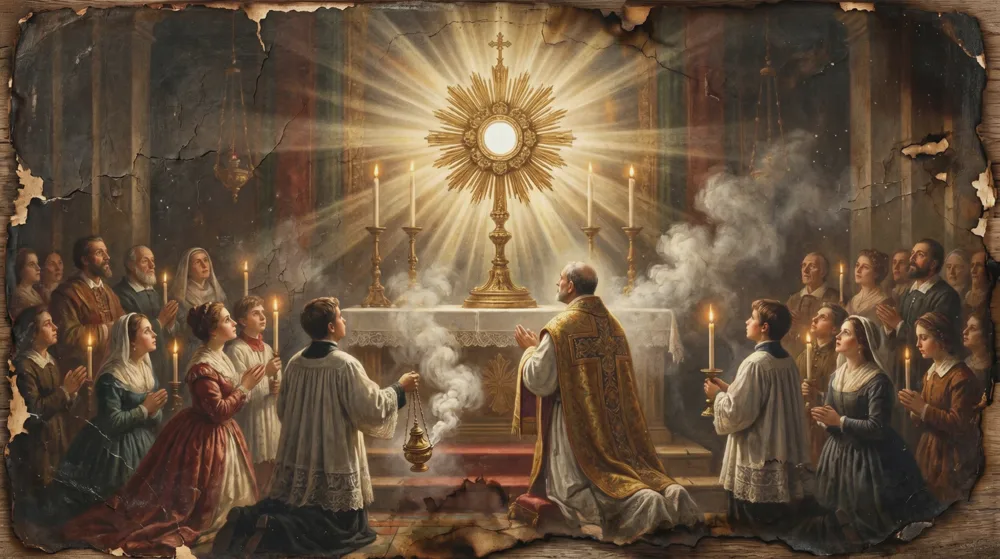
The novena to the Most Blessed Sacrament is nine days of prayer before Our Lord truly present under the appearances of bread and wine, made to revive our Eucharistic faith and to lay one intention at the foot of the tabernacle. Its intercession is not that of a saint but of Christ Himself, who abides among us until the end of the world, and whom we here adore, thank, and ask. It is traditionally prayed in the nine days before Corpus Christi, so as to end on the feast — but it may be begun on any day the soul desires to prepare for Communion or to return to adoration.
The novena to the Blessed Sacrament
Recollect thyself a moment before the Blessed Sacrament, whether present or represented.
In the name of the Father,
and of the Son,
and of the Holy Ghost.
Amen.
Then say the daily invocation, which is recited on each of the nine days before the meditation proper to the day.
O Jesus, truly present in the Most Blessed Sacrament of the altar, I believe, I adore, I hope, and I love Thee. Thou who hast made Thyself bread to abide among us until the end of the world, increase in me a living faith in Thy presence, a hunger to receive Thee, and a desire to adore Thee; and I beseech Thee to grant me, if such be Thy will and if it be good for my soul, the grace I ask in this novena.
Here name, simply and plainly, the intention thou entrustest to Our Lord present in the Blessed Sacrament — the same throughout the nine days.
Praised and adored be the Most Blessed Sacrament of the altar for ever. Amen.
Day 1 — The institution of the Eucharist
On the evening of Holy Thursday, at the Last Supper, on the eve of His Passion, Our Lord took bread, gave thanks, broke it, and gave it to His disciples, saying that this was His Body given for them, and that they should do this in remembrance of Him. Thus He instituted the Eucharist, and with the same act the priesthood that should perpetuate it. It was the gift of His love borne to the uttermost, in the very hour He was to die. But Holy Thursday, wholly turned toward the Passion then beginning, could not unfold the joy that such a gift deserves: Corpus Christi renders it to the Blessed Sacrament in full light.
O Jesus, Thou hast loved us to the end, and to abide with us until the consummation of the ages Thou gavest Thyself as food on the evening of the Supper: obtain for us to receive this unspeakable gift with the faith, reverence, and gratitude it deserves, and never to forget at what price it was made to us.
Our Father, who art in heaven,
hallowed be Thy name.
Thy kingdom come.
Thy will be done
on earth as it is in heaven.
Give us this day
our daily bread.
And forgive us our trespasses,
as we forgive
those who trespass against us.
And lead us not into temptation,
but deliver us from evil.
Amen.
Three times:
Hail Mary, full of grace;
the Lord is with thee.
Blessed art thou amongst women,
and blessed is the fruit of thy womb, Jesus.
Holy Mary, Mother of God,
pray for us sinners,
now and at the hour of our death.
Amen.
Glory be to the Father, and to the Son,
and to the Holy Ghost.
As it was in the beginning,
is now, and ever shall be,
world without end.
Amen.
Day 2 — The Real Presence
The Eucharist contains truly, really, and substantially the Body, Blood, Soul, and Divinity of Our Lord, under the appearances of bread and wine. It is not a symbol nor a bare remembrance: it is the same Jesus who is in Heaven and who was born of the Virgin. By the words of consecration the whole substance of the bread is changed into His Body, and that of the wine into His Blood: this change the Church calls transubstantiation, and the Council of Trent fixed its doctrine against every heresy.
O Jesus hidden beneath the veil of the sacred species, I firmly believe that Thou art there, living and true, my God and my Lord: strengthen my faith when it wavers, and grant me to kneel before the Host as the Magi before the crib, knowing that kneeling before the Blessed Sacrament I kneel before God Himself.
Then the Our Father, three Hail Marys, and the Glory Be, as on the first day.
Day 3 — The sacrifice renewed
The Eucharist is not only a sacrament to be received: it is the sacrifice of the new law. At every Mass the very sacrifice of the Cross is renewed upon the altar in an unbloody manner; the victim is the same, Our Lord Jesus Christ, and the priest is but His minister. Calvary is not repeated but made present, and its infinite fruits are applied to us. This is why the Church willed that the Blessed Sacrament, which perpetuates this sacrifice, should have a feast of its own.
O Jesus, victim ever offered for us upon our altars, teach us to assist at holy Mass with the faith and recollection of the saints, to unite ourselves to Thine oblation and to lay upon it our sorrows, our thanksgivings, and our supplications, that the fruit of Thy sacrifice may not remain barren in us.
Then the Our Father, three Hail Marys, and the Glory Be, as on the first day.
Day 4 — The Bread of Life
Our Lord has promised that whoever eats His flesh and drinks His blood has eternal life, and that He will raise him up on the last day. The Bread of Angels has become the bread of men: in holy Communion He gives Himself to us as food, the remedy of our weakness, the pledge of the life that has no end. To communicate often and worthily, with a pure heart and a prepared soul, is to let Our Lord work within us and transform us little by little into Himself.
O Jesus, living Bread come down from Heaven, give us hunger to receive Thee, the purity that makes our Communions worthy and fervent, and the grace never to approach Thy table by routine or coldness; make of every Communion one step nearer to Thee, until we live by Thy life.
Then the Our Father, three Hail Marys, and the Glory Be, as on the first day.
Day 5 — The adoration of the hidden King
The Blessed Sacrament is kept in the tabernacle of our churches precisely to be adored there and carried to the sick. There, day and night, Our Lord abides, a King hidden beneath the species, waiting for us to come to Him. Eucharistic adoration — to kneel before the Host, exposed or reserved — is the same act of faith the Corpus Christi procession proclaims aloud: to acknowledge in that little bread Christ the King who reigns, and to render Him the worship of adoration due to God alone.
O Jesus, King hidden in the tabernacle, where too often Thou dwellest alone and forsaken, give us the love of adoration and the desire to keep Thee company often; may we never pass a church without remembering that Thou art there, and make Thy peace reign in our souls, our homes, and the whole world.
Then the Our Father, three Hail Marys, and the Glory Be, as on the first day.
Day 6 — St Thomas Aquinas and the Lauda Sion
When he instituted the feast, Pope Urban IV asked St Thomas Aquinas to compose the Mass and Office of the Blessed Sacrament. The Angelic Doctor gave the Church the densest pieces of all Eucharistic liturgy: the Sequence Lauda Sion, which encloses in its verses the whole doctrine of transubstantiation; the hymn Pange lingua, whose last two stanzas form the Tantum ergo of Benediction; the Sacris solemniis, whence comes the Panis angelicus; and the Verbum supernum, whence comes the O salutaris Hostia. In him the highest theology of the Eucharist was made singable, that the people might carry the faith in their mouths and their hearts.
O Jesus, who didst inspire Thy servant Thomas with such beautiful hymns to honour Thy Body and Thy Blood, grant us to love the Church's doctrine on the Eucharist, to keep it pure and entire, and to praise Thee, as he did, with a heart that believes what faith teaches when the senses cannot grasp it.
Then the Our Father, three Hail Marys, and the Glory Be, as on the first day.
Day 7 — St Juliana and the procession
The origin of the feast is at Liège. St Juliana of Mont-Cornillon (1193-1258) saw in prayer a shining disc of the moon marred by a dark break: Our Lord made known to her that the moon figured the Church, and the break the want of a feast in honour of the Blessed Sacrament. Bishop Robert de Thourotte instituted it at Liège in 1246, and Jacques Pantaléon, become Pope Urban IV, extended it to the universal Church by the bull Transiturus in 1264. Ever since, on the day of Corpus Christi, the Church bears the Blessed Sacrament in procession through the streets, beneath the canopy, to the singing of the Pange lingua: a whole city's profession of faith in the Real Presence.
O Jesus, who hast willed that Thy Church bear Thee in triumph through the streets to confess before the world what she adores in secret, give us the courage to profess our Eucharistic faith openly, without human respect, and the zeal to make the Blessed Sacrament known and loved around us.
Then the Our Father, three Hail Marys, and the Glory Be, as on the first day.
Day 8 — Viaticum and the hour of death
Our Lord, who has promised eternal life to whoever eats this bread, wills to be our strength at the last passage. The Blessed Sacrament, carried to the dying, becomes Viaticum — the bread of the journey — food for the road that leads from time to eternity, pledge of resurrection and of the life that has no end. Happy the soul that receives its God on the threshold of eternity, and whom Christ Himself feeds in the hour when every human help fades away.
O Jesus, Bread of eternal life, grant us the grace to receive the holy Viaticum before we die, in full faith and full peace; and at the hour of our death, come Thyself to meet us, that, strengthened by Thy Body, we may pass from this world to Thee and behold Thee face to face for ever.
Then the Our Father, three Hail Marys, and the Glory Be, as on the first day.
Day 9 — Reparation and thanksgiving
This measureless gift is too often unknown. How many pass the tabernacle without a glance; how many communicate without faith, in indifference, sometimes in a state of sin; how many outrages and sacrileges the Saviour receives where He looked only for love. At the close of this novena the Church invites us to repair by our adoration the coldness and the offences, and to give thanks for so great a benefit: for having received so much, it remains only to love and to give thanks.
O Jesus present in the Most Blessed Sacrament, I thank Thee with all my heart for the unspeakable gift of Thy Body and Thy Blood, and I offer Thee in reparation for the outrages done to Thee my love and my adoration; deign, if such be Thy will and for the good of my soul, to grant me the grace I have asked of Thee in this novena, and be for ever praised, adored, and loved in the Blessed Sacrament of the altar.
Then the Our Father, three Hail Marys, and the Glory Be, as on the first day.
The closing of each day
V. Thou hast given them bread from heaven.
R. Having in itself all sweetness.
Let us pray.
O God, who under a wonderful Sacrament hast left us a memorial of Thy Passion: grant us, we beseech Thee, so to venerate the sacred mysteries of Thy Body and Thy Blood, that we may ever feel within us the fruit of Thy redemption. Who livest and reignest world without end. Amen.
In the name of the Father,
and of the Son,
and of the Holy Ghost.
Amen.
The forms this novena takes
The day-by-day novena. The text above is the full nine-day form: one meditation, one petition, and the three vocal prayers each day, with the versicle and collect to close. This is the ordinary way of keeping it, and nothing is left out of it here — the whole novena prayer to the Blessed Sacrament is on this page.
A short form. When the nine days must be kept in the middle of work or family life, the daily invocation, the day's petition, and the collect suffice: three or four minutes. What must not be shortened is the number of days. A novena is nine days; five days prayed generously are five days, not a novena.
For a particular intention. This novena carries any petition — a sick child, work, a conversion, peace in a household — because it is addressed to Christ Himself and not to one saint with one patronage. Name it in the same words each of the nine days. On petitions in general, and how the Church means us to make them, see the wider body of Catholic prayers.
"Come to me" novena to Jesus in the Blessed Sacrament. The name comes from Our Lord's own invitation, Come to me, all you that labour and are burdened, and I will refresh you (Mt 11:28) — an invitation we consider in come to me all you who labour. It is a title given to Eucharistic novenas rather than a distinct approved text; the novena above answers exactly that call.
"Storm novena" before the Blessed Sacrament. "Storm novena" is a recent devotional expression, not a traditional liturgical term: it names an intensified novena, prayed with several people or several times a day, often before the tabernacle. Nothing forbids it, but the older and safer counsel is plain — the nine days kept faithfully, with an examination of conscience and confession within them, do more than volume.
Our Lady of the Blessed Sacrament. Searches for a "novena to Our Lady of the Blessed Sacrament" point to a distinct nineteenth-century devotion, promoted by St Peter Julian Eymard (1811-1868), founder of the Congregation of the Blessed Sacrament, who honoured Our Lady under that title as the first adorer of her Son. It is a Marian devotion in the Eucharistic key, not this novena. The traditional Marian companion to Eucharistic prayer remains the rosary; see how to pray the rosary.
A PDF or printed copy. There is no single official booklet of this novena: it is a traditional text, and printed versions differ in wording. This page may be printed as it stands, or the novena prayed day by day in the Iter Fidei app, which is what we recommend for the nine days.
How to pray the nine days
Fix the start date first. To end on the feast, count the feast itself as the ninth day: Corpus Christi falls on the Thursday after Trinity Sunday — sixty days after Easter in the traditional calendar — so the first day is the Wednesday of the week before. Any other nine consecutive days will serve: before a First Communion, before a Holy Hour, before an operation, before a death expected in the house.
Pray it, if you can, before the Blessed Sacrament itself — in a church during the day, or at Benediction. If not, an image or a crucifix at home is enough; Our Lord is not less real for being adored at a distance. Keep the same intention and the same hour all nine days. Do not break the chain for want of feeling: dryness is not failure, and a novena finished in dryness is worth more than one abandoned in consolation. What the nine days are for, and why the Church counts nine, we set out in what is a novena.
Two things make this novena bear fruit. First, confession: the Eucharist is asked for here with the whole heart, and a heart in mortal sin cannot receive Him. Second, Communion — sacramental if you may, spiritual if you may not, on as many of the nine days as your state allows. The novena is a preparation, and the preparation is meant to arrive somewhere: at the Eucharist itself.
Corpus Christi and where this novena comes from
The devotion is anchored in one feast and two names. The feast is Corpus Christi, and its history is documented rather than legendary. St Juliana, prioress of the leper hospital of Mont-Cornillon near Liège, born about 1193, died at Fosses in 1258, pressed for some forty years a request she said came from a vision — that the Church keep a feast of the Blessed Sacrament. Butler's account is sober about her: she was opposed, driven from her house more than once, and died in obscurity without seeing the feast universal.
Bishop Robert de Thourotte granted it for Liège alone in 1246. Eighteen years later Jacques Pantaléon, once archdeacon of Liège and by then Pope Urban IV, extended it to the whole Church by the bull Transiturus de hoc mundo, dated 11 August 1264. The two dates are firm; the private revelation behind them the Church has never made an article of faith, and no one is bound to it.
The second name is St Thomas Aquinas, whom Urban IV charged with the Mass and Office. That commission is attested and its fruit is still sung: the Sequence Lauda Sion, one of the five surviving in the 1962 Missal, and the hymns from which Tantum ergo, Panis angelicus, and O salutaris Hostia are drawn. The collect of this novena, Deus, qui nobis sub sacramento mirabili, is his — it is the oration of the Mass of Corpus Christi, and we give it here word for word rather than in paraphrase.
Why this devotion has the patronages it has follows from what it honours: Eucharistic adoration and the interior life, priests whose hands consecrate, First Communicants, and the dying who receive Viaticum. Those are not sentimental attachments but the places where the Blessed Sacrament touches a life at its most decisive. Later centuries added their own accents — the Sacred Heart revealed to St Margaret Mary is a Eucharistic devotion at root, and St Peter Julian Eymard's institute made perpetual adoration a state of life — but the feast, the Office, and this novena all stand on the thirteenth century, and on Holy Thursday before it.
Frequently Asked Questions
What is the novena to the Blessed Sacrament?
It is nine consecutive days of prayer addressed to Our Lord Jesus Christ truly present in the Eucharist. Each day has a meditation on one aspect of the mystery — the institution, the Real Presence, the sacrifice of the Mass, the Bread of Life, adoration, the Office of St Thomas, the procession, Viaticum, reparation — followed by a petition, the Our Father, three Hail Marys, and the Glory Be, and closed by the collect of Corpus Christi.
When should I start the 9 day novena to the Blessed Sacrament?
To finish on Corpus Christi, count the feast itself as the ninth day and begin on the Wednesday of the preceding week — the feast falls on the Thursday after Trinity Sunday. Outside that season there is no fixed date: any nine consecutive days are proper, and the novena is often begun before a First Communion, a Holy Hour, or the death of someone in the house.
Must I pray it in front of the Blessed Sacrament?
It is better, and that is its native setting — a church, a chapel of adoration, Benediction. But it is not required. Pray it at home before a crucifix or an image if you cannot go out; the act of faith is the same, and Our Lord is not less present in the tabernacle for your being a mile from it.
Is there a novena to Our Lady of the Blessed Sacrament?
Yes, but it is a different devotion. The title belongs to the nineteenth century and to St Peter Julian Eymard, who honoured our Lady as the first adorer of the Eucharist and gave that name to prayers of his congregation. The novena on this page is addressed to Our Lord in the Sacrament, not to our Lady under that title.
What is the "storm novena" before the Blessed Sacrament?
It is a modern expression for a novena prayed with unusual intensity — several people together, or several times a day, often before the tabernacle. It is not a traditional term and there is no fixed text of that name. The nine days prayed faithfully, with confession and Communion, are what the Church actually asks.
Can I pray this novena for a specific intention?
Yes, and you should name one. Because it is addressed to Christ Himself rather than to a saint with a single patronage, it carries any lawful petition. Say the intention in the same plain words all nine days, and hold Thy will be done underneath it: God answers in His hour and according to what is good for the soul.
Is there a PDF of the Blessed Sacrament novena?
No single official booklet exists — this is a traditional text and printed versions vary in wording. The full text is on this page and may be printed as it stands, or prayed day by day in the app.
What prayers are said each day of the novena?
The daily invocation to Our Lord present in the Sacrament, the petition proper to the day, then the Our Father, three Hail Marys, and the Glory Be. The versicle Thou hast given them bread from heaven and the collect of St Thomas close each day.
Pray the novena to the Blessed Sacrament day by day, with reminders and audio, in the Iter Fidei app. Download it here.
Sources. Holy Scripture (Douay-Rheims); Roman Missal of 1962, Mass and Office of Corpus Christi (St Thomas Aquinas, Lauda Sion, collect Deus, qui nobis sub sacramento mirabili); Urban IV, bull Transiturus de hoc mundo (1264); Council of Trent, Session XIII, on the Most Holy Eucharist; Butler's Lives of the Saints (St Juliana of Mont-Cornillon); Catechism of St Pius X; Roman Ritual, on Viaticum.