
Novenas
St Rose of Lima Novena: Full 9-Day Text & Prayers
The complete novena to St Rose of Lima, day by day: the nine meditations, the daily invocation, each day's prayer and the Missal collect — traditionally prayed from 22 to 30 August.
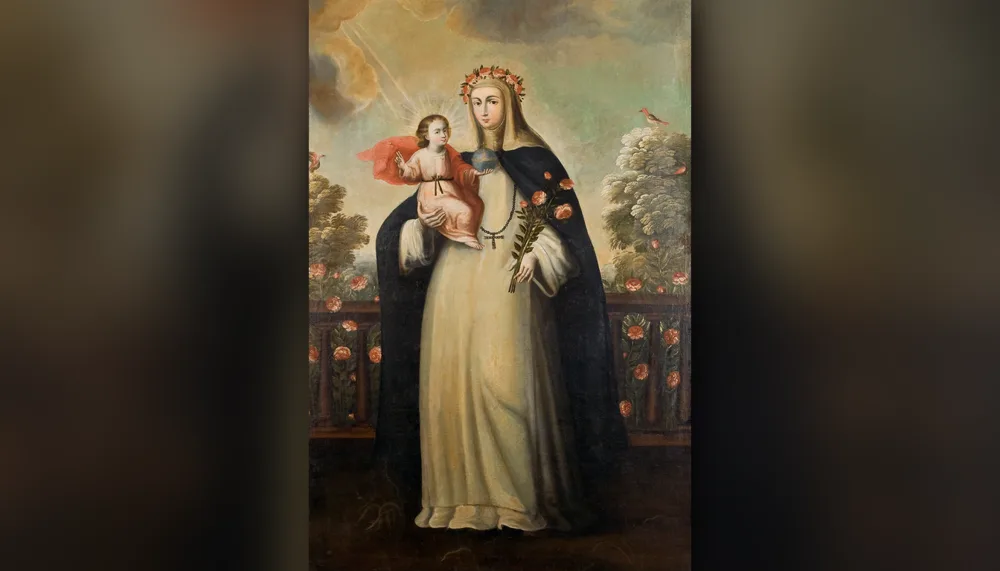
The novena to St Rose of Lima is a nine-day prayer to the first canonised saint of the New World, patroness of the Americas, of Peru, of gardeners and florists, of the poor and the sick, and of all who are mocked for their piety. We come to her for purity of heart when it is under attack, for courage in penance, for patience in the long dryness of the soul, and for whatever need we carry — naming it plainly and leaving the answer to God. It is traditionally begun on 22 August and finished on 30 August, her feast in the calendar of 1962, but it may be prayed at any time of year.
This is the same text the Iter Fidei app carries: nine meditations drawn from the stages of her life, one proper prayer for each day, and the collect of the Roman Missal for her feast.
The Novena to St Rose of Lima
Each day: the Sign of the Cross, the daily invocation with your intention named, the meditation and prayer proper to the day, then the Our Father, three Hail Marys and the Glory Be.
In the name of the Father,
and of the Son,
and of the Holy Ghost.
Amen.
Recollect thyself a moment in silence, then say the daily invocation, which is recited on each of the nine days before the meditation proper to the day.
St Rose of Lima, most pure flower of the New World, thou who didst leave all to live only by the love of Jesus crucified, I trust in thy powerful intercession before God. Obtain for me the love of purity, the courage of penance, and patience in trial; and I earnestly beseech thee to obtain for me also, if it please God and if it be good for my soul, the grace I so ardently ask in this novena.
Here name, simply and plainly, the intention thou entrustest to St Rose — the same throughout the nine days.
St Rose of Lima, patroness of the Americas, pray for us. Amen.
Day 1 — The flower of Lima
Rose was born at Lima on 20 April 1586, into a devout Spanish family soon reduced to poverty, and received at baptism the name Isabel; but the child's grace was such that she was never called anything but Rose, a name that the archbishop St Turibius of Mogrovejo confirmed on the day of her Confirmation. She was the first flower of holiness to open upon the soil of the New World, and the first of its children whom the Church raised to the altars.
St Rose of Lima, first saint of the Americas, most pure flower opened far from the ancient Christian lands, obtain for all the peoples of the New World that they remain faithful to the faith they have received, and cause new flowers of holiness to spring up in our lands grown poor in saints.
Our Father, who art in heaven,
hallowed be Thy name.
Thy kingdom come.
Thy will be done
on earth as it is in heaven.
Give us this day
our daily bread.
And forgive us our trespasses,
as we forgive
those who trespass against us.
And lead us not into temptation,
but deliver us from evil.
Amen.
Three times:
Hail Mary, full of grace;
the Lord is with thee.
Blessed art thou amongst women,
and blessed is the fruit of thy womb, Jesus.
Holy Mary, Mother of God,
pray for us sinners,
now and at the hour of our death.
Amen.
Glory be to the Father, and to the Son,
and to the Holy Ghost.
As it was in the beginning,
is now, and ever shall be,
world without end.
Amen.
Day 2 — The vow of virginity
From her earliest years Rose was drawn to the things of God. Having heard of St Catherine of Siena, she desired to imitate her, and very early made a vow to keep for Christ a perpetual virginity. When her parents, in their poverty, thought to give her in marriage, she refused with as much firmness as gentleness, going so far as to mar her own beauty in order to turn away suitors and to remain wholly her one Spouse's.
St Rose, who from childhood didst give thyself undivided to Jesus thy one Spouse and didst keep the flower of virginity even unto death, obtain for the young purity of heart and of body, and for those whom God calls the strength to give Him all without reserve.
Then the Our Father, three Hail Marys and the Glory Be, as on the first day.
Day 3 — The crown of thorns beneath the roses
Burning to be like Jesus crowned with thorns, Rose laid upon herself penances that grace alone could sustain: long fasts, long vigils, hidden austerities. Upon her head she wore in secret a thin crown set with points, which she concealed beneath a wreath of roses, that none might suspect what she offered to the Saviour. Her penance was no harshness, but love that wills to suffer with Him whom it loves.
St Rose, thou didst hide beneath the roses the crown of thorns for love of Jesus crucified: obtain for us the spirit of penance and of mortification, that, renouncing our ease and our whims, we may bear each day, without complaint, the little cross that God doth send us.
Then the Our Father, three Hail Marys and the Glory Be, as on the first day.
Day 4 — The tertiary of St Dominic
After the example of St Catherine of Siena, whom she had chosen as her model, Rose received the habit of the Third Order of St Dominic and vowed her life to prayer and penance in the very heart of the world. She was soon surnamed the Catherine of Siena of the New World. She withdrew into a little hut at the end of the family garden, where she spent long hours in prayer before the Blessed Sacrament and the crucifix.
St Rose, daughter of St Dominic, thou didst find in the heart of the world the solitude and silence wherein God gives Himself: obtain for us the love of prayer and a relish for recollection, that, amid the noise of our occupations, our heart may stay fixed on God alone.
Then the Our Father, three Hail Marys and the Glory Be, as on the first day.
Day 5 — The labour of her hands
Rose's family had fallen into poverty. To support it, the saint laboured without rest: she raised the flowers of the garden, which she sold at market, and by night she embroidered with her skilful hands. Thus she joined work to prayer, earning bread for her own while keeping her soul united to God, and showing that holiness is not opposed to the humble toils of every day.
St Rose, who didst earn by the labour of thy hands the bread of thy family without ever breaking thy union with God, obtain for all who toil for their own the grace to sanctify their labour, and for our families tried by want the daily bread and trust in Providence.
Then the Our Father, three Hail Marys and the Glory Be, as on the first day.
Day 6 — Charity toward the poor
Rose's heart could not bear the misery of others. Into her house she gathered the poor, the sick, abandoned children, the Indians and the slaves whom none would tend, serving them with her own hands as she would have served Christ Himself. In her men have seen the beginning of organised care for the sick and the needy in Peru.
St Rose, thou didst see and serve Our Lord in the poor, the sick, and the outcast of thy city: obtain for us a heart compassionate to the sufferings of our neighbour, and the generosity to open our hands to those whom the world despises and casts out.
Then the Our Father, three Hail Marys and the Glory Be, as on the first day.
Day 7 — The trials of the soul
God filled Rose with mystical graces, yet also led her through long nights of dryness, of temptation, and of seeming abandonment, in which Heaven appeared closed. She passed through these trials without ever losing her peace, repeating that, apart from the Cross, there is no ladder by which to mount to Heaven. Her long inward suffering was the crucible in which her holiness was made perfect.
St Rose, tried by long droughts of the soul and by the anguish of believing thyself forsaken of God, thou didst yet never cease to hope: obtain for those who cross the night of faith a persevering fidelity, and the certainty that the Cross itself is the way to Heaven.
Then the Our Father, three Hail Marys and the Glory Be, as on the first day.
Day 8 — Patroness of Peru and the Americas
Beatified by Clement IX and then canonized by Clement X in 1671, Rose of Lima was proclaimed patroness of Lima, of Peru, of all America and the Indies, and soon of the Philippines as well. The first saint of the New World became its heavenly protectress, watching from Heaven over the peoples among whom she had lived, prayed, and suffered.
St Rose, patroness of Peru, of the Americas, and of the Indies, spread thy protection over all these peoples: keep the faith among them, defend their families, and obtain for the Church of those lands holy vocations and many labourers for the harvest of the Lord.
Then the Our Father, three Hail Marys and the Glory Be, as on the first day.
Day 9 — The death of St Rose
Rose died at Lima on 24 August 1617, at thirty-one years of age, after a long sickness borne in perfect peace, saying that she had long desired this hour. She went out gently, like a flower that closes at evening to open at last to the light that never fades. At the end of this novena she calls us to hope, as she did, for the one good that does not pass away.
St Rose of Lima, come to the end of thy sufferings in the joy of rejoining thy Spouse, remember us who finish this novena: present our intention to God, obtain for us the grace we ask if it be good for our soul, and above all the grace to live and to die in the love of Jesus crucified. Amen.
Then the Our Father, three Hail Marys and the Glory Be, as on the first day.
The closing of the novena
On the ninth day, or at the end of each day if you wish, add the versicle and the collect of her feast.
V. Pray for us, O holy Rose of Lima.
R. That we may be made worthy of the promises of Christ.
Let us pray.
O almighty God, bestower of all good things, who didst will that blessed Rose, forestalled by the dew of Thy heavenly grace, should blossom among the people of the Indies in the beauty of virginity and patience: grant unto us Thy servants that, running after the odour of her sweetness, we may deserve to be made the good odour of Christ. Who liveth and reigneth with Thee in the unity of the Holy Ghost, God, world without end.
Amen.
In the name of the Father,
and of the Son,
and of the Holy Ghost.
Amen.
The novena in short, in PDF, and for a particular intention
The short form. On a day when there is no time for the whole, keep the bones and drop nothing essential: the Sign of the Cross, the daily invocation with your intention, the prayer proper to the day, and one Our Father, three Hail Marys and one Glory Be. That is a true day of the novena, not a lesser one. What must never be dropped is the day's own prayer — it is what makes the ninth day different from the first.
A printable text. There is no PDF to download here, and there does not need to be: the whole text is on this page, so it prints from your browser or copies into a document as it stands. If you would rather not carry paper, the app keeps the nine days in your pocket and marks where you left off.
For a particular intention. The novena is deliberately built around one intention, named at the same point every day and left unchanged for nine days — that steadiness is half the prayer. St Rose is asked especially for purity threatened or lost, for the grace of a real penance, for the poor and the sick (she nursed them in her own house), for work and for a family short of bread, and for souls in a long spiritual dryness who feel God has gone.
If you are praying for someone gravely ill, our page of prayers for the sick may be joined to it. And note what the daily invocation actually says: if it please God and if it be good for my soul. A novena is not a lever on God; it is nine days of confidence. He answers always, in His hour, and sometimes by giving something better than we asked.
Day by day, with someone. The nine days go well in a family, each member taking a day's reading aloud. Praying it in company is the ordinary way these Catholic devotions have always been kept.
How to pray the novena to St Rose of Lima
When to start. Begin on 22 August and the ninth day falls on 30 August, her feast in the traditional Roman calendar — the classic way, and the one the app follows. (The reformed calendar of 1969 moved her to 23 August; if you are following that book, begin on 15 August, the Assumption, and end on the feast.) Outside August, start whenever the need arises: nine consecutive days, one day at a time, is all the rule there is.
How to keep it. Same intention, same hour if you can — morning offering or evening, before bed or before the crucifix. Nine days is a short school of perseverance, and missing a day is not a sin; if a day is broken, simply take it up where you left it rather than beginning again from the first. If you want the pattern behind all such prayers, see what a novena is: the nine days of the Apostles and Our Lady between the Ascension and Pentecost.
What to add. Confession and Holy Communion, if possible on the feast itself, are the natural crown of the nine days. A rose set before her image, or a flower from your own garden, is an old and fitting custom for the patroness of gardeners.
Who was St Rose of Lima?
The meditations above walk through her life; here is the frame around them.
She was born Isabel Flores de Oliva at Lima on 20 April 1586, one of the thirteen children of Gaspar Flores, an arquebusier of the viceregal guard, and María de Oliva. Lima was then the capital of Spanish Peru and barely fifty years old — a colonial city of immense wealth, brutal inequality and a Church still building. Her Confirmation at the hands of St Turibius of Mogrovejo, the archbishop who reformed that Church, fixed on her the nickname the household already used. The family's fall into poverty followed the failure of a mining venture at Quives; her flower-selling and embroidery (Day 5) were not a pious hobby but the household's income.
She took the habit of the Third Order of St Dominic around 1606, aged twenty, having wished for the cloister and been kept at home by her family. She never entered religion: her whole life was lived in her parents' house and the hut at the end of its garden. Among her neighbours in Dominican Lima were St Martin de Porres and St John Macías — the city produced a remarkable cluster of saints in one generation, and the novena to St Martin de Porres belongs to the same soil. Her model throughout was St Catherine of Siena, whose lay Dominican life in the world she reproduced almost point for point.
She died on 24 August 1617, aged thirty-one. Clement IX beatified her in 1668, Clement X canonised her on 12 April 1671 — the first canonised saint of the Americas — and named her patroness of Lima, of Peru, of the Indies and of the Philippines. Her feast in the 1962 Missal is 30 August, third class; her body lies in the Dominican church at Lima. She is patroness of gardeners and florists (the roses), of the poor and the sick (her house), and of those laughed at for their devotion — she was, in her own city and often in her own family, thought excessive.
What is certain and what is not. Unlike many ancient saints whose acts Butler frankly calls legendary, Rose is well documented: the canonical process opened within thirteen years of her death and took testimony from people who had known her, including her confessors. The frame is solid. The detail is another matter. The most vivid stories of her austerities — the spiked crown, the exact weight of her chains, the numbers of hours and the years of fasting — reach us chiefly through the Vita mirabilis of the Dominican Leonard Hansen (1664), written for the canonisation, and hagiographers of that school do not measure.
Butler and the older lives repeat them while adding the standard and necessary caution: these penances were the work of an extraordinary grace, are not proposed for imitation, and were themselves restrained by her confessors, who judged her obedience the greater virtue. What the Church proposes in her is the virginity and patience named in the collect — and the mortification proper to our own state, which is usually the small cross of the day and not a crown of iron.
Frequently Asked Questions
When do you start the novena to St Rose of Lima?
Traditionally on 22 August, so that the ninth day falls on 30 August, her feast in the 1962 calendar. It may be begun on any date when a need presses: nine consecutive days is the whole requirement.
What is the St Rose of Lima novena prayer?
There is a daily invocation said all nine days — St Rose of Lima, most pure flower of the New World… — in which you name your intention, followed by a prayer proper to each day, and then the Our Father, three Hail Marys and the Glory Be. The nine days close with the collect of her feast from the Roman Missal.
Is there a St Rose of Lima novena PDF?
The complete text is on this page and prints or copies from your browser. The app carries the same nine days offline with a reminder each day.
What is St Rose of Lima the patroness of?
Of Peru, of Lima, of all the Americas, the Indies and the Philippines; of gardeners and florists; of the poor and the sick; of those who do penance; and of anyone mocked for their piety.
What do you ask St Rose of Lima for?
Purity of heart and body, courage in penance, patience in trial and in spiritual dryness, help for the poor and the sick, bread for a family in want — and the particular grace you name, asked always if it please God and if it be good for my soul.
What if I miss a day of the novena?
Take the day you missed and continue; there is no need to start over, and no sin has been committed. A novena is a prayer of confidence, not a mechanism that a broken day invalidates.
Why is St Rose of Lima's feast on 30 August?
That is her day in the traditional Roman calendar, kept as a third-class feast in the Missal of 1962. The 1969 reform moved her to 23 August, nearer the day of her death, 24 August; the traditional novena keeps to 30 August.
Can the novena be prayed with a family or a group?
Yes, and it is well suited to it: one person reads the day's meditation aloud, all say the daily invocation, the day's prayer and the Our Father, three Hail Marys and the Glory Be together.
Pray the nine days with a reminder each morning, the full text and the audio in the Iter Fidei app. Download it here.
Sources. Roman Missal, S. Rosae Limanae Virginis, 30 August (collect); Roman Martyrology; Butler, Lives of the Saints, 30 August; Leonard Hansen, O.P., Vita mirabilis et mors pretiosa B. Rosae de S. Maria Limensis (1664); bulls of Clement IX and Clement X (beatification 1668, canonisation 12 April 1671, patronage of the Indies); Holy Scripture, Douay-Rheims.