
The Saints
St Catherine of Siena
St Catherine of Siena, Dominican tertiary and mystic, who counselled popes and wrote the Dialogue — patron saint of Italy, feast April 30.
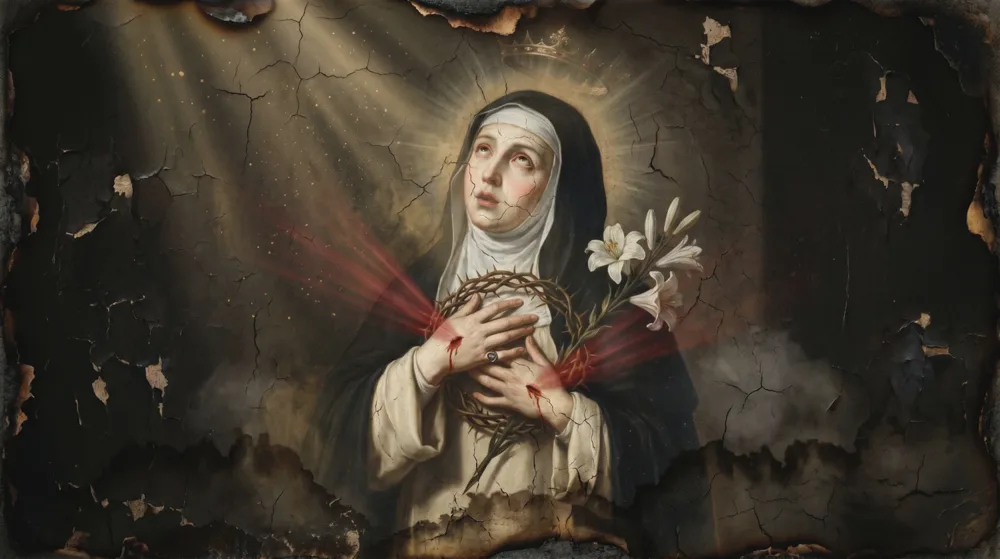
St Catherine of Siena was a Dominican tertiary and mystic of fourteenth-century Italy, a counsellor of popes and the author of the Dialogue, who died in 1380; her feast falls on April 30. She is the patron saint of Italy, invoked for the peace and reform of the Church she loved and laboured to heal.
Who St Catherine of Siena Was
Catherine of Siena was born in Siena on the feast of the Annunciation in 1347, the youngest of the twenty-five children of Giacomo Benincasa, a well-to-do dyer, and his wife Lapa. At the age of six she had a vision of our Lord that sealed her vocation, and she gave herself wholly to prayer and solitude. When her parents wished her to marry, she resisted them; she cut off her hair and bore patient persecution in her own house until she was permitted to receive the habit of a Dominican tertiary — not a cloistered nun, but a member of the Order living under vow in the world.
After years of prayer, fasting and fierce interior trials, she experienced on Shrove Tuesday of 1366 a mystical espousal to Christ. From that hidden union she was sent outward. She went forth into the world, nursing in the hospitals of Siena and deliberately choosing the most repellent cases — cancer and leprosy — that others fled. The pattern of her life is the old pattern of the saints: the love of God learned in solitude, then poured out upon the bodies and souls of men. It is the same pattern that centuries later carried St Junipero Serra from a university chair in Majorca to the missions of California.
What St Catherine of Siena Is Patron Saint Of
St Catherine of Siena is the patron saint of Italy, her native land, whose cities and quarrels she knew and whose peace she sought. Beyond that title she is honoured as a patroness of nurses and of the sick, for her labour in the hospitals among the worst diseases, and she is invoked against fire and against bodily illness. Above all she is a patron of those who pray for the Church in her troubles, for that was the burden of her whole short life.
The Church teaches plainly that it is good and useful to have recourse to such saints. The Catechism of St Pius X asks whether it is good and useful to have recourse to their intercession, and answers that it is very useful to pray to the Saints, and that every Christian ought to do so.
When we say that a saint has granted a grace, the catechism explains, we mean that this saint has obtained it from God — for God alone is the author of grace, and the saints obtain from Him what we ask through them. To name Catherine "patron" of Italy is to confess that her prayers still reach the throne where she stands, as the whole communion of saints reaches it, and that she remains a mother to the land and the Church she served on earth.
The Counsellor of Popes
Catherine lived in one of the darkest hours of the medieval Church. For most of the fourteenth century the popes resided not at Rome but at Avignon in France, and Christendom was torn by faction and by war among its own cities. Into this confusion came an unlettered woman of the dyers' quarter who feared no man for the love of God. She wrote letters — to princes, to cardinals, to the warring republics, and to the pope himself — calling all of them to penance and to peace. Her counsel to the Roman Pontiff was that he return from Avignon to the See of Peter at Rome, and her insistence had its part in that return.
There is no contradiction here between obedience and boldness. Catherine reverenced the papacy utterly; she called the pope "the sweet Christ on earth" and never set herself above his office. Yet she begged him, as a daughter begs a father, to be what his office required. This is the Catholic measure of reform: not rebellion against the Church, but a fiercer love of her, that suffers her wounds as one's own and labours to bind them.
The Dialogue
Catherine's chief written work is her treatise on divine Providence, known to all later ages as The Dialogue. It is cast as a conversation between the soul and God the Father, dictated by Catherine in ecstasy to her secretaries. In it the eternal Father answers the soul's petitions — for herself, for the Church, for the whole world — and unfolds the way of perfection through self-knowledge and the knowledge of God, through the Blood of Christ and the bridge that is His humanity.
The Dialogue belongs to the great current of Catholic mystical teaching, alongside the works of St Teresa of Avila and St John of the Cross. What it teaches is not a private religion but the common doctrine of the Church set ablaze: that the soul rises to God only by descending into its own nothingness, and that charity for the neighbour is the proof of charity for God. Her pages are a school of mental prayer — the silent, attentive converse of the soul with God that she practised from childhood and that bore in her such fruit.
Her Care for the Church
Everything in Catherine bends toward the one thing she loved: the Bride of Christ, the Holy Church. She did not love an abstraction. She loved the visible Church with her sacraments and her shepherds, even when the shepherds failed; she wept over the schism and faction of her day and spent herself, body and prayer alike, to heal them. Her last years she gave to Rome, offering her own sufferings for the unity of Christendom, until her strength was exhausted. She died there on 29 April 1380, at the age of thirty-three.
The traditional honour paid to her is therefore fitting. She was canonized in 1461, and within the Order of Preachers and far beyond it she has been held up as the model of a soul wholly given to God and wholly spent for the Church. Pope Pius XII declared her, with St Francis of Assisi, the principal patron of Italy. Hers is a holiness without softness, the same fearless charity that armed St Joan of Arc to answer her own country's need: prayer that costs, charity that touches the leper, and counsel that fears no throne.
Quotes of St Catherine of Siena
Her own most famous phrase is the name she gave the Pope in her letters: "the sweet Christ on earth" (il dolce Cristo in terra). Some four hundred of her letters survive, besides the Dialogue, and they are the surest place to hear her voice.
Many sayings circulate under her name, and some should be read with care:
- "Be who God meant you to be and you will set the world on fire" is a modern paraphrase, not her exact words, though it echoes a phrase of her letters about becoming what one ought to be.
- "Proclaim the truth and do not be silent through fear," "Nothing great is ever achieved without much enduring," and "All the way to heaven is heaven, because He said, I am the Way" are widely attributed to her, but we have not been able to verify their exact source in the Dialogue or the letters, and we give them only as attributions.
Her words are best read not as slogans but as a school: they send the reader back to prayer and to charity, which is exactly where Catherine herself learned them.
A Prayer to St Catherine of Siena
The Church's own collect for her feast, from the Roman Missal of 1962, may be prayed by the faithful who seek her intercession:
Da, quaesumus, omnipotens Deus: ut, qui beatae Catharinae Virginis tuae natalitia colimus; et annua solemnitate laetemur, et tantae virtutis proficiamus exemplo. Per Dominum nostrum Iesum Christum, Filium tuum, qui tecum vivit et regnat in unitate Spiritus Sancti Deus, per omnia saecula saeculorum. Amen.
Grant, we beseech Thee, O almighty God, that we who keep the birthday of Thy blessed Virgin Catherine may both rejoice in her yearly solemnity and profit by the example of so great virtue. Through our Lord Jesus Christ, Thy Son, who liveth and reigneth with Thee in the unity of the Holy Ghost, God, world without end. Amen.
The Feast Day of St Catherine of Siena
In the 1962 Roman calendar the feast of St Catherine of Siena is kept on April 30, as a feast of the third class, the day after her death on 29 April 1380 (the reform of 1969 moved it to 29 April). On that day the Church honours the Dominican virgin among her holy ones and asks her prayers for the peace of Christendom she sought so hard to win.
The Head and Relics of St Catherine of Siena
A question often asked is why the head of St Catherine of Siena is venerated apart from her body. The answer lies in an old and entirely Catholic custom. Catherine died at Rome in 1380, and her body was laid to rest there, beneath the high altar of the Dominican church of Santa Maria sopra Minerva, where it remains the object of pilgrimage to this day.
But the city of Siena longed for a relic of its own daughter. According to the tradition preserved by the Order of Preachers, her head was separated and translated to Siena, where it is enshrined in the basilica of San Domenico and venerated still. One of her thumbs is kept there as well. This division of relics, strange as it may sound to modern ears, was a common honour paid to the great saints, that more than one place might keep near it a token of one whom heaven had glorified.
The veneration of such relics is no superstition but the ancient practice of the Church, who honours the bodies of the saints as temples of the Holy Ghost and instruments of God's grace. We do not adore the relic; we honour the saint and, through her, God who is wonderful in His saints. To kneel before the head of Catherine at Siena is to ask the prayers of one whose mind, while she lived, was wholly fixed on God. For the other saints of the traditional calendar, month by month, see our guide to the Catholic saints.
Frequently Asked Questions
How did St Catherine of Siena die?
St Catherine died at Rome on 29 April 1380, at the age of thirty-three, worn out by penance and by the sufferings she offered for the unity of the Church during the great schism. She had no single mortal illness so much as a body utterly spent in fasting, prayer, and labour for Christendom; in her last weeks she could no longer take food, and she gave up her soul having offered her life for the Church she loved.
Who is St Catherine of Siena?
St Catherine of Siena was a fourteenth-century Italian mystic and Dominican tertiary — a member of the Order of Preachers living under vow in the world rather than in a cloister. Though unlettered, she counselled popes and princes, nursed the sick in the hospitals of Siena, and dictated the Dialogue; she is the principal patron saint of Italy and her feast is kept on April 30.
What is St Catherine of Siena known for?
She is known as the unlettered Dominican tertiary who counselled popes, cardinals, and princes, calling them to penance and to peace, and whose insistence had its part in the return of the Pope from Avignon to Rome. She is known too as a great mystic and as the author of the Dialogue, her treatise on divine Providence dictated in ecstasy, which ranks among the classics of Catholic mystical teaching.
What is St Catherine of Siena the patron saint of?
She is the principal patron saint of Italy, her native land, declared such by Pope Pius XII together with St Francis of Assisi. She is also honoured as a patroness of nurses and of the sick, for her labour in the hospitals of Siena among the worst diseases, and she is invoked above all by those who pray for the Church in her troubles.
When did St Catherine of Siena die?
She died in 1380, at Rome, having given her last years to prayer and suffering for the unity of Christendom. In the 1962 Roman calendar her feast is kept on April 30, the day after her death on 29 April.
When was St Catherine of Siena born?
St Catherine was born at Siena in 1347, on the feast of the Annunciation, the youngest of the twenty-five children of Giacomo Benincasa, a dyer, and his wife Lapa. At the age of six she had a vision of our Lord that sealed her vocation to a life wholly given to God.
What is a famous quote of St Catherine of Siena?
Her own best-attested phrase is the name she gave the Pope: "the sweet Christ on earth." Lines such as "Proclaim the truth and do not be silent through fear" and "Nothing great is ever achieved without much enduring" are widely attributed to her, but their exact source is uncertain; "Be who God meant you to be and you will set the world on fire" is a modern paraphrase, not her exact words.
Why is the head of St Catherine of Siena venerated at Siena?
Catherine died at Rome in 1380 and her body rests there beneath the high altar of Santa Maria sopra Minerva. By an old custom her head was translated to her native Siena, where it is enshrined and venerated in the basilica of San Domenico, together with one of her thumbs, so that the city she loved might keep near it a relic of its own daughter. The honour paid to such relics is the ancient practice of the Church, which venerates the bodies of the saints as temples of the Holy Ghost.
Where is St Catherine of Siena buried?
Her body rests at Rome, where she died, beneath the high altar of the Dominican church of Santa Maria sopra Minerva. By ancient custom her head was given to her native Siena and is venerated there in the basilica of San Domenico, that the city she loved might keep a relic of its daughter.
The Iter Fidei app carries the prayers, the traditional calendar of feasts, and the catechism — so that a saint's day, and her collect, are always near at hand. Join early access here.
Sources. Butler's Lives of the Saints (life and death of St Catherine of Siena, virgin, d. 1380; mystical espousal of 1366; the Dialogue; her care for the sick); Catechism of St Pius X, Part II, ch. 4 (On the Invocation of the Saints); the Collect of the feast of St Catherine of Siena, Roman Missal of 1962 (April 30); Pope Pius XII, declaration of St Catherine as principal patron of Italy (1939).