
The Spiritual Life
Mental Prayer and Catholic Meditation
Mental prayer is prayer made with the mind alone — a raising of the soul to God in thought, affection, and resolution. Here is what Catholic meditation is, a simple traditional method, and its place in the interior life.
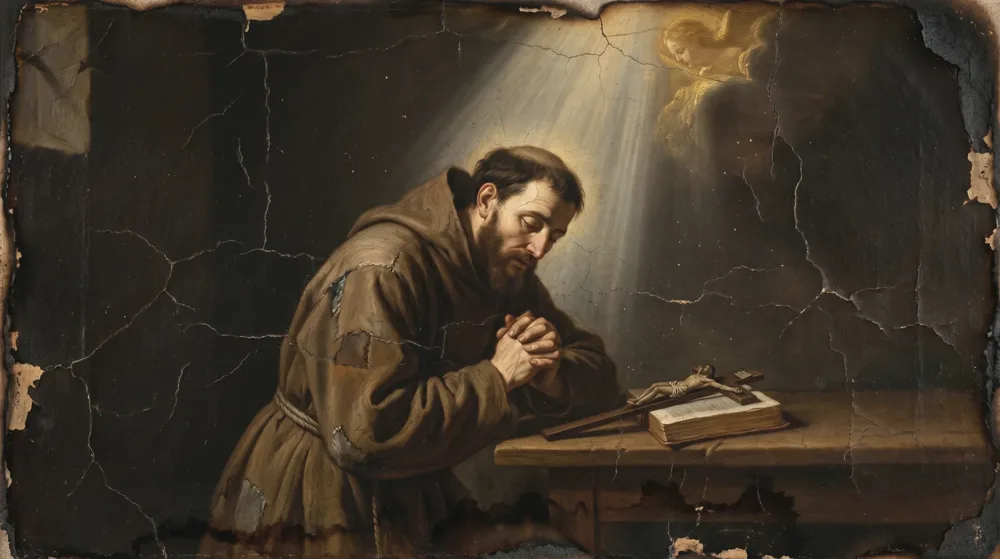
Mental prayer is prayer made with the mind alone — a raising of the soul to God in thought, affection, and resolution, without the spoken words of vocal prayer. The Catechism of Saint Pius X defines prayer as "a raising of the mind to God to adore Him, to thank Him, and to ask of Him what we need," and divides it into two kinds: "mental prayer is that which is made with the mind alone; vocal prayer is that which is made with words." Catholic meditation is the ordinary form of mental prayer for those beginning the interior life: we take a truth of faith, turn it over before God, draw affections and a resolution from it, and so converse with Him in the silence of the heart.
What mental prayer is
Tanquerey, in his classic treatise on the spiritual life, defines mental prayer as "an elevation and an application of our soul to God, to render Him our duties and to become better thereby for His glory." It comprises five elements: the duties of religion we render to God; considerations on God and our relations with Him, to strengthen our convictions; returns upon ourselves, to see where we stand in the practice of the virtues; petitions, to ask the grace we need; and resolutions, to do better in future. These need not follow in fixed order, nor appear all in one prayer — but to be meditation rather than a passing aspiration, the exercise must be prolonged a certain time.
Scupoli, in The Spiritual Combat, gives the same definition in fewer words: "mental prayer is an elevation of the soul to God, in which one asks of Him actually or virtually the things one desires." Mental prayer is therefore not an emptying of the mind, nor a technique, nor a feeling we manufacture. It is the soul lifting itself to a Person and speaking with Him. Popular apps such as Hallow guide meditation with recorded audio; we ask whether Hallow is a Catholic app in a separate article.
Meditation, prayer, and contemplation
The words meditation and prayer are often used for one another. When they are distinguished, Tanquerey explains, meditation names the form of mental prayer "in which consideration or reasoning predominates" — also called discursive meditation — while prayer (oraison) names the forms in which "pious affections or acts of the will predominate." Discursive meditation already contains affections, and affective prayer is usually preceded by some considerations. Meditation, then, is not opposed to affection; the reasoning exists to kindle the heart. As souls advance and their convictions need only be renewed, the prayer grows simpler, until at times it becomes "a simple loving gaze." That higher simplicity is contemplation, which God gives; meditation is the road that prepares for it.
The ways of mental prayer
The tradition speaks of ways of mental prayer because the soul does not pray in one fixed manner all its life. Dom Vitalis Lehodey, in The Ways of Mental Prayer (1908), the classic Cistercian treatise on the subject, traces the ascent from discursive meditation, through affective prayer, to the prayer of simplicity, and on to the beginnings of infused contemplation. His teaching is the same as Tanquerey's and Scupoli's: the reasoning of meditation is meant to give way, as the soul matures, to acts of the will and at last to a simple, loving attention to God.
A beginner need not fear the higher ways; he has only to be faithful to the first. "God leads each soul by the way He pleases," Lehodey writes, and the safest path is to follow the attraction of grace while keeping always to a method until grace plainly draws beyond it. The ordinary way for almost everyone, for many years, is the methodical meditation described below.
Is mental prayer necessary?
Methodical meditation, Tanquerey teaches, "is a very efficacious means of sanctification, but is not, however, necessary for salvation for the body of Christians." What is necessary is to pray, and some reflection on the great truths can be had through parish instruction, good reading, and the examination of conscience. Yet for anyone who wishes to make progress, mental prayer is "the most efficacious means of securing one's salvation." He cites Saint Alphonsus: with other exercises of piety one may unfortunately go on living in mortal sin, "but with prayer one cannot long remain in grave sin: either one will abandon prayer or one will renounce sin." The soul that comes daily before the Author of all holiness cannot for long keep both Him and its sin.
This is why mental prayer is the soul of the interior life. It detaches us from sin by enlightening us on its malice; it strengthens the will against our inertia; it makes us practise faith, hope, and charity by setting the eternal truths again before our eyes; and it prepares our union with God, who, "by dint of frequenting the Author of all perfections," penetrates the soul "as iron placed in the furnace catches fire."
How to meditate: a simple traditional method
The Church received settled methods of meditation from the fifteenth century onward — chiefly that of Saint Ignatius and that of Saint Sulpice. Both contain the same parts, and a beginner can follow either. We give the method of Saint Sulpice, whose master-idea is union with Our Lord, that we may render God His due and reproduce in ourselves the virtues of Christ. Set aside half an hour, ideally in the morning, the first free moment after rising.
1. Preparation
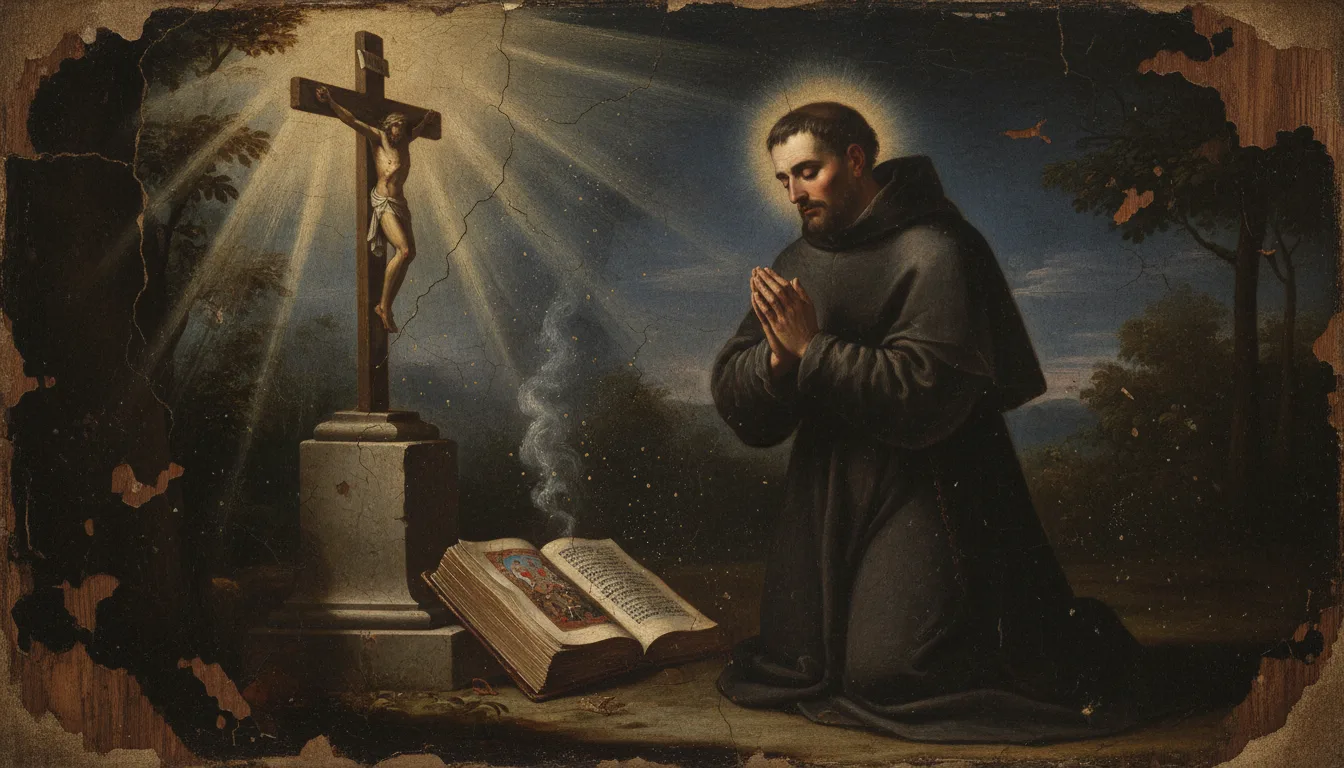
The evening before, choose the subject and read it over — a mystery of Christ, a truth of faith, a virtue you need — and fall asleep thinking on it. This is the proximate preparation. When you sit down to pray, make the immediate preparation in three short acts: place yourself in the presence of God, who is everywhere and above all dwells in your soul; humble yourself at the memory of your sins, with an act of contrition; and invoke the Holy Ghost, acknowledging that of yourself you cannot pray as you ought. Behind all this stands the remote preparation, which is simply a life ordered toward prayer: habitual recollection, humility, and mortification of the senses and passions. Without that, the imagination scatters and distractions multiply.
2. The body of the prayer
The body has three movements, which Monsieur Olier summed up as having Jesus before our eyes, in our heart, and in our hands:
- Adoration — Jesus before our eyes. Consider the truth or virtue in God, in Our Lord, or in a saint; then render Him the duties of religion: adoration, admiration, praise, thanksgiving, love, joy, or compassion.
- Communion — Jesus drawn into the heart. Convince yourself, by motives of faith, of the necessity of the virtue. Examine yourself upon it with contrition for the past, confusion for the present, and desire for the future. Then ask God for the virtue — "it is above all by this petition that we enter into participation in the virtues of Our Lord."
- Cooperation — Jesus in our hands. Take one resolution: particular, present, humble, and possible to carry out this very day.
Scupoli teaches the same in his own way: take a scene of the life or Passion of Christ — the scourging, to obtain patience — and dwell on each point until you feel His pains, then on the patience of His soul, and beg Him for that virtue. The aim of the reasoning is never the reasoning. It is to move the will to love and to resolve.
3. Conclusion
Close with thanksgiving for the graces of the prayer; ask pardon for your negligences in it; commend your resolutions, the day, and your death to God; gather a spiritual nosegay — one thought to carry through the day — and entrust all to the Blessed Virgin with the Sub tuum praesidium. Scupoli, who gives a tender method of meditating with Our Lady as our subject, reminds us that we may always implore God's graces through her merits, "for she has much power in Heaven."
Difficulties: distractions and dryness
Two trials meet every beginner, and neither is a reason to stop. The first is distractions. Tanquerey distinguishes voluntary distractions from those we do not choose, and bids us trouble ourselves only with the former. Involuntary thoughts "are not culpable unless one voluntarily dwells on them," and to repel them is itself a meritorious act: "if twenty times they return to the assault and if twenty times we repel them, this will be an excellent meditation," more meritorious than one made with ease. Repel them promptly and gently as soon as you notice them, and attack their cause by better preparation and by habitual recollection.
The second trial is dryness. When the sensible consolations God granted at first are withdrawn, the soul may think itself abandoned and grow discouraged. Tanquerey answers plainly: "what God asks of us is effort and not success," and there is more merit in persevering when prayer is hard. Scupoli adds that even when the Lord seems to repulse us, we must "continue to pray and to hold firm and lively the confidence" we have in His help. Dryness purifies; it teaches us to pray for God and not for the comfort we feel.
Mental prayer in the interior life
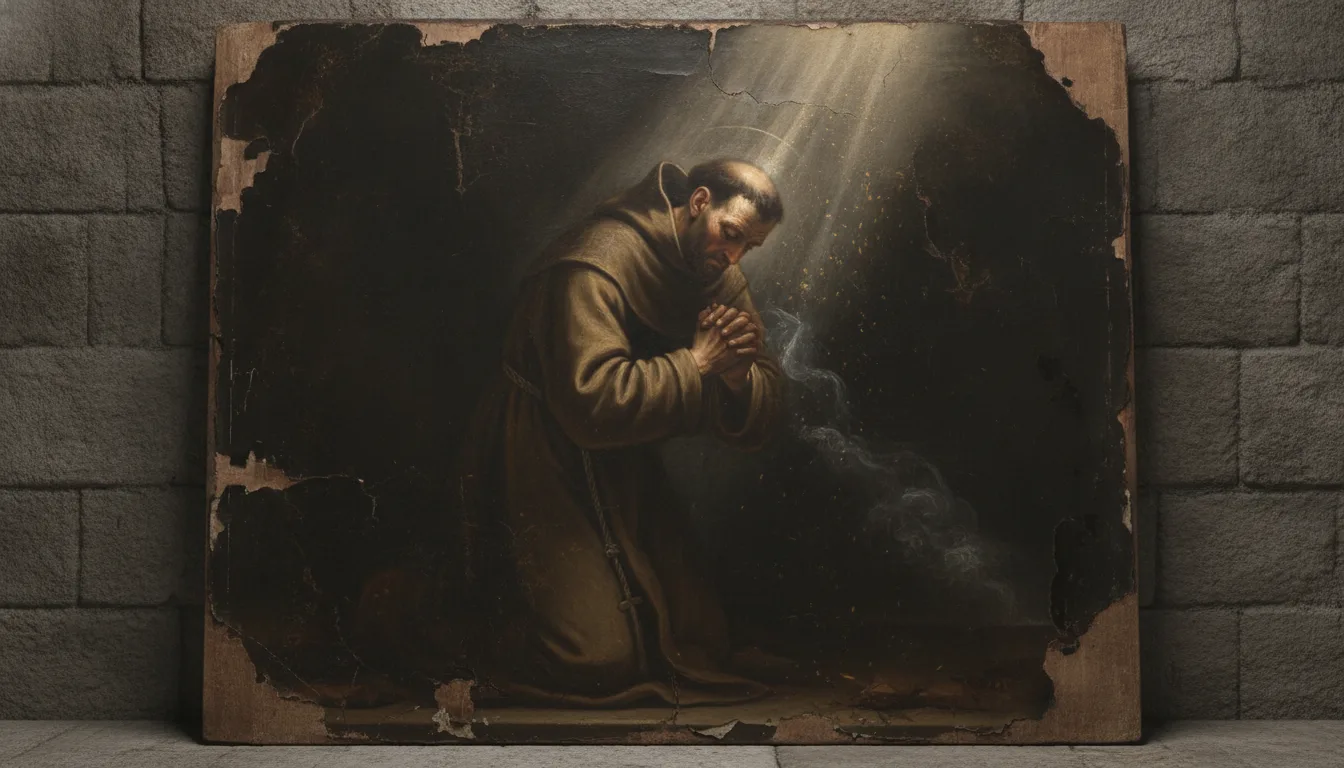
Mental prayer is the daily breathing of the interior life. It is one of the four weapons of the spiritual combat, the channel through which, Scupoli says, the soul places in God's hand "a sword wherewith He will fight and triumph" for it. It does not replace vocal prayer or devotion — it gives them their soul. A meditation made in the morning carries its resolution and its nosegay into the day's work, and there flowers into the brief, wordless prayer Scupoli calls "a simple look of the soul toward God," a weapon we hold "everywhere and at all times." From this same school of recollection the great vocal devotions draw their life; the Rosary is itself a meditation on the mysteries of Christ clothed in words.
Prayer and mental health: what the Church holds
A word must be said for the many who come to this subject not seeking a method of meditation but carrying a heavier burden: anxiety, depression, scruples, grief, or the mental illness of someone they love. The phrase mental prayer is a technical term and is not the same as prayer for mental health — but the Church has much to say to the suffering, and we set it down here plainly, without superstition.
Two truths must be held together. First, mental illness is a real affliction of body and mind, and the Church honours the means God gives for healing it, including the care of a competent physician. Faith does not despise medicine; grace works through nature. Second, prayer is never useless to the sufferer, for it commends him to the One who made and loves him. Prayer does not replace treatment, and no prayer should be used as a charm or a guaranteed cure — that would be superstition, which the tradition condemns. We pray as Our Lord taught us: asking confidently, and adding always, "not my will, but thine be done" (Luke 22:42).
What the Bible says about mental illness
Scripture does not use our modern clinical terms, but it speaks tenderly of the troubled and the broken in mind. It never treats anguish of soul as a sign of God's rejection. "The Lord is nigh unto them that are of a contrite heart: and he will save the humble of spirit" (Psalm 33:19). The afflicted are told plainly that God is near, not far: "A contrite and humbled heart, O God, thou wilt not despise" (Psalm 50:19).
The Psalms themselves are full of the language of despair carried into prayer — "Why art thou sad, O my soul? and why dost thou trouble me? Hope in God" (Psalm 42:5) — which is why they have always been the prayer-book of the suffering. And Our Lord's own invitation is addressed to exactly such souls: "Come to me, all you that labour and are burdened, and I will refresh you" (Matthew 11:28).
What God says about mental health
The repeated word of God to the fearful and downcast is do not be afraid and cast your care on me. "Cast all your care upon him, for he hath care of you" (1 Peter 5:7). "Be nothing solicitous; but in every thing, by prayer and supplication, with thanksgiving, let your petitions be made known to God. And the peace of God, which surpasseth all understanding, keep your hearts and minds in Christ Jesus" (Philippians 4:6–7). Saint Paul names a gift directly opposed to a tormented mind: "God hath not given us the spirit of fear; but of power, and of love, and of a sound mind" (2 Timothy 1:7). These are not promises that suffering will vanish, but assurances that the sufferer is held and need not face the trial alone.
Patron saint of mental health
The Church gives the afflicted heavenly friends. Saint Dymphna, an Irish martyr of the seventh century venerated at Geel in Belgium, is the patroness invoked for mental and nervous afflictions and for those who care for them. Saint Benedict Joseph Labre, who himself bore great interior trials, and Saint John of God, founder of an order devoted to the sick, are likewise invoked for those troubled in mind. A simple invocation:
Saint Dymphna, faithful virgin and martyr, who in thy own affliction didst keep thy soul united to God, intercede for (name) and for all who are troubled in mind. Obtain for them peace of heart, patience under trial, and, if it be God's will, the healing they desire. Amen.
We do not ask the saints as magicians but as friends before the throne of God, who carry our petitions to Him.
A Catholic prayer for mental health and healing
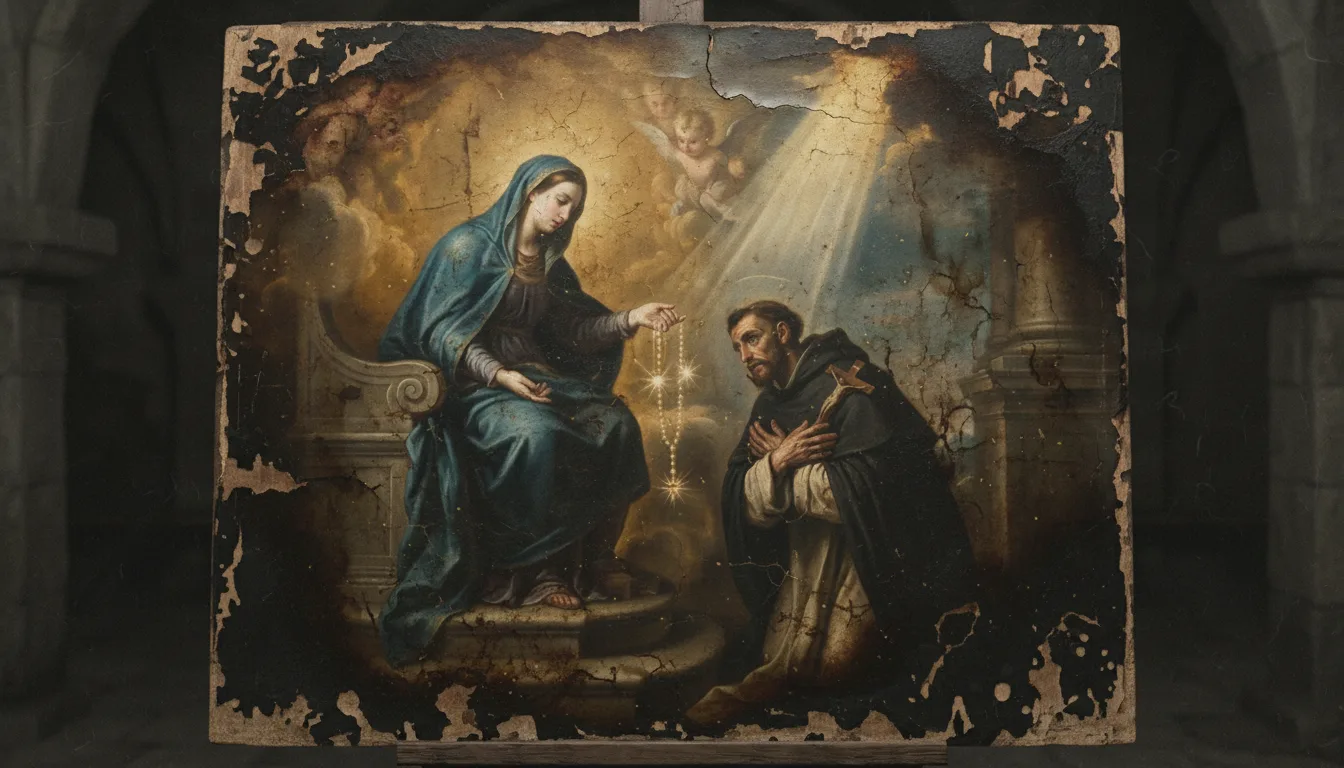
A prayer for one's own peace and healing, or for another, may be made simply in one's own words; here is one form, grounded in Scripture:
O God, who carest for me and knowest my whole heart, look upon the trouble of my mind. Thou hast said, Come to me, all you that labour and are burdened, and I will refresh you. Grant me, then, refreshment and rest. Steady my thoughts, calm my fears, and give me the sound mind thy Apostle promises. Bless the hands of those who care for me, and let thy peace, which surpasseth all understanding, keep my heart and mind in Christ Jesus. And if this burden is not yet to be lifted, give me grace to carry it with Thee, saying with Thy Son, not my will, but thine be done. Amen.
A prayer for mental strength and a sound mind
For strength to endure, and against the fears and obsessive dread that torment the mind, the tradition turns to the Psalms and to the name of Jesus:
Lord Jesus Christ, my strength and my refuge, "the Lord is my light and my salvation, whom shall I fear?" (Psalm 26:1). Give me Thy power against my weakness, Thy love against my despair, and that sound mind which Thou alone canst give. Cast out from me every fear that is not the fear of Thee, and let me rest in the truth that Thou hast care of me. Amen.
Some commend such intentions to deliverance — that is, to be freed from the spirit of fear. This is rightly understood not as a private exorcism, which belongs to the Church and her priests alone, but as the ordinary prayer of any Christian asking God to free him from inward torment, after the example of the Psalmist: "I sought the Lord, and he heard me; and he delivered me from all my troubles" (Psalm 33:5).
A prayer for a son's or daughter's mental health
A parent's prayer for a suffering child is among the dearest to God:
Heavenly Father, I commend to Thee my son (daughter) (name), whom Thou hast given me. Thou lovest him more than I can. Look upon the trouble of his mind and grant him healing of body and soul, peace in his fears, and the light of hope. Lay Thy hand upon those who treat and help him, and surround him with Thy protection. Holy Mary, health of the sick and refuge of sinners, pray for my child. Saint Dymphna, intercede for him. Through Christ our Lord. Amen.
The Church's confidence here is the confidence of the Gospel: the centurion, the Canaanite mother, the father of the possessed boy all brought their loved ones to Christ and were heard. "I do believe, Lord. Help my unbelief" (Mark 9:23) is the prayer of every parent who hopes against discouragement.
Frequently Asked Questions
What is mental prayer?
Mental prayer is prayer made with the mind alone — a raising of the soul to God in thought, affection, and resolution, without the spoken words of vocal prayer. The Catechism of Saint Pius X teaches that "mental prayer is that which is made with the mind alone; vocal prayer is that which is made with words." For beginners it ordinarily takes the form of meditation: we take a truth of faith, turn it over before God, and draw from it affections and a resolution.
How is mental prayer different from vocal prayer?
Vocal prayer is made with words, whether aloud or in the heart, such as the Our Father or the Rosary; mental prayer is made with the mind alone, in silent thought and affection. They are not rivals but companions — mental prayer gives vocal prayer its soul, and as Scupoli notes, the Rosary itself is a meditation on the mysteries of Christ clothed in words. Both raise the mind and heart to God.
Is mental prayer necessary for salvation?
Methodical meditation, Tanquerey teaches, "is a very efficacious means of sanctification, but is not, however, necessary for salvation for the body of Christians." What is strictly necessary is to pray. Yet for anyone who wishes to make real progress, mental prayer is "the most efficacious means of securing one's salvation," for, as Saint Alphonsus says, "with prayer one cannot long remain in grave sin."
How do you do mental prayer?
Set aside half an hour, ideally in the morning. Begin with preparation: place yourself in the presence of God, humble yourself with an act of contrition, and invoke the Holy Ghost. Then take a truth or virtue, consider it to move the will, examine yourself upon it, and ask God for the grace. Close with a single concrete resolution for the day, thanksgiving, and entrustment to Our Lady.
What do you meditate on in mental prayer?
You take a truth of faith, a mystery of the life or Passion of Christ, or a virtue you need. Scupoli, for example, bids us dwell on a scene such as the scourging to obtain patience — pondering each point until we feel His pains, then begging Him for that virtue. The reasoning is never the goal; it exists to kindle the heart and move the will to love and resolve.
How do I deal with distractions during mental prayer?
Trouble yourself only with voluntary distractions; involuntary thoughts "are not culpable unless one voluntarily dwells on them." Repel them promptly and gently as soon as you notice them, and attack their cause through better preparation and habitual recollection. Tanquerey even encourages the soul: "if twenty times they return to the assault and if twenty times we repel them, this will be an excellent meditation."
What is spiritual dryness in prayer?
Dryness is the withdrawal of the sensible consolations God often grants at the beginning, so that prayer feels hard and the soul may think itself abandoned. It is no reason to stop. "What God asks of us is effort and not success," Tanquerey writes, and there is more merit in persevering when prayer is dry; such dryness purifies the soul and teaches it to seek God rather than the comfort it feels.
Is mental prayer the same as prayer for mental health?
No — the two should not be confused. Mental prayer is a technical term for prayer made in the mind, the meditation described above; it is not a remedy for mental illness, and a soul suffering from anxiety, depression, or grief should seek the ordinary helps God provides, including the care of a good physician. That said, the Church has always known that turning the mind to God steadies and consoles the soul, for "a contrite and humbled heart, O God, thou wilt not despise" (Psalm 50). Prayer does not replace healing; it commends the sufferer to the One who heals. Those carrying such burdens may bring them confidently to God, after the manner Scripture commends: "Cast all your care upon him, for he hath care of you" (1 Peter 5:7).
What does the Bible say about mental illness?
Scripture never treats anguish of mind as a sign of God's rejection; it shows God close to the broken. "The Lord is nigh unto them that are of a contrite heart" (Psalm 33:19), and "a contrite and humbled heart, O God, thou wilt not despise" (Psalm 50:19). The Psalms carry despair itself into prayer — "Why art thou sad, O my soul? ... Hope in God" (Psalm 42:5) — and Our Lord calls precisely the burdened: "Come to me, all you that labour and are burdened, and I will refresh you" (Matthew 11:28).
What does God say about mental health?
His repeated word to the fearful is do not be afraid and cast your care on me: "Cast all your care upon him, for he hath care of you" (1 Peter 5:7); "the peace of God, which surpasseth all understanding, [shall] keep your hearts and minds" (Philippians 4:7). Saint Paul names the gift opposed to a tormented mind: "God hath not given us the spirit of fear; but of power, and of love, and of a sound mind" (2 Timothy 1:7).
Who is the patron saint of mental health?
Saint Dymphna, an Irish martyr venerated at Geel, is the patroness invoked for mental and nervous afflictions and for those who care for the troubled in mind. Saint John of God and Saint Benedict Joseph Labre are also invoked. We ask the saints not as magicians but as friends who carry our petitions before God.
Is there a Catholic prayer for mental health or mental illness?
Yes — one may pray simply in one's own words, or use a set form such as the prayers given above for healing, for strength and a sound mind, and for a suffering son or daughter. The Church's rule is twofold: pray with real confidence, and never use a prayer as a charm or a substitute for the physician's care, for grace works through nature and faith does not despise medicine.
Can prayer cure mental illness?
Prayer is never a magic cure, and to treat it as one would be superstition. But prayer is never useless: it commends the sufferer to God, steadies the soul, and obtains grace to endure or to be healed according to His will. The Church honours the ordinary helps God provides — including good medical care — alongside prayer. We ask boldly and add always, "not my will, but thine be done."
Begin small. Half an hour, or even a quarter, faithfully kept each day, will do more than long prayers made by fits and starts. The point is fidelity, not feeling: the soul that comes daily before God, however poorly, is the soul that He quietly transforms.
The Iter Fidei app carries the prayers, the devotions, and a guide to the spiritual life — free to taste before you download, a help for daily meditation. Join early access here.
Sources. The Spiritual Life: A Treatise on Ascetical and Mystical Theology, Adolphe Tanquerey (1924), nos. 664–701 (definition, necessity, and methods of mental prayer; method of Saint Sulpice; distractions and dryness). The Spiritual Combat, Don Lorenzo Scupoli (1589), Chapters XLIV–XLVIII (prayer; what mental prayer is; prayer by way of meditation; meditation on the Blessed Virgin). The Ways of Mental Prayer, Dom Vitalis Lehodey, O.C.R. (1908), on the degrees of mental prayer from discursive meditation to the prayer of simplicity. Catechism of Saint Pius X (1908), Part II, Chapter 1 (Prayer in General). Scripture cited from the Douay–Rheims version (Psalms 26, 33, 42, 50; Matthew 11; Mark 9; Luke 22; Philippians 4; 2 Timothy 1; 1 Peter 5). On the patronage of Saint Dymphna, the Roman Martyrology and traditional devotional usage.