
Novenas
Novena to St Josemaria Escriva
The full novena to St Josemaria Escriva — the daily prayer said nine days for the sanctification of work, with the forms prayed for work, for the sick, for marriage, and for forgiveness, and the saint's life.
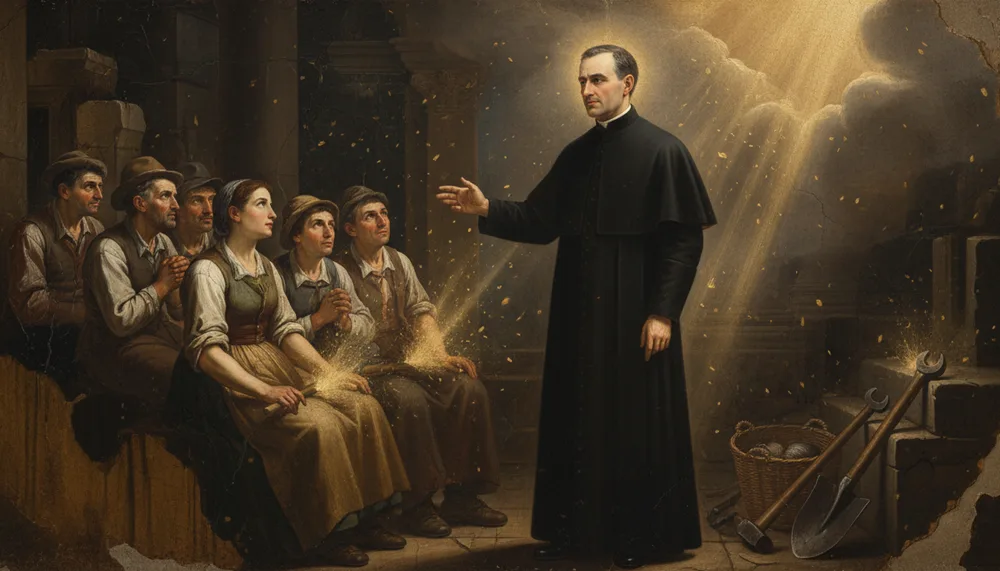
The novena to St Josemaria Escriva is a nine-day prayer to the founder of Opus Dei, asking his intercession above all for the grace to sanctify one's daily work and ordinary duties — and, in its several forms, for a particular need such as work, health, marriage, or forgiveness. It is most fittingly prayed in the nine days from 17 June to 25 June, ending on the eve of his feast on 26 June. Below we give the daily prayer in full, the special forms the faithful most often seek, how to keep the nine days, and the life of the saint himself.
A note on this devotion
St Josemaria Escriva died in 1975 and was canonized by Pope John Paul II in 2002. This devotion, and the prayer at its heart, are therefore modern — composed for private use and approved with ecclesiastical permission, but not part of the 1962 books or the traditional calendar. We give the novena in full because it is widely sought, entirely orthodox, and rich in a very old truth: that a Christian is sanctified in his ordinary work.
Those attached to the traditional treasury may prefer the sure old intercessors for the same needs — St Joseph the Worker for work and provision, or the Litany of Humility for the hidden sanctification of daily duty — and may pray this one alongside them with an easy conscience. If you are new to the practice itself, see our guide to what a novena is and why nine days.
The novena prayer to St Josemaria Escriva
This is the prayer at the heart of the devotion, approved for private recitation and said once on each of the nine days. Name your intention where the prayer opens a space for it, and close each day with the Our Father, Hail Mary, and Glory Be.
O God, through the mediation of Mary our Mother, you granted your priest Saint Josemaria countless graces, choosing him as a most faithful instrument to found Opus Dei, a way of sanctification in daily work and in the fulfillment of the Christian's ordinary duties. Grant that I too may learn to turn all the circumstances and events of my life into occasions of loving you and serving the Church, the Pope, and all souls with joy and simplicity, lighting up the pathways of this earth with faith and love.
Deign to grant me, through the intercession of Saint Josemaria, the favour of (here make your request). Amen.
Our Father. Hail Mary. Glory be.
Many add the short aspiration that Opus Dei carries with the prayer card: "Saint Josemaria, intercessor for daily life, pray for us." The same daily prayer serves every intention; what changes between the forms below is the meditation the faithful bring to it and the particular grace they name.
The nine days: work sanctified
Because St Josemaria's whole message was the sanctification of ordinary work, the most common way to keep the novena is to join to the daily prayer a short reflection on one aspect of Christian work each day. This nine-day path is drawn from his own teaching:
- Day 1 — Work as a path to holiness: that we may see our daily labour not as a curse but as the road God has given us to sanctity.
- Day 2 — Love as the foundation: that we may work for love of God, which alone gives our labour its worth.
- Day 3 — Time as a treasure: that we may not squander the hours, but redeem the time God lends us.
- Day 4 — Work done well: that we may finish our tasks with care, offering God nothing shoddy or half-done.
- Day 5 — The dignity of every honest task: that we may honour the humblest work as much as the great, for all can be offered to God.
- Day 6 — God's presence in our labour: that we may keep Him before us in the midst of the day's business.
- Day 7 — Virtue forged in daily duty: that patience, order, and diligence may grow in us through our work.
- Day 8 — Work as service to others: that our labour may serve our neighbour and the common good.
- Day 9 — Work as apostolate: that our example at work may draw souls toward God.
On each day, read the day's intention, pray the novena prayer above with your own request, and close with the three prayers. Those who prefer may simply repeat the prayer for nine days without the daily themes — the devotion does not bind you to them.
The St Josemaria Escriva novena for work
Of all the forms of this devotion, the novena for work is the most fitting, for the sanctification of ordinary work was the very heart of St Josemaria's preaching. Opus Dei publishes this novena in full, and it is prayed both by those seeking employment and by those asking to do the work they already have for the love of God.
Pray the daily prayer above, naming your request plainly — for honest work, or for the grace to do my work well — and let the nine daily themes above shape your meditation. The soul that turns its office, its trade, or its household into an offering has understood the saint. For the older and surer patronage of a working man, join it to the novena to St Joseph the Worker, the carpenter of Nazareth who fed God Himself by the labour of his hands.
The St Josemaria Escriva novena for the sick
The novena for the sick brings to St Josemaria the intercession he is now most widely invoked for — he is popularly regarded as a heavenly friend of the ill, and the miracle accepted for his canonization was the cure of a grave disease. Pray the daily prayer for the sick person by name, asking health of body if it be God's will, and always the graver grace of a soul made ready and at peace. Illness borne well is itself a work sanctified, as the saint taught. Those who wish may also turn to St Peregrine, the traditional patron of the gravely ill, or to Our Lady of Lourdes, and pray the two together.
The St Josemaria Escriva novena for marriage
The novena for marriage commends to St Josemaria a Christian home — whether asking for a good and holy spouse, or for the healing and strengthening of a marriage already made. His teaching held marriage and family life to be a genuine path to sanctity, no lesser than any vocation, so that spouses are called to become saints precisely through their love and their daily faithfulness to one another. Name your intention in the daily prayer — for a holy marriage, or for the peace of my home — and pray it through the nine days. It joins well to the Holy Family novena, which sets every Christian household under the roof of Nazareth.
The St Josemaria Escriva novena for forgiveness
The novena for forgiveness asks, through the saint's intercession, the grace of true contrition, a good confession, and reconciliation — with God, and often with a person from whom we are estranged. Opus Dei publishes this form as well. St Josemaria preached tirelessly of God's mercy and of "beginning again" each day; his novena for forgiveness leans on that confidence. Pray the daily prayer, naming the sin you wish to be freed of or the person you wish to forgive, and bring the fruit of the novena to the confessional. For the great school of divine mercy itself, pray it beside the Divine Mercy novena.
How to pray this novena
A novena is nine days of steady, trusting prayer, and this one is kept simply.
- When to start. The natural time is 17 June through 25 June, so that the ninth day falls on the eve of his feast, 26 June. But the novena may be prayed at any time of year, before any need.
- The nine days. Pray once each day, at a fixed hour if you can, so the devotion has a settled place in your day. If you miss a day, simply resume — the merit is in the faithful asking, not in a flawless count.
- What to pray. The daily prayer above, with your intention named, followed by the Our Father, Hail Mary, and Glory Be. Add the daily theme if you keep the work form, or your own meditation.
- The disposition. Ask plainly for the favour you need, but ask it in submission: Thy will be done. The novena does not compel God; it commends a need to a friend of God, and waits in trust for the grace He judges best. A novena is well joined to Holy Mass and Communion where you can.
Who is St Josemaria Escriva?
Josemaria Escriva de Balaguer was born at Barbastro, in Aragon, Spain, on 9 January 1902, the son of devout Catholic parents whose small business failed and who knew real hardship — a poverty that marked his understanding of ordinary labour. Feeling a call to the priesthood as a boy after seeing the footprints of a barefoot Carmelite in the snow, he was ordained at Zaragoza on 28 March 1925.
On 2 October 1928, while making a retreat in Madrid, he received what he always described as a divine inspiration: he "saw" Opus Dei — "the Work of God" — a path by which lay men and women, without leaving their trades, their families, or the world, might seek holiness precisely in and through their ordinary work and daily duties. This was the burden of all his preaching: that the workshop, the office, the kitchen, and the field are as real a road to sanctity as the cloister, and that "you must sanctify your work, sanctify yourself in your work, and sanctify others through your work." His best-known book, The Way, gathers this teaching in short maxims.
He lived through the Spanish Civil War, when the Church in Spain was savagely persecuted and priests were hunted and killed, and he ministered in hiding at great risk. After the war Opus Dei spread through Spain and then across the world. He guided it until his sudden death in Rome on 26 June 1975, which came, those with him related, just after he had looked with affection at a picture of Our Lady in the room where he worked.
He was beatified in 1992 and canonized by Pope John Paul II on 6 October 2002, in one of the largest such ceremonies of the age. His feast is kept on 26 June. He is invoked as an intercessor for daily life, for workers and professionals, for students, for the sick, and for families — and he intercedes, in short, for the ordinary Christian who wishes to become a saint without leaving his post in the world.
Frequently Asked Questions
When do you pray the novena to St Josemaria Escriva?
The traditional nine days run from 17 June to 25 June, ending on the eve of his feast on 26 June. That is the favoured time, but the novena may be prayed at any point in the year, whenever a particular need presses. It may also be kept, as Opus Dei suggests for some forms, one day a week over nine weeks.
What is St Josemaria Escriva the patron of?
He is invoked especially as an intercessor for daily work and ordinary life — for the sanctification of one's job and duties. He is also widely sought by the sick, by students and professionals, and by families and spouses. The Church has not assigned him a formal single patronage in the old manner; his "patronage" is the whole of ordinary Christian life offered to God.
Is the St Josemaria Escriva novena approved by the Church?
Yes. St Josemaria was canonized in 2002, and the novena prayer is published for private recitation with ecclesiastical permission by Opus Dei. It is entirely orthodox. It is, however, a modern devotion — not part of the traditional 1962 books — and those attached to the older calendar may prefer to pray it alongside the ancient intercessors for the same needs.
How do you pray the novena for work?
Pray the daily novena prayer once each day for nine days, naming your request for work or for the grace to do your work well, and close with an Our Father, Hail Mary, and Glory Be. Many join to each day a short reflection on one aspect of Christian labour — its dignity, its offering to God, its service to others. It pairs naturally with the novena to St Joseph.
What is the difference between the novenas for work, the sick, marriage, and forgiveness?
The daily prayer is the same in every form. What differs is the intention you name and the meditation you bring: the sanctification of labour for the work form, health of body and soul for the sick, a holy home for marriage, and contrition and reconciliation for forgiveness. Choose the form that fits your need, or simply pray the one prayer with your own petition.
Is there a printable PDF of the St Josemaria Escriva novena?
The complete daily prayer is the one given in full above; copy it to keep beside you for the nine days, adding the Our Father, Hail Mary, and Glory Be. Opus Dei also publishes the several forms — for work, for the sick, for forgiveness — as printable leaflets. The Iter Fidei app carries the devotion with day-by-day reminders and audio, so it can be prayed from a phone without a printed sheet.
Rather than a loose printout, carry it in the Iter Fidei app: each day's text, a reminder at the hour you choose, offline, in Latin and in English. Join early access here.
Why was St Josemaria Escriva controversial?
Some in his lifetime and after questioned the speed of his canonization and the influence of Opus Dei. None of this touches the orthodoxy of the prayers themselves or the truth at their centre — that the ordinary Christian is called to holiness in his daily work. A soul may pray this novena in good conscience while leaving debates about the movement to others; it asks only the grace to love God in the duties of one's own state of life.
Pray this novena with day-by-day reminders and audio in the Iter Fidei app — Join early access here.
Sources. The novena prayer to St Josemaria Escriva (approved for private recitation, published by the Prelature of Opus Dei); the several forms of the devotion (for work, for the sick, for forgiveness) as published by the same; the canonization of St Josemaria Escriva by Pope John Paul II (6 October 2002); the life and teaching of St Josemaria, including The Way and his preaching on the sanctification of ordinary work; the concluding prayers (Our Father, Hail Mary, Glory Be) of the traditional Catholic prayer-books.