
Novenas
Novena to St Benedict
The novena to St Benedict of Nursia — the full 'Glorious St Benedict, sublime model of virtue' prayer said nine days for protection, healing, and deliverance from evil, with the story of the saint and his medal.
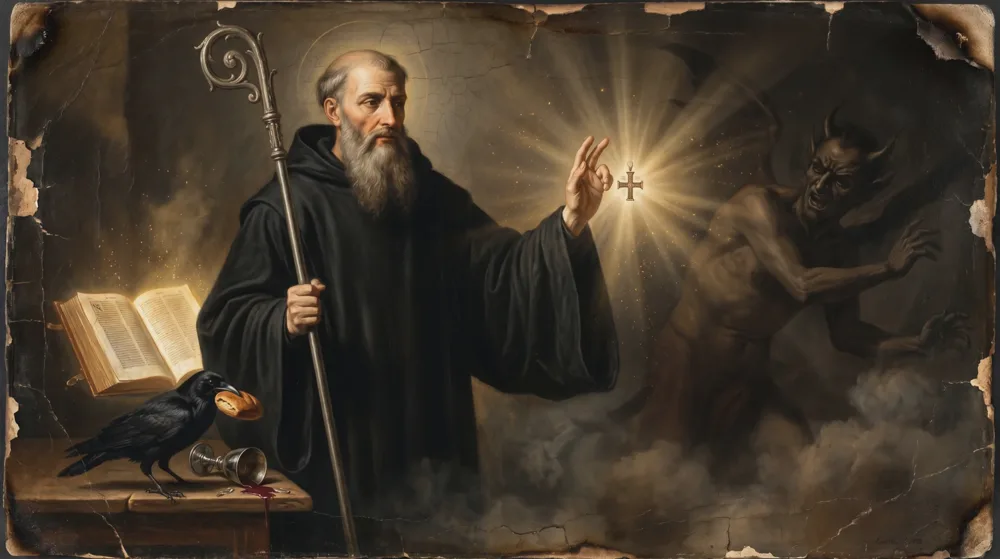
The novena to St Benedict is a nine-day prayer that brings the great patriarch of Western monasticism the needs of a soul under siege — for protection against evil and temptation, for healing of body and mind, for peace, and for the grace to live and die as a faithful child of God.
It leans on the intercession of St Benedict of Nursia (c. 480–547), the abbot whose Rule shaped Christendom, whose medal is the Church's most famous shield against the devil, and whose name has meant the blessed one for fifteen centuries. Below we give the full prayer, the way to pray the nine days, the story of the saint from the old sources, and the meaning of his medal — everything the devotion asks and more. If the word itself is new to you, see our guide to what is a novena.
The full novena prayer to St Benedict
This is the prayer at the heart of the devotion. It is said once on each of the nine days, with your intention named at the start. It is a devotional composition, with no liturgical text and no approval of its own that we can cite; the Church's prayer for his feast is the collect given below. It is a single prayer, prayed identically on every day of the novena — unlike some devotions, this St Benedict novena carries no separate meditation for day one, day two, day three, and so on; its power lies in the same trusting petition repeated for nine days running.
Glorious Saint Benedict, sublime model of virtue, pure vessel of God's grace! Behold me humbly kneeling at your feet. I implore you in your loving kindness to pray for me before the throne of God. To you I have recourse in the dangers that daily surround me. Shield me against my selfishness and my indifference to God and to my neighbour. Inspire me to imitate you in all things. May your blessing be with me always, so that I may see and serve Christ in others, and work for His kingdom.
Graciously obtain for me from God those favours and graces which I need so much in the trials, miseries and afflictions of life. (Here name your request.) Your heart was always full of love, compassion and mercy toward those who were afflicted or troubled in any way. You never dismissed without consolation and assistance anyone who had recourse to you. I therefore invoke your powerful intercession, in the confident hope that you will hear my prayers and obtain for me the special grace and favour I so earnestly implore (name it again), if it be for the greater glory of God and the welfare of my soul.
Help me, great Saint Benedict, to live and die as a faithful child of God, to run in the sweetness of His loving will, and to attain the eternal happiness of heaven. Amen.
To this many join the Church's own prayer for the feast of St Benedict, the collect from the traditional Missal, which makes a fitting close to each day:
May the intercession of blessed Benedict the Abbot commend us, we beseech Thee, O Lord: that what we cannot obtain by our own merits, we may obtain through his patronage. Through Christ our Lord. Amen.
It is customary to add an Our Father, a Hail Mary, and a Glory Be at the end of the prayer each day, and — since St Benedict is so bound to the war against the powers of darkness — the prayer to St Michael the Archangel is a natural companion to the whole nine days.
The novena to St Benedict for healing
Among the most-sought forms of this devotion is the novena to St Benedict for healing — for the sick, for those worn down by long illness, for peace of mind, and for deliverance from what afflicts body and soul together. It is a fitting recourse: St Gregory's Dialogues record that St Benedict cured the sick of the countryside around Monte Cassino, relieved the distressed, and more than once raised the dead.
His medal, treated below, has for centuries been carried by the ill and blessed with a special exorcism against sickness and the malice of the enemy. To pray the novena for healing, use the prayer above and name plainly the person and the sickness — asking always, as the prayer itself teaches, that it be granted if it be for the greater glory of God and the welfare of my soul. The grace of a holy patience under suffering is itself a healing, and never refused to those who ask it well.
A powerful novena for protection against evil
If St Benedict is invoked for anything above all, it is protection — against temptation, against the devil, against every spiritual danger. This is why the devotion is so often called a powerful novena. St Benedict himself was assailed by the tempter under the form of a blackbird and by a violent temptation of the flesh, and conquered both by the sign of the cross and by throwing himself into a thicket of briars; twice men tried to poison him, and twice the poison was undone — the cup shattering at his blessing, the poisoned loaf borne off by a raven.
From this life of combat comes his patronage of those who fight the same war. Prayed for protection, the novena is well joined to the wearing of his medal, to the use of holy water, and to the Chaplet of St Michael — the whole armoury the Church puts into the hands of her children against the enemy.
The St Benedict medal and its prayer
No account of this devotion is complete without the medal of St Benedict, the most celebrated sacramental of the Latin Church, worn and prayed with for deliverance from evil. Every letter on it is a prayer. On the front, around the cross, the letters C S S M L — N D S M D stand for Crux Sacra Sit Mihi Lux, Non Draco Sit Mihi Dux — "May the Holy Cross be my light; let not the dragon be my guide." In the four angles of the cross, C S P B means Crux Sancti Patris Benedicti, "the Cross of the Holy Father Benedict."
Around the rim runs the ancient exorcism: V R S — N S M V — S M Q L — I V B, that is, Vade Retro Satana, Nunquam Suade Mihi Vana; Sunt Mala Quae Libas, Ipse Venena Bibas — "Begone, Satan! Never tempt me with your vanities. What you offer me is evil; drink your own poison." At the top stands the Benedictine word PAX — peace. To pray a novena to St Benedict of the medal is simply to say the prayer above while wearing the medal, or holding it, and to make its inscriptions your own petition against the enemy. Those wishing the fuller account may see our guide to the St Benedict medal.
How to pray the novena to St Benedict
A novena is nine days of prayer for one intention. The form is simple:
- Choose your nine days. The novena may be prayed at any time of year for any grave need. The usual time is the nine days leading to St Benedict's feast on 21 March in the calendar of 1962, beginning on 12 March; those who follow the reformed calendar of 1969, which moved the feast to 11 July, pray it from 3 July (see below).
- Pray once each day. Say the Glorious St Benedict prayer once daily, at a fixed hour if you can, naming your intention at the beginning and again in the body of the prayer.
- Name one intention and hold to it through all nine days — healing, protection, a soul's conversion, a grave temptation, a need of the family or the Church.
- Add the Church's collect, an Our Father, Hail Mary, and Glory Be, and — where you can — join the novena to Holy Mass and Communion, which give it its true weight.
- Ask in submission. The prayer itself sets the disposition: if it be for the greater glory of God and the welfare of my soul. A novena does not bend God's will; it conforms ours to His, and never returns empty.
Who was St Benedict of Nursia?
St Benedict was born about the year 480 at Nursia (Norcia), an ancient town in the Sabine hills, the twin brother of St Scholastica, who from infancy had vowed herself to God. Sent as a youth to Rome for his studies, he was so revolted by the licentiousness of his companions — and so afraid of being corrupted by it — that he fled the city while still not twenty, drawn by God to abandon the world.
After a stay in the mountain village of Enfide he sought complete solitude at Subiaco, where a monk named Romanus clothed him in a sheepskin habit and led him to a cave in the cliff. There, unknown to all but Romanus, who let bread down to him by a rope, St Benedict spent three hidden years in prayer and penance, the years in which God formed him for his work.
Discovered at last, he could not remain hidden. Disciples gathered; he organised them into twelve small monasteries of twelve monks each. Driven at length from Subiaco by the envy of an unworthy priest, he withdrew to Monte Cassino, where he cast down a temple of Apollo, preached the Gospel to a half-pagan people, and about the year 530 laid the foundations of what would become the most famous abbey the world has known.
There he wrote his Rule — a "school for the Lord's service," ordering a life of liturgical prayer, sacred reading, and manual work under one common father — moderate, wise, and destined to shape the monasticism and the civilisation of all the West. It was St Benedict who broke the old prejudice that manual labour was degrading, making it compulsory for noble and peasant alike; from his sons would come the phrase that sums up his spirit, ora et labora, "pray and work."
He was granted the gift of prophecy and of reading hearts. He foretold the destruction of Monte Cassino by the Lombards, which came to pass some forty years after his death; he saw through the Gothic king Totila's attempt to test him by sending a servant in royal robes; he multiplied flour in a famine. Warned of his own approaching death, he had his grave dug, was stricken with fever, received the Body and Blood of the Lord, and died standing on his feet in the chapel, supported by his monks, his hands lifted up to heaven. He was buried beside his sister St Scholastica, on the very site of the idol he had overthrown.
The patronage and feast of St Benedict
St Benedict is the patron of monks and of all religious, the father of Western monasticism; the patron of students and schoolchildren; of farmers, and of a peaceful death; and — through his medal — the great patron invoked against poison, against temptation, against witchcraft and every work of the devil, and for protection in times of danger. In 1964 Pope Paul VI proclaimed him Patron of all Europe, in recognition of the debt the whole continent owes to his Rule.
A word on his feast day, for those attached to the old books. The traditional feast of St Benedict is 21 March, the day of his death (his dies natalis), as it stands in the 1962 Missal and calendar. The reform of 1969 moved his universal feast to 11 July — the ancient date of the translation of his relics — chiefly because 21 March always falls in Lent. Both dates are honourable; most of the popular novenas today count toward 11 July, while those who keep the traditional calendar honour him on 21 March. Either is a fitting close for the nine days.
Other saints named Benedict
Because searches for "St Benedict" gather several saints, a word of distinction. This novena is to St Benedict of Nursia, the abbot and patriarch of monks. He is not the same as St Benedict Joseph Labre (1748–1783), the wandering beggar and pilgrim, patron of the homeless, kept on 16 April; nor St Teresa Benedicta of the Cross (Edith Stein, 1891–1942), the Carmelite convert from Judaism martyred at Auschwitz and canonised in 1998, whose novena is a distinct and modern devotion. When people speak simply of the St Benedict, the novena, and the medal, it is the abbot of Monte Cassino who is meant.
Frequently Asked Questions
What is St Benedict the patron saint of?
St Benedict of Nursia is the patron of monks and religious, of students, of farmers, and of a happy death, and — above all through his medal — the patron invoked against evil, poison, temptation, and the devil, and for protection in danger. In 1964 he was declared Patron of all Europe.
When should I pray the novena to St Benedict?
It may be prayed at any time for a serious need. It is commonly prayed in the nine days before his feast of 21 March in the calendar of 1962 — or, following the reformed calendar of 1969, from 3 July to 11 July. Choose your nine days, hold to one intention, and pray the same prayer once daily throughout.
Is there a day-by-day version — day 1, day 2, day 3?
This St Benedict novena uses one prayer said unchanged on each of the nine days, so "day 1," "day 2," "day 3," and the rest are simply the same Glorious St Benedict prayer repeated with your intention. Its strength is in the perseverance of nine days, not in nine different texts.
Can I pray the novena to St Benedict for healing?
Yes. St Benedict cured the sick and relieved the afflicted in his own life, and his medal has long been blessed for the sick. Pray the novena naming the illness and the person, asking for healing if it be for God's glory and the good of the soul — and asking always for the grace of patience within the suffering.
What do the letters on the St Benedict medal mean?
They are prayers in Latin: Crux Sacra Sit Mihi Lux, Non Draco Sit Mihi Dux ("May the Holy Cross be my light; let not the dragon be my guide"), Crux Sancti Patris Benedicti ("the Cross of the Holy Father Benedict"), and the exorcism Vade Retro Satana ("Begone, Satan… drink your own poison"), with PAX, peace, at the top. The medal is a sacramental against evil, not a charm.
Is the St Benedict novena a powerful prayer for protection?
It is one of the Church's most trusted devotions for protection against temptation and the devil, because St Benedict himself overcame the tempter and the powers of darkness. Prayed with faith — and joined to his medal, to holy water, and to the prayer to St Michael — it places the soul under a proven guardian. Its power is God's, obtained through the saint's intercession, never a force that compels.
Is St Benedict of Nursia the same as St Benedict Joseph Labre?
No. St Benedict of Nursia is the sixth-century abbot and father of monks. St Benedict Joseph Labre is a different and later saint, an eighteenth-century pilgrim and patron of the homeless. This novena, and the famous medal, belong to St Benedict of Nursia.
Pray the novena to St Benedict with day-by-day reminders, the medal prayers, and audio in Latin and your own language in the Iter Fidei app. Join early access here.
Sources. Butler's Lives of the Saints (St Benedict, Abbot, 21 March), drawing on St Gregory the Great, Dialogues, Book II; the Rule of St Benedict; the collect of the Mass of St Benedict, Abbot (traditional Roman Missal); the devotional novena prayer Glorious St Benedict, sublime model of virtue; the inscriptions and blessing of the Medal of St Benedict; Gospel of St Matthew 13:55 on the hidden life of labour.