
The Sacraments
The Roman Missal (1962): Latin-English Missal Guide
The Roman Missal of 1962, the Missale Romanum of the Latin Mass: its parts, its history from Quo primum, the Latin-English hand missals of Lasance and St Andrew, and how to follow Mass with one, in print or online.
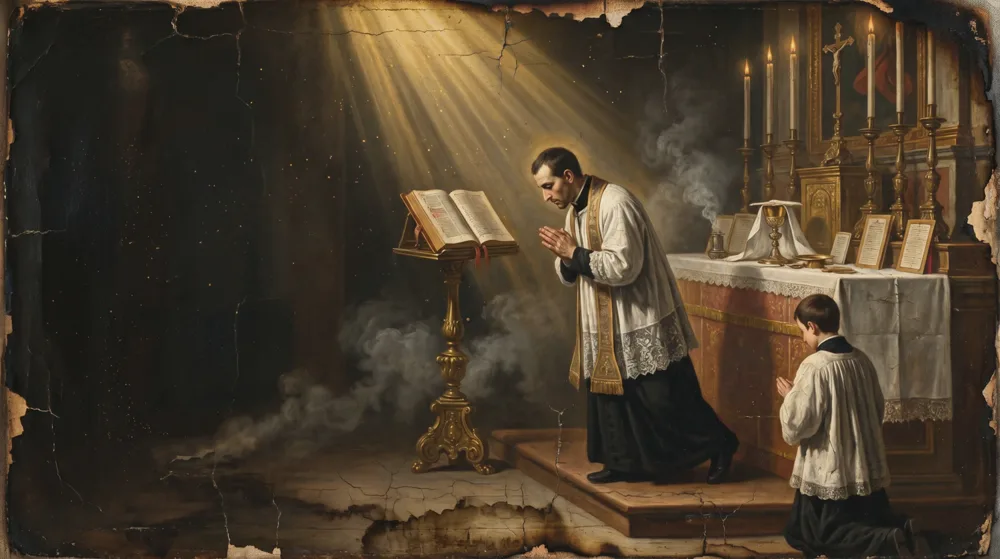
The Roman Missal (Missale Romanum) is the book of the Mass of the Roman rite: everything needed to offer the Traditional Latin Mass, from the fixed prayers of the Ordinary to the changing texts, readings and rubrics of every day of the year.
Codified for the whole Latin Church by Pope St. Pius V in 1570 with the bull Quo primum, it reached its last typical edition in 1962, and that is the edition on the altar wherever the old Mass is offered today (in Spanish-speaking lands, the misal romano of 1962). The faithful follow it in a Latin-English missal, a hand copy of the same book; below we set out what it contains, how the 1962 edition came to be, which hand missals match it, and how to use one at Mass or online.
What the Roman Missal contains: Ordinary, Propers, and calendar
Every traditional Roman Missal, whatever its printing, is built of the same great parts. Knowing them is most of the art of using one.
- The Ordinary of the Mass (Ordo Missae) — the fixed skeleton that never changes: the prayers at the foot of the altar, the Offertory, the Prefaces, the Canon with the words of consecration, and the Communion. Its Latin text, with English, is set out step by step in the order of the Mass in Latin.
- The Proper of the Time (Proprium de Tempore) — the texts that change with the seasons, from the First Sunday of Advent through the last Sunday after Pentecost.
- The Proper of the Saints (Proprium Sanctorum) — the Masses of the saints' feasts, day by day, opening at the end of November around the feast of St. Andrew (November 30).
- The Common of the Saints (Commune Sanctorum) — shared formularies for classes of saints (martyrs, confessors, virgins) used when a feast has no complete proper of its own.
- Votive Masses, Masses for the Dead, and various prayers, together with the calendar and rubrics that determine which Mass is said on which day.
The changing texts of any given Mass — Introit, Collect, Epistle, Gradual, Gospel, Offertory, Secret, Communion, Postcommunion — are called the propers, and we treat them, with the one-year cycle of readings, in Latin Mass readings and Propers. Which set falls on which day is fixed by the traditional Roman Catholic calendar, with its four classes of feasts.
Quo primum: St. Pius V codifies the Missal (1570)
The Roman Missal was not composed in 1570; it was codified then. The Canon of the Mass was already ancient in the sixth century, when Pope St. Gregory the Great gave the Roman liturgy the ordering it has substantially kept ever since. What the Council of Trent asked for, when in its last session (December 1563) it entrusted the revision of the Missal and the Breviary to the Pope, and what St. Pius V supplied, was a single corrected edition to end the confusion of variant printings.
By the bull Quo primum (July 14, 1570), St. Pius V promulgated the restored Missale Romanum and imposed it on the whole Latin Church, excepting only rites that could prove more than two hundred years of continuous use. The bull grants in perpetuity that any priest may use this missal freely and lawfully, "without any scruple of conscience or fear of incurring any penalty," and commands that nothing ever be added to it, removed from it, or changed in it. Later popes issued corrected typical editions (Clement VIII in 1604, Urban VIII in 1634, Benedict XV in 1920 after the reform of St. Pius X), touching the calendar and rubrics while leaving the Ordinary and the Canon intact.
The Missale Romanum of 1962
The 1962 Roman Missal is the last typical edition of this same Tridentine missal. Its title page still names its origin: Missale Romanum ex decreto Sacrosancti Concilii Tridentini restitutum, "the Roman Missal restored by decree of the Holy Council of Trent." In its substance — the Ordinary, the Canon, the one-year cycle of readings, the Offertory prayers, the order of the seasons — it is the missal of St. Pius V. What distinguishes the 1962 edition from the missals our grandparents carried before the war is a short series of rubrical changes, each with an exact date:
| Date | Act | What it changed in the missal |
|---|---|---|
| March 23, 1955 | Decree Cum nostra hac aetate of the Sacred Congregation of Rites | First simplification of the rubrics: fewer commemorations and octaves |
| November 16, 1955 | Decree Maxima redemptionis of the same Congregation | The restored order of Holy Week, with the Easter Vigil returned to the night |
| July 25, 1960 | Motu proprio Rubricarum instructum, with the new Code of Rubrics | Feasts ranked in four classes; rules for commemorations and votive Masses rewritten |
| June 23, 1962 | Decree publishing the new typical edition | The Missale Romanum of 1962, incorporating all of the above |
| November 13, 1962 | Decree Novis hisce temporibus | St. Joseph's name inserted in the Communicantes of the Canon (from December 8, 1962) |
This is the edition used wherever the traditional Latin Mass is celebrated, and the one around which the modern hand missals for the faithful are built. When Catholics speak of the usus antiquior, the Vetus Ordo or simply the old Mass — names whose history we trace in Vetus Ordo, Usus Antiquior: the names of the Latin Mass — the book on the altar is the Missale Romanum of 1962.
Is there a Missale Romanum in English?
The altar missal is a Latin book: the 1962 Mass is offered in Latin, and there is no English altar edition of it. The Missale Romanum in English exists in the hand missals of the faithful, which print the full Latin text with an English translation facing it. That is why a search for a "Latin to English missal" and one for the "1962 Roman Missal" lead to the same books.
The new Roman Missal and the General Instruction
Searches for the Roman Missal often land on a different book. In 1969 Paul VI promulgated a new Missale Romanum for the reformed rite of Mass, whose first typical edition appeared in 1970; its third typical edition appeared in 2002 and entered English-speaking parishes in a new translation in 2011 — the red altar book now found in most parishes. The General Instruction of the Roman Missal (GIRM) is the rubrical preface to that new missal, setting out how the reformed Mass is to be celebrated; in the United States the bishops' conference publishes it.
The traditional Roman Missal has no "General Instruction." Its celebration is governed by its own rubrics printed at the front of the book: the Rubricae generales, the Ritus servandus in celebratione Missae (the order to be observed in celebrating Mass), and the De defectibus, on defects that may occur in celebrating. How the two missals differ — in calendar, readings, Offertory, and orientation — we set out plainly in Tridentine Mass vs Novus Ordo. Our subject here, and the book we pray from, is the traditional missal of St. Pius V in its 1962 edition.
The daily Roman missal: hand missals for the faithful
The altar missal is the priest's book. The daily Roman missal — also called a hand missal — is the faithful's copy: a compact volume setting the Latin and the vernacular side by side, so that the laity can follow every word the priest says at the altar. In English-speaking countries this is the Latin-English missal, with the Latin in one column and the English facing it, usually with short notes on each feast, devotions for Confession and Communion, and the Ordinary printed in the middle of the book so that it can be found by touch. By the twentieth century it was the ordinary way devout Catholics assisted at Mass.
A daily missal contains the complete missal — every day of the year, every feast, the votive Masses and the Masses for the Dead — while a Sunday missal carries only the Sundays and principal feasts. The editions most often asked about fall into two families.
Missals of the 1962 edition. The 1962 Roman Catholic Daily Missal published by Angelus Press and the Daily Missal 1962 from Baronius Press are the standard editions in print, both giving the full 1962 missal in Latin and English, with the restored Holy Week and the calendar of 1960. These match the Mass said today, day for day. (The Daily Roman Missal of Midwest Theological Forum, in its successive editions, is a different book: a hand missal for the reformed rite.)
The classic missals reprinted. Two older Latin-English missals remain much loved:
- Fr. Lasance's New Roman Missal. Edited by Fr. F. X. Lasance, with Fr. Francis Augustine Walsh, O.S.B., and published by Benziger Brothers of New York, it was the great American hand missal of the mid-century; the edition most often reprinted today bears the imprimatur of 1945. Besides the Mass of every day it carries a wealth of prayers, so that for many families it was missal and prayer book in one.
- The St. Andrew Daily Missal. Compiled by Dom Gaspar Lefebvre, O.S.B., a monk of the Abbey of St. André near Bruges, and published in America by the E. M. Lohmann Company of St. Paul, Minnesota, it is known for its liturgical notes introducing each season and feast. Reprints of the 1945 edition are widely sold.
Both predate the restored Holy Week of 1955 and the rubrics of 1960, so on some days (Holy Week above all, and certain feasts, octaves and commemorations) they do not match the Mass said today; the Ordinary and the great majority of the propers are the same. Many chapels also lend a slim Latin Mass missalette, a booklet with the Ordinary of the Mass in Latin and English, which is enough for a first visit to a Latin Mass near you.
How to follow the Mass with a Latin-English missal
The book intimidates at first sight; the practice is simple, and it is learned in a few Sundays.
- Find the day's Mass. A traditional calendar or ordo tells you the feast and its class; our 1962 liturgical calendar shows the coming days. Place one ribbon there, in the Proper of the Time or of the Saints. If a commemoration is made, note its Collect, Secret and Postcommunion too: they follow those of the day.
- Set a second ribbon at the Ordinary of the Mass — the heart of the book, where the prayers at the foot of the altar, the Offertory, the Prefaces and the Canon are printed.
- Move between the two. The Mass alternates in a fixed pattern: Ordinary for the prayers at the foot of the altar, out to the Introit, back for the Kyrie and Gloria, out to the Collect, Epistle, Gradual and Gospel, back for the Credo, out to the Offertory verse, back for the Offertory prayers, and so on to the Communion verse and the Postcommunion. The rubrics in italics signal each move.
- Read the left column, pray in the right. The Latin is what the priest says; the English beside it is so that you may pray the same words with him. The opening dialogue at the foot of the altar shows the layout, taken from Psalm 42:
V. Introíbo ad altáre Dei.
R. Ad Deum qui lætíficat juventútem meam.V. I will go in to the altar of God.
R. To God who giveth joy to my youth.
- Let the altar guide you. The missal on the Epistle side (the right, as you face the altar) means the propers are being read; carried to the Gospel side, it means the Gospel follows; the bell at the Sanctus and at the consecration tells you where the Canon is, even when its words are said silently.
- Do not chase every word. If you lose the place, rest in the Canon and adore. The missal is a means of union with the Sacrifice, not an examination.
At a sung Mass the same book serves, with the chants of the Ordinary — Kyrie, Gloria, Credo, Sanctus, Agnus Dei — carried by the Gregorian chant the missal presupposes. After a Low Mass come the Leonine prayers, also printed in most hand missals.
The Roman Missal online
The traditional missal can be prayed online every day, and a Latin Mass missal online is the simplest way to see how the 1962 missal is laid out before buying one. Our page of today's Latin Mass readings gives the Epistle and Gospel of the day's Mass according to the 1962 missal, and the Latin Mass missal app of Iter Fidei sets the complete propers of each day beside the Ordinary, in Latin and English. For any other date, past or future, Divinum Officium publishes the complete Mass according to the 1962 rubrics, propers and Ordinary side by side. A printed missal remains the noble companion at Mass itself — a bound book, ribbons, no battery — but a missal online is a true missal in content, and many begin that way before buying a book.
Roman Missal PDF and printable text
The full Ordinary of the Mass in Latin and English is given in our page on the order of the Mass in Latin, and it prints as is from your browser; the day's propers print the same way from the readings page. Rather than a stack of loose pages, though, we invite you to carry the missal itself: Join early access here. gives the Mass of every day, propers and Ordinary in Latin and English, offline, with a reminder at the hour you choose.
Frequently Asked Questions
What is the Roman Missal used for?
It is the book from which the priest offers the Holy Sacrifice of the Mass: it gives him every word to be said and every action to be done, for every day of the year. Hand editions of it allow the faithful to pray the same Mass with him.
What is a Roman Catholic missal?
Any book containing the texts of the Mass. The altar missal is the priest's Latin book; a hand missal is the faithful's copy, in Latin and the vernacular. For the traditional rite, both are editions of the Missale Romanum of 1962.
What is the new Roman Missal?
It is the missal of Paul VI, promulgated by the apostolic constitution Missale Romanum of April 3, 1969. The "Roman Missal, Third Edition" sold today is its 2002 edition, and hand missals such as the Daily Roman Missal in its numbered editions follow it; none of them serves for the traditional Mass, which needs a 1962 missal.
What is the General Instruction of the Roman Missal?
In Latin the Institutio Generalis Missalis Romani, it was first issued in 1969 with the new Order of Mass and revised for the third edition of 2002, which is the text now printed at the front of parish altar missals and published separately as a booklet. It has no counterpart of that name in the traditional rite.
How do you set up the Roman Missal for Mass?
Before Mass the priest looks over the Mass of the day and arranges the ribbons of the altar missal, as the Ritus servandus directs, marking the places he will need: the proper of the day, any commemoration, the Preface and the Canon. The missal is then placed on its stand on the Epistle side of the altar, closed or open at the Introit.
How do you cite the Roman Missal?
Cite the edition you quote: for the traditional rite, Missale Romanum ex decreto Sacrosancti Concilii Tridentini restitutum, editio typica 1962, followed by the part (Proper of the Time, Proper of the Saints, Ordinary) and the Mass, for example "Missale Romanum (1962), Dominica I Adventus, Introitus."
What is the daily Roman missal?
It is a hand missal containing the Mass of every day of the year, not only Sundays, with the Latin and English in parallel columns. For the traditional Mass, choose one of the 1962 edition so that it matches the calendar and Holy Week now in use.
The Iter Fidei app puts the traditional Roman Missal in your pocket — the Mass of every day according to the 1962 calendar, propers and Ordinary in Latin and your own language, with the Divine Office beside it. Join early access here.
Sources. Psalm 42:4 (Douay-Rheims); St. Pius V, bull Quo primum (July 14, 1570); Council of Trent, Session XXV (December 3-4, 1563), decree on the Index, the Catechism, the Breviary and the Missal; Sacred Congregation of Rites, decrees Cum nostra hac aetate (March 23, 1955), Maxima redemptionis (November 16, 1955) and Novis hisce temporibus (November 13, 1962); John XXIII, motu proprio Rubricarum instructum (July 25, 1960); Missale Romanum, editio typica 1962, with the Rubricae generales, the Ritus servandus in celebratione Missae and the De defectibus; Fr. F. X. Lasance, The New Roman Missal (1945); Dom Gaspar Lefebvre, O.S.B., St. Andrew Daily Missal (1945).