The Sacraments
Holy Orders: The Catholic Priesthood
Holy Orders is the sacrament by which bishops, priests, and deacons are ordained to offer the Holy Sacrifice and govern the Church.
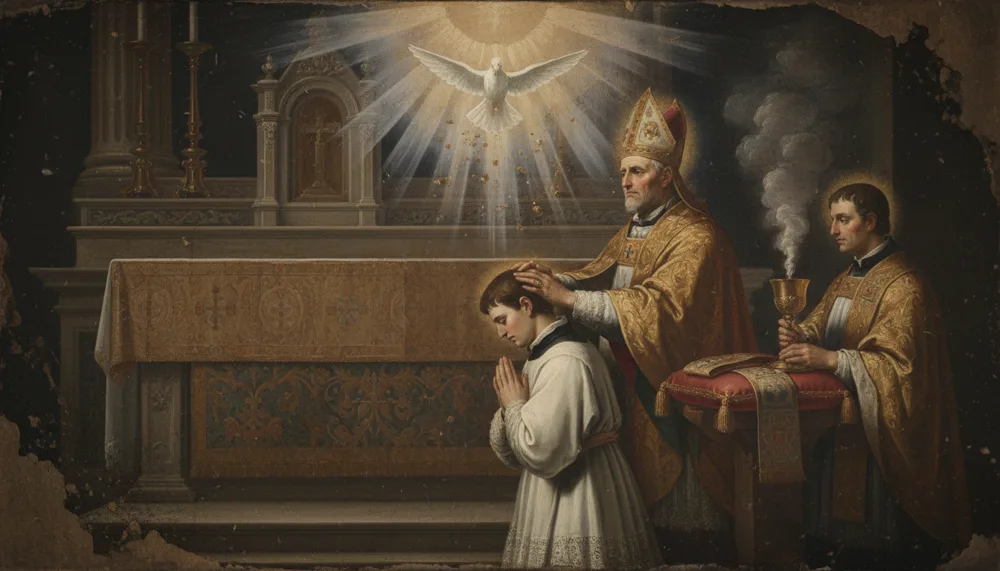
Holy Orders is the sacrament by which bishops, priests, and deacons are ordained to offer the Holy Sacrifice of the Mass, to forgive sins, and to govern the Church. It gives the power to exercise the sacred functions that pertain to the worship of God and the salvation of souls, and it imprints upon the soul of the man who receives it the indelible character of a minister of God. By this sacrament Our Lord continues His own priesthood in the world: as the Father sent Him, and He sent the Apostles, so the Apostles' successors are sent every day with the same powers.
What Holy Orders is
The Catechism of St Pius X defines the sacrament with precision: "Holy Orders is the sacrament which gives the power to exercise the sacred functions that pertain to the worship of God and the salvation of souls, and which imprints upon the soul of him who receives it the character of a minister of God." It is called Order because it comprises several degrees subordinate one to another, whence results the sacred hierarchy.
The word itself carries the meaning. Order renders the Latin ordo, a word the Romans used for a rank or body of men set apart for a public function. The Roman Catechism explains that the name signifies "a regular distribution of superior and inferior parts so harmonising together as to render their mutual relation and connection clearly intelligible." Applied to the Church, the definition of Holy Orders is therefore this: it is the sacrament by which men are set in a fixed rank of the sacred hierarchy and given, by the grace of that rank, the power to serve God's worship and the salvation of souls. To define it more shortly still: Holy Orders is the sacrament that makes a man a deacon, a priest, or a bishop, and never leaves him as it found him.
That hierarchy ascends by rank. The Roman Catechism teaches that the orders are seven, divided into minor and major. The minor orders are Porter, Lector, Exorcist, and Acolyte; the major or sacred orders are Subdeacon, Deacon, and Priest. Above the simple priesthood stands the Episcopate, which contains the fullness of the priesthood. Tonsure precedes them all as a preparation, by which a man first takes the Lord for his portion and inheritance and is numbered among the clergy.
The whole of this ministry is ordered to the Holy Eucharist. The minor orders and the subdiaconate exist to serve the altar; the diaconate assists the bishop and priest in the Sacrifice and reads the Gospel; the priesthood consecrates the Body and Blood of Christ. As the Roman Catechism observes, all the other sacraments depend upon Holy Orders, for without it some could not exist at all and the rest would lose their solemn rites.
The dignity of the Catholic priesthood
The Roman Catechism does not soften the matter: bishops and priests are "the interpreters and ambassadors of God," charged "to hold on earth the place of God Himself," so that no functions can be conceived more noble than theirs. Scripture itself calls them, justly, angels and even gods, "because they exercise in our midst, as it were, the very Power of the immortal God."
What sets the priest of the New Law above every priesthood before him is the power he wields. The Catechism of St Pius X names it a twofold power: over the real body of Christ in the Eucharist, and over His mystical body, the Church. The Roman Catechism makes the same division — the power of Orders, whose object is the adorable Body of Our Lord in the Holy Eucharist, and the power of Jurisdiction, exercised upon His mystical body to govern and lead the Christian people to everlasting happiness. "For the power they have of consecrating and offering the Body and Blood of Our Lord Jesus Christ, and that of forgiving sins, surpasses all our human conceptions. Nothing comparable to it can be found on earth."
Because the priest stands in the place of Christ, to despise him is no small thing. The Catechism of St Pius X calls contempt for priests "a very grave sin, because the contempt and the insults addressed to the priest reach Jesus Christ Himself, who said to His Apostles: 'He that despiseth you despiseth me.'" The priesthood we honour is the same priesthood that consecrates at the altar in the Tridentine Mass.
When Christ instituted the priesthood
The sacrament is not a human invention but a divine institution. The Catechism of St Pius X teaches that "Jesus Christ established the priestly Order at the Last Supper, when He conferred upon the Apostles and their successors the power to consecrate the most Holy Eucharist." Then, on the day of His resurrection, He gave them the power to forgive and retain sins, "thus constituting them the first priests of the new law in all the fullness of their power."
The Roman Catechism grounds this same power in the words of the Lord recorded by Saint John and Saint Matthew: "As the Father hath sent me, I also send you: receive ye the Holy Ghost: whose sins you shall forgive, they are forgiven them." The priesthood of the New Law comes not from Moses but from Jesus Christ, a Priest according to the order of Melchisedech and not of Aaron — a power wholly heavenly, surpassing even that of the Angels.
The matter and form of the priesthood
The Roman Catechism describes the rite of priestly ordination plainly. The bishop imposes hands upon the man being ordained; he anoints his hands with holy oil; he presents the chalice with wine and the paten with bread, saying, "Receive the power of offering Sacrifice to God, and of celebrating the Mass both for the living and for the dead." Then, imposing hands a second time, he says, "Receive the Holy Ghost, whose sins you shall forgive, they are forgiven them, and whose sins you shall retain, they are retained." These words joined to the matter "really confer the power of consecrating the Eucharist," and they "imprint upon the soul a character" — which is why ordination, like Baptism and Confirmation, is never repeated.
The bishop, sole minister of the sacrament
Holy Orders cannot be conferred by just anyone. The Catechism of St Pius X is exact: "The only minister of this sacrament is the Bishop." The Roman Catechism agrees that to the bishop alone belongs the conferring of holy orders, proven by Scripture, tradition, the Fathers, the councils, and the constant custom of the Church. A single bishop suffices to ordain subdeacons, deacons, and priests; but by an apostolic tradition always kept in the Church, the consecration of a bishop requires three.
At the summit of the hierarchy stands the Roman Pontiff, seated upon the see of Saint Peter. The Roman Catechism teaches that the Church recognises in him "the Primacy of honour and the universality of Jurisdiction, which he holds, not from the decrees of Councils or from other human constitutions, but from God Himself," as the lawful and true Vicar of Our Lord Jesus Christ governing the whole Church.
Why the priesthood is necessary
The Catholic priesthood is not optional furniture in the Church; it is the channel of her life. The Catechism of St Pius X states that without it "the faithful would be deprived of the Holy Sacrifice of the Mass and of the greater part of the sacraments; they would have no one to instruct them in the Faith, they would remain like sheep without a shepherd at the mercy of the wolves; in a word, the Church would no longer exist as Jesus Christ instituted it." For this reason the priesthood "will endure until the end of the ages, for Jesus Christ has promised that the powers of hell shall never prevail against His Church."
The divine vocation
No man may take this dignity to himself. The Roman Catechism, citing the Apostle, warns that "neither doth any man take the honour to himself, but he that is called by God, as Aaron was." The Catechism of St Pius X teaches that what is necessary above all to enter the ecclesiastical state is the divine vocation, discerned by fervent prayer, the counsel of one's bishop or a prudent director, and an honest examination of one's aptitudes. To enter without that call is "a very grave wrong," a danger of perdition; and parents who, for human motives, push a son into orders without a vocation usurp the right God reserves to Himself of choosing His ministers.
The faithful, for their part, owe the priesthood three things: to leave their sons free to follow the divine call; to pray God for good pastors and zealous ministers — the very end for which the fasts of the Ember Days were instituted; and to hold in singular respect all those who, by Orders, are consecrated to the service of God.
The symbols of Holy Orders
Each sacrament speaks through visible signs, and the symbols of Holy Orders are drawn from the very rite of ordination. They are not decorations added afterward; they are the matter and ceremonies through which the bishop confers the office, so that the eye is taught what the soul receives.
The first and chief symbol is the imposition of hands. The bishop lays his hands upon the head of the one being ordained, in silence, as the Apostles did when they "prayed and imposed hands" upon their first ministers. This gesture is the essential sign of the conferring of the sacred power, and Scripture itself binds the grace to it: "Stir up the grace of God which is in thee by the imposition of my hands."
For the priesthood, the central symbols are the chalice and paten with the bread and wine. The bishop places them in the hands of the new priest, saying, "Receive the power of offering Sacrifice to God, and of celebrating the Mass both for the living and for the dead." Chalice and paten are thus the proper emblem of the priest, for they declare the very thing the priesthood exists to do: to offer the Holy Sacrifice. Beside them stands the anointing with holy oil, by which the bishop consecrates the hands that will consecrate the Body and Blood of Christ — the symbol of a man set apart and made fit for sacred things.
To these are joined the vestments handed on in the rite, each a sign of the order conferred: the stole, worn by deacon, priest, and bishop as the badge of the sacred ministry and a figure of the yoke of Christ and the robe of immortality; the chasuble of the priest, a sign of charity covering all his works; the dalmatic of the deacon. The bishop receives further symbols of the fullness of the priesthood: the mitre, the crosier or pastoral staff that marks him as shepherd, and the ring, sign of his fidelity to the Church his bride.
The minor orders too have their symbols, for each was given by handing the candidate the instruments of his office: keys to the Porter, the book of lessons to the Lector, the book of exorcisms to the Exorcist, candlestick and cruets to the Acolyte. In every case the symbol teaches the same lesson — that the man is given a real share in the service of the altar, sealed upon his soul by a character that no symbol could ever erase.
Holy Orders among the seven sacraments
Holy Orders is one of the seven sacraments instituted by Christ, and one of the two — with Marriage — directed to the good of the whole community rather than chiefly to the sanctification of the receiver. Yet it stands apart even there, for it is the sacrament that makes the others possible. The priest baptizes, absolves in Confession, and above all consecrates the Eucharist. Where there is no validly ordained priesthood, the altar falls silent. The Catholic priesthood is therefore the sacrament by which Christ keeps His own presence and His own pardon within reach of His people until the end of the world.
Frequently Asked Questions
What is Holy Orders?
Holy Orders is the sacrament instituted by Christ which gives a man the power to exercise the sacred functions that pertain to the worship of God and the salvation of souls, and which imprints upon his soul the indelible character of a minister of God. By it bishops, priests, and deacons are ordained to offer the Holy Sacrifice, forgive sins, and govern the Church. Because this character can never be effaced, the sacrament, like Baptism and Confirmation, is received only once.
What are the holy orders?
The Roman Catechism teaches that the orders are seven, divided into minor and major. The minor orders are Porter, Lector, Exorcist, and Acolyte; the major or sacred orders are Subdeacon, Deacon, and Priest. Above the simple priesthood stands the Episcopate, which holds the fullness of the priesthood, while Tonsure precedes all the rest as a preparation by which a man first takes the Lord for his portion.
What is the sacrament of Holy Orders?
It is one of the seven sacraments, and the one that makes the others possible, for the priest baptizes, absolves in Confession, and consecrates the Eucharist. The Catechism of St Pius X defines it as the sacrament "which gives the power to exercise the sacred functions that pertain to the worship of God and the salvation of souls." As the Roman Catechism observes, all the other sacraments depend upon Holy Orders, "for without it some could not exist at all and the rest would lose their solemn rites."
How many orders are there in the Catholic Church?
The Roman Catechism teaches that the orders are seven, divided into minor and major. The four minor orders are Porter, Lector, Exorcist, and Acolyte; the three major or sacred orders are Subdeacon, Deacon, and Priest. Above the simple priesthood stands the Episcopate, which holds the fullness of the priesthood, and Tonsure precedes all the rest as a preparation. These sacred orders are not to be confused with the religious orders — the Benedictines, Dominicans, Franciscans, and the like — which are communities living under a rule, not degrees of the sacrament.
Who can administer the sacrament of Holy Orders?
The only minister of Holy Orders is the Bishop. A single bishop suffices to ordain subdeacons, deacons, and priests; but by an apostolic tradition always kept in the Church, the consecration of a new bishop requires three. No man may take this dignity to himself, for "neither doth any man take the honour to himself, but he that is called by God, as Aaron was" — the divine vocation is necessary above all.
What is the meaning of Holy Orders?
The meaning lies in the word. Order renders the Latin ordo, a rank or body set apart for a public function, which the Roman Catechism explains as "a regular distribution of superior and inferior parts so harmonising together as to render their mutual relation and connection clearly intelligible." Applied to the Church, Holy Orders means the sacrament by which a man is set in a fixed degree of the sacred hierarchy — deacon, priest, or bishop — and given the grace and power proper to that degree for the worship of God and the salvation of souls.
What are the symbols of Holy Orders?
The symbols are drawn from the rite of ordination itself. The chief symbol is the imposition of the bishop's hands, the essential sign of the conferring of sacred power. For the priesthood the central symbols are the chalice and paten with bread and wine, handed to the new priest as the emblem of his office of offering the Holy Sacrifice, together with the anointing of his hands with holy oil. The vestments are also symbols: the stole worn by deacon, priest, and bishop; the chasuble of charity; and, for a bishop, the mitre, crosier, and ring. Each sign teaches what the soul invisibly receives.
What is Holy Orders in the Catholic Church?
In the Catholic Church, Holy Orders is the sacrament that ordains bishops, priests, and deacons and forms the sacred hierarchy. It is the order that makes the others possible: the priest baptizes, absolves in Confession, and consecrates the Eucharist, so that where there is no validly ordained priesthood the altar falls silent. It is conferred only by a bishop, only upon men called by God, and it imprints an indelible character, which is why it is received only once and can never be repeated.
The Iter Fidei app carries the prayers, the catechism, and a guide to the Faith — free to taste, simple to download. Download it here.
Sources. Catechism of the Council of Trent (Roman Catechism, 1566), Part II, "On the Sacrament of Holy Orders"; Catechism of St Pius X (1908), Part IV, Chapter 8, "Holy Orders." Scripture: Douay-Rheims (John 20; Matthew 18; Hebrews 5 and 7; 2 Timothy 1; Luke 10).