
The Sacraments
The Sacrament of Confirmation
Confirmation is the sacrament by which the baptised receive the Holy Ghost in fullness, with His seven gifts, to be strengthened as soldiers of Christ to profess and defend the Faith.
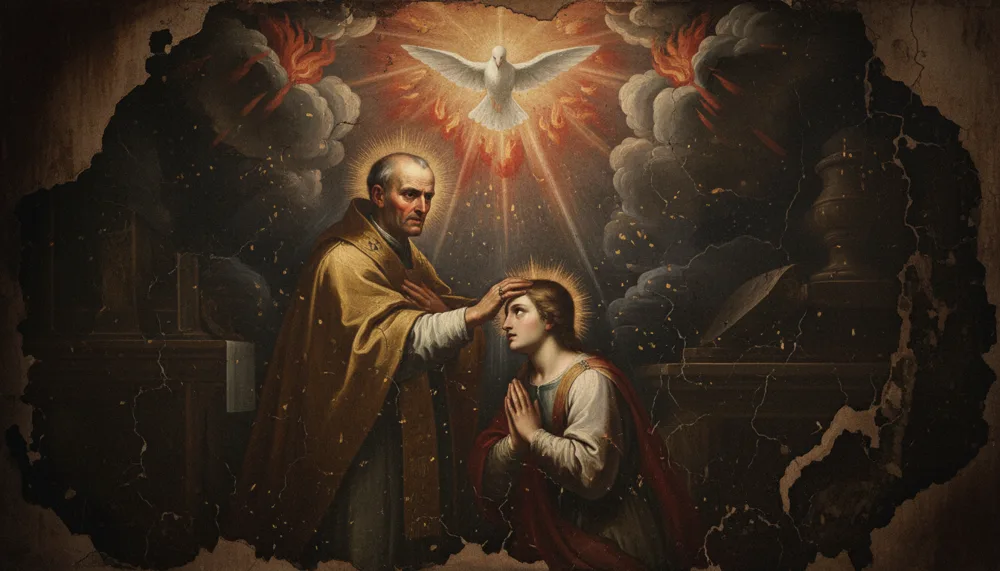
Confirmation is the sacrament by which the baptised receive the Holy Ghost in fullness, with His seven gifts, to be strengthened as soldiers of Christ and made able to profess and defend the Faith. It is the second of the seven sacraments, administered ordinarily by a Bishop, who anoints the forehead with holy Chrism. The Catechism of Saint Pius X answers the head question without qualification: "Confirmation is a sacrament which gives us the Holy Ghost, imprints upon our soul the character of soldiers of Christ, and makes us perfect Christians."
What is Confirmation?
What is Confirmation, beneath the ceremony the eye sees? It is the giving of the Holy Ghost to one already born again. Baptism gives the divine life; Confirmation brings it to strength. The Catechism of Saint Pius X teaches that "Confirmation makes us perfect Christians because it confirms us in the faith and perfects the other virtues and the gifts which we received in holy Baptism; and it is from this that it takes its name." It is not a renewal of baptismal promises by the candidate, as is sometimes supposed, but the act of God confirming what Baptism began.
The Roman Catechism, drawn up by the Council of Trent in 1566, sets the two side by side in the order of natural life: "By Baptism men are begotten unto a new life; by Confirmation, on the contrary, having been already begotten, they become full-grown men." The Chrism "renders them stronger to resist the assaults of the flesh, the world, and the devil." Catholic Confirmation is therefore no ornament, but the arming of the soul for battle.
Confirmation in Scripture: Pentecost and the laying on of hands
The sacrament is not a later invention; its pattern is given in the Acts of the Apostles. At Pentecost the Holy Ghost came down upon the disciples in the upper room: "And there appeared to them parted tongues, as it were of fire... And they were all filled with the Holy Ghost" (Acts ii. 3-4). The same men who had fled at His arrest, the same Peter who had denied Him three times, now preached Christ before Jerusalem without fear. The grace that changed them is the grace Confirmation gives.
What Pentecost did once for the Apostles, the Apostles then did for others by the laying on of hands. When Samaria had received the word of God and been baptised, the Apostles "sent unto them Peter and John... For he was not as yet come upon any of them: but they were only baptized in the name of the Lord Jesus. Then they laid their hands upon them: and they received the Holy Ghost" (Acts viii. 14-17). The Samaritans were already validly baptised — by Philip, a deacon — yet a further gift was wanting, and for it the Apostles were sent. Scripture thus shows at once that Confirmation is distinct from Baptism, gives the Holy Ghost, and belongs to the apostolic office — whence the rule that the Bishop, successor of the Apostles, is its proper minister.
Soldiers of Christ
The figure that runs through the tradition is military. Confirmation imprints "the character of soldiers of Christ," in the words of the Catechism of Saint Pius X. Baptism washes; Confirmation arms. The anointing is made on the forehead — where fear and shame show — that the Christian "ought not to blush at the name and profession of a Christian, nor to be afraid of the enemies of the faith." The light stroke the Bishop gives upon the cheek teaches him to "be ready to suffer every kind of affront and pain for the faith of Jesus Christ."
A soldier signed with the crucifix upon his brow is meant to confess Christ where confession costs something — in the profession of the Divine Praises and the honour of the Holy Name of Jesus.
The seven gifts of the Holy Ghost
Confirmation gives the Holy Ghost, and with Him His sevenfold endowment. The Catechism of Saint Pius X names them: "The gifts of the Holy Ghost which are received in Confirmation are the following seven: Wisdom, Understanding, Counsel, Fortitude, Knowledge, Piety, and the Fear of God." These gifts of the Holy Ghost are the supernatural equipment of the soldier of Christ, perfecting the virtues already given. What was poured out at the first Pentecost is poured into the soul of every confirmed Christian still.
The matter, the form, and the minister
A sacrament is made of matter, form, and a minister. In Confirmation each is fixed.
The matter is "the anointing made upon the forehead of the baptised with holy Chrism," besides the imposition of the Bishop's hands. The Chrism is "olive oil mingled with balm and consecrated by the Bishop on Holy Thursday." The substances teach the soul: the oil "signifies the abundance of grace"; the balm, "fragrant" and preserving "from corruption," that the Christian may "spread abroad the good odour of the Christian virtues." On blessed signs more broadly, see sacramentals.
The form — the words pronounced at the anointing — is this: "I sign thee with the sign of the Cross, and I confirm thee with the Chrism of salvation, in the name of the Father, and of the Son, and of the Holy Ghost. Amen." In the Latin of the Roman Pontifical: Signo te signo crucis, et confirmo te chrismate salutis. In nomine Patris, et Filii, et Spiritus Sancti. The rite revised in 1971 (apostolic constitution Divinae consortium naturae) adopted a different form, "Be sealed with the Gift of the Holy Spirit," and replaced the light stroke on the cheek with the words "Peace be with you."
The minister is the Bishop. "The ordinary minister of the sacrament of Confirmation is the Bishop alone," teaches the Catechism of Saint Pius X — the truth Acts viii showed, where the deacon baptised but the Apostles were sent to confer the Holy Ghost. By this apostolic ordering the visible body of the Catholic Church keeps continuity with the upper room. In the Latin Church a priest confirms only as extraordinary minister, by a faculty granted by law or by the Holy See; in the Eastern Catholic churches, by ancient grant, the priest confirms immediately after Baptism with Chrism the Bishop has consecrated — a difference of discipline, not of doctrine.
The effects: the character and the increase of grace
Confirmation produces two abiding effects. First, it imprints an indelible character on the soul — a permanent spiritual mark no sin can erase — so it can be received only once. The Catechism of Saint Pius X warns that to receive it a second time "would commit a sacrilege, because Confirmation is one of those sacraments which imprint a character upon the soul." It stands with Baptism and Holy Orders among the three sacraments never repeated.
Second, it gives an increase of sanctifying grace and the special grace of the sacrament: the strength of the Holy Ghost to profess and defend the Faith. The grace is kept by use. To preserve it, the Christian "ought to pray often, to do good works, and to live according to the law of Jesus Christ, without human respect." The confirmed soul is meant to draw near to the altar — to the Eucharist, to eucharistic adoration and Benediction — and to take up the practices that train the soldier of Christ: meditation on the Passion of Jesus Christ and the Stations of the Cross. That this same apostolic gift divides Catholic from Orthodox is treated in Catholic versus Orthodox.
The age of Confirmation
The age of Confirmation in the Latin Church the Catechism of Saint Pius X gives as "about seven years; because then temptations usually begin, and one can sufficiently know the grace of this sacrament and remember that he has received it." The dispositions match the gravity of the gift: one "must be in the state of grace, must know the principal mysteries of our holy faith, and must approach it with reverence and devotion." An older child or adult therefore confesses first, so that the soul is clean when the Holy Ghost descends. Yet the same Catechism is firm that none ought to neglect it: "everyone ought to take care to receive the sacrament of Confirmation." The age is a matter of fitting discipline; the obligation is not. A baptised soul that refuses to be armed walks unarmed.
The Confirmation sponsor
Confirmation, like Baptism, is received with a sponsor — a godparent who undertakes a lasting spiritual duty. The Roman Catechism states it plainly: "For Confirmation, as for Baptism, a Sponsor is also taken," and gives the reason with a soldier's image: if gladiators need a master to teach them to fight, how much more do the faithful need "a leader to guide and instruct them" once they have been clothed with the arms Confirmation gives. The Catechism of Saint Pius X says the same in a sentence: sponsors are there so that, "by their words and their example, they may guide the confirmed in the way of salvation, and may sustain him in the spiritual combat."
The sponsor in Confirmation "contracts the same spiritual relationship as the sponsor in Baptism." He "must be of a suitable age, a Catholic, confirmed, instructed in the most necessary things of religion, and of good morals" (Catechism of Saint Pius X). Under the 1917 Code of Canon Law he was, as a rule, to be someone other than the baptismal godparent. By laying his hand upon the candidate's shoulder during the anointing, the sponsor pledges before God to support that soul in the lifelong profession of the Faith.
Confirmation names: choosing a saint
A long-standing Latin custom lets the candidate take a new name at Confirmation — ordinarily the name of a saint, chosen as a patron and model. The practice fits the sacrament exactly: as Confirmation makes the baptised a full-grown soldier of Christ, the soul chooses a captain under whom to serve. The saint becomes a patron to imitate and to invoke, and his feast a yearly remembrance of the day the Holy Ghost was given.
The chosen name should be a Christian name — that of a canonised saint or of a mystery of the Faith — and not a worldly or fanciful one, for the Church has always wished her children to bear the names of those already crowned. Many choose a saint whose life answers their own need: a martyr for courage, a doctor for wisdom, a virgin for purity. The patron so chosen is rightly honoured ever after, for the communion of saints binds the Church militant on earth to the Church triumphant in heaven.
The symbols of Confirmation
Every sign in the rite teaches the soul. The Chrism — olive oil mingled with balm — is the chief symbol: the oil signifies "the abundance of grace," and the balm, fragrant and preserving from corruption, that the confirmed "may spread abroad the good odour of the Christian virtues." The anointing on the forehead marks the soldier where fear and shame would show, that he "ought not to blush at the name and profession of a Christian." The sign of the Cross traced in the Chrism enlists him under the crucifix.
The imposition of the Bishop's hands carries down the apostolic gesture of Acts viii, by which the Holy Ghost is given. The light stroke upon the cheek teaches him to "be ready to suffer every kind of affront and pain for the faith of Jesus Christ." Fire, the wind, and the dove — the figures of the Holy Ghost at Pentecost — stand behind all these as the abiding symbols of the Spirit Confirmation pours out. On blessed signs more broadly, see sacramentals.
Confirmation and First Holy Communion
In the order of the sacraments of initiation, Confirmation follows Baptism and goes with the first reception of the Eucharist. The catechisms list them in the order Baptism, Confirmation, Eucharist. The Roman Catechism adds that Confirmation should not be given before the use of reason: "if it be not thought necessary to wait for the age of twelve years, at least it is fitting not to administer it before the age of seven years."
Since Saint Pius X admitted children to First Communion at the age of reason (Quam singulari, 1910), in many places First Communion has in practice come before Confirmation; the two remain distinct sacraments with distinct effects. Confirmation gives the Holy Ghost in fullness for the battle of the Faith; First Holy Communion gives the Body and Blood of Christ as the food of that battle.
Confirmation dresses and the outward keeping of the day
The Church fixes the sacrament; she leaves to custom the way the day is kept. White is the traditional colour, recalling the white garment of Baptism and the purity of the soul that receives the Holy Ghost; in many places girls wear white dresses and boys their best attire, and a red sash or ribbon may be worn for the fire of Pentecost. These are pious customs, not parts of the rite, and the soul's disposition — being in the state of grace — is incomparably more important than any garment. The candidate "must be in the state of grace, must know the principal mysteries of our holy faith, and must approach it with reverence and devotion."
The certificate of Confirmation
Because Confirmation imprints an indelible character and is received only once, the Church records it. The certificate of Confirmation is the written proof, drawn from the parish register where the sacrament is entered with the date, the minister, the candidate, and the sponsor. It is commonly required afterward — for marriage in the Church, or where proof of the sacrament is needed — and is obtained from the parish where Confirmation was conferred. The register, not the keepsake certificate, is the standing record; the parish supplies an attested copy on request.
Frequently Asked Questions
What is Confirmation in the Catholic Church?
Confirmation is the sacrament by which the baptised receive the Holy Ghost in fullness, with His seven gifts, to be strengthened as soldiers of Christ and made able to profess and defend the Faith. The Catechism of St Pius X answers without qualification: "Confirmation is a sacrament which gives us the Holy Ghost, imprints upon our soul the character of soldiers of Christ, and makes us perfect Christians." It is the second of the seven sacraments, ordinarily given by a Bishop who anoints the forehead with holy Chrism.
What does Confirmation mean in the Catholic religion?
It means the strengthening — the confirming — of the divine life already given in Baptism. The Roman Catechism sets the two in the order of natural life: "By Baptism men are begotten unto a new life; by Confirmation, on the contrary, having been already begotten, they become full-grown men." It is not a renewal of baptismal promises by the candidate, as is sometimes supposed, but the act of God confirming and perfecting what Baptism began.
What is the sacrament of Confirmation?
A sacrament is made of matter, form, and a minister. In Confirmation the matter is the anointing of the forehead with holy Chrism — olive oil mingled with balm, consecrated by the Bishop on Holy Thursday — together with the imposition of his hands. The form is the words pronounced at the anointing: "I sign thee with the sign of the Cross, and I confirm thee with the Chrism of salvation, in the name of the Father, and of the Son, and of the Holy Ghost. Amen." The minister is the Bishop, successor of the Apostles who in the Acts laid hands on the baptised to give the Holy Ghost.
What is the Catholic Confirmation age?
The Catechism of St Pius X gives the age in the Latin Church as "about seven years; because then temptations usually begin, and one can sufficiently know the grace of this sacrament and remember that he has received it." The age is a matter of fitting discipline, not of doctrine; the obligation itself binds all. In the Eastern Catholic churches, by ancient grant, Confirmation is given to infants immediately after Baptism.
What are the seven gifts of Confirmation?
Confirmation gives the Holy Ghost with His sevenfold endowment. The Catechism of St Pius X names them: "Wisdom, Understanding, Counsel, Fortitude, Knowledge, Piety, and the Fear of God." These gifts of the Holy Ghost are the supernatural equipment of the soldier of Christ, perfecting the virtues already received. What was poured out at the first Pentecost is poured into the soul of every confirmed Christian still.
Can Confirmation be received more than once?
No. Confirmation imprints an indelible character on the soul — a permanent spiritual mark no sin can erase — so it can be received only once. The Catechism of St Pius X warns that to receive it a second time "would commit a sacrilege, because Confirmation is one of those sacraments which imprint a character upon the soul." It stands with Baptism and Holy Orders among the three sacraments never repeated.
What is a Confirmation sponsor?
The sponsor is a godparent for Confirmation, who undertakes to watch over the confirmed in the Faith. "For Confirmation, as for Baptism, a Sponsor is also taken," says the Roman Catechism, and the Catechism of Saint Pius X explains why: to "guide the confirmed in the way of salvation" and "sustain him in the spiritual combat." He must be a Catholic of suitable age, confirmed, instructed and of good morals; by laying his hand on the candidate's shoulder during the anointing he pledges before God to support that soul in the lifelong profession of the Faith.
What are Confirmation names?
A long-standing Latin custom lets the candidate take a new name at Confirmation — ordinarily the name of a saint, chosen as a patron and model to imitate and invoke. The name should be a Christian one, that of a canonised saint or a mystery of the Faith, not a worldly or fanciful name. The custom fits the sacrament: as Confirmation makes the baptised a soldier of Christ, the soul chooses a captain under whom to serve.
What are the symbols of Confirmation?
The chief symbol is the holy Chrism — olive oil signifying the abundance of grace, mingled with balm signifying the good odour of Christian virtue. With it go the anointing on the forehead, the sign of the Cross, the imposition of the Bishop's hands (the apostolic gesture of Acts viii), and the light stroke on the cheek that teaches readiness to suffer for the Faith. Behind all stand fire, wind, and the dove — the figures of the Holy Ghost at Pentecost.
Does Confirmation come before or after First Holy Communion?
The catechisms list the sacraments in the order Baptism, Confirmation, the Eucharist, and the Roman Catechism forbids Confirmation before the age of seven. Since Saint Pius X opened First Communion to children at the age of reason (Quam singulari, 1910), First Communion has in many places come first in practice. They are distinct sacraments — Confirmation gives the Holy Ghost in fullness; First Holy Communion gives the Body and Blood of Christ.
How do I get a Catholic certificate of Confirmation?
The certificate is obtained from the parish where Confirmation was conferred. Because the sacrament imprints an indelible character and is received only once, it is entered in the parish register with the date, minister, candidate, and sponsor; the parish supplies an attested copy on request. Such proof is commonly required afterward — for marriage in the Church, for example.
Confirmation makes the baptised a full-grown Christian and a soldier of Christ, fit to confess the Faith without fear. What descended on the Apostles at Pentecost is given still — on the forehead, in oil and balm, by the hand of the Bishop.
The Iter Fidei app carries the Douay-Rheims Bible, the catechism, and the traditional prayers. Join early access here.
Sources. Catechism of Saint Pius X (1908), Part IV, "Confirmation" (definition, the seven gifts of the Holy Ghost, matter and form, the Bishop as minister, the ceremonies, the age and dispositions, and the indelible character). Catechism of the Council of Trent (Roman Catechism, 1566), Part II, "On the Sacrament of Confirmation" (its distinction from Baptism, the strengthening it confers, the sponsor, and the age). Saint Pius X, decree Quam singulari (1910) on the age of First Communion. Scripture per the Douay-Rheims Bible (1582/1610): Pentecost (Acts ii. 1-4) and the Apostles laying on hands at Samaria (Acts viii. 14-17).