
The Faith
The Four Cardinal Virtues
Prudence, justice, fortitude, and temperance: the four cardinal virtues defined from Scripture, St Thomas Aquinas and the Catechism of St Pius X, with their parts, their contrary vices, and how to grow in them.
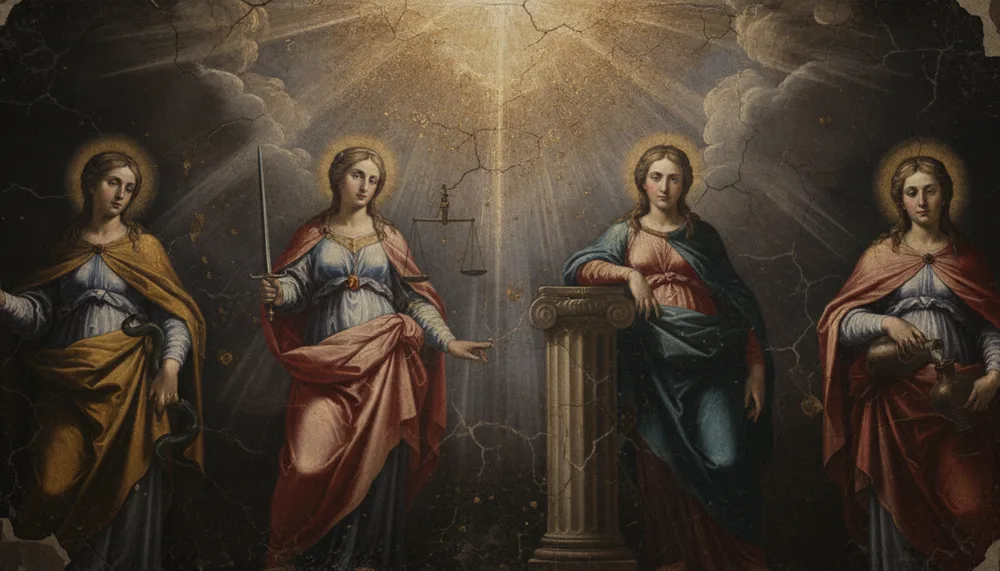
The four cardinal virtues are prudence, justice, fortitude, and temperance. They are the hinges — in Latin, cardines — on which the whole moral life turns. Where the three theological virtues of faith, hope, and charity look directly to God and are infused by His grace, the cardinal virtues order our human acts: they govern the mind, the will, and the passions so that a man does the right thing, for the right reason, with steadiness and measure. Scripture names all four together in a single verse, and the tradition of the Church, above all Saint Thomas Aquinas in the Summa Theologiae, has built the entire moral edifice upon them.
What are the four cardinal virtues?
The Catholic tradition lists them plainly. The Book of Wisdom, in the Douay-Rheims, says of divine Wisdom:
"And if a man love justice: her labours have great virtues: for she teacheth temperance, and prudence, and justice, and fortitude, which are such things as men can have nothing more profitable in life." (Wisdom 8:7)
Here are the four, each in a sentence:
- Prudence — right reason applied to action; it discerns the true good in every circumstance and chooses the right means to attain it. Spiritual writers call it auriga virtutum, the charioteer of the virtues, because it steers all the others.
- Justice — the constant and perpetual will to render to each one his due: to God the worship He is owed (the virtue of religion), to neighbour his rights, to authority obedience.
- Fortitude — firmness of soul in the face of difficulty and danger; it strengthens the will to pursue the good even unto death, as in the martyrs, and equally to endure long, hidden, unglamorous suffering.
- Temperance — the moderation of the desire for pleasure, especially the pleasures of food, drink, and the flesh, keeping them within the bounds set by reason.
They are called cardinal (from cardo, a hinge) because, in the words of the Catechism of St Pius X, "all the moral virtues are founded and hinged around them." Saint Thomas gives the reason: every moral virtue needs right reason, a right will toward others, firmness against fear, and restraint of desire, and these four supply exactly those conditions (Summa Theologiae I-II, q. 61, a. 2–3). They are the moral virtues par excellence.
Prudence is seated in the reason and is therefore an intellectual virtue by nature, but it is numbered with the moral virtues because its whole matter is human action (I-II, q. 58, a. 3, ad 1). The other three perfect the will and the passions. All four can be acquired by repeated good acts, and God also infuses them with sanctifying grace so that they bear upon our eternal end (I-II, q. 63, a. 3).
The order of the cardinal virtues: why prudence comes first
The order in the lists is not accidental. Prudence is named first because it governs the other three. No act of justice, fortitude, or temperance is virtuous unless reason has first judged rightly what should be done here and now. A man may be brave and yet rash; generous and yet imprudent; abstemious and yet scrupulous. Prudence is the rudder.
After prudence comes justice, because it is the highest of the three remaining, ordering a man not toward himself but toward others and toward God. Then fortitude and temperance, which discipline the passions: fortitude steadies the irascible appetite — anger, fear, daring — while temperance bridles the concupiscible appetite, the desire for pleasure. Saint Thomas ranks fortitude above temperance because it holds the will firm against the dangers of death, the hardest of all things to bear, while temperance governs pleasures, which touch the common good less nearly (II-II, q. 123, a. 12; q. 141, a. 8).
Together with the theological virtues they form the seven principal virtues. Popular lists of the seven heavenly virtues sometimes mean these seven, and sometimes mean the seven contrary virtues set against the seven deadly sins; the two lists are distinct, but they meet here, because most of the contrary virtues are parts of a cardinal virtue.
Prudence: the charioteer of the virtues
Prudence is not mere caution, and still less is it timidity. It is recta ratio agibilium — right reason about things to be done. The prudent man takes counsel well, judges soundly, and commands his own action accordingly. Its three acts are to deliberate, to judge, and to command; the last is the chief act, for prudence is not finished until the good is actually done.
Saint Thomas names eight integral parts of prudence, the elements that must concur in a fully prudent act: memoria (memory of past experience), intellectus (understanding of present principles), docilitas (the humility to be taught), solertia (shrewdness in finding the means), ratio (reasoning well), providentia (foresight of the end), circumspectio (weighing the circumstances), and cautio (caution against evils that mix with good) (II-II, q. 49). Its opposing vices fall into two groups. By defect there is imprudence, with its species precipitation, thoughtlessness, and inconstancy, and also negligence (qq. 53–54).
By false resemblance there are the "prudence of the flesh," craftiness, guile, and fraud, which use the cleverness of prudence for a bad end (q. 55). To grow in prudence we take counsel before acting, we learn from those wiser than ourselves, and we ask God for wisdom: "But if any of you want wisdom, let him ask of God who giveth to all men abundantly and upbraideth not. And it shall be given him" (James 1:5). A prayer for wisdom or a prayer for guidance before any weighty decision is prudence at prayer.
Justice: rendering to each his due
Justice is "the perpetual and constant will to render to each one his right," the classical definition that Saint Thomas adopts and defends (II-II, q. 58, a. 1). The Catechism of St Pius X puts it simply: justice is "the virtue which disposes us to give everyone what belongs to him." Its first and greatest object is God Himself: the virtue of religion, a part of justice, renders to the Creator the adoration, thanksgiving, and prayer that are His due. Toward our neighbour, justice forbids us to steal, to slander, to defraud, or to withhold what is owed, and it commands restitution where we have wronged another.
The Decalogue is, in large part, the law of justice: Saint Thomas shows that the precepts of the Ten Commandments are precepts of justice (II-II, q. 122, a. 1), and the second tablet (honour your parents, do not kill, do not steal, do not bear false witness) is justice toward our neighbour written by the finger of God. Justice itself is either commutative, between one person and another, or distributive, from the community to its members (q. 61).
Around it stand the virtues annexed to it, which render what is owed without being able to render it equally: religion toward God, piety toward parents and country, observance toward those in authority, gratitude, truthfulness, affability, liberality, and epikeia, the equity that keeps the spirit of a law where its letter fails (q. 80). Its contrary vice is injustice, which breaks out in murder, theft, fraud, detraction, and rash judgement (qq. 59–78).
Fortitude: courage that endures
Fortitude makes the soul firm against the fear that would turn it from duty. The Catechism of St Pius X defines it as "the virtue which renders us courageous to the point of not fearing danger, not even death, for the service of God." Its two acts are to attack and to endure, and Saint Thomas teaches that endurance is the chief act, because it is harder to stand fast under the blows of the stronger than to strike (II-II, q. 123, a. 6), for the long patience of the bedridden, the persecuted, and the tempted is a greater work than a single brave deed. The martyrs are the supreme witnesses of fortitude, but so is the mother who carries a hidden cross for years without complaint.
Saint Thomas names the parts of fortitude: magnanimity (confidence in undertaking great things for God), magnificence (carrying great works through), patience, and perseverance (II-II, q. 128). Its contrary vices are fear or timidity, which flees the danger it ought to face, and, on the other side, fearlessness and daring, which court danger without reason (qq. 125–127). Fortitude is also one of the gifts of the Holy Ghost, by which the Spirit raises the natural virtue to a heroic, supernatural firmness. When the trial is heavy we ask for this grace, in a prayer for strength or a prayer in difficult times, confident that "I can do all things in him who strengtheneth me" (Philippians 4:13).
Temperance: measure in all things
Temperance moderates the attraction of sensible pleasure and keeps the appetite obedient to reason; the Catechism of St Pius X says that it "disposes us to control the inordinate desires that please the senses and makes us use temporal goods with moderation." Saint Thomas divides it carefully (II-II, q. 143). Its integral parts are shamefacedness, which recoils from what is base, and honesty, the love of the beauty of a well-ordered life.
Its species are abstinence and sobriety (food and drink) and chastity and purity (the pleasures of the flesh). Its annexed virtues reach further: continence, meekness and clemency, and modesty, under which fall humility and studiousness, the restraint of idle curiosity. Temperance is not contempt for created goods — the Church is no enemy of the table or the marriage bed — but the ordering of those goods to their proper end.
This is the virtue the Church drills into us each year through fasting and abstinence, the disciplines of Lent, and the practice of Christian mortification. By small, deliberate denials we teach the lower appetites to obey, so that when a grave temptation comes the will is not already a slave. Its opposing vices are intemperance, with gluttony, drunkenness, and lust, on the one side, and on the other insensibility, a joyless rejection of lawful goods that reason itself requires (II-II, q. 142, a. 1).
How to grow in the cardinal virtues
The acquired cardinal virtues are built by repeated acts, as a habit is formed: choose the just thing today, and the next just choice comes easier. But the Christian aims higher than mere natural virtue. In the state of grace, God infuses the cardinal virtues, ordering them to our supernatural end, and they grow with charity. The means are the ordinary ones the Church has always taught: frequent recourse to the sacraments, especially Confession and the Eucharist, daily mental prayer, an honest examination of conscience, and the patient work of spiritual combat against our besetting faults.
No virtue stands alone. The four are knit together by prudence and crowned by charity, "which is the bond of perfection" (Colossians 3:14). A man grows in all of them at once or in none, for to be truly brave he must be prudent and just, and to be temperate he must love rightly. This is the architecture of the moral life as the saints lived it, and as the Church has handed it down unbroken.
Frequently Asked Questions
What are the four cardinal virtues?
They are prudence, justice, fortitude, and temperance. Prudence is right reason in action; justice renders to each his due; fortitude is firmness in difficulty and danger; temperance moderates the desire for pleasure. They are called "cardinal" from the Latin cardo, a hinge, because the whole moral life turns upon them.
Where are the cardinal virtues in the Bible?
The four are named together in the Book of Wisdom: divine Wisdom "teacheth temperance, and prudence, and justice, and fortitude, which are such things as men can have nothing more profitable in life" (Wisdom 8:7, Douay-Rheims). Each is also taught throughout Scripture — justice in the Decalogue, fortitude in the martyrs, temperance in the call to sobriety, prudence in the Book of Proverbs.
Who named the four cardinal virtues first?
The four were named by Greek philosophy before Christ, above all by Plato, and the Book of Wisdom names all four together (Wisdom 8:7). Saint Ambrose, Saint Augustine, and Saint Gregory the Great received them into Christian teaching, and Saint Thomas Aquinas gave them their full theological treatment in the Summa Theologiae, where each is studied with its parts and its contrary vices (II-II, qq. 47–170).
What is the difference between the cardinal and theological virtues?
The three theological virtues — faith, hope, and charity — are infused by God, have God Himself for their direct object, and cannot be acquired by human effort. The four cardinal virtues are moral virtues that govern our human acts toward their right end; they can be acquired by repeated good acts, though God also infuses them in the soul that is in His grace.
Why is prudence the first of the cardinal virtues?
Because it governs the other three. Prudence is the right judgment of what should be done here and now; without it, justice, fortitude, and temperance lack direction and can become mere obstinacy, rashness, or scruple. The ancients called prudence the "charioteer of the virtues" because it steers them all.
Which deadly sin does each cardinal virtue oppose?
The Catechism of St Pius X sets one contrary virtue against each of the seven deadly sins: humility against pride, liberality against covetousness, chastity against lust, patience against anger, abstinence against gluttony, brotherly love against envy, and diligence against sloth. Most of these belong to a cardinal virtue in Saint Thomas's scheme. Humility, chastity, and abstinence are parts of temperance; liberality is annexed to justice; patience is a part of fortitude. Brotherly love and the fervour that overcomes sloth belong instead to charity, a theological virtue. So the cardinal virtues fight five of the seven directly, and charity the other two.
How can I grow in the cardinal virtues?
By repeated good acts, which form holy habits, and above all by living in the state of grace, where God infuses these virtues and grows them with charity. The ordinary means are the sacraments, daily prayer, frequent examination of conscience, and the steady discipline of mortification and fasting that trains the appetites to obey reason.
Sources. Holy Scripture, Douay-Rheims (Wisdom 8:7; James 1:5; Philippians 4:13; Colossians 3:14); Catechism of St Pius X, Part V, ch. 1, "On the Cardinal Virtues," and ch. 6, on the capital vices and their contrary virtues; Saint Thomas Aquinas, Summa Theologiae I-II, qq. 58, 61, 63; II-II, q. 47 (prudence), qq. 49, 53–55, q. 58 (justice), qq. 61, 80, 122, q. 123 (fortitude), qq. 125–128, q. 141 (temperance), qq. 142–143.
Iter Fidei serves the prayers, the Divine Office and the liturgical calendar, in Latin and English with audio. Join early access here.