
The Faith
The Three Theological Virtues (Faith, Hope, Charity)
What are the three theological virtues? Faith, hope, and charity, infused by God at Baptism, defined from the Catechism of St Pius X, with St Paul's praise of charity in 1 Corinthians 13 and the Acts of Faith, Hope, and Love of the Baltimore Catechism.
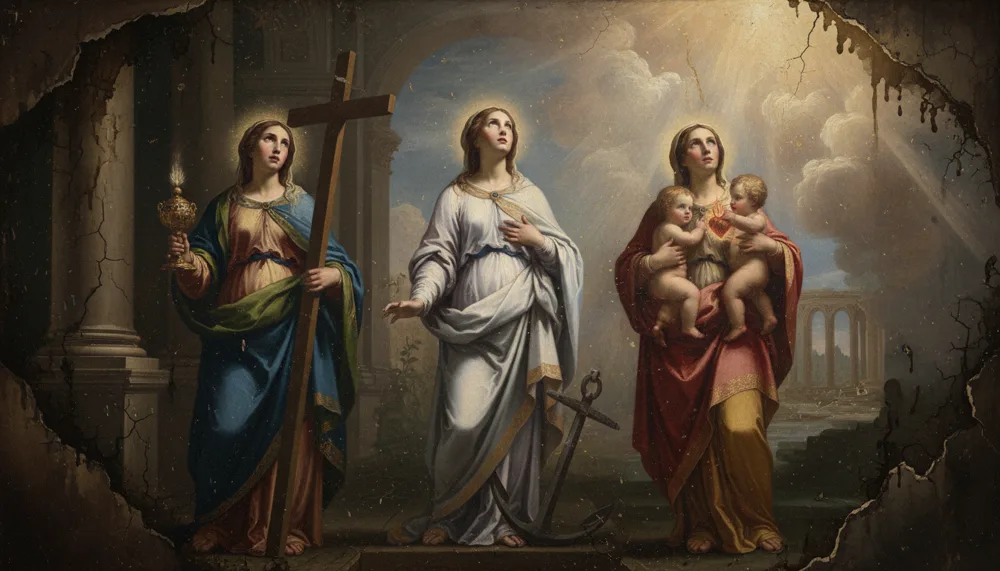
The three theological virtues are faith, hope, and charity. They are called theological — from the Greek for "God" — because God is their object, their motive, and their author: by them the soul believes in God, hopes in God, and loves God above all things. Unlike the moral virtues, which we can acquire by repeated good acts, the theological virtues are infused: poured into the soul by God Himself, together with sanctifying grace, at the moment of Baptism. St Paul names all three at the close of his great hymn to love: "And now there remain faith, hope, and charity, these three: but the greatest of these is charity" (1 Corinthians 13:13, Douay-Rheims).
What are the three theological virtues?
The three theological virtues are faith, hope, and charity. The Catechism of St Pius X calls them theological "because they have God as their immediate and principal object, and are infused by Him," and then defines each in turn. Faith "is a supernatural virtue, which God infuses into our souls, and by which, relying on the authority of God Himself, we believe everything which He has revealed and which through His Church He proposes for our belief." Hope "is a supernatural virtue, infused by God into the soul, by which we desire and expect that eternal life that God has promised to His servants, as well as the means necessary to attain it." Charity "is a supernatural virtue, infused into our soul by God, by which we love God above all for His own sake, and our neighbor as ourselves for the love of God" (Catechism of St Pius X, Part V, ch. 1).
Three things mark these virtues off from every other:
- Their object is God Himself. The moral virtues order us rightly toward created things and toward our neighbour. The theological virtues reach all the way to God: we believe Him, we hope in Him, we love Him.
- They are infused, not acquired. No amount of practice produces them. God gives them with grace, and where mortal sin drives out charity, an act of perfect contrition or the sacrament of Penance restores it — as we explain in the Act of Contrition.
- They are the root of the whole spiritual life. Faith shows the soul its end, hope makes it strain toward that end, and charity unites it to that end even now. With the four cardinal virtues they make up the seven principal virtues, which is one of the two lists people mean when they speak of the seven heavenly virtues.
Why is charity the greatest?
St Paul answers the question himself: "but the greatest of these is charity" (1 Corinthians 13:13). Faith and hope belong to this life only. In heaven faith gives way to vision — we shall no longer believe what we do not see, for "then face to face" we shall behold God (1 Corinthians 13:12). Hope gives way to possession — one does not hope for what one already holds. But charity never ends. "Charity never falleth away" (1 Corinthians 13:8). The love by which we love God on earth is the same love by which the saints love Him in glory; it is the one virtue that crosses the threshold of death unchanged and is perfected, not abolished.
This is why Saint Thomas calls charity the form of all the virtues, for it directs the acts of every other virtue to the last end (Summa Theologiae II-II, q. 23, a. 8). A faith without charity is, as St James warns, dead (James 2:26), a truth we unfold in faith without works is dead. Charity is the soul of the other two: it makes faith living and hope filial. The man who has charity has the friendship of God; lose it by mortal sin, and faith and hope may remain, but lifeless, like embers without flame.
Faith, hope, and charity in 1 Corinthians 13
The thirteenth chapter of St Paul's First Epistle to the Corinthians is the Scripture every reader associates with these virtues. It is not a sentimental poem but a doctrinal exposition: charity is the measure of all gifts. We give its heart in the Douay-Rheims:
If I speak with the tongues of men and of angels, and have not charity, I am become as sounding brass, or a tinkling cymbal. And if I should have prophecy and should know all mysteries and all knowledge, and if I should have all faith, so that I could remove mountains, and have not charity, I am nothing. (1 Corinthians 13:1–2)
Then comes the portrait of charity itself, the lines so often read at weddings yet meant for every Christian:
Charity is patient, is kind: charity envieth not, dealeth not perversely, is not puffed up, is not ambitious, seeketh not her own, is not provoked to anger, thinketh no evil: rejoiceth not in iniquity, but rejoiceth with the truth: beareth all things, believeth all things, hopeth all things, endureth all things. (1 Corinthians 13:4–7)
A word on the Douay reading. Where modern Bibles render the Greek agapē as "love," the Douay-Rheims, following the Vulgate's caritas, says charity. The older word is more exact: it names not natural affection but the supernatural, infused love of God — the very theological virtue under discussion. When a Catholic reads "charity" in 1 Corinthians 13, he should hear the third theological virtue, not philanthropy.
The Act of Faith
The Acts of Faith, Hope, and Charity are short prayers by which we exercise each virtue deliberately. The Catechism of St Pius X teaches that receiving these virtues at Baptism is not enough for one who has the use of reason: we are obliged to make their acts "when we come to the use of reason; often during life; and when in danger of death." The texts below are those printed in the Baltimore Catechism of 1885, from which generations of English-speaking Catholics learned them. Here is the Act of Faith:
O my God! I firmly believe that Thou art one God in three Divine Persons, Father, Son, and Holy Ghost; I believe that Thy Divine Son became man, and died for our sins, and that he will come to judge the living and the dead. I believe these and all the truths which the Holy Catholic Church teaches, because Thou hast revealed them, who canst neither deceive nor be deceived.
Faith rests not on the strength of our reasoning but on the authority of God revealing — "who canst neither deceive nor be deceived." That is the motive of faith: the truthfulness of God. The articles we profess are gathered in summary form in the Apostles' Creed, the rule of what the Church proposes to our belief.
The Act of Hope
Hope is the virtue that keeps the soul from the two opposite ruins of presumption and despair. The Act of Hope runs:
O my God! relying on Thy infinite goodness and promises, I hope to obtain pardon of my sins, the help of Thy grace, and life everlasting, through the merits of Jesus Christ, my Lord and Redeemer.
Notice what hope leans upon: not our own merits, but God's "infinite goodness and promises," and the merits of Christ. The Catechism of St Pius X gives the same ground: God, "being both faithful and omnipotent, He never fails in His promises." This is why hope is firm without being presumptuous. To despair is to call God a liar in His promises; to presume is to expect glory without the means He has appointed. The Act of Hope steers between both.
The Act of Charity
The Act of Charity, printed in the Baltimore Catechism as the Act of Love, unites the two commandments on which, Our Lord said, depend the whole law and the prophets (Matthew 22:40):
O my God! I love Thee above all things, with my whole heart and soul, because Thou art all-good and worthy of all love. I love my neighbor as myself for the love of Thee. I forgive all who have injured me, and ask pardon of all whom I have injured.
We love God "because Thou art all-good and worthy of all love." That phrase — for His own sake — is the very definition of charity. We do not love God merely for the heaven He gives (that is hope); we love Him for what He is in Himself. And because we love Him, we love our neighbour, made in His image, "for the love of Thee." The forgiveness clause is no afterthought: charity that will not forgive is charity only in name. Whoever wishes to grow in this love will find the path traced in how to love God.
The theological virtues and the moral virtues
It helps to set the three theological virtues beside the four cardinal — prudence, justice, fortitude, and temperance — which we treat in the cardinal virtues. The cardinal virtues are hinges (Latin cardo) on which the moral life turns; they can be acquired by human effort and were possessed in part even by virtuous pagans. The theological virtues are wholly God's gift and direct us immediately to Him. Seven together — three theological, four cardinal — they form the traditional list of the principal virtues.
The order matters. Without the theological virtues, the cardinal virtues remain merely natural and cannot merit heaven. Charity, infused at Baptism, takes up prudence, justice, fortitude, and temperance and raises them — making them supernatural and ordered to God as their last end. This is why the Church gives the theological virtues the first place.
How we receive and grow in them
The theological virtues are first given at Baptism, with sanctifying grace, and they grow as grace grows — through the sacraments, through prayer, and through their own exercise. We grow in charity above all by acts of charity, and the Eucharist, the sacrament of charity, nourishes it. Our own effort is never the whole story: the increase of these virtues goes with the increase of sanctifying grace, the divine life in the soul.
Mortal sin destroys charity in the soul, though it may leave faith and hope wounded but alive; a sin against faith (heresy, apostasy) or against hope (despair, presumption) can destroy those too. The remedy is always the same: the mercy of God, sought in perfect contrition or in sacramental Penance. The Catechism of St Pius X says that charity "is regained by making acts of the love of God, by duly repenting and making a good confession." For the examination that prepares that confession, see our examination of conscience.
Frequently Asked Questions
What are the three theological virtues?
The three theological virtues are faith, hope, and charity. They are called theological because their direct object is God Himself: by faith we believe in God, by hope we trust in God, by charity we love God above all things. They are infused by God into the soul, together with sanctifying grace, at Baptism — not acquired by our own effort, as the moral virtues are.
Why are they called "theological" virtues?
Because their object, motive, and author are all God. The word comes from the Greek theos, "God." The moral or cardinal virtues order us toward created goods and toward our neighbour; the theological virtues reach all the way to God, uniting us to Him directly. They are also called theological because God alone can infuse them — no human practice produces them.
Which is the greatest of the theological virtues?
Charity. St Paul declares it: "And now there remain faith, hope, and charity, these three: but the greatest of these is charity" (1 Corinthians 13:13). Faith and hope belong to this life only — in heaven faith yields to vision and hope to possession — but "charity never falleth away" (1 Corinthians 13:8). It is the one virtue that endures into glory, and the form that gives life to the other two.
What is the difference between the theological and cardinal virtues?
The theological virtues — faith, hope, charity — are infused by God and direct us immediately to Him. The cardinal virtues — prudence, justice, fortitude, temperance — are the hinges of the moral life; they can be acquired by human effort and order us toward created things and our neighbour. Charity raises the cardinal virtues, making them supernatural and meritorious of heaven.
What is the Act of Faith?
The Act of Faith is a short traditional prayer by which we deliberately exercise the virtue of faith. In the Baltimore Catechism it reads: "O my God! I firmly believe that Thou art one God in three Divine Persons... I believe these and all the truths which the Holy Catholic Church teaches, because Thou hast revealed them, who canst neither deceive nor be deceived." It rests our belief on the authority of God revealing, not on our own reasoning.
Where are faith, hope, and charity in the Bible?
The clearest text naming all three together is 1 Corinthians 13:13: "And now there remain faith, hope, and charity, these three: but the greatest of these is charity" (Douay-Rheims). The whole of 1 Corinthians 13 — St Paul's hymn to charity — is the Scripture most associated with the theological virtues, especially its portrait of charity: "Charity is patient, is kind..." (verses 4–7).
Iter Fidei serves the prayers, the Divine Office and the liturgical calendar, in Latin and English with audio. Join early access here.
Sources. Catechism of St Pius X, Part V, ch. 1, "The Main Virtues" (theological virtues, faith, hope, charity). Holy Scripture, Douay-Rheims: 1 Corinthians 13:1–13; James 2:26; Matthew 22:40. Saint Thomas Aquinas, Summa Theologiae I-II, q. 62; II-II, q. 23, a. 8. The Acts of Faith, Hope, and Love as printed in A Catechism of Christian Doctrine prepared by order of the Third Plenary Council of Baltimore (1885).