
Prayer
Act of Contrition: The Traditional Prayer (Full Text)
The traditional Act of Contrition in full, the old Baltimore Catechism form, in Latin and Spanish too, with its meaning, when to say it, and prayers for confession.
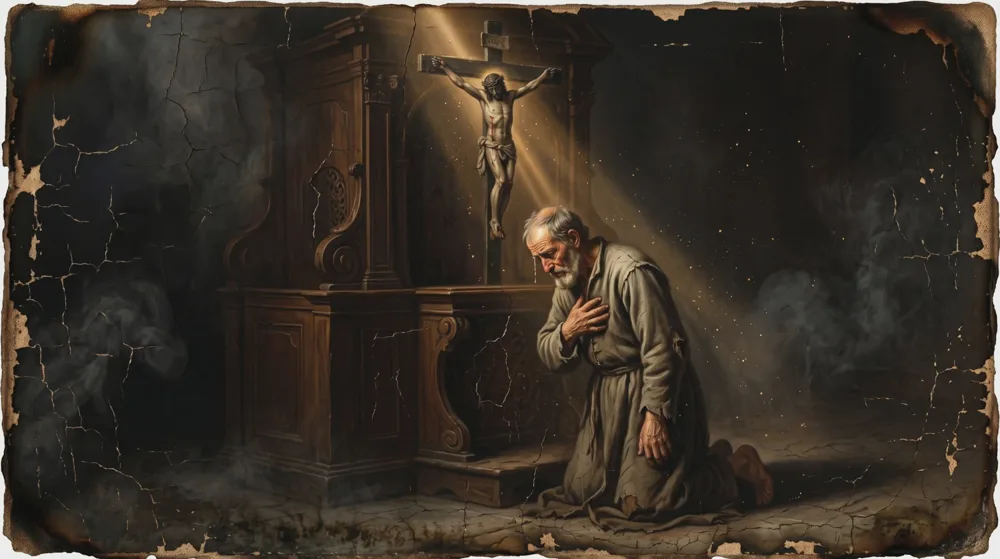
The Act of Contrition is the prayer by which a Catholic tells God that he is sorry for his sins and firmly resolves to sin no more. It is said in the confessional, in the Sacrament of Penance, while the priest gives absolution, and it may be said every day, especially at night. Many people look for it as the "act of confession" or the "confession prayer": it is the same prayer. Here is the traditional Act of Contrition in full, the "old act of contrition" of the catechisms, what its words mean, and the traditional prayers to say before and after confession.
The traditional Act of Contrition (full text)
This is the form printed in the Baltimore Catechism (No. 3, 1891 edition) and prayed in English-speaking churches for generations before the Council, the form people mean when they ask for the "old version" or the "traditional act of contrition":
O my God, I am heartily sorry for having offended Thee, and I detest all my sins, because I dread the loss of heaven and the pains of hell; but most of all because they offend Thee, my God, Who art all good and deserving of all my love. I firmly resolve, with the help of Thy grace, to confess my sins, to do penance, and to amend my life. Amen.
Many prayer books end it with a slightly different clause: "I firmly resolve, with the help of Thy grace, to sin no more and to avoid the near occasion of sin." Both endings say the same thing: the firm purpose of amendment.
What the words mean
The prayer is short, but it holds everything the Church asks of a penitent.
- "Heartily sorry for having offended Thee": true sorrow, from the heart, and not mere regret for the consequences of sin.
- "I detest all my sins": contrition is not only sadness but a turning of the will against sin. The Council of Trent defines it as "a sorrow of mind and a detestation of sin committed, with the purpose of not sinning for the future."
- "Because I dread the loss of heaven and the pains of hell": this is the lesser motive, fear of God's punishments. Sorrow from this motive is called attrition, or imperfect contrition, and the Church teaches that it suffices within the sacrament.
- "But most of all because they offend Thee, my God, Who art all good": this is the higher motive, love of God for His own sake. Sorrow from this motive is perfect contrition. The prayer climbs from the one to the other, as the penitent should. We set out the distinction in contrition and attrition.
- "I firmly resolve, with the help of Thy grace": we cannot keep the resolve by our own strength, so we ask for grace.
- "To confess my sins, to do penance, and to amend my life": the three things that follow true sorrow, namely the accusation, the satisfaction, and a changed life.
When to say it
- In confession. After you have confessed your sins and received your penance, the priest begins the absolution; you say the Act of Contrition at that moment, quietly and audibly. The sorrow it expresses is part of the sacrament itself, for without contrition there is no forgiveness. The whole order of the confession is set out in how to go to confession.
- Each night. It is a holy custom to make an Act of Contrition before sleep, after a short examination of conscience on the day.
- In danger of death. When no priest can be had, an act of perfect contrition, joined to the will to confess as soon as possible, restores the soul to grace. This is why the prayer is taught to children and said beside the dying, as in the prayer for a happy death.
The "act of confession": the Act of Contrition and the Confiteor
Many search for the "act of confession prayer." In the confessional, the prayer the penitent says is the traditional Act of Contrition given above: that is what a priest means when he says, "Now make a good act of contrition." The Church's prayer of confession properly so called is the Confiteor, "I confess to almighty God," said at the foot of the altar in the traditional Mass and every night at Compline in the Breviary: it confesses that we have sinned and asks the prayers of the saints, while the Act of Contrition expresses sorrow and the resolve to amend.
Prayer before confession
Before confession, pray for two graces: light to know your sins and sorrow to detest them. The traditional way is to call upon the Holy Ghost, then to make the examination of conscience, then to stir up contrition. Begin with this prayer to the Holy Ghost:
Come, O Holy Ghost, fill the hearts of Thy faithful, and kindle in them the fire of Thy love.
V. Send forth Thy Spirit, and they shall be created.
R. And Thou shalt renew the face of the earth.
Let us pray. O God, Who didst instruct the hearts of the faithful by the light of the Holy Ghost, grant us by the same Spirit to be truly wise, and ever to rejoice in His consolation. Through Christ our Lord. Amen.
Those who have more time may say the hymn Veni Creator in its place. Then, after the examination, ask for sorrow in the words of the Miserere, the psalm of David's repentance (Psalm 50:3-5, Douay-Rheims):
Have mercy on me, O God, according to thy great mercy. And according to the multitude of thy tender mercies blot out my iniquity. Wash me yet more from my iniquity, and cleanse me from my sin. For I know my iniquity, and my sin is always before me.
Finish by saying the Act of Contrition slowly once before you go into the confessional. These are the three movements of the Catholic prayer before confession: light, examination, sorrow.
Prayer after confession
The first thing to do after confession is the penance the priest gave you, as soon as you can, before you forget it. Then give thanks. The Church has always found her thanksgiving for pardon in the psalms; the opening of Psalm 102 (verses 1-4, Douay-Rheims) is a fitting prayer after confession:
Bless the Lord, O my soul: and let all that is within me bless his holy name. Bless the Lord, O my soul, and never forget all he hath done for thee. Who forgiveth all thy iniquities: who healeth all thy diseases. Who redeemeth thy life from destruction: who crowneth thee with mercy and compassion.
Some add the Te Deum, the Church's hymn of thanksgiving, or a Memorare to ask Our Lady's help in keeping the resolution. Then renew your purpose of amendment, think of the occasion of sin you most need to avoid in the days ahead, and at your next Mass receive Holy Communion with a clean heart; the prayers before and after Communion follow naturally.
The old version and the new version compared
Many people search for the "new version" because the wording they learned after the Council differs from the older form. The reformed Rite of Penance of 1973 offers several prayers of the penitent; the one most often printed in English reads:
My God, I am sorry for my sins with all my heart. In choosing to do wrong and failing to do good, I have sinned against You whom I should love above all things. I firmly intend, with Your help, to do penance, to sin no more, and to avoid whatever leads me to sin. Our Saviour Jesus Christ suffered and died for us. In His name, my God, have mercy. Amen.
Any sincere act of contrition suffices in the confessional, and a penitent who knows only this form is not to be troubled. We keep and teach the older form for two reasons: it is the prayer of the catechisms our fathers learned, and it names both motives of sorrow, the fear of losing heaven and, above it, the love of God who is all good, so that it teaches the doctrine of contrition as it is prayed. What saves is not the wording but the sorrow.
A short Act of Contrition
The traditional act is already short: it takes less than half a minute and is best learned whole. But when time is shorter still, in sudden danger or beside a sick person, a few words are enough, provided the sorrow and the resolve are real. The Church has long commended two such ejaculations: "My Jesus, mercy!", indulgenced in the Raccolta, and the prayer of the publican in the Gospel, "O God, be merciful to me a sinner" (Luke 18:13). Said from the heart, for love of God and with the will to confess, they can carry an act of perfect contrition.
A children's Act of Contrition
The Baltimore Catechism was written for children, and generations of them learned the full act above for their first confession, phrase by phrase. We think it still the best form to teach: a child of seven can understand "heartily sorry," "the loss of heaven," and "Who art all good," and the words will serve him for life. Teach it a line a day over a week, explain each phrase with the notes above, and have the child say it each night before sleep, so that in the confessional it comes without effort. What matters in a child, as in us, is that he is truly sorry because he has offended God, Who is so good, and that he means not to sin again.
The Act of Perfect Contrition
Perfect contrition is sorrow for sin because it offends God, Who is goodness itself and worthy of all our love, and not only from fear of hell or loss of heaven, which is imperfect contrition, or attrition. The traditional act leads the soul to it in its words "but most of all because they offend Thee."
This matters greatly. The Council of Trent teaches that perfect contrition, joined to the resolve to receive the sacrament, reconciles the soul to God even before confession. It does not dispense from confession: the mortal sins must still be confessed at the next opportunity, and what makes a sin mortal or venial is worth knowing exactly. But in danger of death when no priest can come, it is the door that is always open.
The Act of Contrition in Spanish
The Act of Contrition is one prayer in every tongue. For the Spanish-speaking faithful, the traditional Acto de Contrición runs:
¡Señor mío Jesucristo! Dios y Hombre verdadero, Creador, Padre y Redentor mío; por ser Vos quien sois, Bondad infinita, y porque os amo sobre todas las cosas, me pesa de todo corazón de haberos ofendido; también me pesa porque podéis castigarme con las penas del infierno. Ayudado de vuestra divina gracia, propongo firmemente nunca más pecar, confesarme y cumplir la penitencia que me fuere impuesta. Amén.
The same two essentials are there: sorrow because God is good and loved above all things, and the firm purpose of amendment.
The Act of Contrition in Latin
The traditional Latin form, which follows the English ending "to sin no more and to avoid the near occasion of sin," reads:
Deus meus, ex toto corde pænitet me omnium meorum peccatorum, eaque detestor, quia peccando, non solum pœnas a te iuste statutas promeritus sum, sed præsertim quia offendi te, summum bonum, ac dignum qui super omnia diligaris. Ideo firmiter propono, adiuvante gratia tua, de cetero me non peccaturum peccandique occasiones proximas fugiturum. Amen.
In the traditional rite the priest's prayers of absolution are in Latin, but the penitent may make his act of contrition in his own tongue; those who love the Church's language may say it in Latin.
A printable Act of Contrition (PDF)
The full text of the traditional Act of Contrition is given above, with the Latin and Spanish forms, and prints exactly as it stands from this page. Better than a card in a missal, though, is to have it with you every day: Join early access here. gives the Act of Contrition each night with a reminder, works offline, and has the prayers in Latin and English. Its confession guide also places the act at the very moment the priest gives absolution, after an examination of conscience in four parts.
Frequently Asked Questions
What is the Act of Contrition?
The Act of Contrition is a prayer by which we tell God we are heartily sorry for our sins and firmly resolve, with the help of His grace, to sin no more. The Council of Trent teaches that contrition is "a sorrow of mind and a detestation of sin committed, with the purpose of not sinning for the future." It is the first and chief act of the penitent in the Sacrament of Penance.
How do you say the Act of Contrition?
Slowly, and meaning each phrase: kneeling, if you can, with the mind turned to God rather than to the words. In the confessional say it quietly but audibly, so the priest knows you are making it. Outside confession it may be said anywhere, at any hour, and the Church has always counselled it before sleep.
When do you say the Act of Contrition in confession?
After you have confessed your sins and the priest has given your penance, he begins the prayers of absolution; you say the Act of Contrition then. In the traditional rite the priest prays in Latin while you pray in English, and the heart of his prayer is the form Ego te absolvo a peccatis tuis, "I absolve thee from thy sins."
How can I learn the Act of Contrition fast?
Learn it by its sense rather than by rote. It falls into three parts: I am sorry and detest my sins; for two reasons, the fear of losing heaven and, above all, because they offend God Who is all good; and I resolve to confess, do penance and amend. Say one part a day, then the whole each night before sleep; within a week most people have it by heart.
How many versions of the Act of Contrition are there?
There is one act, sorrow with the purpose of amendment, and many wordings. English-speaking Catholics have chiefly known the traditional Baltimore form with its two endings, and since 1973 the shorter prayer of the reformed rite; every language has its own, such as the Spanish Acto de Contrición. Any wording that truly expresses sorrow and resolve suffices.
Does the Act of Contrition forgive sins?
Within confession, contrition joined to the priest's absolution forgives every sin confessed. Outside confession, venial sins are remitted by sincere sorrow, and an act of perfect contrition with the resolve to confess restores the soul to grace even before the sacrament; the mortal sins must still be confessed at the next opportunity.
How do you make a perfect act of contrition?
Think first of God Himself: His goodness, His love for you, Christ crucified for your sins. Then grieve that you have offended One so good, more than for any punishment you fear, and resolve with His grace to sin no more and to confess. The words of the traditional act, "but most of all because they offend Thee," carry that motive.
The Iter Fidei app carries the Act of Contrition inside a step-by-step guide to confession, with an examination of conscience and a private notebook of your sins. Join early access here.
Sources. Baltimore Catechism (1891), the Act of Contrition; Council of Trent, Session XIV (1551), ch. 4, on contrition; Catechism of the Council of Trent (1566), On the Sacrament of Penance; Missale Romanum (1962), the Confiteor; Breviarium Romanum (1962), Compline; Holy Scripture (Douay-Rheims), Psalm 50:3-5, Psalm 102:1-4, Luke 18:13; The Raccolta, the prayer to the Holy Ghost and the ejaculation "My Jesus, mercy."