
Apologetics
Why Do Catholics Confess to a Priest?
Catholics confess to a priest because Christ gave His Apostles, and their successors, the power to forgive and retain sins (John 20:23); the priest absolves in His name.
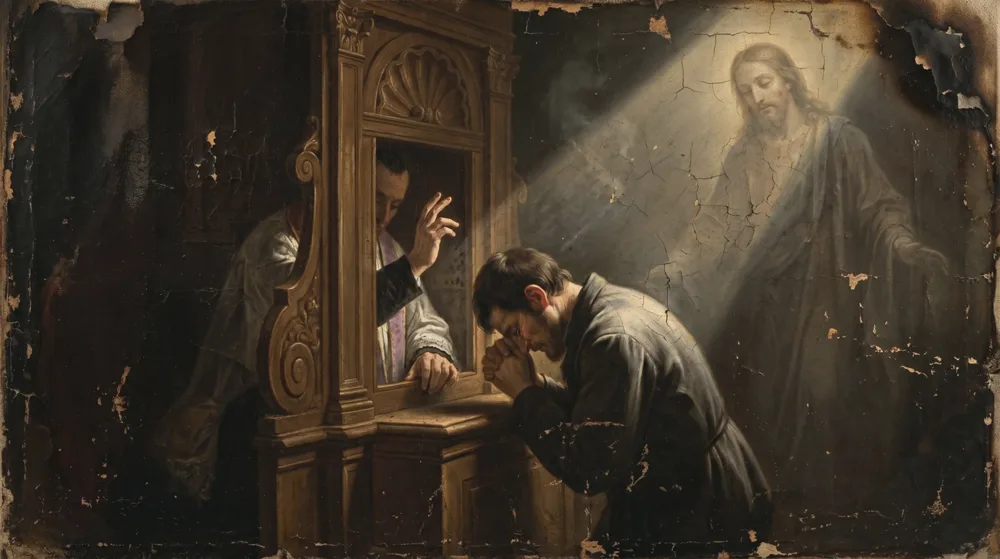
Catholics confess their sins to a priest because Christ Himself willed it so. On the evening of His Resurrection He breathed on the Apostles and said, "Receive ye the Holy Ghost: whose sins you shall forgive, they are forgiven them; and whose sins you shall retain, they are retained" (John 20:22-23). We confess to God, but God appointed that His pardon should reach us through the men to whom He gave this power. The priest does not forgive by any power of his own; he absolves in the name and the person of Jesus Christ.
This is the heart of why Catholics confess to a priest, and it is one of the points at which Catholics and many of the separated brethren divide. We will state the Catholic position as the Church has always held it, explain the real difference honestly, and answer the common objection that one may simply confess to God alone.
Why confess to a priest, and not to God directly?
The objection sounds pious: God alone forgives sins, so why bring a man into it? The Catholic answer does not deny the first half. God alone forgives sins. But it was God Himself who chose to forgive them by the ministry of men. That is the whole point of John 20:23. Christ did not say that repentance in the heart suffices; He gave to particular men a power to forgive and to retain — a real authority to judge, in His name, which sins are loosed and which are bound.
The Roman Catechism, drawn up by the Council of Trent, faces this very objection. It cites Saint Augustine against those of his day who said what we still hear now: "Let no one say to himself: I do penance in secret before the Lord... For then it would have been said without reason: Whatsoever you shall loose upon earth shall be loosed in heaven; without reason also the keys would have been confided to the Church of God" (Roman Catechism, On the Sacrament of Penance). To say "I will confess to God alone" is, in effect, to say that Christ gave the keys for nothing.
Saint Ambrose answered the same error, the error of the Novatians who "pretended that God alone has the power to remit sins." He asked, the Catechism records, "Which of the two honours God the more, he who obeys His Commandments, or he who resists them? God has commanded us to obey His Ministers, and when we obey them, it is God alone that we honour" (Roman Catechism, On the Sacrament of Penance). The Catholic who kneels before the priest is not honouring the man; he is obeying the God who appointed this means.
The Scriptural basis: Christ gave the power to forgive sins
The institution of confession is not a later invention. The Roman Catechism is express: the faithful are to be taught "without the least hesitation, that Confession was instituted by Our Lord Jesus Christ" (Roman Catechism, On the Sacrament of Penance). The proof is John 20:23, and the Church reads it exactly as it stands; we read the verse phrase by phrase in whose sins you shall forgive.
If Christ gave the power to forgive and to retain, He made the Apostles judges. The Council of Trent draws the necessary conclusion: a judge cannot pass a just sentence on a cause he does not know. "It follows that penitents are bound to reveal to the Priests, by Confession, all their sins one after another" (Roman Catechism, On the Sacrament of Penance). This is why we confess our sins aloud, by name — not to parade them, but to accuse ourselves, that the one given authority to judge may judge.
Scripture confirms the pattern elsewhere. Christ said to Peter, "I will give to thee the keys of the kingdom of heaven. And whatsoever thou shalt bind upon earth, it shall be bound also in heaven: and whatsoever thou shalt loose upon earth, it shall be loosed also in heaven" (Matthew 16:19). When He raised Lazarus, He bade the bystanders "loose him" — which Saint Augustine takes as a figure of the power given to priests to loose the penitent (Roman Catechism, On the Sacrament of Penance). And He sent the ten lepers to show themselves to the priests (Luke 17:14). The keys are real, and they are held by real men.
The priest acts in persona Christi
Here is the answer to the deepest part of the objection. When the priest absolves, it is not the man who forgives; it is Christ who forgives through him. The Roman Catechism is exact: in the sacrament of Penance the words I absolve thee "have no other meaning than those of Our Lord to the paralytic: Son, be of good heart; thy sins are forgiven thee."
The priest, "as Ministers of the Lord," really gives "the Absolution which is at the same time ratified by God Himself, the Author and Principle of grace and of justification" (Roman Catechism, On the Sacrament of Penance). The Catechism of Saint Pius X says the same in a line: absolution is "the sentence which the priest pronounces in the name of Jesus Christ to remit the sins of the penitent" (Catechism of St. Pius X, Penance).
This is what is meant by the priest acting in persona Christi — in the person of Christ. The power belongs to Holy Orders: the Roman Catechism teaches that Bishops and Priests "hold on earth the place of God Himself," and that the power "of forgiving sins... surpasses all our human conceptions" (Roman Catechism, On the Sacrament of Holy Orders). The sinner at the confessional, the Catechism says, ought "to reverence in the Priest, who is his lawful judge, the Person and the power of Jesus Christ Himself" (Roman Catechism, On the Sacrament of Penance). The priest is a channel, not a source. We confess to God through him, as Christ willed.
Catholic confession to a priest versus confession to God alone
The honest difference between the Catholic position and that of many Protestant communities can be stated without insult to anyone. Both hold that God forgives sins; both hold that contrition is necessary; both reverence Sacred Scripture. The Catholic Church teaches, on the words of Christ, that He gave to His Church a sacrament of forgiveness administered by ordained priests, the divinely-willed means of pardon for grave sins committed after Baptism. Those who reject sacramental confession do so sincerely, but they are in error on this point: they set aside a power Christ plainly gave and a practice the Fathers — Augustine, Ambrose, Jerome, Cyprian — testify the Church has held from the beginning (Roman Catechism, On the Sacrament of Penance).
We do not say that all paths are equal or that the disagreement is a matter of taste; that would be untrue, and charity does not require falsehood. The Catholic Church is the one Church Christ founded, and she received the keys. But the man who confesses his sins privately to God in good faith, never having been taught this, is not our enemy; he is a soul Christ died for, who has not yet been shown the fuller gift. The disagreement is about what Christ established, not about who loves God more.
Do you have to confess to a priest?
For mortal sin, yes. The Roman Catechism teaches plainly that "every man guilty of a mortal sin cannot return to the life of Grace save by sacramental Confession" (Roman Catechism, On the Sacrament of Penance). The Catechism of Saint Pius X says the sacrament "is necessary in order to be saved for all those who, after Baptism, have committed any mortal sin" (Catechism of St. Pius X, Penance). Perfect contrition can restore the soul before confession, but only because it always carries within it the resolve to confess; it does not dispense from the priest, it includes him.
For venial sins, confession is not strictly required, yet the Church has always counted frequent confession among the surest helps to the spiritual life (Catechism of St. Pius X, Penance). The duty binds every member of the faithful, once they reach the age of reason, to confess grave sins at least once a year, and to seek the sacrament without delay in danger of death. To prepare, the penitent calls his sins to mind by a traditional examination of conscience, weighing which are grave by the rule set out in mortal and venial sin.
So the Catholic kneels before the priest not out of distrust of God's mercy, but in obedience to it. Christ could have forgiven sins by a wordless act in each heart. Instead He breathed on the Apostles and sent them to forgive in His name. To confess to a priest is to receive pardon the way the Saviour chose to give it.
Frequently Asked Questions
Why do Catholics confess to a priest?
Because Christ Himself gave the power to forgive sins to particular men, not to the sinner alone. On the evening of His Resurrection He breathed on the Apostles and said, "Whose sins you shall forgive, they are forgiven them; and whose sins you shall retain, they are retained" (John 20:22-23). The priest forgives nothing by his own power; he absolves in the name and the person of Jesus Christ, who willed that His pardon reach us through the ministry of men.
Why do Catholics confess to a priest and not to God directly?
We do confess to God, but it was God Himself who chose to forgive sins by the ministry of men. To say "I will confess to God alone" is, as the Roman Catechism teaches with Saint Augustine, to make the keys Christ gave to His Church "confided... without reason" (Roman Catechism, On the Sacrament of Penance). The Catholic who kneels before the priest is not distrusting God's mercy; he is receiving it the very way the Saviour chose to give it.
Why do Catholics call a priest "father"?
We call a priest "father" because he begets souls to the supernatural life and feeds them with the Sacraments, as a father begets and nourishes his children. Saint Paul did the same: "For if you have ten thousand instructors in Christ, yet not many fathers. For in Christ Jesus, by the gospel, I have begotten you" (1 Corinthians 4:15). Our Lord's words against calling men "father" (Matthew 23:9) forbid setting any man above God, not the natural and spiritual use of the title, which Scripture itself employs throughout.
How do you confess to a priest?
You examine your conscience, make an act of contrition, and then accuse yourself by name of every mortal sin since your last good confession, telling their number as far as you can recall; the priest may question and counsel you, and then pronounces absolution in the person of Christ. You must be truly sorry and resolve to sin no more, accepting the penance he assigns. The Iter Fidei confession app carries the examination and a step-by-step guide to take into the confessional.
Why do Catholics confess?
We confess because Christ commanded it, breathing on the Apostles and saying, "Whose sins you shall forgive, they are forgiven them; and whose sins you shall retain, they are retained" (John 20:23). The Roman Catechism teaches that a man guilty of mortal sin cannot return to the life of grace save by sacramental Confession (Roman Catechism, On the Sacrament of Penance). We confess to receive God's pardon by the very means He appointed for it.
The Iter Fidei app prepares you for the sacrament Christ gave His Church: an examination of conscience, a private notebook, and a guide in the confessional. Join early access here.
Sources. Holy Scripture (Douay-Rheims): John 20:22-23; Matthew 16:19; Luke 17:14. Catechism of the Council of Trent (Roman Catechism), On the Sacrament of Penance; On the Sacrament of Holy Orders. Catechism of St. Pius X, Penance.