
The Divine Office
What Is the Divine Office? The Breviary Explained
The Divine Office is the Church's official daily prayer — the Breviary — eight hours of psalms, hymns, and Scripture that sanctify the day. What each hour is, who prays it, and how the laity can pray it.
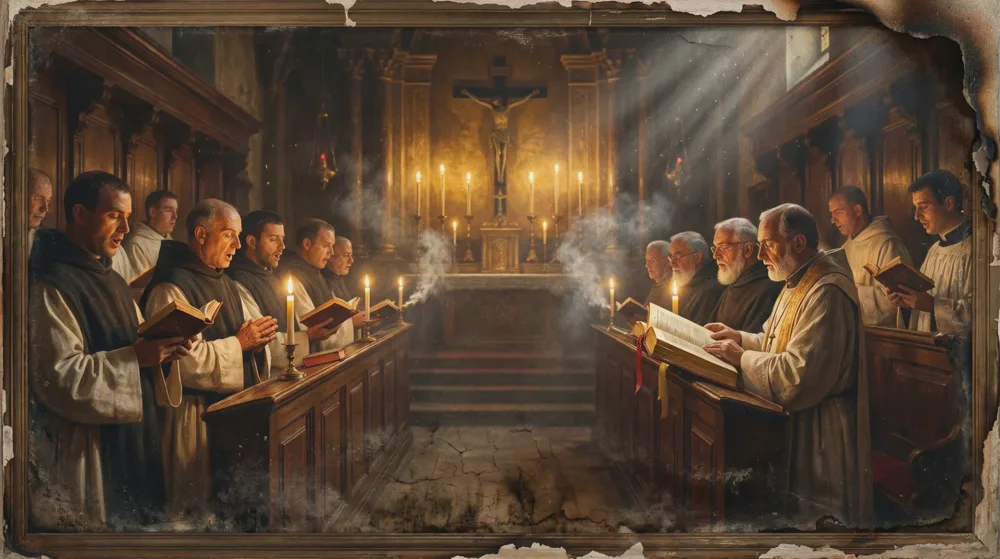
The Divine Office is the official daily prayer of the Catholic Church — the public worship that the Church, the Bride of Christ, offers to God at fixed hours throughout the day and night. It is contained in the book called the Breviary, and it is built chiefly of the Psalms, together with hymns, Scripture readings, and prayers. In the traditional Roman rite it is woven into eight hours: Matins, Lauds, Prime, Terce, Sext, None, Vespers, and Compline. Where the Mass is the Church's sacrifice, the Office is her unceasing voice of praise.
What the Divine Office is
The Office is not a private devotion but the Church's own liturgy — the second great act of her worship after the Holy Sacrifice. Clerics and religious bound to it pray it in the name of the whole Church, so that day and night, somewhere on earth, the praise of God never falls silent. The Roman Catechism teaches that prayer rises to God under a twofold character — petition, by which we ask His help, and praise and thanksgiving, by which we render Him the homage owed to His goodness; the Office is the form in which the Church discharges this duty publicly and at every hour (Roman Catechism, On Prayer).
Its substance is Scripture. The 150 Psalms are its backbone, distributed across the week so that the praying Church passes through the whole Psalter and lets David's inspired words become her own. To these are joined the great canticles of the Gospel — the Magnificat at Vespers, the Benedictus at Lauds — hymns such as the Te Deum, lessons from the Scriptures and the Fathers, antiphons, and collects.
The eight hours of the Breviary
The day is sanctified by being marked at its hinges. The traditional Office unfolds in eight hours.
- Matins — the night office, the longest hour. Psalms and lessons drawn from Scripture, the Fathers, and the lives of the saints. On feasts it is crowned by the Te Deum.
- Lauds — the dawn office of praise, prayed at daybreak. Its name means "praises"; it greets the rising sun as a figure of the risen Christ and sings the Benedictus.
- Prime — the first hour of the working day, asking God's blessing on the labor ahead.
- Terce — the third hour (mid-morning), recalling the descent of the Holy Ghost at Pentecost.
- Sext — the sixth hour (midday), the hour of Our Lord's crucifixion.
- None — the ninth hour (mid-afternoon), the hour at which Christ gave up His spirit on the Cross.
- Vespers — the evening office, the great sung hour of the day, closing the daylight with the Magnificat as the lamps are lit.
- Compline — the night prayer, prayed before sleep, commending the soul to God against the dangers of the dark and ending with an antiphon to Our Lady.
Prime, Terce, Sext, and None are called the Little Hours: short, fixed, easily prayed amid work. Lauds and Vespers are the two hinges of the day and the heart of the Office. This sevenfold and eightfold rhythm answers the Psalmist: Seven times a day have I given praise to thee (Ps. 118:164), and At midnight I rose to give praise to thee (Ps. 118:62).
The Breviary and the "Liturgy of the Hours"
The Breviary is simply the book that gathers all of this into one — the word means an abridgment, a compendium that drew the older, scattered liturgical books into a single volume a priest could carry. To pray the Liturgy of the Hours, to "say the Office," and to "pray the Breviary" all name the same thing: the Church's appointed prayer at the appointed hours. We serve the traditional Office of the Roman Breviary as it stood in 1962, with its full Psalter, its ancient antiphons, and the calendar of the old rite — the Office the saints prayed.
Who prays the Divine Office
By the law of the Church, the Office is the daily obligation of clerics in major orders and of religious bound to choir. Priests pray it from their ordination; monks and nuns chant it together in their monasteries, where it is the framework of the whole day. When they pray it, they pray not merely for themselves but in the name of the entire Mystical Body, lending their voices to the Church's unceasing praise.
But the Office was never walled off from the faithful. From ancient times the laity joined the public chanting of Vespers on Sundays and feasts, and many a Christian household has prayed Compline before sleep. The Office is the common patrimony of the baptized.
How the laity can pray the Divine Office
No layman is obliged to the whole Office, and none should be daunted by its length. The way in is to begin small and pray with the Church.
- Begin with Vespers and Compline. These two hours — evening prayer and night prayer — are the easiest, the most beautiful, and the most fruitful for the layman. Compline scarcely changes from day to day and is quickly learned.
- Add Lauds as morning prayer when you are ready, so that your day opens and closes with the Church.
- Pray in Latin and your own language together — the Latin is the Church's voice, the vernacular your understanding of it.
- Pray it sung where you can. The Office is made to be chanted; even spoken, its rhythm carries you.
Do not try to seize all eight hours at once. Take Vespers tonight, Compline before bed, and let the habit grow. To do this you do not need a shelf of ribboned volumes: the whole Office, arranged for the right day, can now sit in your hand. Divinum Officium renders the traditional Office for any date — see our note on Divinum Officium — the free iBreviary app puts the Hours on the phone, and the popular Universalis app serves a modern form of the Hours. Broader prayer apps approach the Office differently: read our look at whether Hallow is a Catholic app before you choose one. For the traditional 1962 Office, bilingual and with audio, built for the phone, we made Iter Fidei.
Frequently Asked Questions
What is the Divine Office?
The Divine Office is the official daily prayer of the Catholic Church — her public worship offered to God at fixed hours throughout the day and night. It is contained in the book called the Breviary and built chiefly of the Psalms, together with hymns, Scripture readings, and prayers. In the traditional Roman rite it is woven into eight hours: Matins, Lauds, Prime, Terce, Sext, None, Vespers, and Compline. Where the Mass is the Church's sacrifice, the Office is her unceasing voice of praise.
What is the difference between the Divine Office, the Breviary, and the Liturgy of the Hours?
They name the same thing. The Divine Office is the prayer itself; the Breviary is the book that gathers it into one volume (the word means an abridgment); and "the Liturgy of the Hours" is the more modern name for the same appointed prayer at the appointed hours. To "say the Office," to "pray the Breviary," and to "pray the Hours" are interchangeable. We serve the traditional Office of the Roman Breviary as it stood in 1962.
Who is obliged to pray the Divine Office?
By the law of the Church, the Office is the daily obligation of clerics in major orders and of religious bound to choir. Priests pray it from their ordination; monks and nuns chant it together in their monasteries. When they pray it, they pray not merely for themselves but in the name of the whole Mystical Body. No layman is obliged to the Office, but it has never been walled off from the faithful, who from ancient times joined Vespers on Sundays and prayed Compline before sleep.
How can a layman start praying the Divine Office?
Begin small and pray with the Church. Start with Vespers (evening prayer) and Compline (night prayer) — the easiest, most beautiful, and most fruitful hours; Compline scarcely changes from day to day and is quickly learned. Add Lauds as morning prayer when you are ready. Pray in Latin and your own language together, and sung where you can. Do not try to seize all eight hours at once.
What apps can be used to pray the Divine Office?
Several. Divinum Officium renders the traditional Office for any date; the free iBreviary app puts the Hours on the phone; and the popular Universalis app serves the modern form of the Hours. Broader prayer apps approach the Office differently — see our look at whether Hallow is a Catholic app. For the traditional 1962 Office, bilingual and with audio, built for the phone, we made Iter Fidei.
The Mass is offered once; the Office never ceases. Through it the whole Church, in choir and in the layman's room alike, keeps the watch of praise that David began and that will not end until the everlasting day. To take up even one hour is to add your voice to that great unbroken song.
For more, see liturgy of the hours.
(The Iter Fidei app carries the traditional Office, the Mass of the day, and the prayers of the Church — in Latin and your own language, with audio — in your pocket. Download it here.)
Sources. Roman Catechism (Catechism of the Council of Trent, 1566), Fourth Part, On Prayer; the Psalms (Douay-Rheims), especially Psalm 118; the traditional Roman Breviary (1962); the Te Deum and the Magnificat as prayed in the traditional Office.