
Prayer
The Magnificat (Mary's Canticle)
The Magnificat — Mary's song of praise from Luke 1, in English and Latin — with its full traditional text, its meaning, and how the Church sings it at Vespers.
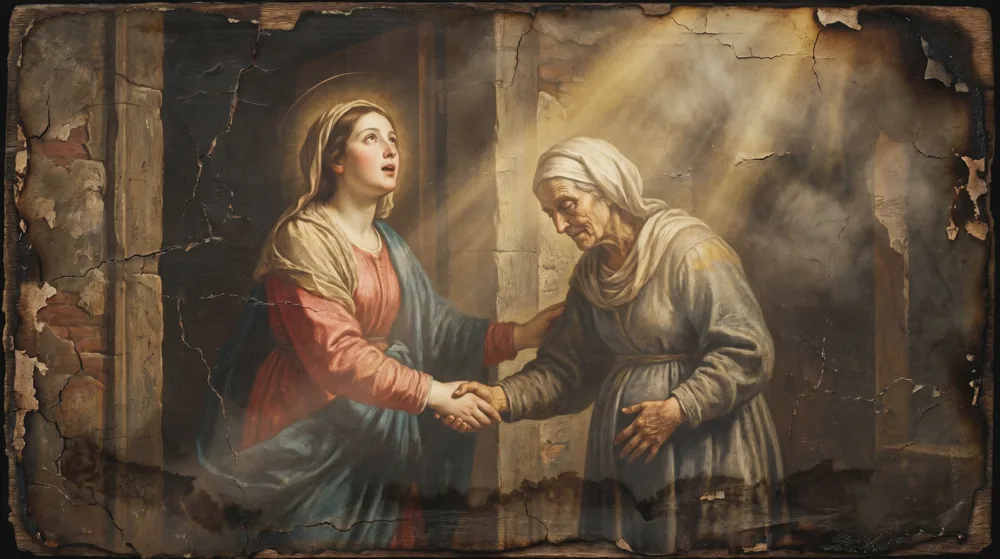
The Magnificat is the canticle the Blessed Virgin Mary spoke when she visited her cousin Saint Elizabeth, recorded in the first chapter of Saint Luke's Gospel, and it opens in English with the words "My soul doth magnify the Lord." It is Mary's song — a prayer of pure praise and thanksgiving, in which she returns to God all the glory of what He had begun to work in her. The Church holds it so dear that she sings it every evening at Vespers, the evening prayer of the Divine Office. Here we give the full Magnificat prayer in English and in its traditional Latin form, and explain what it means.
The Magnificat in English
The traditional English text follows the Douay-Rheims rendering of Luke 1:46-55, the wording the Church has used at Vespers and in devotion for centuries.
My soul doth magnify the Lord,
and my spirit hath rejoiced in God my Saviour.
Because he hath regarded the humility of his handmaid:
for behold from henceforth all generations shall call me blessed.
Because he that is mighty hath done great things to me;
and holy is his name.
And his mercy is from generation unto generations,
to them that fear him.
He hath shewed might in his arm:
he hath scattered the proud in the conceit of their heart.
He hath put down the mighty from their seat,
and hath exalted the humble.
He hath filled the hungry with good things;
and the rich he hath sent empty away.
He hath received Israel his servant,
being mindful of his mercy:
as he spoke to our fathers,
to Abraham and to his seed for ever.
When the canticle is sung in the Office, the Church adds the doxology — Glory be to the Father, and to the Son, and to the Holy Ghost — making Mary's own praise of God the frame of the Church's evening worship.
The Latin Magnificat
The canticle has a fixed traditional Latin form, taken from the Vulgate. Its first word, Magnificat, is what gives the whole prayer its name.
Magnificat anima mea Dominum,
et exsultavit spiritus meus in Deo salutari meo.
Quia respexit humilitatem ancillae suae:
ecce enim ex hoc beatam me dicent omnes generationes.
Quia fecit mihi magna qui potens est:
et sanctum nomen ejus.
Et misericordia ejus a progenie in progenies
timentibus eum.
Fecit potentiam in brachio suo:
dispersit superbos mente cordis sui.
Deposuit potentes de sede,
et exaltavit humiles.
Esurientes implevit bonis:
et divites dimisit inanes.
Suscepit Israel puerum suum,
recordatus misericordiae suae.
Sicut locutus est ad patres nostros,
Abraham et semini ejus in saecula.
What it means
The Magnificat is, before anything else, a prayer of praise and thanksgiving. The Roman Catechism teaches that prayer has two principal parts, petition and thanksgiving, and that in the second we thank God for the countless benefits with which He never ceases to load the human race. Mary's canticle is thanksgiving in its purest form: it asks God for nothing and gives Him everything. Every line returns to Him the credit for what has been done.
That is why the song begins not with herself but with God: My soul doth magnify the Lord. To "magnify" is to make great, to declare His greatness — and Mary makes plain at once that the great things worked in her are His doing, not her own. He that is mighty hath done great things to me; and holy is his name. The Roman Catechism, treating of the very words the Church borrows from this scene, teaches that in saluting the Blessed Virgin we give God praise and thanks for all the heavenly gifts with which He filled her. The Magnificat is Mary doing exactly this for herself — turning every gift back to its Giver.
The hinge of the whole canticle is humility. He hath regarded the humility of his handmaid. Mary calls herself God's handmaid, His servant; she sees that He looked not on any merit of station but on her lowliness, and chose her. From this she draws the great prophecy — from henceforth all generations shall call me blessed — which the Church has fulfilled in every age by honouring her.
The Roman Catechism, contemplating the same mystery of the Incarnation that Mary here praises, dwells on the God who humbled Himself to take on the lowliness and weakness of our nature, in order to raise mankind to the highest glory. Mary's own lowliness, lifted up by God, is the first instance of that pattern. This is why the canticle belongs to her in particular as the Mother of God: it was sung at the moment she carried in her womb the Son she had just conceived by the Holy Ghost.
The second half of the song turns from Mary to the whole work of God in history, and it is bracing rather than soft. He hath put down the mighty from their seat, and hath exalted the humble. He hath filled the hungry with good things; and the rich he hath sent empty away. This is the justice of God seen from below: He reverses the order the world esteems, casting down what is proud and raising what is small, exactly as He had just done in choosing a humble virgin over the great of the earth.
The Catechism of Saint Pius X recalls that when the Blessed Virgin visited Elizabeth she "then bore her Divine Son in her womb" — and the might in his arm that Mary praises is the same power that brought God Himself into her arms.
The canticle closes by binding this moment to the whole history of salvation: He hath received Israel his servant, being mindful of his mercy: as he spoke to our fathers, to Abraham and to his seed for ever. What God works in Mary is not an isolated wonder but the keeping of an ancient promise — the mercy pledged to Abraham, now coming to its term in her Son. The Magnificat thus reaches from one woman's lowliness out to the redemption of the world, and it does so entirely in the language of praise. Those who pray it with attention are taught the same posture: to read their own life as God's gift and to magnify Him for it.
The Magnificat in the Bible
The Magnificat is not a composed devotion but a passage of Holy Scripture. It is found in the Gospel of Saint Luke, chapter 1, verses 46 to 55 — the only Evangelist who records the infancy of Christ from Mary's side. The setting is the Visitation: Mary, having just conceived the Word by the Holy Ghost at the Annunciation, travels into the hill country of Judea to her cousin Elizabeth, who is herself with child (Saint John the Baptist). When Elizabeth greets her as "blessed... among women" and as "the mother of my Lord" (Luke 1:42-43), Mary answers with this canticle. So the words come straight from the inspired text; when we pray the Magnificat we are praying the very Gospel.
Saint Luke's first chapter holds three of the great canticles the Church still sings daily in the Divine Office: the Magnificat of Mary (Vespers), the Benedictus of Zechariah (Lauds), and — at Compline — the Nunc dimittis of Simeon, which Luke records in chapter 2. The Magnificat itself is woven through with the Old Testament: Mary's song closely echoes the canticle of Hannah in the First Book of Kings (1 Kings 2:1-10, the Vulgate numbering of 1 Samuel), the mother who likewise praised God for lifting up the lowly. Mary, full of Scripture, prays Scripture back to its Author.
Madonna of the Magnificat (the Botticelli painting)
The scene of Mary singing her canticle has been a favourite of Christian art, and the most famous image is Sandro Botticelli's Madonna of the Magnificat (Madonna del Magnificat), painted around 1481 and kept in the Uffizi Gallery in Florence. It is a tondo — a circular panel — showing the Blessed Virgin writing in an open book with a quill, the Child Jesus on her lap with His hand upon her arm, and angels holding a crown above her head; the open book bears the words of the canticle.
The image is a meditation rather than a record: it does not claim Mary literally wrote her song down, but it makes visible the truth of the canticle — that her words are God's gift, that the Child she bore is their source, and that her humility is crowned by heaven, "all generations shall call me blessed." Botticelli's painting, and the many Madonna of the Magnificat works that followed it, are why the title "Madonna of the Magnificat" is so often searched: it names this whole tradition of depicting Mary at the moment of her praise. As with all sacred images, the Church venerates not the panel or the paint but the person it represents, leading the eye through the picture to the Mother of God and through her to her Son.
The Magnificat prayer in Spanish
Because the Magnificat is prayed across the whole Church, it is naturally found in every Catholic tongue. In Spanish, as the Iter Fidei app gives it, it opens "Engrandece mi alma al Señor, y mi espíritu se llena de gozo en Dios mi Salvador" — My soul doth magnify the Lord, and my spirit hath rejoiced in God my Saviour. The Latin remains the same in every country, Magnificat anima mea Dominum, which is one reason the Church has kept Latin for the Office: a pilgrim from any land can join the same evening praise. Whatever the language, the canticle is the same Gospel words of Mary, and the Iter Fidei app gives them in Latin alongside your own tongue.
A Magnificat prayer book
Many of the faithful first meet the Magnificat in a prayer book, because it has a fixed and honoured place in Catholic devotion. It is printed in the Breviary (the book of the Divine Office, where it stands at Vespers every day), in the older Diurnal and Little Office of the Blessed Virgin Mary, and in nearly every traditional manual of prayers and missal supplement. Praying it from a book is fitting: the words are not ours to improvise but Mary's own, given by the Holy Ghost, and the Church hands them on unchanged. A sound traditional source will give the canticle in Latin and the vernacular side by side, with the doxology — Glory be to the Father... — added at the end as it is sung in the Office.
When to pray it
The Magnificat is, above all, the canticle of Vespers — the Church's evening prayer in the Divine Office. Every day, as the light fades, the Church puts Mary's words on her own lips and gives God thanks for the day, all standing for it and, at solemn Vespers, the altar being incensed, marking it as the high point of the evening hour. To pray the Magnificat at evening is to make our own thanksgiving in the words of her who thanked God best.
It belongs also to private devotion. We may pray it whenever God has done some great thing in us and we wish to return Him the praise — after a grace received, after Communion, or simply as the day ends. It is naturally joined to the Hail Mary, whose words the Church drew from the same chapter of Saint Luke: the Hail Mary salutes Mary, and the Magnificat lets us pray in her own voice. Like all true Marian prayer, it never stops at Mary but carries us through her to God, which is precisely what she does in every line of it.
Frequently Asked Questions
What is the Magnificat?
The Magnificat is the canticle the Blessed Virgin Mary spoke when she visited her cousin Saint Elizabeth, recorded in the first chapter of Saint Luke's Gospel (1:46-55). It opens in English with "My soul doth magnify the Lord," and in Latin with Magnificat anima mea Dominum — the word that gives it its name. It is a song of pure praise and thanksgiving in which Mary returns to God all the glory of what He had begun to work in her, and the Church sings it every evening at Vespers.
What does the Magnificat mean?
It is thanksgiving in its purest form: it asks God for nothing and gives Him everything, turning every gift back to its Giver. Its hinge is humility — He hath regarded the humility of his handmaid — from which Mary draws the prophecy from henceforth all generations shall call me blessed. The second half praises the justice of God, who hath put down the mighty from their seat, and hath exalted the humble, and binds the moment to the promise made to Abraham. It is Mary reading her own life as God's gift and magnifying Him for it.
Why is it called the Magnificat?
Because Magnificat — "[my soul] doth magnify" — is the first word of the canticle in the Latin Vulgate. The Church names many prayers by their opening Latin word, as with the Pater Noster and the Credo; the Magnificat takes its title from Mary's first act of praise, to "magnify" being to make great, to declare God's greatness.
Where is the Magnificat in the Bible?
In the Gospel of Saint Luke, chapter 1, verses 46 to 55. Mary speaks it at the Visitation, when she comes to her cousin Elizabeth shortly after the Annunciation. Saint Luke is the only Evangelist to record it. The same first chapter of Luke also holds the Benedictus of Zechariah, and chapter 2 holds the Nunc dimittis of Simeon — the three Gospel canticles the Church sings every day in the Divine Office.
Who wrote the Magnificat?
The words are the Blessed Virgin Mary's own, spoken at the Visitation and recorded by Saint Luke under the inspiration of the Holy Ghost. It is therefore a passage of Holy Scripture, not a later composition. Mary's song echoes the canticle of Hannah in the Old Testament (1 Kings 2:1-10, Vulgate), so she is praying the Scriptures she knew back to God.
What is the Madonna of the Magnificat?
It is the title of a celebrated painting by Sandro Botticelli (c. 1481, in the Uffizi, Florence), and of the wider tradition of sacred images it represents. The circular panel shows the Virgin writing the words Magnificat anima mea Dominum in a book, the Child Jesus at her side and angels crowning her. Like all holy images, it is venerated for the person it depicts, leading the eye through the picture to the Mother of God and her Son.
Why was the Magnificat banned?
The Magnificat has never been banned by the Catholic Church; it stands at the heart of Vespers every day of the year. The idea comes from stories, repeated online and hard to verify, that some modern governments forbade its public recital because they read its second half — He hath put down the mighty from their seat... and the rich he hath sent empty away — as political agitation. But this is the justice of God seen from below, not a worldly programme: He casts down the proud and raises the humble, exactly as He did in choosing a lowly virgin over the great of the earth.
When does the Church pray the Magnificat?
Above all at Vespers, the Church's evening prayer in the Divine Office, where it is the high point of the hour, sung standing and, at solemn Vespers, honoured with incense. It is fitting also for private devotion — after a grace received, after Communion, or simply as the day ends — whenever the soul wishes to give God thanks in the words of her who thanked Him best.
To go further, read also vespers.
The Iter Fidei app serves the Magnificat in Latin and in your own language, with audio to pray along with the Church at Vespers. Join early access here.
Sources. Gospel of Saint Luke 1:46-55, with the Visitation 1:39-45 (Douay-Rheims; Vulgate); the canticle of Hannah, 1 Kings 2:1-10 (Vulgate numbering of 1 Samuel). Catechism of the Council of Trent (Roman Catechism, 1566), on Prayer (petition and thanksgiving; the Angelic Salutation) and on the Incarnation. Catechism of Saint Pius X, on the Hail Mary (the Visitation of Mary to Saint Elizabeth). Sandro Botticelli, Madonna of the Magnificat (c. 1481, Galleria degli Uffizi, Florence). The Magnificat as said at Vespers in the Roman Breviary and the Little Office of the Blessed Virgin Mary.