
Prayer
Morning Offering Prayer: The Traditional Catholic Text
The Catholic Morning Offering prayer in its traditional Apostleship of Prayer form, then a short form, a children's verse, the Latin daily offering of the Raccolta, the prayer of St Thérèse, its history from Fr Gautrelet in 1844, and how to make it each morning.
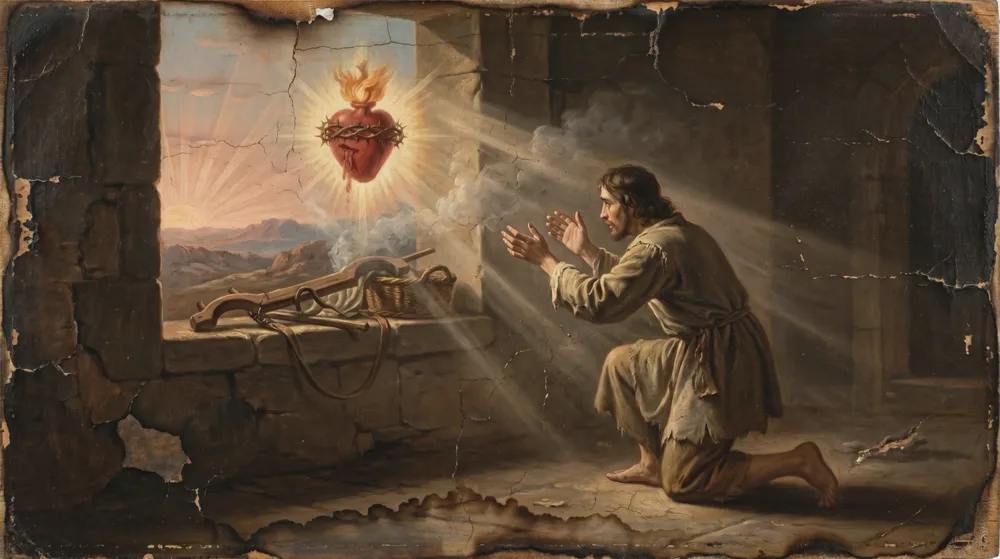
The Morning Offering is the prayer by which a Catholic, on first waking, gives the whole of the coming day to God — every prayer, work, joy and suffering — through the Sacred Heart of Jesus. It takes less than a minute, yet it consecrates the entire day before a single act of it is done. Saint Paul asks nothing less: "Whether you eat or drink, or whatsoever else you do, do all to the glory of God" (1 Corinthians 10:31).
We give first the traditional text of the Apostleship of Prayer, exactly as the old leaflets printed it, then a short form, a verse for children, the Latin daily offering of the Raccolta, the morning offering of St Thérèse, the history of the devotion, and how to make it well.
The Morning Offering prayer (traditional text)
This is the Morning Offering as the Apostleship of Prayer taught it to its members before the Council, in the form Catholic bulletins were still printing in 1961:
O Jesus, through the Immaculate Heart of Mary, I offer Thee my prayers, works, joys and sufferings of this day, for all the intentions of Thy Sacred Heart, in union with the Holy Sacrifice of the Mass throughout the world, in reparation for my sins, for the intentions of all our Associates, and for the General Intention recommended this month. Amen.
"All our Associates" are the members of the Apostleship, who pray for one another's intentions, and "the General Intention recommended this month" is the intention blessed by the Holy Father and proposed each month to the whole association; many cards simply say "and in particular for the intentions of the Holy Father." Families not enrolled often name their own in that place, as in the form the Iter Fidei app gives:
O Jesus, through the Immaculate Heart of Mary, I offer Thee my prayers, works, joys, and sufferings of this day, in union with the Holy Sacrifice of the Mass throughout the world, in reparation for my sins, for the intentions of all my relatives and friends, and in particular for the intentions of the Holy Father. Amen.
The substance is the same in both: the day, given whole, through the Heart of Mary to the Heart of her Son.
A short Morning Offering
When the morning is short, the whole offering can be made in a single line. The Raccolta, the Holy See's own collection of indulgenced prayers, gives one indulgenced by the Holy Office on 26 November 1908:
All for Thee, Most Sacred Heart of Jesus.
What makes the offering is the act of the will giving the day to God, not the number of words. The same aspiration renews the offering at each new task, together with the old invocation of the Raccolta:
Sweet Heart of my Jesus, grant that I may love Thee more and more.
A Morning Offering for children
Children can learn the full Apostleship prayer early. For the very little ones, a rhymed verse attributed to Mgr Robert Hugh Benson was printed in 1938 for parents of pre-school children in Religion in the Home:
My God, I offer up to Thee
My soul and heart, Thine own to be;
And all I do or hear or say
And all my work and play.
Said at the bedside with the Sign of the Cross, it plants the habit that matters: the first thought of the day goes to God.
The Latin daily offering
The Apostleship formula above was spread in the languages of its members, and we have found no authentic Latin original of it; rather than a modern back-translation, we give the Latin daily offering recorded in the Raccolta (Sacred Congregation of Indulgences, 19 December 1885), a different prayer and a fine companion to the first:
Domine Iesu Christe, in unione illius divinae intentionis, qua in terris per sanctissimum Cor tuum laudes Deo persolvisti et nunc in Eucharistiae Sacramento ubique terrarum persolvis usque ad consummationem saeculi, ego per hanc diem integram, ad imitationem sacratissimi Cordis beatae Mariae semper Virginis immaculatae, tibi libentissime offero omnes meas intentiones et cogitationes, omnes meos affectus et desideria, omnia mea opera et verba.
The Raccolta's English reads:
O Jesus Christ, in union with that divine intention wherewith on earth Thou didst offer to God Thy praises through Thy Most Sacred Heart, and dost now offer them in the Sacrament of the Eucharist everywhere on earth even to the end of time, I most gladly offer Thee throughout this entire day, all my thoughts and intentions, all my affections and desires, all my words and deeds, in imitation of the most sacred Heart of the blessed and ever Virgin Mary Immaculate.
The Morning Offering of Saint Thérèse
Saint Thérèse of the Child Jesus, canonised in 1925, left her own act of morning offering. It is not the Apostleship formula but a personal consecration in the same spirit, offering the day for the intentions and the glory of the Heart of Jesus:
O my God! I offer Thee all my actions of this day for the intentions and for the glory of the Sacred Heart of Jesus.
I desire to sanctify every beat of my heart, my every thought, my simplest works, by uniting them to His infinite merits;
and I wish to make reparation for my sins by casting them into the furnace of His Merciful Love.
O my God! I ask of Thee for myself and for those whom I hold dear, the grace to fulfil perfectly Thy Holy Will,
to accept for love of Thee the joys and sorrows of this passing life, so that we may one day be united together in heaven for all Eternity. Amen.
Many pray the Apostleship act for its precision and Thérèse's for its warmth; the two are not rivals. Her life and "little way" are told in our page on St Therese of Lisieux, the Little Flower.
The Brown Scapular and the Morning Offering
The Brown Scapular of Our Lady of Mount Carmel and the Morning Offering belong together because both are daily consecrations: the scapular is a wordless offering worn on the body, the Morning Offering its spoken counterpart. Those enrolled may add the old act of oblation to Our Lady, given by the Raccolta in English and Latin (Sacred Congregation of Indulgences, 5 August 1851):
My Queen! my Mother! I give thee all myself, and, to show my devotion to thee, I consecrate to thee my eyes, my ears, my mouth, my heart, my entire self. Wherefore, O loving Mother, as I am thine own, keep me, defend me, as thy property and possession.
O Domina mea! O Mater mea! Tibi me totum offero, atque, ut me tibi probem devotum, consecro tibi oculos meos, aures meas, os meum, cor meum, plane me totum. Quoniam itaque tuus sum, o bona Mater, serva me, defende me ut rem ac possessionem tuam.
So the day is given to the Sacred Heart of the Son through the heart of the Mother whose habit one wears.
The history: Fr Gautrelet, Vals, 1844
The Morning Offering goes back to Father François-Xavier Gautrelet, S.J., spiritual director of the young Jesuits studying at Vals, near Le Puy, in France. The scholastics longed for the foreign missions while their days were filled with study. On 3 December 1844, the feast of St Francis Xavier, he proposed to them that they offer each day's prayers, studies and sufferings for the intentions of the Heart of Jesus — so that the hidden routine of the seminary would itself become an apostolate, as fruitful for souls as preaching. From that simple practice the Apostleship of Prayer was born.
Its spread owed most to another Jesuit, Fr Henri Ramière, who in 1861 adapted the association to parishes, schools and religious houses and made it known through his book The Apostleship of Prayer, translated into many languages. In 1879 Pius IX approved its first statutes, which Leo XIII revised and approved in 1896. Those statutes set out three degrees of membership: the daily offering of one's prayers, good works and sufferings; a daily decade of the Rosary for the Holy Father's monthly intention; and Communion of reparation on an assigned day each month or week. The Morning Offering is therefore the first and essential degree — the one practice every member makes.
Gautrelet's exact first wording has not come down to us in a text we can quote with certainty. So the "original Morning Offering prayer" is the act itself — the day offered to the Sacred Heart — and the received text above is its lawful development, not a different prayer. By 1907, the Catholic Encyclopedia reports, the association counted over twenty-five million members.
The devotion grew from the same root as the Sacred Heart of Jesus devotion revealed to St Margaret Mary: the same Encyclopedia defines the Apostleship as "a league of prayer in union with the Heart of Jesus," its members were long known as the League of the Sacred Heart, and its Communion of reparation is close kin to the Nine First Fridays devotion.
What the Morning Offering means
The Morning Offering is an act of religion. Prayer, the Catechism of Saint Pius X teaches, "is an elevation of the mind to God to adore Him, to thank Him, and to ask Him for what we need." Its "first and best disposition" is "to be in the state of grace," and the chief things we should ask are "His own glory, our eternal salvation and the means of obtaining it." The Morning Offering places the whole day under exactly that order: God's glory first, and our salvation worked out through the day He gives. It does at dawn, once for the whole day, what we are taught to do before each task: "All whatsoever you do in word or in work, do all in the name of the Lord Jesus Christ" (Colossians 3:17).
Why offer joys and sufferings, and not only prayers and works? Because God asks for the whole life and not our words alone: St Paul begs us "that you present your bodies a living sacrifice, holy, pleasing unto God, your reasonable service" (Romans 12:1). Nothing in the day is too small or too painful to be offered; suffering accepted in union with Christ becomes itself a prayer, and the sick person who can only endure makes the whole day fruitful.
The offering is made through the Heart of Jesus, and this is not decoration. The Catechism of Saint Pius X teaches that we ask in the Name of Jesus Christ "because He is our Mediator, and it is through Him alone that we can approach the throne of God." Of themselves our works have no weight before God; joined to the Heart of Christ, they are taken up into His own offering.
It is made in union with the Holy Sacrifice of the Mass throughout the world, because at every hour a priest is somewhere at the altar, as Malachias foresaw: "From the rising of the sun even to the going down, my name is great among the Gentiles, and in every place there is sacrifice, and there is offered to my name a clean oblation" (Malachias 1:11).
It is made with Mary, through the Immaculate Heart of Mary, because the surest way to the Son is through His Mother, who presents our offering purified by her intercession; our page on the Immaculate Heart of Mary explains why the Church honours it. And it is made in reparation and for the Holy Father's intentions, so that the smallest day enters the common prayer of the whole Church.
How to make a Morning Offering
- Make it first. On waking, before the phone, the news or the day's worries, make the Sign of the Cross and give your heart to God. "O Lord, in the morning thou shalt hear my voice. In the morning I will stand before thee" (Psalm 5:4-5). Prayed then, the offering governs everything that follows; prayed at noon, it has already let half the day slip by unoffered.
- Kneel if you can, at the bedside, as the old custom has it; lying down or on the way to work, the offering is just as true.
- Say it slowly. Pause on prayers, works, joys, sufferings and think of what this day holds — the hard conversation, the tedious task, the pain that will not lift — handing each over in advance.
- Name an intention: the person or need you carry, and the Holy Father's intention for the month.
- Renew it during the day. "All for Thee, Most Sacred Heart of Jesus" at each new task keeps the morning act alive.
- Be in the state of grace. The offering is made by a soul in friendship with God; if mortal sin weighs on you, begin with an act of perfect contrition and go to confession soon.
The Morning Offering opens a day of prayer. The fuller traditional Catholic morning prayers — the Acts of Faith, Hope and Charity, and Prime, the Church's own morning hour — can follow once dressed; the collect of Prime says in the Church's words what the Morning Offering says in ours:
O Lord God Almighty, who hast safely brought us to the beginning of this day, defend us in the same by Thy mighty power, that this day we may fall into no sin, but that all our words may so proceed, and all our thoughts and actions may be so directed as to do always that which is just in Thy sight. Through Christ our Lord. Amen.
At noon, the Angelus prayer in Latin and English stops the work at the bell and returns the heart to the Incarnation. At night, the daily examen of St Ignatius looks back over the very day that was offered in the morning, and before confession a fuller examination of conscience does the same for the weeks since. Morning Offering, Angelus, examen: three short acts hold the day in God's hand, alongside the essential traditional Catholic prayers every Catholic should know.
The Morning Offering with the daily Mass readings
Many Catholics join the Morning Offering to the readings of the day. The instinct is sound: the offering is made in union with the Holy Sacrifice of the Mass throughout the world, so reading the very texts offered at the altar that day makes the union concrete. For a traditional Catholic those are the propers of the 1962 Missal: you will find today's Gospel and readings of the Latin Mass and the day's feast in the 1962 liturgical calendar; those who pray the Office can go on to today's Lauds in the 1962 Breviary.
Morning Offering prayer card and printable text
The full traditional text of the Morning Offering is given above and prints as it is, on a card for the bedside or the missal. Better still, install Join early access here.: it gives the Morning Offering every day, with a morning reminder, in Latin and English, and works offline.
Frequently Asked Questions
What is a morning offering in the Catholic Church?
A morning offering is a short act of consecration made on waking, by which a Catholic gives God, in advance, everything the day will contain. The best-known form is that of the Apostleship of Prayer, addressed to Jesus through the Immaculate Heart of Mary; any sincere form that offers the whole day to God fulfils the practice.
Do I have to say the Morning Offering in exact words?
No. The Apostleship form is worth learning by heart, but the offering consists in the act of the will; the set text is a help to make it well, not a condition.
What if I forget to make the Morning Offering?
Make it as soon as you remember: an offering at ten o'clock still gives God the rest of the day. The habit forms quickly when tied to a fixed gesture, such as the Sign of the Cross before your feet touch the floor.
Can I make the Morning Offering if I am in a state of mortal sin?
Yes, and you should still pray. But the Council of Trent teaches that it is the good works of the justified that truly merit an increase of grace and eternal life (Session VI, canon 32), so a soul in mortal sin should join to the offering an act of perfect contrition and go to confession as soon as possible, that the day may be fully fruitful.
Is the Morning Offering the same as morning prayers?
No. The Morning Offering is one act, the gift of the day; morning prayers are a fuller set — adoration, the Acts of Faith, Hope and Charity, the Our Father, Hail Mary and Creed — within which it is usually placed.
Is the Morning Offering only for members of the Apostleship of Prayer?
No. Any Catholic may make it. Enrolment adds the bond of praying for all the Associates and the Holy Father's monthly intention as one league.
The Iter Fidei app serves the Morning Offering every morning in Latin and in English, with a morning reminder, even offline, so the offering can become the first word of every day. Join early access here.
Sources. Psalm 5:4-5; Malachias 1:11; Romans 12:1; 1 Corinthians 10:31; Colossians 3:17 (Douay-Rheims); Catechism of Saint Pius X, Prayer in General; Council of Trent, Session VI, canon 32; the Morning Offering of the Apostleship of Prayer, founded by Fr F.-X. Gautrelet, S.J. (Vals, 1844), statutes approved by Pius IX (1879) and Leo XIII (1896); The Raccolta (Benziger, 1943), nos. 47, 76, 203, 216, 310; Breviarium Romanum, collect of Prime; St Thérèse of the Child Jesus, Prayers, no. 10 (Offering of the Day).