
Prayer
The Nicene Creed
The Nicene Creed is the Catholic profession of faith sung at Mass — the Credo of Nicaea 325 and Constantinople 381 — given here in English and Latin, with its meaning.
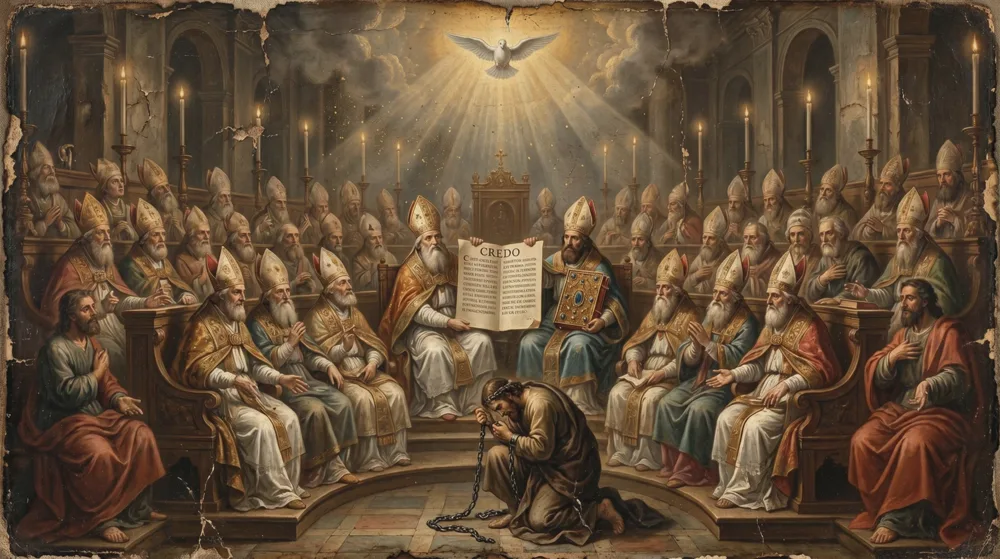
The Nicene Creed is the Catholic profession of faith chanted or recited at Mass on Sundays and the greater feasts — the prayer that begins I believe in one God. It is called Nicene because the Church fixed its wording at two early councils, Nicaea in the year 325 and Constantinople in 381, to confess the whole faith against those who denied that the Son is true God. Below we give the Nicene Creed prayer in English and in the traditional Latin Credo, and then explain what it means and when to pray it.
The Nicene Creed in English
I believe in one God, the Father Almighty, Maker of heaven and earth, and of all things visible and invisible.
And in one Lord Jesus Christ, the only-begotten Son of God, born of the Father before all ages. God of God, Light of Light, true God of true God; begotten, not made; consubstantial with the Father, by whom all things were made. Who for us men, and for our salvation, came down from heaven. And was incarnate by the Holy Ghost of the Virgin Mary, and was made man. He was crucified also for us, suffered under Pontius Pilate, and was buried. And on the third day He rose again, according to the Scriptures. And He ascended into heaven, and sitteth at the right hand of the Father. And He shall come again with glory to judge the living and the dead; of whose kingdom there shall be no end.
And in the Holy Ghost, the Lord and Giver of Life, who proceedeth from the Father and the Son. Who together with the Father and the Son is adored and glorified; who spoke through the Prophets.
And in one, holy, Catholic, and Apostolic Church. I confess one baptism for the remission of sins. And I look for the resurrection of the dead, and the life of the world to come. Amen.
The Nicene Creed in Latin (the Credo)
This is the Creed as it stands in the Roman Missal, sung or said at Mass after the Gospel and the sermon.
Credo in unum Deum, Patrem omnipoténtem, factórem cæli et terræ, visibílium ómnium et invisibílium.
Et in unum Dóminum Jesum Christum, Fílium Dei unigénitum. Et ex Patre natum ante ómnia sǽcula. Deum de Deo, lumen de lúmine, Deum verum de Deo vero. Génitum, non factum, consubstantiálem Patri: per quem ómnia facta sunt. Qui propter nos hómines et propter nostram salútem descéndit de cælis. Et incarnátus est de Spíritu Sancto ex María Vírgine: et homo factus est. Crucifíxus étiam pro nobis: sub Póntio Piláto passus, et sepúltus est. Et resurréxit tértia die, secúndum Scriptúras. Et ascéndit in cælum: sedet ad déxteram Patris. Et íterum ventúrus est cum glória judicáre vivos et mórtuos: cujus regni non erit finis.
Et in Spíritum Sanctum, Dóminum et vivificántem: qui ex Patre filióque procédit. Qui cum Patre et Fílio simul adorátur et conglorificátur: qui locútus est per prophétas.
Et unam sanctam cathólicam et apostólicam Ecclésiam. Confíteor unum baptísma in remissiónem peccatórum. Et exspécto resurrectiónem mortuórum. Et vitam ventúri sǽculi. Amen.
At the words and was incarnate by the Holy Ghost of the Virgin Mary, and was made man (Et incarnátus est… et homo factus est) all kneel, in adoration of the mystery by which the Son of God took our flesh.
What the Nicene Creed means
A creed is a summary of the truths of the faith. The catechism teaches that to say Credo, I believe, is to hold for absolutely true all that the Creed contains, and to believe it more firmly than if we saw it with our own eyes — because God, who can neither deceive nor be deceived, has revealed these truths to the Church, and through her to us. To believe is not to suppose or to have an opinion; it is a most firm and unshakable assent of the mind to the mysteries revealed by God.
The Nicene Creed confesses the same faith as the shorter Apostles' Creed, but it spells out, against early heresy, what the Church holds about the Son of God. We profess that He is born of the Father before all ages — begotten from eternity, the eternal Word, as the second Person of the Most Holy Trinity. The Catechism of Saint Pius X teaches that the Son "is begotten by the Father from all eternity by way of intelligence," and that, "like the Father, He is God eternal, omnipotent, Creator and Lord."
This is why the Creed piles up its phrases: God of God, Light of Light, true God of true God; begotten, not made; consubstantial with the Father. The word consubstantial — consubstantiálem in Latin, of one substance — was set by the Council of Nicaea precisely to confess that the Son is not a creature but is one in being with the Father. We are sons of God by adoption; He alone is Son by nature.
The Creed then traces the whole work of our salvation: the Son came down from heaven, was made man by the Holy Ghost of the Virgin Mary, was crucified, died, and rose the third day according to the Scriptures, ascended, and shall come again with glory to judge the living and the dead. We confess the Holy Ghost, the Lord and Giver of life, true God adored together with the Father and the Son — the Spirit to whom, the catechism teaches, "is specially attributed the sanctification of souls."
And we end with the Church herself: one, holy, catholic and apostolic, one baptism for the remission of sins, the resurrection of the dead, and the life of the world to come. These are, in the words of the catechism, the principal things we must believe concerning God, concerning Jesus Christ, and concerning the Church His spouse — the whole of what Catholics believe, gathered into one prayer.
The Nicene Creed and the Apostles' Creed
The two creeds are not rivals; they are the same faith in two forms. The Apostles' Creed is the older and shorter — twelve articles that summarise the truths taught by the Apostles, the form recited at the start of the Rosary. The Nicene Creed is longer and more exact: it is the conciliar profession that names the Son consubstantial with the Father and the Holy Ghost the Lord and Giver of life, drawn up to leave no room for error about the divinity of Christ.
Both confess one God in three Persons, the Incarnation, the Cross and Resurrection, the Church, and life everlasting. The Apostles' Creed is the daily prayer of the faithful; the Nicene Creed is the Creed of the Mass. A third, the Athanasian Creed, unfolds the same faith in the Trinity and the Incarnation at greater length, and is recited in the Breviary at Prime on Trinity Sunday.
The differences between the Nicene and Apostles' Creed
The two professions agree in faith but differ in origin, length, and use. The chief differences are these:
- Origin. The Apostles' Creed grew from the baptismal profession of the Roman Church and summarises the teaching of the Apostles; the Nicene Creed was fixed by the Councils of Nicaea (325) and Constantinople (381).
- Length and precision. The Apostles' Creed has twelve short articles; the Nicene Creed is longer and more exact, adding the conciliar terms drawn up against heresy.
- The Son. Only the Nicene Creed says the Son is God of God, Light of Light, true God of true God, begotten not made, consubstantial with the Father — the words set to confess His true divinity.
- The Holy Ghost. Only the Nicene Creed names the Holy Ghost the Lord and Giver of life… who proceedeth from the Father and the Son.
- Use. The Apostles' Creed opens the Rosary and is the form for private devotion; the Nicene Creed is sung or said at Mass.
They are not in conflict: the Nicene Creed simply unfolds, in fuller words, the one faith the Apostles' Creed already holds.
The Nicene Creed: the new Catholic version (2011 translation)
People sometimes ask about a "new version" of the Nicene Creed. The faith and the structure are unchanged; what changed in the English-speaking world is the translation used at the new rite of Mass. From the First Sunday of Advent 2011, the corrected English translation of the Missale Romanum restored a wording closer to the Latin Credo. The most noticed changes are these:
- The Creed now begins "I believe" (in the singular, for Credo), in place of the earlier "We believe."
- It says the Son is "consubstantial with the Father," restoring the precise term consubstantiálem in place of the older "one in Being with the Father."
- It says "incarnate of the Virgin Mary," and "born of the Father before all ages," following the Latin more closely.
This is the English text now used at the new rite. In the traditional Latin Mass the Credo has never changed: it is sung in Latin from the Roman Missal, exactly as given above. The doctrine of the Creed — fixed at Nicaea and Constantinople — is the same in every age; only the translation was revised.
The Nicene Creed in the Orthodox Churches
The Eastern Orthodox recite the same Nicene-Constantinopolitan Creed, with one difference: their text says the Holy Ghost proceeds "from the Father" alone, without the Filioque — the words and the Son. The Catholic Church confesses, with the Latin tradition and the lawful councils, that the Holy Ghost proceeds from the Father and the Son as from one principle, and so the Creed of the Roman Missal keeps qui ex Patre Filioque procédit. The difference of wording over the Filioque is one of the historic points between East and West; the Creed is otherwise held in common.
When to pray the Nicene Creed: the Creed at Mass
The Creed at Mass is the Nicene Creed. It is sung or said after the Gospel and the sermon, on every Sunday, on the feasts of Our Lord and Our Lady, on the feasts of the Apostles, and on the greater solemnities of the year — the days on which the Church most solemnly hands on her faith. In the traditional Latin Mass it is the Credo of the chant, and the whole congregation kneels at the Et incarnátus est.
Outside of Mass, it may be prayed at any time as an act of faith. The catechism counsels us to recite the Creed often, so as to impress ever more deeply on our hearts the truths of the faith. The instinct to carry this confession into daily life is old: St Patrick's Breastplate, the most ancient of the traditional Irish blessings, arms the soul each morning with "the invocation of the Trinity, through belief in the Threeness, through confession of the Oneness."
Frequently Asked Questions
What is the Nicene Creed?
The Nicene Creed is the Catholic profession of faith sung or said at Mass after the Gospel on Sundays and the greater feasts — the prayer that begins I believe in one God. It is a summary of the chief truths of the faith concerning the Father, the Son, the Holy Ghost, and the Church, fixed by the councils to confess that Jesus Christ is true God. To say Credo, I believe, is to hold for absolutely true all that it contains, because God who can neither deceive nor be deceived has revealed it.
Who wrote the Nicene Creed?
No single man wrote it. The Creed was drawn up by the bishops gathered at the Council of Nicaea in the year 325, who fixed the word consubstantial to confess that the Son is true God; the clauses on the Holy Ghost and the Church were added by the Council of Constantinople in 381. It is therefore the work of the Church in council, guided by the Holy Ghost, not of any private author.
When was the Nicene Creed written?
It was written in two stages. Its first form was drawn up at the Council of Nicaea in the year 325, against those who denied that the Son is true God. It was then completed at the Council of Constantinople in 381, which added the fuller confession of the Holy Ghost and of the Church — which is why it is sometimes called the Niceno-Constantinopolitan Creed.
What are the words of the Nicene Creed?
It begins I believe in one God, the Father almighty, maker of heaven and earth, and confesses one Lord Jesus Christ… God of God, Light of Light, true God of true God, begotten, not made, consubstantial with the Father, who came down from heaven, was made man, was crucified, rose the third day, and shall come again to judge the living and the dead. It then confesses the Holy Ghost, the Lord and Giver of life, and one holy, catholic and apostolic Church. The full prayer in English and Latin is given above.
Why was the Nicene Creed written?
It was written to confess, against the early heresy that denied the Son's divinity, that Jesus Christ is true God of true God, consubstantial with the Father. By fixing this in a common profession the Church guarded the faith of the Incarnation and gave the whole Church one prayer in which to confess the Most Holy Trinity, the work of our salvation, and the life of the world to come.
What is the Filioque clause of the Nicene Creed?
The Filioque is the words and the Son — Filioque in Latin — in the clause that confesses the Holy Ghost who proceedeth from the Father and the Son (qui ex Patre Filioque procédit). It professes that the Holy Ghost proceeds eternally from the Father and the Son as from one principle, the faith the catechism teaches and the Latin Church sings in the Creed of the Mass.
When was the Filioque added to the Nicene Creed?
The truth it expresses was always held, but the word Filioque was added to the Latin text gradually in the West, affirmed by local councils in Spain and Gaul from the sixth and seventh centuries onward, and received at Rome by the eleventh century. It remains a fixed part of the Creed of the Roman Missal sung at Mass.
Is the Nicene Creed Catholic?
Yes. It is the Catholic profession of faith, sung or said at Mass after the Gospel on Sundays and the greater feasts. It was promulgated by the lawful councils of the Church and confesses the one, holy, catholic and apostolic Church — the very faith Catholics hold and have always held.
What is the difference between the Nicene Creed and the Apostles' Creed?
They confess the same faith in two forms. The Apostles' Creed is older, shorter (twelve articles), and used for private devotion and the start of the Rosary. The Nicene Creed is longer and more exact, fixed by the councils to confess that the Son is consubstantial with the Father, and is the Creed sung at Mass. The Nicene Creed unfolds in fuller words the one faith the Apostles' Creed already holds.
Is there a new version of the Nicene Creed?
The faith never changed; only the English translation did. From Advent 2011 the corrected translation used at the new rite begins "I believe" (for Credo) instead of "We believe," and says the Son is "consubstantial with the Father." In the traditional Latin Mass the Credo has never changed and is sung in Latin from the Roman Missal.
Why does the Orthodox Nicene Creed not have the Filioque?
The Eastern Orthodox keep the wording of the council of 381, which said the Holy Ghost proceeds "from the Father." The Latin Church added Filioque — and the Son — to confess that the Holy Ghost proceeds from the Father and the Son as from one principle. The truth was always held; the West simply made it explicit in the Creed.
Where can I find the text of the Nicene Creed to print?
The full text of the Nicene Creed in English and in the Latin Credo is given above and may be copied or printed for prayer. The Iter Fidei app also serves the Creed in Latin and your own language, with audio to pray along.
The Nicene Creed is the faith of the whole Church set to one breath: one God, the Father, the Son consubstantial with Him, the Holy Ghost adored with them, one Church, and the life of the world to come. We say it standing at Mass because it is the faith we are willing to live and die in.
The Iter Fidei app serves this prayer in Latin and your own language, with audio to pray along. Join early access here.
Sources. Catechism of the Council of Trent (1566), First Part, on Faith and the Creed; Catechism of Saint Pius X, The Creed in General, the Second and Eighth Articles; the Lorica of St Patrick (tr. Kuno Meyer); Latin Credo per the Ordinary of the Roman Missal of 1962.