
Prayer
The Te Deum
The Te Deum — the Church's great hymn of thanksgiving and praise — its full text in English and Latin, its meaning, and when it is sung.
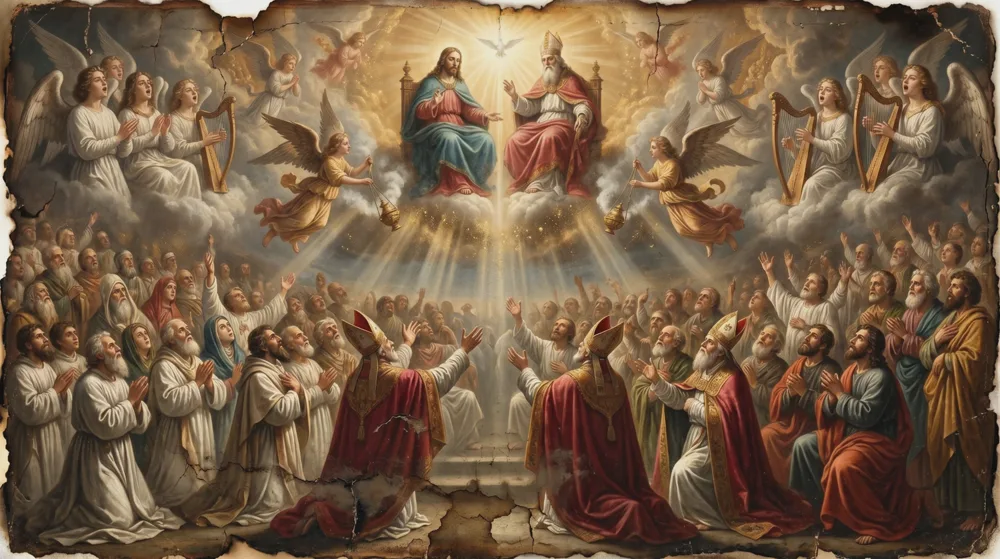
The Te Deum is the Church's great hymn of thanksgiving and praise — a song of the whole Church on earth joining the angels and saints of heaven in glorifying God. It takes its name from its first Latin words, Te Deum laudamus — "We praise Thee, O God." For centuries it has been sung in thanksgiving for every great mercy. Here is the hymn in full, in English and Latin, with its meaning.
The Te Deum
We praise Thee, O God :
we acknowledge Thee to be the Lord.
All the earth doth worship Thee,
the Father everlasting.
To Thee all Angels,
to Thee the heavens and all the powers therein ;
to Thee Cherubim and Seraphim
cry out without ceasing :
Holy, Holy, Holy,
Lord God of Sabaoth.
Heaven and earth are full
of the majesty of Thy glory.
The glorious choir of the Apostles,
the admirable company of the Prophets,
the white-robed army of Martyrs praise Thee.
Throughout the world,
the holy Church doth acknowledge Thee :
the Father of an infinite majesty ;
Thy adorable,
true and only Son ;
also the Holy Ghost the Comforter.
Thou art the King of glory, O Christ.
Thou art the everlasting Son of the Father.
When Thou tookest upon Thee to deliver man,
Thou didst not abhor the Virgin's womb.
When Thou hadst overcome the sting of death,
Thou didst open the kingdom of heaven to all believers.
Thou sittest at the right hand of God,
in the glory of the Father.
We believe that Thou shalt come to be our Judge.
We beseech Thee, therefore, help Thy servants,
whom Thou hast redeemed with Thy Precious Blood.
Make them to be numbered with Thy Saints
in glory everlasting.
Save Thy people, O Lord,
and bless Thine inheritance.
Govern them, and lift them up
for ever.
Day by day we bless Thee,
and we praise Thy name forever,
yea, world without end.
Vouchsafe, O Lord, this day,
to keep us without sin.
Have mercy on us, O Lord,
have mercy on us.
Let Thy mercy, O Lord, be upon us,
as we have hoped in Thee.
In Thee, O Lord, have I hoped :
let me not be confounded forever.
In Latin
Te Deum laudamus :
te Dominum confitemur.
Te aeternum Patrem,
omnis terra veneratur.
Tibi omnes Angeli,
tibi caeli et universae potestates :
Tibi Cherubim et Seraphim,
incessabili voce proclamant :
Sanctus, Sanctus, Sanctus,
Dominus Deus Sabaoth.
Pleni sunt caeli et terra
majestatis gloriae tuae.
Te gloriosus Apostolorum chorus,
Te Prophetarum laudabilis numerus,
Te Martyrum candidatus laudat exercitus.
Te per orbem terrarum
sancta confitetur Ecclesia :
Patrem immensae majestatis ;
Venerandum tuum verum,
et unicum Filium ;
Sanctum quoque Paraclitum Spiritum.
Tu Rex gloriae, Christe.
Tu Patris sempiternus es Filius.
Tu, ad liberandum suscepturus hominem,
non horruisti Virginis uterum.
Tu, devicto mortis aculeo,
aperuisti credentibus regna caelorum.
Tu ad dexteram Dei sedes,
in gloria Patris.
Judex crederis esse venturus.
Te ergo quaesumus, tuis famulis subveni,
quos pretioso sanguine redemisti.
Aeterna fac cum sanctis tuis
in gloria numerari.
Salvum fac populum tuum, Domine,
et benedic hereditati tuae.
Et rege eos, et extolle illos
usque in aeternum.
Per singulos dies benedicimus te ;
Et laudamus nomen tuum in saeculum,
et in saeculum saeculi.
Dignare, Domine, die isto
sine peccato nos custodire.
Miserere nostri, Domine,
miserere nostri.
Fiat misericordia tua, Domine, super nos,
quemadmodum speravimus in te.
In te, Domine, speravi :
non confundar in aeternum.
In Spanish (Te Deum en español)
A ti, oh Dios, te alabamos,
a ti, Señor, te reconocemos.
A ti, eterno Padre,
te venera toda la creación.
Los ángeles todos, los cielos
y todas las potestades te honran.
Los querubines y serafines
te cantan sin cesar:
Santo, Santo, Santo es el Señor,
Dios del universo.
Los cielos y la tierra están llenos
de la majestad de tu gloria.
A ti te ensalza el glorioso coro de los Apóstoles,
la multitud admirable de los Profetas,
el blanco ejército de los Mártires.
A ti la Iglesia, por toda la tierra,
te aclama:
Padre de inmensa majestad,
Hijo único y verdadero, digno de adoración,
Espíritu Santo, Defensor.
Tú eres el Rey de la gloria, Cristo.
Tú eres el Hijo eterno del Padre.
Tú, para liberar al hombre,
no has rehusado nacer de una Virgen.
Tú, rotas las cadenas de la muerte,
abriste a los creyentes el reino del cielo.
Tú te sientas a la derecha de Dios
en la gloria del Padre.
Creemos que un día has de venir como juez.
Te rogamos, pues, que vengas en ayuda de tus siervos,
a quienes redimiste con tu preciosa sangre.
Haz que en la gloria eterna
nos asociemos a tus santos.
The same hymn is sung in Spanish-speaking lands, where the Te Deum is a fixture of national thanksgivings (the Te Deum de Acción de Gracias) and great feasts. The text above renders the praise and the petition; the Latin remains the form in which it is chanted in the traditional Roman rite.
What it means
The Te Deum is built in three movements. It begins as a hymn of praise — the whole creation, the angels, the apostles, prophets, and martyrs, and the Church throughout the world acknowledging the majesty of God, Father, Son, and Holy Ghost. (See The Holy Trinity.) It passes to the confession of Christ — the King of glory, the everlasting Son, who did not abhor the Virgin's womb, who overcame death and opened heaven, and who shall come to be our Judge. It ends in petition — that we may be helped, numbered among the saints, saved and governed, kept this day without sin, and never confounded in our trust in God.
When it is sung
The Te Deum is sung in thanksgiving: on great feasts, at the end of the year, after the election of a Pope, at a canonization, a coronation, or any signal blessing. In the Divine Office it crowns Matins on feast days. The faithful pray it in private thanksgivings too — it is the most traditional of birthday prayers and blessings, sung in gratitude for another year of life. Wherever the Church has cause to thank God, she sings the Te Deum.
The Te Deum chant
The proper music of the Te Deum is Gregorian chant. The Roman books give it in two tones — a solemn tone for great feasts and a simple tone for ordinary use — both belonging to a recitative type in which the verses are sung to a flexible, formula-based melody rather than to fixed measured notes. The hymn is intoned by the celebrant or cantor at Te Deum laudamus, and the choir or congregation takes it up, alternating verse by verse. It is this plainchant, unhurried and antiphonal, that has carried the hymn through sixteen centuries of the Church's worship. (See Gregorian Chant.)
Charpentier's Te Deum
The best-known modern setting is the Te Deum in D major (H. 146) by Marc-Antoine Charpentier (1643–1704), composed in the late seventeenth century. Its triumphant orchestral prelude — the Marche en rondeau — is familiar far beyond the church, having been adopted as the theme of the European Broadcasting Union. Charpentier's setting is a concert and liturgical paraphrase of the ancient text, not a substitute for it: the words sung are the very words of the Te Deum given above.
Bruckner's Te Deum
Anton Bruckner (1824–1896), a devout Catholic organist and composer, set the Te Deum in C major (WAB 45) for soloists, chorus, orchestra, and organ, completing it in 1884. Bruckner thought it among his finest works and inscribed it "to God in thanks." Like Charpentier's, it is a grand concert setting of the same liturgical text — a fitting witness that the Church's hymn of thanksgiving has drawn the best of sacred music to itself. The chanted Gregorian Te Deum, however, remains the form proper to the Divine Office.
Frequently Asked Questions
What does Te Deum mean?
Te Deum is Latin for "Thee, O God," the opening of the hymn's first line, Te Deum laudamus — "We praise Thee, O God." The whole phrase Te Deum laudamus means "We praise Thee, O God; we acknowledge Thee to be the Lord." The hymn takes its name, as many ancient prayers do, from its first words, and the title has come to stand for any solemn act of thanksgiving to God.
What is the Te Deum prayer?
The Te Deum is the Church's great hymn of thanksgiving and praise — the song of the whole Church on earth joining the angels and saints of heaven in glorifying God. It is built in three movements: a hymn of praise to the Father, Son, and Holy Ghost; a confession of Christ the King of glory who overcame death and opened heaven; and a closing petition for help, mercy, and final glory among the saints. Its full text in English and Latin is given above.
When is the Te Deum sung?
It is sung in thanksgiving for every great mercy: on solemn feasts, at the close of the civil year on New Year's Eve, after the election of a Pope, at a canonization, a royal coronation, or any signal blessing. In the traditional Divine Office it crowns Matins on feast days. Wherever the Church has cause to thank God, she lifts up the Te Deum.
Who wrote the Te Deum?
Tradition ascribes the Te Deum to Saints Ambrose and Augustine, holding that they composed it together on the night of Augustine's baptism — which is why it was long called the Hymnus Ambrosianus, the Ambrosian Hymn. Modern scholars more often attribute it to Nicetas of Remesiana in the late fourth century. Whatever its precise author, it is one of the most ancient hymns of the Latin Church, sung without interruption for some sixteen centuries.
What is the Te Deum laudamus?
Te Deum laudamus is the full opening line of the hymn and its proper title — Latin for "We praise Thee, O God." The Church names the whole hymn by these first words, just as she names other ancient prayers. The phrase declares the hymn's purpose at once: it is an act of praise and thanksgiving addressed directly to God, the entire creation joining the angels and saints in His worship.
Who composed the Charpentier and Bruckner settings?
Marc-Antoine Charpentier (1643–1704) composed his celebrated Te Deum in D major (H. 146), whose prelude is now the theme of the European Broadcasting Union. Anton Bruckner (1824–1896) set the Te Deum in C major (WAB 45), finished in 1884 and inscribed in thanks to God. Both are grand concert settings of the same ancient liturgical text; the form proper to the Divine Office remains the Gregorian chant, sung to its solemn or simple tone.
See also a thanksgiving prayer and What is the Divine Office?
(Iter Fidei serves the Te Deum in Latin and your own language, with audio to sing along, in the app.) Join early access here.
Sources. The Te Deum, the ancient hymn of thanksgiving of the Roman Church (traditionally ascribed to Sts Ambrose and Augustine; the Liber Usualis for the solemn and simple chant tones). Marc-Antoine Charpentier, Te Deum H. 146; Anton Bruckner, Te Deum WAB 45.