
The Faith
When Was Jesus Born? The Year and the Date
Jesus Christ was most likely born around 6–4 BC, before the death of Herod the Great, and the Church has kept His birth on 25 December since antiquity. We explain the year, the date, and why Christmas falls when it does.
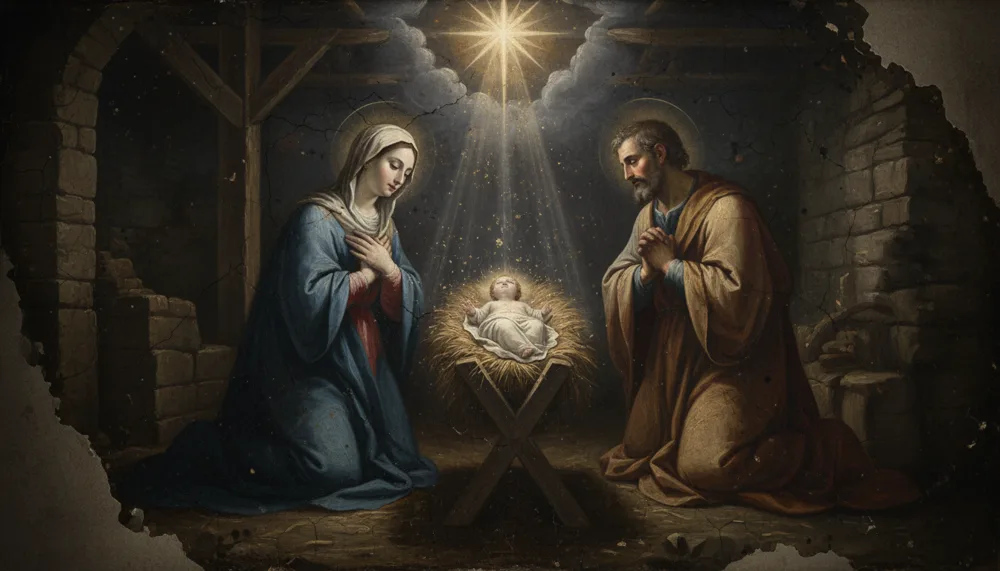
Jesus Christ was most likely born around 6 to 4 BC, a few years earlier than our calendar's count of years suggests, and the Church keeps the day of His birth on 25 December, as she has done since antiquity. Two questions are folded into the single question of when Jesus was born: in what year, and on what day. They have different answers, and the difference is worth understanding plainly. The year is a matter of history, and our reckoning of it is slightly off; the date is a matter of the Church's ancient observance, fixed long before the modern objections raised against it.
What year was Jesus born?
The strange and honest answer is that the Son of God, the eternal Word made flesh, was almost certainly born several years "before Christ" — before the year our calendars assign to His coming. The reason lies in how the count of years was first devised.
The system of dividing history into years "before Christ" (BC) and "in the year of the Lord" (Anno Domini, AD) was the work of a Roman monk, Dionysius Exiguus, in the sixth century. Around the year 525 he calculated the year of Christ's birth in order to set the date of Easter, and from his reckoning the AD count descends. But Dionysius, working with the records available to him, made an error of a few years. He placed the Nativity too late.
The correction comes from the Gospel itself. Saint Matthew records that Jesus was born "in the days of king Herod" (Matthew 2:1, Douay-Rheims), and that Herod, seeking to destroy the Child, ordered the slaughter of the male infants of Bethlehem. Herod the Great died in 4 BC, as the historical record attests. The Holy Family's flight into Egypt and return after Herod's death must therefore fall before that year. Reckoning back from the massacre and the events around it, our Lord's birth is most reasonably placed around 6 to 4 BC. So the man who invented our calendar set the count a few years late, and the irony stands: by our own numbering, Christ was born "before Christ."
This does not trouble the faith in the least. The Church does not rest the truth of the Incarnation on the precision of a sixth-century monk's arithmetic. What Scripture affirms is not a calendar year but a fullness of time: "But when the fulness of the time was come, God sent his Son, made of a woman, made under the law" (Galatians 4:4). The hour was God's own choosing. For the deeper question of who this Child is — true God and true man — we treat it elsewhere, in who is Jesus Christ and in what does Jesus Christ mean.
When is Jesus' birthday? Why Christmas is on December 25
The date the Church keeps is 25 December, and she has kept it from early Christian antiquity. The Feast of the Nativity on that day is attested in Rome by the fourth century and was received throughout the Church as the day of Christmas, the celebration of our Lord's birth. It is not a date the Church chose on a whim, nor — as is often claimed today — one she borrowed from the pagans. Two ancient reasons explain it, and both are Christian to the root.
The Sun of Justice and the winter solstice
The first reason is symbolic and was understood by the Fathers. The Nativity falls near the winter solstice, the turning of the year when the days, having shortened to their darkest, begin again to lengthen and the light returns. The Church saw in this a figure of Christ Himself, the true Light coming into a world grown dark. The prophet Malachias had foretold Him under exactly this image: "But unto you that fear my name, the Sun of justice shall arise, and health in his wings" (Malachias 4:2, Douay-Rheims). Christ is the Sun of Justice; His birth in the dead of winter, as the natural sun begins its return, proclaims that the true light has dawned upon those who sat in darkness.
Far from copying a sun-cult, the Church claimed the solstice for Christ. Where the heathen had worshipped the created sun, the faithful now adored the One the created sun had only foreshadowed. The objection that "Christmas is just a baptized pagan festival" inverts the truth: it was the darkness that borrowed light's calendar, not the Church that borrowed the darkness's calendar.
The calculation from the Annunciation, 25 March
The second reason is older still and more precise. The early Christians fixed 25 March as the date of the Annunciation — the day the angel Gabriel came to the Virgin Mary and the Word was conceived in her womb, the very moment of the Incarnation. From the conception, the birth follows nine months after: 25 March to 25 December. The date of Christmas is thus calculated from the date of the conception. The whole mystery hangs together: the Word is made flesh at the Annunciation, and is born at Christmas nine months later, of her whose perpetual virginity the Church confesses and whom she honours as the Mother of God.
This is why the two great feasts stand exactly nine months apart in the calendar, and why neither is arbitrary. The day of His birth was reckoned from the day of His conception, both held in faith and reverence.
What does the Bible say about when Jesus was born?
Scripture does not give a year or a calendar date for the Nativity, and it was never meant to. What it gives instead are anchors — fixed points of history and prophecy — from which the year can be recovered and the date received in the Church's tradition. It is worth setting them out plainly, because the man who asks honestly what the Bible actually says about when Jesus was born deserves more than a slogan.
The first anchor is the reign of Herod. "When Jesus therefore was born in Bethlehem of Juda, in the days of king Herod" (Matthew 2:1, Douay-Rheims). Herod the Great died in 4 BC; the Nativity must therefore fall before that year, which is how we arrive at the window of 6 to 4 BC.
The second anchor is the Roman census under Caesar Augustus: "And it came to pass, that in those days there went out a decree from Caesar Augustus, that the whole world should be enrolled. This enrolling was first made by Cyrinus, the governor of Syria" (Luke 2:1–2, Douay-Rheims). It was this enrolment that drew Joseph and Mary from Nazareth to Bethlehem, the city of David, so that prophecy might be fulfilled.
The third anchor is the prophecy of the place itself, which Saint Matthew quotes from Micheas: "And thou Bethlehem the land of Juda art not the least among the princes of Juda: for out of thee shall come forth the captain that shall rule my people Israel" (Matthew 2:6; cf. Micheas 5:2).
The fourth and deepest is not a date but a measure of the hour: "But when the fulness of the time was come, God sent his Son, made of a woman, made under the law" (Galatians 4:4). The Bible's answer to when is finally this: in the fullness of time, in the days of Herod, under the census of Augustus, in Bethlehem of Juda as the prophets foretold. The Church added the day, 25 December, by her ancient reckoning from the Annunciation; the year, by reading the Gospel's own clock.
When was Jesus actually born — and when was He really born?
The words actually and really are usually pressed into service against the faith, as if the Church had something to hide about the date. She has not. The honest historical answer and the answer of faith do not compete; they fit together.
Historically, our Lord was actually born around 6 to 4 BC, before the death of Herod the Great. The famous oddity that Christ appears to have been born "before Christ" is no flaw in the Gospel but a few years' slip in the sixth-century arithmetic of Dionysius Exiguus, which our modern calendar inherited and which we have never bothered to correct. The Gospels are not thereby discredited; on the contrary, it is only because they tie the Nativity to a real and datable reign that the calendar can be corrected at all.
So when was Jesus really born? In a real year of real history, in a real town under a real emperor — and on a day the Church has kept in faith since antiquity. "Really" and "actually" are not solvents that dissolve the feast; rightly used, they confirm it.
Correcting the common myths
Several modern claims deserve a firm and charitable answer. It is said that no one knows when Jesus was born, and that the date is therefore meaningless. But the Church never claimed to possess a birth certificate; she claimed, and kept, a feast — and the day she keeps rests on the ancient calculation from the Annunciation, not on guesswork.
It is said that 25 December was lifted from a pagan winter festival. The historical case for this is far weaker than its confident repetition suggests; the calculation from 25 March is independently Christian and at least as old. The Church did not need the heathen to tell her when to honour her Lord.
And it is said that the gap between the Gospel's "days of Herod" and our AD count proves the Gospels unreliable. The opposite is true: it is precisely because the Gospel anchors the Nativity to a real, datable reign — Herod's — that we can correct the calendar at all. The error is in Dionysius's sixth-century sum, not in the inspired text, which from Genesis to the Apocalypse the Church receives as the word of God (see Catholic Bible verses).
The Child of Bethlehem
The year, then, is around 6 to 4 BC; the day the Church keeps is 25 December. But the question of when shrinks beside the question of who. The Infant whose birth we count our years from is the eternal Son, who in the fullness of time took flesh of the Virgin and was laid in a manger — the same Lord who would later teach the mysteries of the kingdom in the parables of Jesus, suffer His Passion, whose crucifixion our sins, not any people, brought about, and who rose again in His Resurrection.
"And she brought forth her firstborn son, and wrapped him up in swaddling clothes, and laid him in a manger; because there was no room for them in the inn" (Luke 2:7). At His Holy Name every knee shall bow. That is the answer Christmas was given to us to keep.
Frequently Asked Questions
When was Jesus Christ born?
Jesus Christ was most likely born around 6 to 4 BC, a few years earlier than our calendar's count suggests, and the Church keeps the day of His birth on 25 December. The year is a matter of history; the date is a matter of the Church's ancient observance. Scripture affirms not a calendar number but a fullness of time: "But when the fulness of the time was come, God sent his Son, made of a woman" (Galatians 4:4, Douay-Rheims).
What year was Jesus Christ born?
Most reasonably around 6 to 4 BC. Our AD count, devised by the monk Dionysius Exiguus about the year 525, placed the Nativity a few years too late. Saint Matthew records that Jesus was born "in the days of king Herod" (Matthew 2:1), and Herod the Great died in 4 BC, so our Lord's birth must fall before that year.
Where was Jesus Christ born?
Jesus Christ was born in Bethlehem of Juda, as the prophet Micheas had foretold and as Saint Matthew records: "When Jesus therefore was born in Bethlehem of Juda, in the days of king Herod" (Matthew 2:1, Douay-Rheims). There the Virgin "brought forth her firstborn son... and laid him in a manger; because there was no room for them in the inn" (Luke 2:7).
What day was Jesus Christ born?
The Church keeps His birth on 25 December and has done so since early Christian antiquity. The date was reckoned from the Annunciation on 25 March, the day of His conception, nine months earlier. The Feast of the Nativity on 25 December is attested in Rome by the fourth century.
When and where was Jesus Christ born?
He was born in Bethlehem of Juda around 6 to 4 BC, in the days of King Herod, and the Church keeps the day of His birth on 25 December. The "where" is fixed by Scripture and prophecy; the "when" by the Gospel's anchoring of the Nativity to Herod's reign and by the Church's ancient calculation of the date.
When was Jesus Christ actually born?
Historically, around 6 to 4 BC, before the death of Herod the Great. The apparent oddity that Christ was born "before Christ" is no error of the Gospel but a few years' miscalculation in Dionysius Exiguus's sixth-century arithmetic, which our calendar inherited.
When was Jesus Christ really born?
Really and historically, around 6 to 4 BC, before the death of Herod the Great in 4 BC. The Church keeps the day of His birth on 25 December. The appearance that Christ was born "before Christ" is not an error of Scripture but a miscalculation of a few years in the sixth-century work of Dionysius Exiguus, which our calendar inherited.
What does the Bible say about when Jesus was born?
Scripture gives no year or calendar date, but it gives the anchors from which both are recovered: the Nativity fell "in the days of king Herod" (Matthew 2:1), during the census decreed by Caesar Augustus when Cyrinus governed Syria (Luke 2:1–2), in Bethlehem of Juda as Micheas had foretold (Matthew 2:6; Micheas 5:2), and above all "when the fulness of the time was come" (Galatians 4:4, Douay-Rheims).
Why is Christmas on December 25?
The Church fixed the Nativity on 25 December for two ancient Christian reasons: the day falls near the winter solstice, when the light returns, a figure of Christ the "Sun of justice" (Malachias 4:2); and it stands exactly nine months after the Annunciation on 25 March, the day of His conception. The common claim that the date was borrowed from a pagan festival is far weaker than its confident repetition suggests.
The Iter Fidei app carries the Douay-Rheims Bible, the catechism, and the prayers of the Church. Join early access here.
Sources. The Holy Bible, Douay-Rheims (Matthew 2:1, 2:6; Luke 2:1–2, 2:7; Galatians 4:4; Malachias 4:2; Micheas 5:2). The Catechism of the Council of Trent (1566), Chapter on the third article of the Creed, on the Incarnation and Nativity. The historical reckoning: Dionysius Exiguus, Argumenta Paschalia (c. 525), origin of the Anno Domini count; the reign and death of Herod the Great (4 BC) as fixed in the ancient record.