
The Saints
Saint Nicholas of Myra (the true Santa Claus)
Saint Nicholas, bishop of Myra in the fourth century, gave gold in secret to save three poor maidens — and from his name and his bounty came the figure of Santa Claus. His life, a prayer, his patronage and his feast on 6 December.
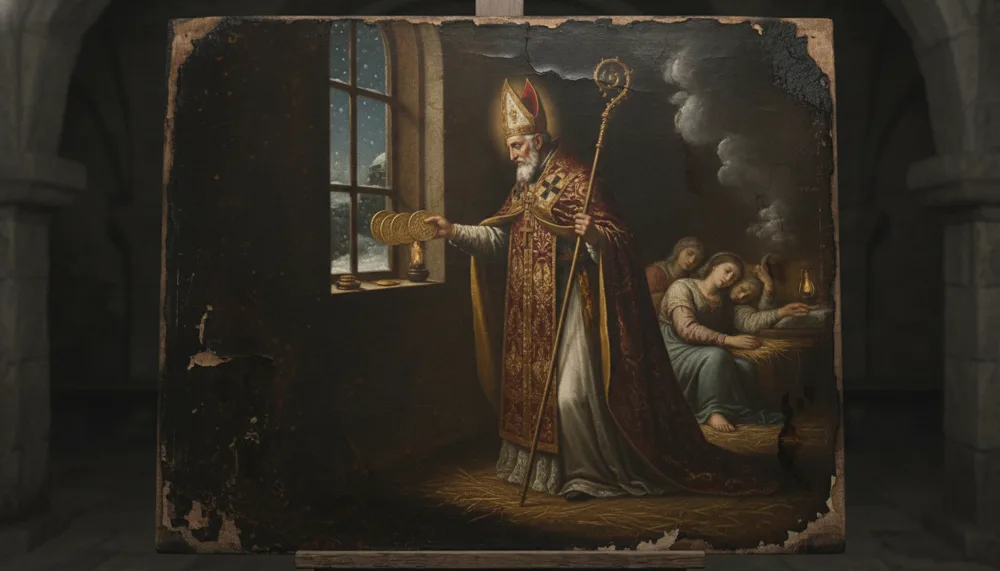
Saint Nicholas was a bishop of Myra, in the province of Lycia in Asia Minor, who lived in the fourth century and gave his goods in secret to the poor. The Church keeps his feast on 6 December, the day of his death and his birth into heaven, and honours him among the most beloved of all the holy bishops. He is a true saint of the Roman Martyrology, venerated East and West for fifteen centuries — not the jolly invention of greeting cards, but a man who fed the hungry, defended the faith, and whose charity to three poor maidens has come down to us, by way of his very name, in the figure the world now calls Santa Claus.
Who Saint Nicholas was
The accounts of his life are old and much loved, though, as with many saints of the early Church, the bare facts come to us wrapped in pious tradition, and we report them as the tradition reports them. Nicholas was born of Christian parents in the city of Patara, in Lycia, toward the end of the third century. Left an orphan while still young, and heir to a considerable fortune, he resolved to spend the whole of it in the service of God and the relief of the poor, keeping nothing for himself.
In time he was chosen bishop of Myra, the chief city of the province, and governed his flock with a father's care through years of trial. The persecution of Diocletian fell upon the Church in those days, and the tradition holds that Nicholas confessed the faith and suffered imprisonment for the name of Christ, being spared death only when the peace of Constantine restored the Church. He is numbered, therefore, among the confessors — those who suffered for Christ without shedding their blood in martyrdom.
The Roman Martyrology records under 6 December Nicholas, bishop of Myra, renowned for miracles, of whom it relates that his city was once delivered from famine through his prayers and his care. The oldest witnesses to his cult are found in the East, where he was venerated within a few generations of his death; the West received his honour and spread it widely, until churches without number were dedicated to him from Russia to the Atlantic. He is honoured alongside the other great bishops of the early Church, in the same company as Saint Augustine and the holy pastors who fed the flock of Christ in the first Christian centuries.
The story of the three poor maidens
The deed for which Saint Nicholas is best remembered, and from which the whole later tradition of his gift-giving flows, concerns three young women of his city. Their father, once well-to-do, had fallen into such poverty that he could provide no dowry for his daughters, and was on the point — for want of any other means — of giving them over to a life of shame. The tradition relates that Nicholas, hearing of their distress, resolved to save them without making himself known.
By night he came to their house and cast a purse of gold through the window — enough to dower the eldest and see her honourably married. On a second night he did the same for the second daughter, and on a third for the youngest; and when the father, watching to learn the name of his benefactor, ran out and recognised the bishop, Nicholas charged him to tell no one while he lived. It is from this threefold gift of gold that the saint is shown in art with three golden balls or three purses, and from it, above all, that the custom grew of giving presents in his name and on his day.
The act is the perfect image of the charity Our Lord commanded: But when thou dost alms, let not thy left hand know what thy right hand doth. That thy alms may be in secret, and thy Father who seeth in secret will repay thee (Matthew 6:3-4). Nicholas gave not to be seen of men, but for the love of God and of the poor; and because he hid his charity, God has made his name known to the ends of the earth. Here is the heart of the man, and the true root of all that came after.
Saint Nicholas and Santa Claus
It must be said plainly, because the two are so often confused: the man in the red suit is a faint and worldly echo of a real bishop and saint. The name itself tells the story. The Dutch settlers of the New World kept the feast of the saint they called Sint-Nicolaas, or in their familiar speech Sinterklaas — and from Sinterklaas, on English-speaking tongues, came Santa Claus. The custom of giving children gifts on the saint's eve, the figure of an old bishop bringing good things to the good, the very memory of the gold cast through the window — all of these are the worn remnants of the cult of Saint Nicholas of Myra.
What the world has done since is to strip the bishop of his mitre and his faith, and to leave a kindly figure of the winter season, emptied of Christ. We do not condemn the giving of gifts; generosity to children and to the poor is a good thing, and a fitting echo of the saint's own bounty, kept rightly within the joy of Christmas and the season of Advent that prepares for it. But the Christian does well to look past the legend to the man: a bishop who gave all he had to the poor, confessed the faith under persecution, and is venerated as a saint of God. To give in his name is to give as he gave — quietly, for the love of God, and to those in real need.
The prayer of the Church to Saint Nicholas
The surest prayer to Saint Nicholas is the prayer of the Church on his feast, the Collect of his Mass in the Roman Missal of 1962 (a feast of the third class):
Collect of the feast, 6 December
Deus, qui beátum Nicoláum Pontíficem innúmeris decorásti miráculis: tríbue, quǽsumus; ut ejus méritis et précibus a gehénnæ incéndiis liberémur. Per Dóminum nostrum Jesum Christum, Fílium tuum: qui tecum vivit et regnat in unitáte Spíritus Sancti Deus, per ómnia sǽcula sæculórum. Amen.
O God, You who made the holy Bishop Nicholas renowned for countless miracles, grant, we beseech You, that by his merits and prayers we may be saved from the fires of hell. Through Jesus Christ, thy Son our Lord, Who liveth and reigneth with thee, in the unity of the Holy Ghost, God, world without end. Amen.
The shortest invocation is that of the Litany of the Saints: Sancte Nicolae, ora pro nobis, "Saint Nicholas, pray for us." As with every prayer to the saints, we do not pray to Nicholas as we pray to God; we ask a fellow member of Christ's body, made perfect in glory, to carry our petition to the Lord. The same order of intercession is set out in the Litany, where the whole Church on earth calls by name upon the whole Church in heaven, and it is the ground of why Catholics pray to the saints at all.
A novena to Saint Nicholas
A novena is nine days of prayer for a particular intention. In the older custom it is kept on the nine days before a feast, so a novena to Saint Nicholas would be prayed from 27 November to 5 December, ending on the eve of his day. There is no single official text; the faithful may repeat the Collect above each day, naming their intention, adding the invocation of the Litany Saint Nicholas, pray for us and three Our Fathers, Hail Marys, and Glory Bes in honour of the Most Holy Trinity.
The novena is a sacramental devotion, not a guaranteed mechanism. Its power is the power of persevering prayer, which Our Lord Himself commended, and its fruit is whatever God in His wisdom judges best for the one who prays. Those wishing to learn the form more fully may read what we have written on what a novena is.
What Saint Nicholas is patron saint of
By the long custom of the Christian people, Saint Nicholas is honoured above all as the patron of children, from the gifts brought in his name and from the many tales of his care for the young. He is likewise the patron of sailors and of those in peril on the sea, for the tradition tells of mariners delivered from storm at his prayer; of the poor and of unmarried maidens, from his gift of the three dowries; and of merchants, pawnbrokers, and bakers, among many others. Whole nations and cities have taken him for their protector.
Whatever the patronage, its ground is always the same: a saint is a friend of God who, having loved Him to the end, now pleads for those who call upon him. To take Nicholas as patron is to ask that we be given his own charity — open-handed to the poor, gentle to children, and steadfast in the faith he confessed.
The feast of Saint Nicholas
The feast of Saint Nicholas, bishop and confessor, falls on 6 December, the day of his death and of his birth into heaven. In the traditional Roman calendar it is kept in the season of Advent, the Church recalling on this day the holy bishop of Myra even as she waits for the coming of her Lord at Christmas. His feast belongs to the rhythm of the traditional liturgical year, which sets each saint in his season, and in many lands it has long been the day on which children receive small gifts in his honour, a memory of the gold he gave in secret.
Those who keep his feast do well to honour him as the Church honours him — not chiefly as the patron of a winter custom, but as one of the great pastors of the early Church, who fed the hungry and defended the faith, and who now stands before God to plead for all who call upon him, and above all for the children and the poor. St Nicholas takes his place among the saints of the year in our guide to the Catholic saints, listed by feast day.
Frequently Asked Questions
Who is Saint Nicholas?
Saint Nicholas was a bishop of Myra, in Lycia in Asia Minor, who lived in the fourth century. Born of Christian parents at Patara and left a wealthy orphan, he gave his whole inheritance to the poor, was made bishop of Myra, confessed the faith under the persecution of Diocletian, and was renowned for his charity and his miracles. He is a true saint of the Roman Martyrology, venerated in both East and West, and his feast is kept on 6 December.
Who was Saint Nicholas, and how did he die?
Nicholas was bishop of Myra through years of persecution and trial, and the tradition holds that he suffered imprisonment for the name of Christ before the peace of the Church under Constantine. He is numbered among the confessors — those who suffered for the faith without dying as martyrs. He died in peace, in his own city, on 6 December, and was at once venerated as a saint; the date of his death became the date of his feast.
Is Saint Nicholas real, and is he the same as Santa Claus?
Saint Nicholas was a real bishop of the fourth century, honoured as a saint for fifteen hundred years. The figure of Santa Claus descends from him: the Dutch kept the feast of Sint-Nicolaas, called familiarly Sinterklaas, and from that name came "Santa Claus." The custom of giving gifts in his name, and the image of an old bishop bringing good things to the good, are worn remnants of his cult. The man in the red suit is a worldly echo; the saint is the reality behind him.
What did Saint Nicholas do for the three poor maidens?
Their father, fallen into poverty, could give them no dowry and was near to giving them over to a life of shame. Nicholas, to save them without being known, cast a purse of gold through their window by night, and did so on three nights, dowering each daughter in turn. When the father recognised him, the saint charged him to tell no one while he lived. From this threefold gift come the three golden balls in his images and the custom of secret gift-giving in his name.
When is Saint Nicholas Day?
The feast of Saint Nicholas falls on 6 December, the day of his death and his birth into heaven. In the traditional Roman calendar it is kept during Advent, as the Church prepares for Christmas. In many lands children receive small gifts on his eve or his day, in memory of the gold he gave in secret to the poor.
Is there a prayer to Saint Nicholas?
Yes. The prayer of the Church is the Collect of his feast on 6 December, given above, which asks that by his merits and prayers we may be delivered from the fires of hell. The short invocation of the Litany of the Saints is: "Saint Nicholas, pray for us." As with all prayer to the saints, we ask his intercession before God, not a favour he grants in God's place.
Iter Fidei serves the prayers, the Divine Office and the liturgical calendar, in Latin and English with audio. Join early access here.
Sources. Roman Martyrology, 6 December (Nicholas, bishop of Myra, renowned for miracles). Alban Butler, The Lives of the Fathers, Martyrs, and Other Principal Saints, under 6 December, St Nicholas. The traditional acts and life of St Nicholas as received in the East and West, including the account of the three dowries. Scripture from the Douay-Rheims: Matthew 6:3-4. On the communion of saints and intercession, the Catechism of the Council of Trent (Roman Catechism, 1566), Part I, on the Ninth Article of the Creed.