
The Saints
St Augustine of Hippo
Who was St Augustine? The great Doctor of the Church, bishop of Hippo, author of the Confessions and the City of God, converted by the word Take and read.
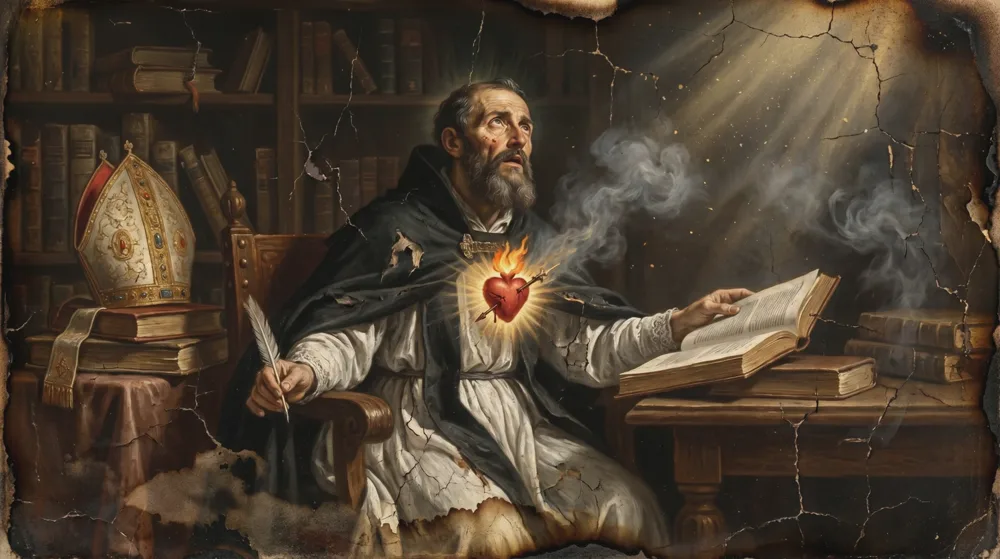
St Augustine of Hippo was a bishop and Doctor of the Church, born in 354 and died in 430, the author of the Confessions and the City of God and the Church's great teacher on grace. We mean the saint, not the city in Florida named after him: Augustine was an African, bishop of Hippo Regius in Numidia, and one of the four great Doctors of the Latin Church, beside St Ambrose, St Gregory the Great, and St Jerome, the translator of the Vulgate.
Who was St Augustine?
He was born on 13 November 354 at Tagaste, a small town of Numidia in north Africa. His parents were of good position but not rich; his father Patricius was a pagan, baptised only before his death through the example of his wife, St Monica. Augustine was entered in infancy among the catechumens, but in early youth he fell into evil ways, and until the age of thirty-two led a life defiled by licence and by the Manichean heresy, of which he speaks at large in his Confessions. He was brilliant, restless, and a master of rhetoric who taught at Carthage, Rome, and Milan while his soul remained in disorder.
We do not soften this. Augustine is great not because he was always good, but because the mercy of God reached a man who was for years neither chaste nor orthodox, and made of him a bishop, a Doctor, and a pillar of the Church. His own books are written to show forth, in his phrase, the mercy of God in the life of one sinner.
The conversion: "Take and read"
The turning came at Milan, under the preaching of St Ambrose and the long prayers of his mother. Augustine knew the truth in his mind but could not give his will. In a garden, broken and weeping, he heard the voice of a child from a neighbouring house repeating the words Tolle, lege — "Take and read." He took up the Epistles of St Paul, opened them, and read the first words his eye fell upon: "Not in rioting and drunkenness, not in chambering and impurities, not in contention and envy: but put ye on the Lord Jesus Christ" (Romans 13:13-14). He read no further. At once, he tells us, a light of certainty flooded his heart and every shadow of doubt fled. He was baptised by St Ambrose at Easter, 387.
This is why his cry from the Confessions has never been forgotten: "Late have I loved Thee, O Beauty so ancient and so new, late have I loved Thee." Conversion, for Augustine, is not a man finding God by his own strength but God seizing a man who could not save himself. It is the lived proof of the doctrine he would spend his life defending. This cry and his other genuine prayers, with those only attributed to him, are gathered in the prayers of St Augustine.
The Doctor of grace
After his conversion and the death of St Monica, Augustine returned to Africa, was ordained, and in 395 became bishop of Hippo. From that chair he became a great bishop and writer, and above all the Church's teacher on grace, against the Pelagians who taught that man can take the first step toward salvation, and persevere in good, by his own natural powers.
Augustine answered that fallen man, wounded by original sin, cannot will or do any saving good without the prior, healing grace of God. The good will itself is God's gift; we begin to be saved only because He moves us first. This is the heart of his teaching, and the Church has made it her own: sanctifying grace, the supernatural life poured into the soul, is wholly the work of God, not the wage of nature.
The Council of Trent, against later errors, taught the same against the same false confidence in man — that grace is gratuitous, prior, and necessary from the first movement of conversion to the last act of perseverance. Augustine is the father of that defence, and the Church calls him Doctor gratiae, the Doctor of grace; centuries later St Thomas Aquinas would build his own treatise on grace upon Augustine's foundations.
The Confessions and the City of God
Two works carry his name through the centuries. The Confessions are the first true autobiography of a soul: not a record of deeds but a long prayer, in which Augustine lays his whole past life open before God and gives thanks for the mercy that drew him out of it. Its most quoted line is the key to the whole: "Thou hast made us for Thyself, and our heart is restless until it rests in Thee." This is why we still read his Confessions — they are the diagnosis of every soul that seeks rest in created things and finds none.
The City of God he wrote after the sack of Rome in 410, when pagans blamed the Christian faith for the fall of the empire. Against them Augustine set two cities built by two loves: the earthly city, built by the love of self even to the contempt of God; and the City of God, built by the love of God even to the contempt of self. The first passes with the world; the second endures forever. It remains the Church's great meditation on history, on the state, and on the patience of the saints in a hostile age. In its first book he teaches that violence suffered against the will cannot stain the soul — the ground on which the Church has ever vindicated her virgin martyrs, among them St Lucy.
Famous quotes of St Augustine
Few Fathers are so quoted, and so often quoted wrongly. Here are the words that are genuinely his, with their place in his writings, so that what is repeated is what he actually wrote.
- "Thou hast made us for Thyself, and our heart is restless until it rests in Thee." (Confessions, Book I)
- "Late have I loved Thee, O Beauty so ancient and so new, late have I loved Thee." (Confessions, Book X)
- "Give me chastity and continence, but not yet." — his own prayer in the years before his conversion, recorded against himself. (Confessions, Book VIII)
- On the love that builds the two cities: "Two loves built two cities: the love of self, even to the contempt of God, the earthly; the love of God, even to the contempt of self, the heavenly." (City of God, Book XIV)
A line often hung on St Augustine — "Love, and do what you will" — is also truly his, from his homilies on the First Epistle of John; but he means the love of God that cannot will sin, not licence. Read in full, it is the opposite of the slogan it is sometimes made into.
Patron and feast day
St Augustine is honoured as patron of theologians, of printers, and of those who seek conversion (for whom the novena to St Augustine is prayed above all), and his name is invoked against the disorder of the passions he himself long suffered. The Order that bears his Rule — the Augustinians — looks to him as father.
His feast in the 1962 Roman calendar is kept on 28 August, as a feast of the third class, the day on which, in 430, with the penitential psalms hung on tablets beside his bed and read with tears, he resigned his spirit into the hands of God, having lived seventy-six years and spent almost forty in the ministry. His mother St Monica, who wept and prayed for him through all his wandering years, is kept on 4 May in the 1962 calendar (the reform of 1969 moved her to 27 August, the day before her son).
A prayer of St Augustine
A prayer drawn from his own Confessions, long used in the Church:
O Lord, Thou hast made us for Thyself, and our heart is restless until it rests in Thee. Late have I loved Thee, O Beauty so ancient and so new, late have I loved Thee. Thou wast within me, and I abroad seeking Thee. Thou didst call and cry aloud, and didst burst my deafness; Thou didst shine and chase away my blindness; Thou didst breathe, and I drew breath and now pant for Thee. I tasted Thee, and now hunger and thirst for Thee; Thou didst touch me, and I burned for Thy peace. Amen.
St Augustine Catholic churches and the name
Because he is so great a Doctor, parishes, schools, and religious houses across the world are dedicated to St Augustine — written either "St Augustine" or "St. Augustine," the abbreviation being the same saint. A church of St Augustine is a church placed under his patronage, asking his intercession; it is not named for the city in Florida, though that city, founded by Spanish Catholics in 1565, was itself named for the saint on whose feast its site was first sighted.
When you look for a St Augustine Catholic church, you are looking for the bishop of Hippo, Doctor of grace, whose feast falls on 28 August. Whether the parish keeps the traditional Roman rite or the newer form, its patron is the same African Father whose conversion this page recounts. St Augustine takes his place among the saints of the year in our guide to the Catholic saints, listed by feast day.
Frequently Asked Questions
Who was St Augustine?
St Augustine of Hippo (354–430) was a bishop and Doctor of the Church, the author of the Confessions and the City of God, and the Church's great teacher on grace. He was an African, bishop of Hippo Regius in Numidia — not the city in Florida named after him — and one of the four great Doctors of the Latin Church.
What is St Augustine known for?
He is known above all as the Doctor of grace (Doctor gratiae), who taught against the Pelagians that fallen man cannot will or do any saving good without the prior, healing grace of God. He is also famous for his Confessions, the first true autobiography of a soul, and his City of God, the Church's great meditation on history.
How was St Augustine converted?
At Milan, under the preaching of St Ambrose and the long prayers of his mother St Monica. Weeping in a garden, he heard a child's voice repeat Tolle, lege — "Take and read." He opened the Epistles of St Paul to Romans 13:13-14, and at once, he tells us, a light of certainty flooded his heart. He was baptised by St Ambrose at Easter, 387.
When is the feast of St Augustine?
In the traditional Roman calendar his feast is kept on 28 August, the day he died in 430, with the penitential psalms read beside his bed. His mother St Monica, who prayed for him through all his wandering years, is kept on 4 May in the 1962 calendar.
What does St Augustine teach us about grace?
He teaches one stark thing: no man is too far gone for grace, and no man is saved without it. The good will itself is God's gift; we begin to be saved only because He moves us first. The Council of Trent made this teaching its own — that grace is gratuitous, prior, and necessary from the first movement of conversion to the last act of perseverance.
The Iter Fidei app carries this prayer, the traditional calendar of feasts on which St Augustine is kept the 28th of August, and the catechism, for those who would keep his memory and learn from his conversion. Join early access here.
Sources. Butler's Lives of the Saints (entry for St Augustine, 28 August); St Augustine, Confessions, Books VIII and X; St Augustine, The City of God, Book XIV; Catechism of the Council of Trent (Roman Catechism, 1566), on justifying grace; Holy Scripture, Douay-Rheims version (Romans 13:13-14); Roman calendar of 1962 (St Augustine, 28 August; St Monica, 4 May).