
The Saints
St Thomas Aquinas, the Angelic Doctor
Who was Thomas Aquinas? The great Dominican Doctor of the Church, author of the Summa Theologiae, patron of students and theologians, kept on March 7.
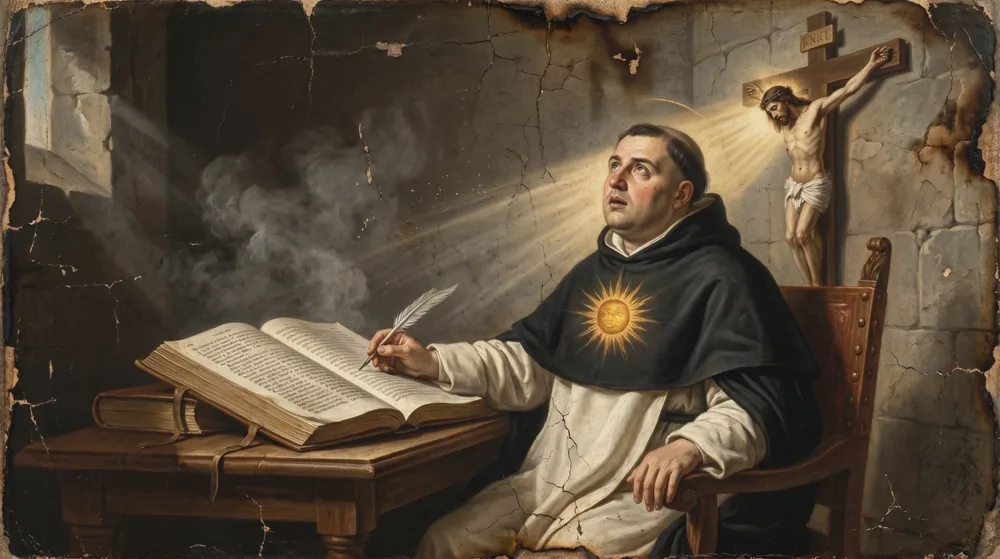
St Thomas Aquinas (c. 1225–1274) was the great Dominican friar whom the Church names the Angelic Doctor, the foremost theologian of the West and the author of the Summa Theologiae. He is a Doctor of the Church, patron of students, universities, and theologians, and his feast in the traditional calendar falls on March 7. He is not to be confused with St Thomas the Apostle, the "doubting Thomas" of the Gospel, whose feast falls on 21 December.
To the question who was Thomas Aquinas, the plain answer is this: a Friar Preacher who set the whole of Christian doctrine in order, defended the faith against error with the tools of reason, and adored the same God in the Blessed Sacrament whom he had defined with such precision. His learning and his prayer were one act.
Who was Thomas Aquinas
Thomas was born about 1225 in the castle of Rocca Secca near Aquino, the youngest of four sons. As a child of five he was placed as an oblate at the Benedictine abbey of Monte Cassino, and he later studied at the University of Naples, where he was drawn to the newly founded Order of Preachers and received the Dominican habit at about nineteen.
His family violently opposed the choice. His brothers waylaid him and held him prisoner, and even tempted him with a woman of bad character, whom he drove from the room with a burning brand snatched from the hearth. Freed at last, he gave himself wholly to the Order, lecturing at Paris and in Italy and becoming, in the Church's judgment, her greatest theologian.
Twice, Butler relates, Our Lord approved what he had written: once in a vision, "Thou hast written well of the sacrament of my Body"; and later at Salerno, from the crucifix, "Thou hast written well of me, Thomas; what reward wouldst thou have?" — to which he answered, "Nothing but thyself, Lord." After a revelation late in 1273 he wrote no more, calling all he had composed "so much straw" beside what had been shown him. Falling ill on his way to the Second Council of Lyons, he died in 1274 at the Cistercian abbey of Fossa Nuova.
The Angelic Doctor
The title the Angelic Doctor was given Thomas for the purity of his life and the loftiness of his teaching, which seemed to treat of God and the things of God with an angel's clarity. The Church did not invent the honour lightly. St Pius V, himself a Dominican, gave the Church the best edition of St Thomas and formally recognized him as a Doctor of the Church, ranking his authority among the highest of the schools.
What the title means in practice is that Thomas is a sure guide. He did not aim at originality. He gathered the teaching of Scripture, the councils, and the Fathers — above all St Augustine, the greatest Doctor of the West before him, on whom he leaned in page after page — and set it in such order that error had no shadow to hide in. Where an older theology resembled a virgin forest, Thomas left a kept garden, every plant in its place and named.
The Summa Theologiae and his teaching
The Summa Theologiae, begun about 1266, is his masterwork: a complete ordering of sacred doctrine, moving from God in Himself, to creation and the moral life, to Christ and the sacraments by which we return to God. Its method is the disputed question — the objection stated at its strongest, the answer given from Scripture and the Fathers, each difficulty resolved in turn. Thomas baptized the philosophy of Aristotle into the service of revealed truth, holding firmly that faith and reason cannot contradict, since both have one Author.
His teaching on the Holy Eucharist is the surest fruit of this method. Against every later denial, Thomas set out with exactness the doctrine the Church calls transubstantiation: that the whole substance of bread is changed into the Body of Christ and the whole substance of wine into His Blood, the outward appearances alone remaining. What we adore in the Eucharist is not a sign of an absent Lord but the Lord Himself, truly, really, and substantially present. This is the faith the Council of Trent would later define, in terms Thomas had made precise.
His prayer and the hymns of Corpus Christi
Thomas was not a theologian only at his desk. When Pope Urban IV instituted the feast of Corpus Christi in 1264 for the universal Church, he entrusted to St Thomas the composition of its Office. From that commission come the hymns the Church still sings: the Pange Lingua with its Tantum Ergo, the Lauda Sion, the Sacris Solemniis with its Panis Angelicus, and the Verbum Supernum with its O Salutaris Hostia. The Office of Corpus Christi is, in the Church's estimation, a classic and perfect work of liturgical art, a masterpiece of doctrine, devotion, and literary measure.
To him is also ascribed the Adoro Te Devote, the prayer of adoration before the hidden God of the altar. It is the theologian on his knees, confessing that what reason cannot reach, faith holds fast:
Adoro te devote, latens Deitas,
Quae sub his figuris vere latitas:
Tibi se cor meum totum subjicit,
Quia te contemplans totum deficit.Visus, tactus, gustus in te fallitur,
Sed auditu solo tuto creditur.
Credo quidquid dixit Dei Filius:
Nil hoc verbo Veritatis verius.In cruce latebat sola Deitas,
At hic latet simul et humanitas:
Ambo tamen credens atque confitens,
Peto quod petivit latro paenitens.Plagas, sicut Thomas, non intueor:
Deum tamen meum te confiteor.
Fac me tibi semper magis credere,
In te spem habere, te diligere.O memoriale mortis Domini:
Panis vivus, vitam praestans homini:
Praesta meae menti de te vivere,
Et te illi semper dulce sapere.Pie pellicane, Jesu Domine,
Me immundum munda tuo sanguine:
Cujus una stilla salvum facere
Totum mundum quit ab omni scelere.Jesu, quem velatum nunc aspicio,
Oro fiat illud quod tam sitio:
Ut te revelata cernens facie,
Visu sim beatus tuae gloriae.
Amen.I devoutly adore Thee, hidden Deity,
who truly hidest beneath these appearances;
to Thee my whole heart submits,
for in contemplating Thee, it wholly fails.Sight, touch, taste are deceived in Thee,
but by hearing alone one safely believes.
I believe whatever the Son of God has said;
nothing is more true than this word of Truth itself.On the cross only the Godhead was hidden;
here the humanity also is hidden.
Yet believing and confessing both,
I ask what the penitent thief asked.I do not see Thy wounds as Thomas did;
yet I confess Thee as my God.
Make me believe in Thee ever more,
place my hope in Thee, love Thee.O memorial of the Lord's death,
living Bread giving life to man:
grant that my mind may live by Thee,
and that it may ever taste Thy sweetness.Pious pelican, Lord Jesus,
cleanse me, unclean, by Thy Blood;
one drop of which can save
the whole world from every sin.O Jesus, whom I now behold veiled,
I pray that what I so thirst for may come:
that beholding Thee with unveiled face,
I may be blessed in the sight of Thy glory.
Amen.
It is fitting that the man who defined the Real Presence with such rigour should pray before it with such tenderness. The doctrine and the devotion are the same truth, met first by the mind and then by the heart.
The prayers of St Thomas Aquinas
Besides the hymns of Corpus Christi, several prayers have come down to us under the name of St Thomas. They are not the prayers of a beginner but of a master who knew that all learning is barren unless it ends in God. We give the chief of them here.
His best-known short prayer is the opening of the longer Concede mihi, an act of self-offering and petition:
Concede mihi, misericors Deus, quae tibi sunt placita, ardenter concupiscere, prudenter investigare, veraciter agnoscere, et perfecte adimplere ad laudem et gloriam nominis tui.
Grant me, O merciful God, to desire eagerly, to investigate prudently, to acknowledge sincerely, and to fulfil perfectly those things that are pleasing to Thee, to the praise and glory of Thy name.
This is the prayer of a Christian who asks not for success but for conformity to the will of God — to desire, seek, know, and do what God wills. It is fittingly said at the beginning of any work undertaken for God.
St Thomas Aquinas prayer before study
The most sought of all his prayers is the one he is said to have recited before he wrote or taught: the prayer before study, beginning Creator ineffabilis. It is given in full, with his prayers before Mass and after Communion, in the prayers of St Thomas Aquinas. It is the patron of students asking, for those who come after him, the very light by which he himself worked. We give it in Latin and in its traditional English:
Creator ineffabilis, qui de thesauris sapientiae tuae tres Angelorum hierarchias designasti et eas super caelum empyreum miro ordine collocasti, atque universi partes elegantissime distribuisti: Tu, inquam, qui verus fons luminis et sapientiae diceris ac supereminens principium, infundere digneris super intellectus mei tenebras tuae radium claritatis, duplices, in quibus natus sum, a me removens tenebras, peccatum scilicet et ignorantiam.
Tu, qui linguas infantium facis disertas, linguam meam erudias atque in labiis meis gratiam tuae benedictionis infundas. Da mihi intelligendi acumen, retinendi capacitatem, addiscendi modum et facilitatem, interpretandi subtilitatem, loquendi gratiam copiosam. Ingressum instruas, progressum dirigas, egressum compleas. Tu, qui es verus Deus et homo, qui vivis et regnas in saecula saeculorum. Amen.
Creator ineffable, who of the riches of Thy wisdom didst appoint three hierarchies of Angels and didst set them in wondrous order over the highest heavens, and who didst apportion the elements of the world most wisely: do Thou, who art in truth the fountain of light and wisdom, deign to shed upon the darkness of my understanding the rays of Thine infinite brightness, and remove far from me the twofold darkness in which I was born, namely, sin and ignorance.
Do Thou, who givest speech to the tongues of little children, instruct my tongue and pour into my lips the grace of Thy benediction. Give me keenness of apprehension, capacity for remembering, method and ease in learning, insight in interpretation, and copious eloquence in speech. Instruct my beginning, direct my progress, and set Thy seal upon the finished work, Thou, who art true God and true Man, who livest and reignest world without end. Amen.
Said before opening a book or sitting an examination, it asks for the right things in the right order: light against ignorance, grace upon the lips, and that the whole labour begin, continue, and end in God. This is why the Church gives St Thomas to students as their patron — not to make study easy, but to make it holy.
Patron of students and theologians
St Thomas is the patron of students and of theologians, and in 1880 Leo XIII declared him patron of all Catholic universities, colleges, and schools, for he is the model of learning that bends the knee. He is also invoked, by old popular devotion, against thunderstorms and sudden death: Butler records that a little sister was killed by lightning in the room where he slept, and that all his life he feared storms. Those who study under his patronage ask not for cleverness but for the gift he himself had: to love the truth, to state it plainly, and to refer all of it to God. Students and teachers who wish to place a particular work of learning under his care may make a novena to St Thomas Aquinas, praying for his intercession over nine days.
His feast day
The feast of St Thomas Aquinas is kept on March 7, the day of his death, under the title Confessor and Doctor of the Church; in the calendar of 1962 it is a feast of the third class, in white vestments, which in Lent gives way to the Lenten weekday and is commemorated. The Church honours on that day not a man of one age but a teacher for all ages, whose ordering of the faith remains, after seven centuries, the school in which her doctors are still trained. For the other saints of the traditional calendar, month by month, see our guide to the Catholic saints.
Frequently Asked Questions
Who was St Thomas Aquinas?
St Thomas Aquinas (c. 1225–1274) was a Dominican friar, priest, and the foremost theologian of the Latin Church, whom she names the Angelic Doctor. He wrote the Summa Theologiae, ordered the whole of sacred doctrine with the aid of reason, and composed the Office and hymns of Corpus Christi. A Doctor of the Church and a canonised saint, his feast is kept on March 7, the day of his death.
What is St Thomas Aquinas known for?
He is known above all for the Summa Theologiae, his complete and orderly setting-forth of sacred doctrine, and for showing that faith and reason cannot contradict, since both have one Author. He gave exact expression to the Church's doctrine of transubstantiation and composed the Office and hymns of Corpus Christi. For the clarity and holiness of this work the Church calls him the Angelic Doctor.
What did St Thomas Aquinas do?
He entered the Order of Preachers, lectured at Paris and in Italy, and became, in the Church's judgment, her greatest theologian. He wrote the Summa Theologiae and many other works, baptising the philosophy of Aristotle into the service of revealed truth, and at the request of Pope Urban IV he composed the Office and hymns of Corpus Christi (1264). To him is also ascribed the Adoro Te Devote, the prayer of adoration before the hidden God of the altar.
When did St Thomas Aquinas live?
St Thomas lived in the thirteenth century, from about 1225 to 1274, in the age of the great medieval universities. He studied at Naples, received the Dominican habit, and taught chiefly at Paris and in Italy. He died on the way to the Second Council of Lyons.
When was St Thomas Aquinas born?
He was born about the year 1225 in the castle of Rocca Secca near Aquino, the youngest of four sons of a noble family. As a child of five he was placed as an oblate at the Benedictine abbey of Monte Cassino, and he later studied at the University of Naples, where he was drawn to the newly founded Order of Preachers.
How did St Thomas Aquinas die?
After a revelation late in 1273 he ceased to write, calling all he had composed "so much straw" beside what had been shown him. Falling ill on his journey to the Second Council of Lyons, he died in 1274 at the Cistercian abbey of Fossa Nuova, and the Church keeps his feast on March 7, the day of his death.
What is St Thomas Aquinas the patron saint of?
St Thomas is the patron of students, of universities and Catholic schools, and of theologians and academics, for he is the very model of learning that bends the knee before God. By old custom he is also invoked against thunderstorms and against sudden death. Those who study under his patronage ask not for cleverness but for his own gift: to love the truth, state it plainly, and refer all of it to God.
What is the St Thomas Aquinas prayer before study?
It is the prayer beginning Creator ineffabilis — "Ineffable Creator" — which St Thomas is said to have recited before he wrote or taught. It asks God to cast a beam of His light upon the darkness of the mind, to grant keenness of understanding, memory, and clarity of speech, and to order the beginning, progress, and completion of one's work. Catholic students have used it for centuries before opening a book or sitting an examination; we give the full traditional text above.
Is there a short St Thomas Aquinas prayer?
Yes. The opening of his Concede mihi asks: "Grant me, O merciful God, to desire eagerly, to investigate prudently, to acknowledge sincerely, and to fulfil perfectly those things that are pleasing to Thee, to the praise and glory of Thy name." It is a fitting prayer to begin any work undertaken for God. To St Thomas is also ascribed the Adoro Te Devote, the prayer of adoration before the Blessed Sacrament, given in full above.
When is the feast day of St Thomas Aquinas?
In the traditional calendar the feast of St Thomas Aquinas is kept on March 7, the day of his death in 1274, under the title Confessor and Doctor of the Church. (In the calendar reformed after 1969 his memorial was moved to January 28, the date on which his relics were translated; the traditional Roman calendar that Iter Fidei follows keeps March 7.)
The Iter Fidei app carries his prayers, the traditional calendar of feasts, and the catechism, that the faithful may keep his memory and learn from his teaching. Join early access here.
Sources. Butler, Lives of the Saints, March 7 (life, the Corpus Christi Office, St Pius V and the doctorate, Leo XIII and the patronage of schools); the Roman Missal of 1962 (March 7); the Office and hymns of Corpus Christi (Pange Lingua, Lauda Sion, Sacris Solemniis, Verbum Supernum) composed by St Thomas at the request of Pope Urban IV (1264); the Adoro Te Devote and the prayers attributed to St Thomas Aquinas (Concede mihi, the prayer before study Creator ineffabilis); the Roman Catechism (Catechism of the Council of Trent) on the Holy Eucharist and transubstantiation; St Pius V on the authority of St Thomas as Doctor of the Church.