
The Saints
St Teresa of Avila, Doctor of Prayer
St Teresa of Avila (1515-1582), Carmelite reformer and Doctor of the Church, is the great mistress of mental prayer, patron of those who pray; her feast is October 15.
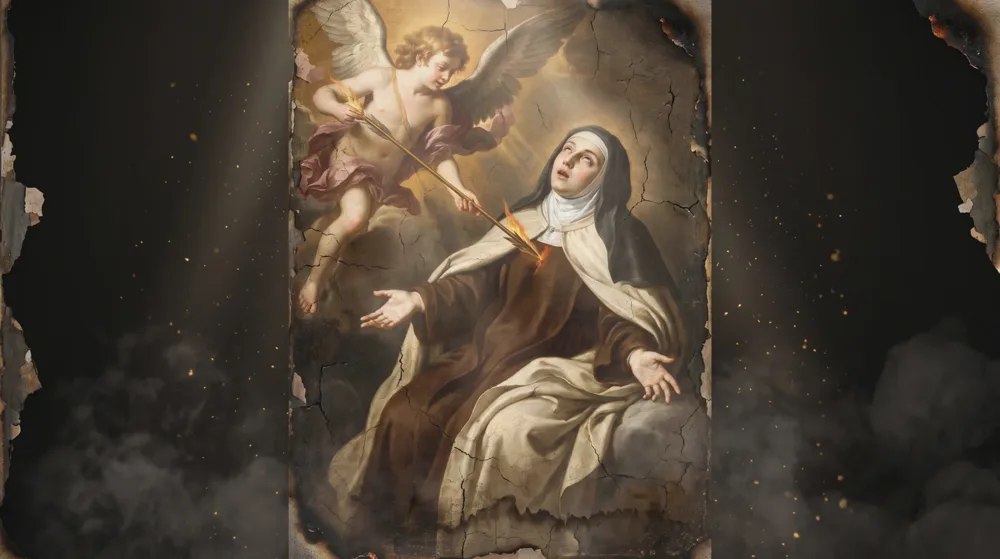
St Teresa of Avila (1515-1582) was a Spanish Carmelite nun, foundress of the Discalced Carmelites, and the great mistress of mental prayer, whom the faithful honour as patron of those who pray. Her feast is kept on October 15 in the traditional calendar, as that of a virgin; the title of Doctor of the Church, long given her popularly though not officially, was conferred by Paul VI only in 1970, after the calendar of 1962. We turn to her because no saint has charted the interior life of prayer with greater authority: from the simple lifting of the heart to God, through the prayer of quiet, to the prayer of union she describes in her Interior Castle.
Who St Teresa of Avila was
Teresa de Cepeda y Ahumada was born at or near Avila, in Castile, on March 28, 1515, into a large and virtuous family. As a child she once set out with her brother Rodrigo to seek martyrdom among the Moors. After a worldly adolescence she entered the Carmelite convent of the Incarnation at Avila, where for many years she wavered before giving herself wholly to God. The decisive turn came when, already a religious, she stopped resisting grace and gave her whole soul to prayer.
God then favoured her with extraordinary gifts: the prayer of quiet and of union, intellectual visions, and interior communications. Teresa, far from trusting her own lights, submitted all of it to careful direction — by Jesuit fathers and by St Peter of Alcantara, who assured her that her visions came from God. This is the mark of the true mystic and the safeguard of sound doctrine: obedience, humility, and submission to the judgment of the Church rather than to private feeling.
The reform of Carmel
Teresa was not only a contemplative but a reformer. Judging that the Carmelite life of her day had grown lax, she undertook to restore its primitive rigour — strict enclosure, poverty, silence, and unceasing prayer. Despite fierce opposition she founded seventeen houses of the reform, aided by King Philip II and by St John of the Cross, who carried the same reform to the friars. Her work shows that contemplation and labour are not opposed: the same soul that was rapt in the prayer of union travelled the dust of Castile to plant convents.
We have written elsewhere of her great companion in this work; her reform and his are one story, told from two sides, in our account of St John of the Cross. Broken in health by her labours, Teresa died at Alba de Tormes on the night of October 4, 1582, and was canonized in 1622.
St Teresa of Avila, mistress of mental prayer
Her enduring title is Doctor of Prayer. Mental prayer — the prayer not of recited formulas but of the mind and heart raised to God in considered attention — is the heart of her teaching, and we treat its practice at length in our note on mental prayer. Teresa's own famous definition is plain: mental prayer is nothing else than an intimate sharing between friends, taking time frequently to be alone with Him who we know loves us.
In The Interior Castle she pictures the soul as a castle of many rooms, with God dwelling in the innermost. The life of prayer is the journey from the outer rooms inward — from vocal prayer and meditation, through the prayer of quiet, to the spiritual marriage of the soul with God in the centre. The ascetical and mystical tradition received and ordered her teaching: the degrees she described — meditation, affective prayer, the prayer of simplicity, then the infused states of quiet and union — are the same rungs that Tanquerey lays out in his Précis de théologie ascétique et mystique, citing her constantly as the surest guide to the higher reaches of prayer.
Two cautions belong to her doctrine. First, the extraordinary graces are God's free gift, never the goal; the soul is to seek not consolations but the God who gives them, and is to be as faithful in dryness as in delight. Second, the foundation of all prayer is humility and the keeping of the commandments; rapture without virtue is illusion. Mental prayer is itself a discipline, a daily warfare against distraction and self-love — the inward face of the spiritual combat that every Christian must wage.
What St Teresa of Avila is patron of
St Teresa is invoked as patron of those who pray, and of those who seek progress in the interior life. Popular piety also invokes her against headaches and bodily ills, which she bore patiently through long years, and she is honoured as a patron of religious and of the contemplative life. Those who take up mental prayer and find it dry, wandering, or seemingly fruitless turn to her with confidence, for she knew those very trials and persevered through them for nearly twenty years before God flooded her soul.
A prayer of St Teresa of Avila
The best known of St Teresa of Avila's quotes is the verse found in her breviary after her death, a perfect summary of the abandonment her whole life taught. We give it as a prayer:
Nada te turbe,
nada te espante,
todo se pasa,
Dios no se muda;
la paciencia
todo lo alcanza;
quien a Dios tiene
nada le falta:
sólo Dios basta.Let nothing disturb thee,
nothing affright thee;
all things are passing,
God never changeth.
Patient endurance attaineth to all things;
who God possesseth in nothing is wanting;
alone God sufficeth.
This is the doctrine of Carmel in a few lines: the world passes, God does not change, and the soul that possesses Him lacks nothing. It is fitting matter for daily mental prayer, to be turned over slowly before the Blessed Sacrament until the words become one's own.
Prayers of St Teresa of Avila
Besides "Let nothing disturb thee," those who seek her help in the interior life often pray with the refrain of one of her own poems, Vuestra soy, para Vos nací — an act of total surrender to the will of God:
Vuestra soy, para Vos nací:
¿qué mandáis hacer de mí?Yours I am, for You I was born:
what will You have done with me?
It may be used to open a time of mental prayer, or repeated through the day as a short ejaculatory prayer. It is no magic formula; its value lies in the disposition of surrender it forms in the soul.
A word of caution belongs here. The well-loved lines that begin "Christ has no body now on earth but yours" are constantly printed under her name, yet they are not found in her writings; they are a later devotional text in her spirit, and should not be quoted as hers.
Sayings and quotes of St Teresa of Avila
The sayings of St Teresa are among the most quoted in the spiritual tradition, plain and bracing like the woman herself. A few of the best known, drawn from her Life and her Foundations:
- "Let nothing disturb thee; let nothing affright thee. God alone sufficeth." (the verse found in her breviary)
- Mental prayer "is nothing else than an intimate sharing between friends; it means taking time frequently to be alone with Him who we know loves us." (Life, ch. 8)
- "The Lord walks among the pots and pans" (entre los pucheros anda el Señor), said to nuns set to work in the kitchen. (Foundations, ch. 5)
- "From silly devotions, good Lord, deliver us" — a saying attributed to her by tradition rather than found in her books.
We give these not as slogans but as matter for prayer; a single line, weighed slowly before God, is worth more than a page read in haste. Her wit guards against the great danger of the spiritual life, which is to mistake gloom for holiness. Two lines often passed around under her name — "Christ has no body now but yours" and "More tears are shed over answered prayers than over unanswered ones" — are not hers.
The books of St Teresa of Avila
St Teresa was called a doctor of the Church by popular acclaim long before the title was formally conferred in 1970, and she owes it chiefly to her books, all written in obedience to her confessors rather than from any wish to teach. Four are essential reading:
- The Life (Vida) — her spiritual autobiography, written under obedience, recounting her conversion and the degrees of prayer through which God led her. It contains her famous image of the four waters by which a garden is watered, a figure of the four stages of prayer.
- The Way of Perfection (Camino de perfección) — written for her nuns, a practical guide to mental prayer and a long commentary on the Our Father; the best place for a beginner to start.
- The Interior Castle (Las Moradas) — her masterpiece, picturing the soul as a castle of seven dwelling-places, with God in the innermost, and tracing the soul's journey to union with Him.
- The Book of the Foundations — the lively chronicle of her seventeen convents and the trials of founding them.
For those beginning, we counsel reading her under direction and not alone, for the higher states she describes are God's gift and not to be sought for their own sake; the foundation is always meditation, humility, and the keeping of the commandments.
The incorrupt body of St Teresa of Avila
The body of St Teresa is venerated as incorrupt. She was buried at Alba de Tormes in 1582; when her grave was opened some months later the body was found whole and fragrant, and it has been examined at intervals ever since. In the disputes over where she should rest, her heart and one arm were separated as relics, and her left hand and other relics are kept in various Carmelite houses; the greater part of the body remains at the Carmelite convent of Alba de Tormes.
The Church proposes such incorruption soberly, as a sign and not as an object of credulity. We do not number it among the proofs of her sanctity — that rests on her heroic virtue and her doctrine — nor do we treat the relics superstitiously. They are venerated, with the honour the Church gives the bodies of the saints as temples of the Holy Ghost and seeds of the resurrection, and no more.
The Transverberation and Bernini's statue
The most famous image of St Teresa is the Ecstasy of Saint Teresa sculpted by Gian Lorenzo Bernini (1647-1652) for the Cornaro Chapel in Santa Maria della Vittoria in Rome. It depicts the event Teresa herself recorded in her Life: the Transverberation, in which an angel held "a long spear of gold, and at the iron's point there seemed to be a little fire," and seemed to thrust it into her heart, leaving her "all on fire with a great love of God." "So surpassing was the sweetness of this excessive pain," she wrote, "that I could not wish to be rid of it."
Bernini's marble has been admired for centuries as a summit of Baroque art, though some have wrongly read its rapture in a merely sensual key. The Church reads it as Teresa read her own experience: a spiritual wound, a grace of mystical union far above the senses, of which the bodily swooning was only an overflow. The Transverberation is kept as a separate Carmelite feast (August 26), and Teresa's wounded heart is itself preserved as a relic at Alba de Tormes.
How she is shown in images, statues, and sculpture
In sacred art St Teresa is shown in the brown habit, white mantle, and black veil of the Carmelite, often with a few fixed attributes: a book and pen (for her writings and her doctorate), a dove or flame near her head (the Holy Ghost who inspired her), and frequently an arrow or the angel of the Transverberation piercing her heart. She may also bear the IHS monogram of the Holy Name, to which she had great devotion. These signs let the faithful read at a glance who she is and what the Church honours in her: the Doctor of Prayer, wounded by divine love.
Ten facts about St Teresa of Avila
For those who want the essentials at a glance:
- She was born near Avila in Castile on March 28, 1515, as Teresa de Cepeda y Ahumada.
- As a small girl she ran away with her brother to seek martyrdom among the Moors.
- She did not give herself wholly to prayer until well into her religious life, after years of wavering.
- She founded the Discalced (reformed) Carmelites and established seventeen convents.
- St John of the Cross was her companion in the reform and carried it to the friars.
- She wrote four major spiritual classics, chief among them The Interior Castle.
- She experienced the Transverberation, the piercing of her heart by an angel.
- She died at Alba de Tormes on October 4, 1582.
- Her body is venerated as incorrupt and her heart is kept as a relic.
- She was canonized in 1622; long called a doctor of the Church by popular acclaim, she was formally declared one by Paul VI in 1970, after the calendar of 1962 — the first woman so honoured.
Her feast day
In the traditional Roman calendar the feast of St Teresa of Avila, virgin, is kept on October 15. In the calendar of 1962 it is a feast of the third class, in white vestments. Carmelites and the wider Church keep her memory as a teacher of prayer, ranking her among the greatest of the Catholic mystics beside St John of the Cross. To honour her well is to do what she did: to take time frequently to be alone with Him who we know loves us. St Teresa of Avila takes her place among the saints of the year in our guide to the Catholic saints, listed by feast day.
Frequently Asked Questions
Who was St Teresa of Avila?
St Teresa of Avila (1515-1582) was a Spanish Carmelite nun and foundress of the Discalced Carmelites, declared a Doctor of the Church in 1970. She is honoured as the Church's great mistress of mental prayer and the author of The Interior Castle. Worn out by her labours for the reform of Carmel, she died in 1582 and was canonized in 1622.
What is St Teresa of Avila known for?
She is known above all as the Doctor of Prayer, who charted the interior life from simple meditation to the prayer of union with greater authority than any other saint. She reformed the Carmelite Order, founding seventeen houses of the Discalced reform across Castile, and left the Church her great writings on prayer, chiefly The Interior Castle and her Life.
What is St Teresa of Avila the patron saint of?
St Teresa of Avila is honoured above all as the patron of those who pray and who seek progress in the interior life, for she is the Church's great mistress of mental prayer. Popular piety also invokes her against headaches and bodily ills, which she bore patiently for many years, and she is venerated as a patron of the contemplative life.
How did St Teresa of Avila die?
St Teresa died at Alba de Tormes on the night of October 4, 1582, broken in health and worn out by her constant travels and labours for the reform of Carmel. She gave up her soul to God in peace and was canonized in 1622.
What did St Teresa of Avila do?
She reformed the Carmelite Order, restoring its primitive rigour of enclosure, poverty, and unceasing prayer, and founded seventeen houses of the Discalced reform, aided by St John of the Cross. She also left the Church her great writings on prayer, for which she was declared a Doctor of the Church in 1970.
When is St Teresa of Avila's feast day?
In the traditional Roman calendar the feast of St Teresa of Avila, virgin, is kept on October 15. In the calendar of 1962 the feast is of the third class and keeps her title of virgin; the title of Doctor of the Church dates from 1970.
What books did St Teresa of Avila write?
She wrote four principal works, all under obedience to her confessors: The Life (her spiritual autobiography), The Way of Perfection (a practical guide to prayer written for her nuns), The Interior Castle (her masterpiece on the soul's journey to union with God), and The Book of the Foundations. For these writings she was declared a Doctor of the Church in 1970.
Is the body of St Teresa of Avila incorrupt?
Yes. St Teresa was buried at Alba de Tormes in 1582, and when her grave was opened her body was found whole and fragrant; it has been venerated as incorrupt ever since. Her heart, one arm, and her left hand were separated as relics, while the greater part of the body remains at the Carmelite convent of Alba de Tormes. The Church proposes such incorruption soberly, as a sign and not as the proof of her sanctity, which rests on her virtue and doctrine.
What is Bernini's statue of St Teresa of Avila?
It is the Ecstasy of Saint Teresa, sculpted by Gian Lorenzo Bernini between 1647 and 1652 for the Cornaro Chapel in Santa Maria della Vittoria in Rome. It depicts the Transverberation, in which an angel pierced Teresa's heart with a golden, fire-tipped dart, wounding her with the love of God. The Church reads it as a spiritual grace of mystical union, far above the senses.
What are some sayings of St Teresa of Avila?
Among her best-known authentic sayings are "Let nothing disturb thee; God alone sufficeth," "The Lord walks among the pots and pans," and her definition of mental prayer as "an intimate sharing between friends." "Christ has no body now but yours," often printed under her name, is not found in her writings. Her sayings are best taken not as slogans but as matter for prayer, weighed slowly before God.
The Iter Fidei app carries the prayers, the psalms and the liturgical calendar, in Latin and English with audio. Join early access here.
Sources. Butler, Lives of the Saints, October 15 (b. Avila, March 28, 1515; reform of the Discalced Carmelites, seventeen foundations; Transverberation; d. Alba de Tormes, October 4, 1582; canonized 1622); A. Tanquerey, Précis de théologie ascétique et mystique (degrees of mental prayer — meditation, affective prayer, prayer of simplicity, prayer of quiet, prayer of union); the prayer "Let nothing disturb thee" (Nada te turbe) from St Teresa's breviary, tr. H. W. Longfellow; the poem Vuestra soy, para Vos nací. Works of St Teresa: Vida (Life), Camino de perfección (Way of Perfection), Las Moradas (Interior Castle), Libro de las Fundaciones (Book of the Foundations). Transverberation (piercing of her heart by an angel, recorded in her Life), kept as a Carmelite feast (August 26); incorruption of the body and relics venerated at Alba de Tormes; Ecstasy of Saint Teresa by Gian Lorenzo Bernini (1647-1652), Cornaro Chapel, Santa Maria della Vittoria, Rome. Doctor of the Church declared by Paul VI, 1970 (first woman). Feast: October 15, traditional Roman calendar.