
The Saints
St Sebastian: Martyr of the Arrows, Patron of Soldiers
St Sebastian, Roman martyr under Diocletian, a soldier according to his Acts — the arrows and the second martyrdom, what he is patron saint of, his feast day January 20, the collect of his feast, and his place in art.
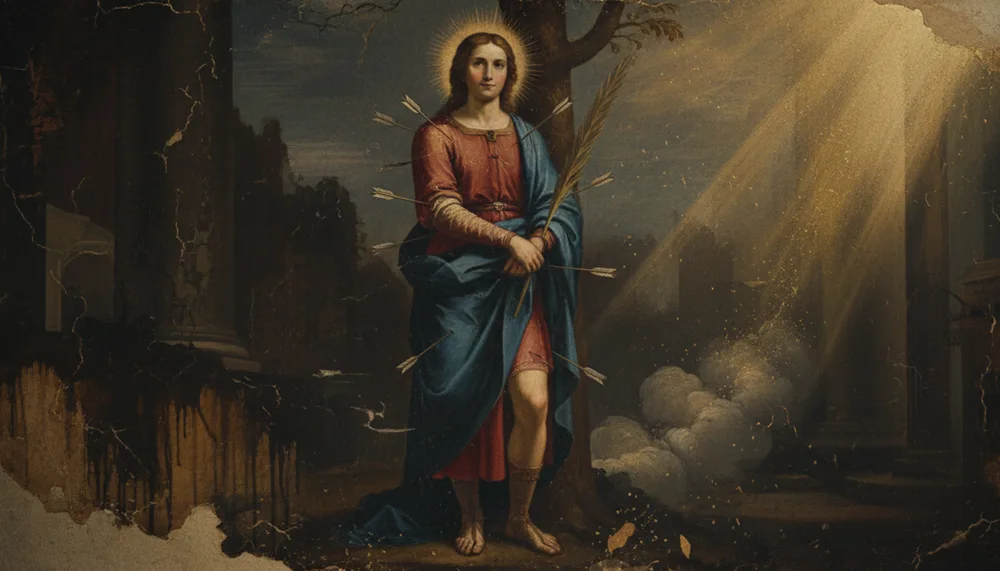
St Sebastian was a Roman soldier of the Praetorian Guard, martyred under the Emperor Diocletian about the year 288. Shot through with arrows and left for dead, he survived, confronted the emperor a second time, and was beaten to death; he is the patron saint of soldiers, archers, and athletes, and is invoked against plague. His feast is kept on the 20th of January, and his body rests in the catacombs on the Appian Way that bear his name.
Who St Sebastian was
According to his ancient Acts, followed by Butler, Sebastian was born at Narbonne in Gaul and brought up at Milan; St Ambrose, preaching on Psalm 118 within a century of his death, speaks of him as a Milanese and holds him out as a model of constancy. A fervent Christian in an age when the faith was a capital crime, he entered the Roman army about the year 283 not from love of the military life, but so that, under a soldier's cloak, he might assist the confessors and martyrs without arousing suspicion.
The stratagem succeeded for years. He so distinguished himself that Diocletian and Maximian, ignorant of his religion, made him a captain of the first cohort of the Praetorian Guard. From that post he strengthened the brothers Marcus and Marcellianus on the eve of their martyrdom, and won many conversions, among them Chromatius, prefect of Rome. The Church honours in him those Catholic saints who served God in hidden fidelity before confessing Him openly.
The martyrdom of St Sebastian: the arrows and the second martyrdom
Denounced at last as a Christian, Sebastian was brought before Diocletian, who reproached him with ingratitude and ordered him bound to a stake and shot with arrows. The archers left him pierced and apparently lifeless — the image of St Sebastian and the arrows that art has fixed forever. But he was not dead. Irene, widow of the martyr St Castulus, came by night to bury him, found him breathing, and nursed his wounds until he recovered.
His friends urged him to flee. Instead, Sebastian posted himself on a staircase of the palace and openly rebuked Diocletian for his cruelty against the Christians. The emperor, astonished to find alive a man he had ordered executed, commanded that he be beaten to death with cudgels — the second martyrdom — and his body thrown into the great sewer of Rome, so that the faithful could not honour it.
A pious lady named Lucina, instructed by the martyr in a vision, recovered the body and buried it in the cemetery on the Appian Way. The Roman Martyrology for January 20 keeps the heart of the story: commander of the first cohort, he was bound to a stake in the middle of a field for confessing Christ, shot through with arrows by the soldiers, and at last beaten with clubs until he died.
The detailed narrative comes from his Acts, a text written perhaps before the end of the fifth century, which Butler's editors judge to be largely a pious legend. What can be held with certainty is less, but it is solid: Sebastian was a Roman martyr, he had some tie with Milan and was already venerated there in the time of St Ambrose, and he was buried on the Appian Way, close to the present basilica that bears his name.
What St Sebastian is the patron saint of
St Sebastian is the patron saint of soldiers and of archers, from his profession and the manner of his first martyrdom, and by extension the patron saint of athletes: a man of disciplined body and trained endurance who bore two martyrdoms without yielding, set before all who contend bodily that they may contend first for the incorruptible crown of which St Paul speaks — "every one that striveth for the mastery, refraineth himself from all things" (1 Corinthians 9:25).
He is invoked also against plague and contagious disease. Paul the Deacon, in his History of the Lombards, records that about the year 680 a pestilence ravaging Pavia ceased when an altar was raised to St Sebastian there; from that time the West took him for a protector in time of epidemic. As with every patronage, the saint does not act in God's place; he intercedes — the order of prayer set out in the Litany of the Saints, where Sancti Fabiane et Sebastiane stands among the martyrs, and the reason Catholics pray to the saints at all.
The feast of St Sebastian: January 20
The feast of St Sebastian is kept on the 20th of January. In the traditional Roman calendar he shares the day with Pope St Fabian, martyred under Decius in 250, and the Mass joins the two martyrs in a single collect. Dom Guéranger, in The Liturgical Year, treats the pontiff and the soldier together, as the liturgy does, twin witnesses of the age of persecution. In the calendar of 1962 the feast is of the third class, in red vestments. Two days later, on 22 January, the calendar keeps another martyr of Diocletian's persecution, the Spanish deacon St Vincent of Saragossa.
The prayer of the Church to St Sebastian
The Church's own prayer to St Sebastian is the collect of his feast in the Roman Missal:
Infirmitátem nostram réspice, omnípotens Deus: et, quia pondus própriæ actiónis gravat, beatórum Mártyrum tuórum Fabiáni et Sebastiáni intercéssio gloriósa nos prótegat. Per Dóminum nostrum Jesum Christum, Fílium tuum: qui tecum vivit et regnat in unitáte Spíritus Sancti Deus, per ómnia sǽcula sæculórum. Amen.
Have regard to our weakness, almighty God, and since the burden of our own deeds weighs heavily upon us, may the glorious intercession of Thy blessed martyrs Fabian and Sebastian protect us. Through our Lord Jesus Christ, Thy Son, who liveth and reigneth with Thee in the unity of the Holy Ghost, God, world without end. Amen.
The Litany of the Saints invokes him with his fellow martyr of the same day: Sancti Fabiane et Sebastiane, orate pro nobis, "Saints Fabian and Sebastian, pray for us." Soldiers, athletes, and all who face bodily trial may make this prayer their own, asking not victory first but fidelity; in time of sickness or epidemic it stands beside the Church's other intercessions, such as the traditional prayer for protection. In the same peril the faithful have long invoked St Roch, the pilgrim who nursed the plague-stricken and then caught the sickness himself; his intercession is sought in the novena to St Rocco.
The catacombs and basilica of St Sebastian
The martyr's body was laid in the cemetery on the Appian Way known from ancient times as ad catacumbas — the place that gave the very word "catacomb" to the language. The catacombs of St Sebastian were never lost to memory through the Middle Ages, and tradition holds that the relics of the Apostles Peter and Paul were sheltered there for a time during persecution. Above them stands the Basilica of St Sebastian Outside the Walls, one of the seven pilgrim churches of Rome, where his relics are venerated. His cult is as old as the peace of the Church: the Depositio Martyrum of the year 354 already marks his burial there.
St Sebastian in art
Few saints have been painted more often. From the Renaissance onward the martyrdom of St Sebastian — the young soldier bound to a tree or column, pierced by arrows, his eyes raised to heaven — became one of the great subjects of Christian art: Mantegna painted him three times, one canvas hanging in the Louvre, and Guido Reni's St Sebastian is among the most known. His symbols are the arrows, the tree or column, the soldier's garb, and the crown of martyrdom, and they mark the medals and statues the faithful carry in his honour. The image endures because the truth it fixes endures: a body given entirely to God, wounded and not conquered — the same witness the Church honours in the soldier-martyr St George.
Frequently Asked Questions
Who was St Sebastian?
St Sebastian was a Christian officer of the Praetorian Guard under the Emperor Diocletian, martyred at Rome about the year 288. He had entered the army to assist the persecuted Christians in secret, until he was denounced, shot with arrows, and finally beaten to death.
How did St Sebastian die?
He was bound to a stake and shot through with arrows, then left for dead; the widow Irene found him alive and nursed him back to health. When he then publicly rebuked Diocletian, the emperor had him beaten to death with cudgels. This is why tradition speaks of his two martyrdoms.
When was St Sebastian born?
No exact year of birth is recorded; he was born about the middle of the third century. The ancient Acts followed by Butler place his birth at Narbonne in Gaul and his upbringing at Milan; St Ambrose calls him a Milanese.
What is St Sebastian the patron saint of?
St Sebastian is the patron saint of soldiers, archers, and athletes, and he is invoked against plague and contagious disease. The military patronages come from his profession and the arrows of his martyrdom; the protection against plague dates at least from the pestilence of Pavia about 680, recorded by Paul the Deacon.
Why is St Sebastian the patron saint of athletes?
Because he was a soldier of trained body and disciplined endurance who bore two martyrdoms without yielding. The Church sets him before athletes as a model of the discipline St Paul describes: striving for the mastery, for an incorruptible crown (1 Corinthians 9:25).
When is St Sebastian's feast day?
His feast is kept on the 20th of January. In the traditional Roman calendar he shares the day with Pope St Fabian, martyred in 250, and the collect of the Mass names the two martyrs together.
When was St Sebastian canonized?
He was never canonized by a formal process, because he died long before such processes existed. His cult is ancient and universal: he is named in the Depositio Martyrum of 354, honoured by St Ambrose in the fourth century, and venerated at his tomb on the Appian Way from the earliest ages of the Church.
What is St Sebastian known for?
He is known above all for the arrows of his martyrdom, which he survived, and for the boldness with which he then confessed Christ to Diocletian a second time. He is known also as the protector invoked against plague, and as one of the most painted saints in Christian art.
The Iter Fidei app carries the traditional calendar of feasts, the prayers and litanies of the saints, and the Roman Martyrology. Join early access here.
Sources. Roman Martyrology, 20 January (entry for St Sebastian, martyr). Alban Butler, The Lives of the Fathers, Martyrs, and Other Principal Saints, under 20 January, St Sebastian, Martyr. St Ambrose, Commentary on Psalm 118 (sermo 20). Paul the Deacon, History of the Lombards, book VI. Dom Prosper Guéranger, The Liturgical Year, January 20, Ss. Fabian and Sebastian. Roman Missal, collect for January 20. Douay-Rheims Bible, 1 Corinthians 9:25.