
Novenas
Novena to St Rocco
The traditional novena to St Rocco (St Roch) against plagues and contagious disease — the full 'O Great St Rocco, deliver us' prayer, said nine days for health of body and soul, ending on his feast of 16 August.
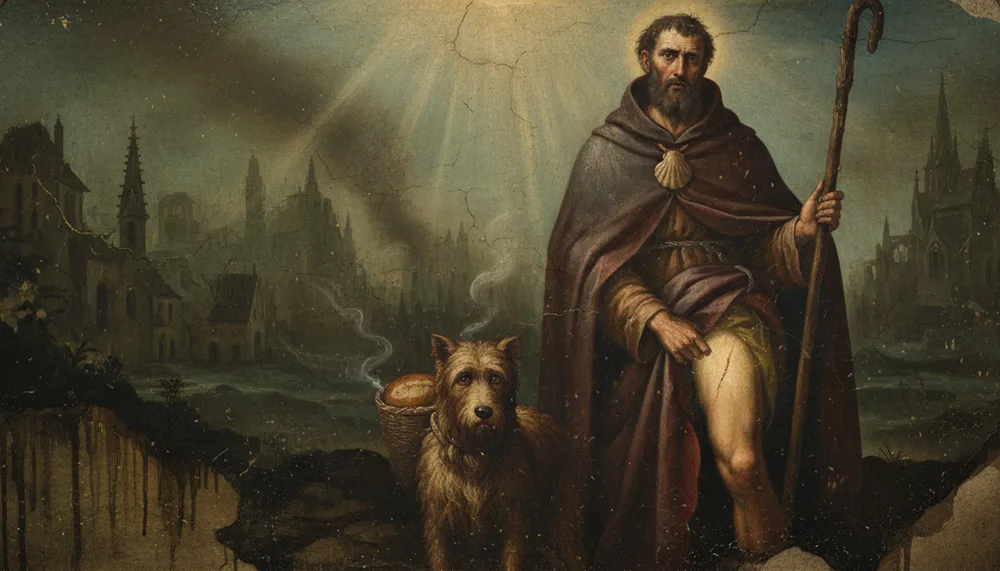
The novena to St Rocco is the old prayer beginning "O Great St Rocco, deliver us, we beseech thee, from contagious diseases," said nine days running to ask the pilgrim-saint of Montpellier — St Roch, in Italian San Rocco — to guard body and soul against plague, epidemic, and every contagion. For six hundred years he has been the Church's great intercessor against pestilence, invoked in the plague-years of the Middle Ages and in every outbreak since. His feast falls on 16 August, and the nine days before it are the natural time to pray this novena. Below we give the full prayer, the way to pray it, and the life of the saint who tended the plague-stricken with his own hands until he caught the sickness himself.
The novena prayer: "O Great St Rocco, deliver us"
This is the prayer at the heart of the devotion — the St Rocco novena against plagues. It is said once on each of the nine days, with your own intention named within it. The traditional form opens and closes with the sign of the cross:
In the name of the Father, and of the Son, and of the Holy Spirit. Amen.
O Great St Rocco, deliver us, we beseech thee, from contagious diseases. Through thy intercession, preserve our bodies from illness, and our souls from the contagion of sin. Obtain for us salubrious air; but, above all, purity of heart. Assist us to make good use of health, to bear suffering with patience, and, after thy example, to live in the practice of penance and charity, that we may one day enjoy the happiness which thou hast merited by thy virtues.
(Here name the grace you ask.)
St Rocco, pray for us. (three times)
In the name of the Father, and of the Son, and of the Holy Spirit. Amen.
The same prayer is repeated each of the nine days; there is no separate meditation appointed for each day in the traditional form. What changes is not the words but the soul that says them — nine days of steady asking, in the confidence that the saint who did not flee the plague will not turn away from those who call on him. If you are new to this kind of prayer and wonder why nine days, see our guide to what is a novena.
An older Italian form of the same prayer, still dear to the confraternities of southern Italy, casts the petition a little differently:
O Great St Rocco, deliver us, we beseech thee, from the scourges of God; through thy intercession, preserve our bodies from contagious diseases, and our souls from the contagion of sin. Amen.
The prayer to St Rocco (single-day form)
Not everyone can keep all nine days, and the tail of this devotion is often just a prayer to St Rocco for a single pressing need — a sick relative, an outbreak, a fear of contagion. The heart of the prayer above stands alone perfectly well:
O Great St Rocco, deliver us, we beseech thee, from contagious diseases. Through thy intercession, preserve our bodies from illness, and our souls from the contagion of sin; and obtain for us, above all, purity of heart. St Rocco, pray for us. Amen.
Said with faith, one heartfelt petition is heard as surely as nine days of them. The novena simply gives that petition a shape and a discipline.
The St Rocco novena against plagues
The full title by which this devotion is most often searched — the St Rocco novena against plagues — names its oldest purpose exactly. St Rocco is the plague-saint above all others. In the great pestilences of the fourteenth and fifteenth centuries whole cities placed themselves under his protection; the Council of Constance, meeting in 1414 while plague threatened the assembled bishops, is said to have ordered public prayers and a procession in his honour, and the sickness abated.
From that day his patronage against epidemic disease was fixed in the mind of Christendom, and it has never been withdrawn. When contagion comes — and it comes in every age under a new name — the Church still turns to the pilgrim who nursed the dying and was healed of the plague himself. For bodily health more broadly, this devotion sits naturally beside the novena to Our Lady of Good Health and the novena to St Peregrine, invoked against cancer and grave sickness.
The prayer asks two things at once, and the order matters: preservation of the body from illness, yes — but above all, purity of heart. St Rocco himself would have it so. He did not fear death; he feared sin. The novena against plagues is not a charm against microbes but a plea to a saint who knew that the deadlier contagion is the one that kills the soul, and who asks God to guard us from both.
How to pray the novena to St Rocco
A novena is nine consecutive days of prayer. To pray this one:
- Begin on 8 August, so that the ninth day falls on his feast, 16 August — or begin on 7 August to finish on the vigil. You may of course pray it at any time of year when there is need; the days before the feast are simply the most fitting.
- Say the prayer once each day, at a fixed hour if you can, naming your intention plainly within it and adding St Rocco, pray for us three times.
- Name one intention and keep it through all nine days — health for a sick person, protection in an epidemic, the grace of a good death, or the deeper petition for purity of heart.
- Ask in submission. Health is a good, but not the highest good; the novena is prayed well only by a soul that adds Thy will be done, ready to receive either the healing it names or the better grace God chooses to send.
Where you can, join the novena to Mass, Holy Communion, or a decade of the Rosary. Many keep a candle before an image of the saint, who is shown as a pilgrim lifting his robe to reveal the plague-sore on his thigh, his faithful dog at his side.
Who is St Rocco? The life of St Roch of Montpellier
St Rocco — St Roch, San Rocco, Sant Roc — was born at Montpellier in the south of France, around the year 1295, the son of the town's governor. Tradition holds that he was marked from birth with a red cross on his breast, and that even as an infant he fasted in devotion. Orphaned at about twenty, he came into a large inheritance; and like St Francis before him, he gave the whole of it to the poor, resigned the governorship that was his by right to his uncle, put on the plain habit of a pilgrim, and set out for Rome.
He arrived in Italy in the midst of a raging plague. Instead of fleeing it, he went straight to the pest-houses. At Acquapendente, Cesena, Rome, Mantua, Modena, Parma, and Piacenza he nursed the plague-stricken, and — the constant tradition says — healed great numbers of them by prayer and the sign of the cross made over the sores. For three years he served the dying in city after city, asking nothing, hiding his name, a nobleman turned beggar for the love of Christ in the sick.
At Piacenza he caught the plague himself. Unwilling to be a burden, he dragged himself out of the city to a hut in the forest, resigned to die alone. Here belongs the most beloved detail of his story: a hound belonging to a nobleman named Gottardo found him, and each day carried a loaf of bread from his master's table to the dying pilgrim, and licked his wounds, until the nobleman followed his dog, discovered the saint, and was converted. This is why St Rocco is always shown with a dog, and why he is honoured as a patron of dogs and of those who care for them. Nursed and recovered, he returned at last to Montpellier.
There the story turns dark. So changed was he by illness and hardship that no one knew him; refusing, out of humility, to name himself or claim his family, he was taken for a spy and thrown into prison, where he lay forgotten for five years and died about 1327 — some accounts place his birth and death later, near 1348 and 1379, but the older tradition follows the earlier dates. Only after his death was he recognised: by the red cross on his breast, and by a writing found in his cell, in which — tradition says — an angel promised that whoever invoked St Rocco should be preserved from the plague. His townsmen buried him with honour, and miracles multiplied at his tomb.
His feast is kept on 16 August. His body was later translated to Venice, where it rests still in the church of San Rocco. Pope Urban VIII approved his office, and confraternities under his name spread across Europe; in Italy his feast remains one of the great popular festivals of high summer, with processions, bonfires, and the blessing of the sick. He is the patron against plague and every contagious disease, and also of invalids, of the falsely accused (as he himself was), of pilgrims and travellers, of surgeons and apothecaries, of the knee-afflicted, and of dogs. As a pilgrim-saint he keeps company with St Christopher and the other patrons of travellers; as a plague-saint, with St Sebastian, whose image so often stands beside his in the old churches.
Because St Rocco tended the dying and himself died forgotten in a prison cell, he is also a fitting patron for the grace of a holy and provided death — a devotion that pairs well with the First Fridays and with a sober remembrance of the Four Last Things.
Frequently Asked Questions
What is St Rocco the patron saint of?
St Rocco is, above all, the patron saint against plague and contagious disease — invoked in every epidemic since the fourteenth century. He is also the patron of the sick and of invalids, of the falsely accused (he died wrongly imprisoned as a spy), of pilgrims and travellers, of surgeons and apothecaries, of those with knee and skin ailments, and — because of the hound that fed him in the forest — of dogs and those who care for them.
When is the feast of St Rocco?
The feast of St Rocco (St Roch) is kept on 16 August. In Italy and among Italian communities it is one of the great feasts of the summer, marked with processions and the blessing of the sick. The nine days before it — beginning 7 or 8 August — are the traditional time to pray his novena.
When should I start the St Rocco novena?
Begin on 8 August so that the ninth and last day falls on his feast, 16 August; or begin on 7 August to end on the vigil. You may also pray the novena at any time of the year when there is real need — during an outbreak, or for a sick person — since the feast is the fitting occasion, not a restriction.
Is St Rocco the same as St Roch?
Yes. St Rocco is the Italian name for St Roch of Montpellier (in Latin Rochus, in French Roch, in Catalan Roc, and sometimes anglicised as Rollox or Roque). He is one and the same fourteenth-century pilgrim-saint of the plague; "Rocco" is simply the form his devotion took as it spread through Italy, where it remains strongest.
Why is St Rocco prayed to against plague and disease?
Because he spent his life serving plague victims and was miraculously healed of the plague himself. When pestilence threatened the Council of Constance in 1414, prayers and a procession in his honour were ordered and the sickness is said to have abated; from then his patronage against epidemic disease was fixed throughout Christendom. Tradition also holds that an angel promised that whoever invoked St Rocco would be preserved from the plague.
Why is St Rocco shown with a dog?
When St Rocco fell ill with the plague and withdrew alone to a forest hut to die, a nobleman's dog found him and brought him bread each day from its master's table, and licked his sores until he recovered. For this reason he is nearly always pictured as a pilgrim with a dog at his side, often lifting his robe to show the plague-sore on his thigh — and is honoured as a patron of dogs.
Can I pray the St Rocco novena for someone who is sick?
Yes — this is one of its chief purposes. Name the sick person within the prayer where it asks for the grace you seek, keep that intention through all nine days, and ask for health of body if it be God's will and health of soul in every case. Add Thy will be done: the novena commends the sick to a saint who nursed the dying, and trusts God with the outcome.
The Iter Fidei app carries the novenas, chaplets, litanies and prayers — including the novena and prayers to St Rocco — in Latin and your own language, with audio and day-by-day reminders. Download it here.
Sources. Butler, Lives of the Saints, 16 August (St Roch of Montpellier); the traditional novena and prayer O Great St Rocco, deliver us, as carried in the traditional Catholic prayer-books; the feast of St Rocco (16 August); the invocation of the saints as taught in the Catechism of St Pius X, Part II; on health and God's will, Thy will be done (Matthew 6:10).