
Novenas
Novena to St Peregrine
The full novena to St Peregrine Laziosi — the patron of cancer, incurable disease, and foot ailments — with the nine-day prayers, the daily petition for the sick, and how to pray it before his feast.
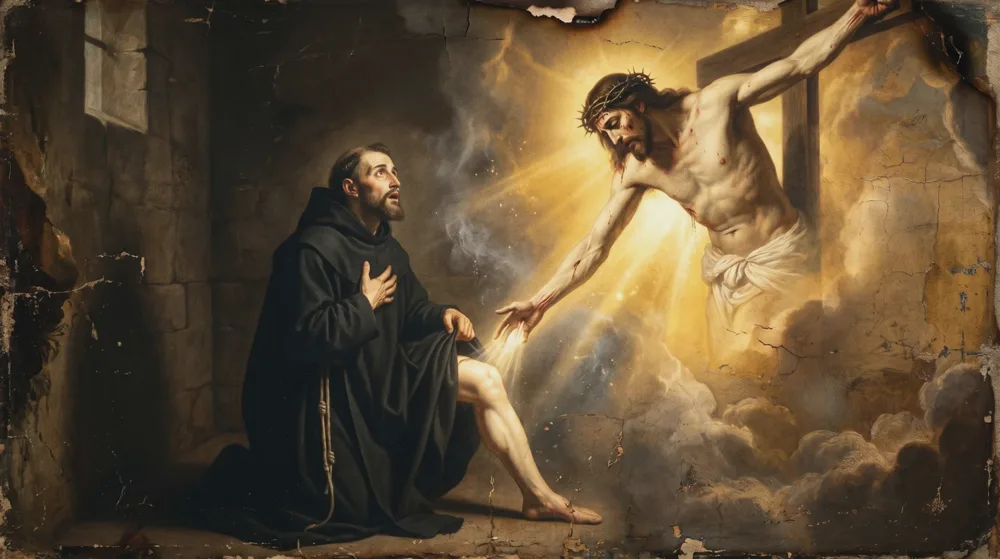
The novena to St Peregrine is the nine-day prayer to St Peregrine Laziosi — the Servite friar whom Catholic devotion invokes as the patron of cancer, of incurable disease, and of those who suffer in body — asking his intercession for a sick person we love, or for ourselves. It is prayed above all when a diagnosis has been given that human medicine cannot mend, because, according to the account of his life, Peregrine himself was healed of an open cancerous sore on his leg the night before it was to be amputated, when he saw Christ come down from the Cross to touch it.
His day is 1 May, so the novena is commonly begun on 22 April to end on the eve, though it may be prayed at any time of need. Below is the devotion as it is popularly prayed — the daily prayer, the prayer "Glorious wonder-worker," and an intention with a verse of Scripture for each of the nine days — followed by his life and the answers to what people most often ask.
The full novena to St Peregrine
The novena is prayed once a day for nine consecutive days. Each day has the same shape: you begin with the Sign of the Cross, say the daily petition for the sick, then the great prayer to St Peregrine, hold before God the intention proper to that day, and close with the Our Father, Hail Mary, and Glory Be. Name your sick person — or your own affliction — plainly, and hold that one intention through all nine days. If you are new to this kind of prayer, our guide to what is a novena explains why the Church prays for nine days.
A word on the texts: the prayers below are popular prayers, found on the prayer cards and novena leaflets of the twentieth century. They are not liturgical texts, they carry no indulgence that we can document, and we give them as such.
The daily prayer (said every day)
Begin each day, after the Sign of the Cross, with this petition for the sick:
O good St Peregrine, patron of those suffering from foot ailments, cancer, and incurable diseases, grant, we beseech you, relief from suffering to those who are ill. (Here name the person or persons who are sick.) In your compassion, we beg you to intercede with Our Lord Jesus Christ that mankind may soon find a cure for the dread disease of physical cancer, as well as for the moral cancer which grips so much of our world today. Amen.
Then say the prayer of the novena, which recalls his own miraculous healing and asks a share in his patience:
Glorious wonder-worker, St Peregrine, you answered the divine call with a ready spirit, and forsook all the comforts of a life of ease and all the empty honours of the world to dedicate yourself to God in the Order of His holy Mother. You laboured manfully for the salvation of souls. In union with Jesus crucified, you endured painful sufferings with such patience as to deserve to be healed miraculously of an incurable cancer in your leg by a touch of His divine hand. Obtain for me the grace to answer every call of God and to fulfil His will in all the events of life. Enkindle in my heart a consuming zeal for the salvation of all men. Deliver me from the infirmities that afflict my body (especially name your own). Obtain for me also a perfect resignation to the sufferings it may please God to send me, so that, imitating our crucified Saviour and His sorrowful Mother, I may merit eternal glory in heaven. Amen.
After this, recall the intention proper to the day (below), and finish with one Our Father, one Hail Mary, and one Glory Be, and the Sign of the Cross.
The nine days
Each day carries a distinct intention and a verse of Scripture (Douay-Rheims) to dwell on, so that in nine days the whole work of Christ the Healer is prayed over. These are intentions, not further prayers: read the verse, name the intention in your own words, then say the two prayers above.
Day 1 — For the conversion of sinners
"Do penance: for the kingdom of heaven is at hand" (Matthew 3:2). Peregrine himself turned from the anti-papal factions of Forlì to the service of God; ask for sinners the grace of repentance, and for the sick the healing of soul as well as body.
Day 2 — For patience and comfort in suffering
"Blessed are they that mourn: for they shall be comforted" (Matthew 5:5). Ask for all who suffer the courage to carry their cross in union with Christ.
Day 3 — For peace
"Peace I leave with you: my peace I give unto you" (John 14:27). Ask the peace of Christ for the world, and for the anxious heart the peace that no illness can take away.
Day 4 — For religious and priestly vocations
"Come ye after me, and I will make you to be fishers of men" (Matthew 4:19). Peregrine left everything to follow Christ in the Order of the Servants of Mary; ask labourers for the harvest.
Day 5 — For respect for human life
"For God made not death, neither hath he pleasure in the destruction of the living" (Wisdom 1:13). Ask that every human life, above all the weak, the sick, and the unborn, be guarded.
Day 6 — For the young
"Suffer the little children to come unto me, and forbid them not" (Mark 10:14). Ask for the young protection from the corruption of the world and the grace to seek Christ early.
Day 7 — For the aged
"Cast me not off in the time of old age: when my strength shall fail, do not thou forsake me" (Psalm 70:9). Commend the elderly and the long-suffering to God.
Day 8 — For the hungry and the poor
"They shall no more hunger nor thirst" (Apocalypse 7:16). Ask bread for the starving and mercy for all in want.
Day 9 — For a holy death
"Lord, remember me when thou shalt come into thy kingdom" (Luke 23:42). Ask for the sick person the grace of healing if it be God's will, and if not, the grace of a holy and peaceful passage to Him. Our prayer for the dying gives the Church's own prayers for that hour.
The novena for cancer and incurable disease
Because his own cancer was healed, St Peregrine is invoked above all by those who face cancer, tumours, and diseases the doctors call incurable — which is why so many search for the St Peregrine novena for cancer by name. The whole devotion above is that novena; there is no separate text. When you pray it for a cancer patient, name them at the daily prayer and at the great prayer's "deliver me from the infirmities," and pray Day 2 and Day 9 with special care, for they ask exactly the two graces a sick soul most needs: patience under the cross now, and a holy passage at the end.
St Peregrine does not always obtain the bodily cure — he obtains what is best for the soul, as every true intercessor does. For the grace of resignation in serious illness, many join this novena to the Seven Sorrows Chaplet or the novena to Our Lady of Sorrows, the great devotion of his own Servite Order, or to a prayer for healing said over the sick, and they ask the help of St Raphael, the archangel whose name means "God heals." Above all, a gravely ill Catholic should be given the sacraments in good time, Extreme Unction among them.
The prayer to St Peregrine "the Wonder-Worker"
Alongside the novena, there is a shorter popular prayer, found on countless prayer cards, used to ask his help for a sick person by name — the one that opens "O great St Peregrine." It may be added to the novena or said on its own, any day of the year:
O great St Peregrine, you have been called "The Mighty," "The Wonder-Worker," because of the numerous miracles which you have obtained from God for those who have had recourse to you. For so many years you bore in your own flesh this cancerous disease that destroys the very fibre of our being, and you had recourse to the source of all grace when the power of man could do no more. You were favoured with the vision of Jesus coming down from His Cross to heal your affliction. Ask of God and Our Lady the cure of the sick whom we entrust to you. (Pause and silently name the sick for whom you pray.) Aided in this way by your powerful intercession, we shall sing to God, now and for all eternity, a song of gratitude for His great goodness and mercy. Amen.
How to pray the novena to St Peregrine
Pray it once a day for nine days running, at a fixed hour if you can. Begin on 22 April to end on 30 April, the eve of his day on 1 May, or begin any day of the year that need arises — a novena binds no calendar. Name one intention and keep it through all nine days.
Where you are able, join the novena to Holy Mass and Communion for the sick person, or at least to a decade of the Rosary; on how the Rosary is prayed, see our guide to the Rosary. Above all, pray in submission: ask for the cure plainly, and add always Thy will be done. The novena that pleases God is prayed by a soul content to receive either the healing it names or the greater grace He chooses to send in its place.
Who is St Peregrine Laziosi?
St Peregrine Laziosi was born about the year 1260 (some accounts say 1265) at Forlì, a city of the Romagna in northern Italy, into a well-placed family. In his youth the city was under the Church's interdict for its rebellion against the Pope, and the young Peregrine threw himself into the anti-papal party. When St Philip Benizi, Prior General of the Servites, came to Forlì to preach peace, the crowd drove him out, and Peregrine, by the tradition of his Order, struck the holy friar on the face. Philip, in the manner of the Gospel, turned the other cheek. That silent patience broke the young man's heart. Peregrine repented, sought out the friar he had wounded, and gave himself to God.
He entered the Order of the Servants of Mary — the Servites — whose devotion is centred on the Sorrows of the Blessed Virgin at the foot of the Cross, made his profession at Siena, and was sent back to the Servite house of his native Forlì. There he became famous for his charity to the poor and the sick, and for a penance he is said to have kept for thirty years: never to sit when he could stand, so that he stood at all times except when necessity forced him to rest. In his later years this discipline, together with age, brought on a cancer — an open, running sore — on his right leg (some older accounts say the foot), so grievous and so foul that the surgeon determined the leg must be amputated.
On the night before the operation, Peregrine dragged himself to the chapter room, knelt before a fresco of the Crucifixion, and prayed through the hours for healing. In a vision — or a waking dream between prayer and sleep — he saw Christ come down from His Cross and touch the diseased leg. When he woke, the cancer was entirely gone; the wound was healed, the flesh sound. The surgeon who came to amputate found nothing to cut. Peregrine lived on some twenty years after, dying at Forlì on 1 May 1345, about eighty years old, and miracles multiplied at his tomb from the first.
He was canonized by Pope Benedict XIII on 27 December 1726. The Roman Martyrology names him on 1 May: "At Forlì, holy Peregrinus, of the Order of Servants of the Blessed Virgin Mary." He is not in the General Roman Calendar of the 1962 Missal (1 May there is St Joseph the Worker); his feast belongs to the proper calendar of the Servite Order and to local churches. From his own healing of an incurable cancer, and from the countless cures reported through his intercession since, Catholics honour him as the patron of cancer patients, of the incurably ill, and of those afflicted with sores and diseases of the foot and leg.
He is a saint for the sickbed, for the diagnosis that ends hope, for the soul that must learn, as he did, to stand at the foot of the Cross. His whole life is told in our article on St Peregrine, patron of cancer patients. Those who pray to him for desperate causes often turn as well to St Jude, patron of hopeless cases, and to the Italian St Rita, patron of the impossible.
Frequently Asked Questions
What is St Peregrine the patron saint of?
St Peregrine Laziosi is the patron saint of cancer patients, of those suffering from incurable and life-threatening illness, and of people afflicted with running sores and ailments of the foot and leg. He holds this patronage because he was himself healed of an open cancer in his leg — scheduled for amputation the next morning — by a vision of Christ descending from the Cross to touch it. He is invoked for the sick above almost every other saint.
When should I pray the St Peregrine novena?
You may pray it at any time a need for healing arises — there is no season a novena is confined to. The usual time is the nine days before his day, 1 May: begin on 22 April and end on 30 April, the eve. Many begin it on the day a diagnosis is received, or before a surgery or a course of treatment, and pray the nine days running from there.
How do I pray the St Peregrine novena for a sick person?
Pray the daily prayer and the prayer "Glorious wonder-worker" once each day for nine days, naming your sick person at the points marked for the intention, and recalling the intention proper to each day. Keep the same one intention through all nine days, close each day with the Our Father, Hail Mary, and Glory Be, and where you can, offer a Mass or Communion for the person. The full text is given in this article.
Is St Peregrine's novena only for cancer?
No. Cancer is his best-known patronage because of his own healing, and the St Peregrine novena for cancer is the most-prayed form — but he is invoked for any grave or incurable illness, for foot and leg ailments, for the dying, and for the sick in general. The nine days also carry intentions for sinners, for peace, for vocations, for the young and the aged, and for a holy death, so the whole novena reaches well beyond one disease.
Who was St Peregrine and how was he healed?
He was a Servite friar of Forlì, born about 1260, who as a young man struck St Philip Benizi and, moved by the friar's patience, converted and entered the Servite Order. Late in life he developed a cancer on his leg that was to be amputated; the night before, praying before an image of the Crucifixion, he saw Christ come down from the Cross to touch the leg, and awoke completely healed. He died on 1 May 1345 and was canonized by Benedict XIII on 27 December 1726. The Roman Martyrology commemorates him on 1 May.
Is there a printable PDF of the St Peregrine novena?
The complete nine-day novena is given in full on this page — the daily prayer, the prayer to St Peregrine, and each day's intention — so it can be prayed straight from your screen with nothing further to download. You may copy the prayers above to keep beside a sickbed for the nine days. Better than a PDF: the Iter Fidei app sets the right text before you each day and reminds you to pray it, even without a connection. Join early access here.
Can I pray the St Peregrine novena for myself?
Yes. The novena prayer includes the words "deliver me from the infirmities that afflict my body," precisely for those praying over their own illness. Name your own affliction there, ask plainly for healing, and recall the day's intention. Pray in trust and in resignation to God's will, as St Peregrine himself endured his cancer "with such patience" before he was healed.
Pray this novena with day-by-day reminders and audio in the Iter Fidei app, so you never lose your place across the nine days. Join early access here.
Sources. The novena prayers to St Peregrine (the daily prayer for the sick, "Glorious wonder-worker, St Peregrine," and "O great St Peregrine"), popular prayers of twentieth-century prayer cards and novena leaflets, not liturgical texts; Holy Scripture, Douay-Rheims (Matthew 3:2; 4:19; 5:5; Mark 10:14; Luke 23:42; John 14:27; Wisdom 1:13; Psalm 70:9; Apocalypse 7:16); Martyrologium Romanum, 1 May ("Foro Livii sancti Peregrini, ex Ordine Servorum beatae Mariae Virginis"); Compendium vitae, virtutum et miraculorum B. Peregrini Latiosi Foroliviensis (Sacred Congregation of Rites, Rome 1726) and the canonization by Pope Benedict XIII, 27 December 1726.