
The Saints
St Peregrine, Patron of Cancer Patients
St Peregrine Laziosi, the patron saint of cancer patients — the Servite friar healed of cancer of the leg, his life, a St Peregrine prayer, and his feast day.
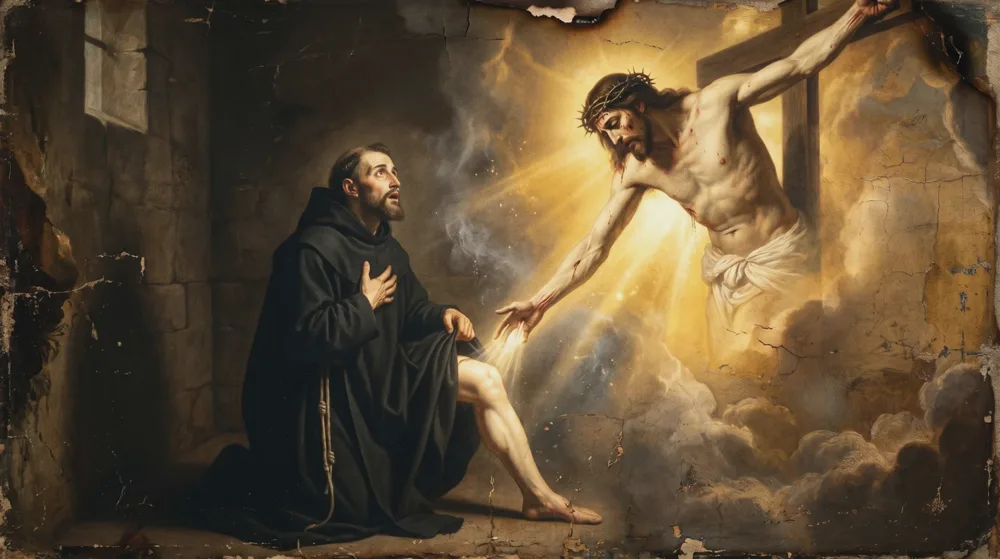
St Peregrine Laziosi is the saint to whom Catholics turn in grave illness, and above all the patron saint of cancer and of those who suffer from cancer, open sores, and incurable disease. A Servite friar of thirteenth- and fourteenth-century Italy, Saint Peregrine was, by the account of his life, cured of a cancer of the leg on the eve of an amputation; the Roman Martyrology names him on the 1st of May.
Who St Peregrine was
Peregrine Laziosi was born about 1265 at Forlì, in the Romagna, of a well-placed family. The city of his birth was in those years torn by the strife between the Guelphs and the Ghibellines, and in his youth Peregrine took the side of the party that resisted the Holy See. He was, by the older accounts, hot-tempered and a leader among the malcontents of the town.
When the city lay under interdict for its rebellion, St Philip Benizi, the prior general of the Order of the Servants of Mary, was sent to Forlì to preach peace and reconciliation. Peregrine, with the crowd, mocked and harassed him; in the heat of it he struck the saint on the face. Philip Benizi turned the other cheek. The gesture broke the young man. Stricken with remorse, Peregrine sought out the one he had struck, begged his pardon, and from that hour amended his life. He gave himself to prayer before the image of Our Lady, and in time, at her bidding as the tradition holds, he went to Siena and entered the Servite Order, the Order of St Philip himself.
As a friar Peregrine was marked by penance and by charity to the poor and the sick. He imposed on himself the discipline of standing whenever it was not necessary to sit, so that for years he scarcely rested his legs. In his old age this austerity, or the course of nature, brought on a cancer of the right leg (some older accounts say the foot) — a running, fetid sore that ate into the flesh. The surgeon judged that the leg must be cut off to save his life.
The night before the amputation, Peregrine dragged himself before a crucifix in the chapter house and spent the hours in prayer, begging God for whatever He willed. Falling into a light sleep, he seemed to see Christ come down from the cross to touch the diseased leg. When he woke, the cancer was gone and the flesh sound. The surgeon, coming in the morning to operate, found nothing to cut. Peregrine lived on, healthy, and died at Forlì on 1 May 1345, an old man of about eighty.
His body was venerated at once, and many cures were reported at his tomb. After his cult had been approved by the Holy See, he was canonized by Pope Benedict XIII on 27 December 1726.
Why St Peregrine is the patron saint of cancer
The title is drawn straight from his own life. Peregrine is invoked as the patron saint of cancer patients — and more widely of those afflicted with running sores, ulcers, foot ailments, and incurable or life-threatening disease — because he himself bore a cancer of the leg and was delivered from it on the very threshold of the surgeon's knife.
He is held out, here as with every saint of healing, not as a worker of cures in his own right but as a powerful intercessor before God, who alone is the author of life and health. His cure was no reward for impatience but the fruit of a long night spent in resignation to the divine will: he asked first not for healing but for whatever God should send. That order is the heart of his patronage. Those who invoke him are taught by his example to seek above all the grace to suffer well, and to leave the issue — cure or cross — in God's hands.
Devotion to St Peregrine has therefore always gone hand in hand with the sacraments the Church gives to the sick. The gravely ill are commended to Extreme Unction, the sacrament instituted for the relief and strengthening of the soul, and sometimes of the body, in serious illness; the prayer to St Peregrine completes, and does not replace, that sacramental help. The Roman Catechism teaches that "a last effect of Extreme Unction is to restore the health of the body, when that is advantageous to the sick" — the very benefit St Peregrine himself received, though by another way.
A prayer to St Peregrine
Saint Peregrine is honored with his own novena, prayed over nine days for the sick. The most common invocation is a popular prayer of the twentieth-century prayer cards — not a liturgical text — that gathers his story into a single petition, and may be said for oneself or for another in serious illness:
O great St Peregrine, thou who hast been called "The Mighty," "The Wonder-Worker," on account of the numerous miracles which thou hast obtained from God for those who have had recourse to thee; thou who for so many years didst bear in thine own flesh this cancerous disease that destroys the very fibre of our being, and who hadst recourse for a cure to the source of all grace when the power of man could do no more; thou who wast favored with the vision of Christ coming down from His Cross to heal thine affliction: ask of God and Our Lady the cure of the sick whom we entrust to thee. (Here name the petition.) Aided in this way by thy powerful intercession, we shall sing to God, now and for all eternity, a song of gratitude for His great goodness and mercy. Amen.
The shortest invocation is simply: St Peregrine, pray for us. As with all the saints, the prayer asks not that Peregrine act in God's place but that he carry our petition to Him; this is the order of intercession set out in the Litany of the Saints, where the whole Church on earth calls upon the whole Church in heaven. Those who pray for the sick may join to his name that of another patron of the suffering, St Gerard, or of St Raphael, the archangel whose name means "God heals".
A short prayer to St Peregrine
For those who keep a verse in mind through the day, a short prayer to St Peregrine serves where the long invocation cannot be said. The simplest takes the form of every invocation of the saints in the litanies:
St Peregrine, pray for us.
To it may be joined the Church's own official words about him, the entry of the Roman Martyrology for 1 May: "Foro Livii sancti Peregrini, ex Ordine Servorum beatae Mariae Virginis" — "At Forlì, holy Peregrinus, of the Order of Servants of the Blessed Virgin Mary." The Martyrology is not a prayer, but it is the Church's own witness that he stands among the saints. Collects and longer formulas said to come from his Mass circulate on the internet; as we have not been able to verify them against the Servite proper, we do not reproduce them.
The St Peregrine "miracle prayer"
What is often searched as the St Peregrine miracle prayer is the same great invocation given above — it carries that name because it recalls the miracle worked in his own body, the cancer that vanished the night before the amputation. There is no separate or secret formula. To pray it well is not to expect a wonder as one's due, but to ask, as Peregrine asked, first for conformity to God's will and then, if it should please Him, for the cure.
The cures reported through his intercession down the centuries are real, but they are gifts freely given, not the mechanical result of the right words. The Church warns against treating any prayer as a charm whose effect is guaranteed by its recitation; this is the error of superstition, and it is the opposite of the trust St Peregrine showed before his crucifix.
The novena to St Peregrine, day by day
The novena to St Peregrine is nine successive days of prayer, made most often before his day on the 1st of May, or begun at the onset of an illness for oneself or another. A novena is not a count that must be kept unbroken on pain of failure — that, again, would be superstition — but a settled, persevering prayer in imitation of the nine days the Apostles and Our Lady spent in prayer between the Ascension and Pentecost.
There is no single official text; our novena to St Peregrine gives the full popular form, day by day. A simpler way to keep it is the same each of the nine days:
- Begin with the Sign of the Cross and an act of contrition.
- Say the great prayer to St Peregrine given above, naming your petition.
- Add one Our Father, one Hail Mary, and one Glory Be, offered for the sick person.
- Close with the invocation: St Peregrine, pray for us.
Those who look for a structured day-one opening often begin the first day by recalling Peregrine's conversion — the blow he struck St Philip Benizi and the patience that won him — and ask, before any cure, for the grace of a like conversion of heart. The following days may dwell in turn on his penance, his standing vigil, his cancer, his night before the crucifix, his healing, his long life of charity, his holy death, and his intercession now in heaven. The point throughout is the disposition of the one praying, not the tally of days.
The St Peregrine chaplet
Some of the faithful keep a St Peregrine chaplet, a short string of beads used to honor him much as the Rosary honors Our Lady. There is no chaplet of St Peregrine prescribed in the Church's official books; the various forms in circulation are private devotions, and they differ from one leaflet to the next, so we do not set one out here. The chaplet that belongs to his own Order is that of the Seven Sorrows of Our Lady, the great devotion of the Servites. Because such chaplets are not part of the public liturgy, they bind no one; they are simply a help to those who find a rhythm of beads steadies their prayer.
St Peregrine medals, holy cards, and prayer cards
The St Peregrine medal and the St Peregrine holy card or prayer card are sacramentals — blessed objects the Church gives to dispose the soul to grace and to keep holy things before the mind. A medal of St Peregrine usually shows the friar in the black Servite habit, often kneeling before the crucifix, sometimes with his afflicted leg bared; a prayer card carries his image on one side and the invocation on the other, and is frequently given to the sick or laid by a hospital bed.
It is right and ancient to wear or carry such things, but their use must be understood as the Church understands it: a medal has no power in itself. Its value is that it is blessed, that it stirs the wearer to prayer and confidence in God, and that it expresses the bond between the sick member of the Church and the saint who intercedes for him. To trust the metal rather than the God it points to would be to fall back into the superstition the Faith condemns. Worn rightly, a St Peregrine medal is a standing prayer: a quiet act of faith renewed every time it is touched. Before being worn, a medal or card is fittingly blessed by a priest with the Church's blessing for such objects.
The shrine and relics of St Peregrine
The chief St Peregrine shrine is at Forlì, in the basilica of the Servites (San Pellegrino Laziosi), where his body, which tradition reports incorrupt, has rested and been venerated since the fourteenth century. Pilgrims come there, and to Servite churches throughout the world, to ask his intercession; his statue — the friar in his habit before the cross — stands in many parishes, and not a few churches outside Italy are placed under his patronage and called by his name. The veneration of his relics, like the use of his medal, is no honor paid to the bones for their own sake, but honor given to God in His saint, and a confident appeal to one whom the Church holds out as a friend of the sick before the throne of God.
His feast day
St Peregrine Laziosi is commemorated on the 1st of May, the day of his death, in the Roman Martyrology. He is not in the General Roman Calendar of the 1962 Missal — the 1st of May there is the feast of St Joseph the Worker, and before 1955 that of the Apostles Philip and James — so his feast is kept in the proper calendar of the Servite Order and in churches dedicated to him, where his day and the novena before it are often marked by special prayers for the sick.
Those who keep his feast do well to honor him as the Church honors him: not as a charm against disease, but as one of the cloud of witnesses who proved that affliction, borne in patience and offered to God, is not wasted — and that the same Lord who came down from His cross to heal a friar's leg still hears the prayer of the sick who call on Him through His saints. Our guide to the Catholic saints sets St Peregrine in the company of the other saints, listed month by month by feast day.
Frequently Asked Questions
Who is St Peregrine?
St Peregrine Laziosi (c. 1260/1265–1345) was a Servite friar of Forlì in Italy. A hot-tempered young man who once struck St Philip Benizi, he was converted by the saint's patience, entered the Servite Order, and gave himself to penance and charity. In old age he was stricken with a cancer of the leg; the night before the surgeon was to amputate, he prayed before a crucifix and was cured. He is venerated as the patron saint of cancer patients.
What is St Peregrine the patron saint of?
St Peregrine is the patron saint of cancer patients, and more widely of those afflicted with running sores, ulcers, foot ailments, and incurable or life-threatening disease. The title is drawn straight from his own life, for he himself bore a cancer of the leg and was delivered from it on the very threshold of the surgeon's knife.
What is the St Peregrine prayer for cancer?
The most common invocation asks "great St Peregrine," who bore a cancerous disease in his own flesh and was favoured with the vision of Christ coming down from His Cross to heal him, to obtain of God and Our Lady the cure of the sick entrusted to him. It is a popular prayer, not a liturgical text. A shorter invocation is simply: St Peregrine, pray for us. The prayer asks not that Peregrine act in God's place but that he carry our petition to Him.
How do you pray a novena to St Peregrine?
A novena to St Peregrine is nine successive days of prayer for the sick, prayed especially before his feast. The popular prayer to St Peregrine may be repeated on each of the nine days, joined to the Our Father, the Hail Mary, and the Glory Be. His own cure was the fruit of a long night spent in resignation to God's will: those who invoke him are taught to seek above all the grace to suffer well, and to leave the issue — cure or cross — in God's hands.
When is the feast day of St Peregrine?
St Peregrine is commemorated on the 1st of May in the Roman Martyrology. He is not in the 1962 General Roman Calendar; his feast is kept in the proper calendar of the Servite Order and in churches dedicated to him.
What does a St Peregrine medal mean, and is it allowed?
A St Peregrine medal is a sacramental: a blessed object that stirs the wearer to prayer and confidence in God and expresses the bond between the sick and the saint who intercedes for them. It is entirely allowed, and ancient, to wear or carry one; but it has no power in itself. To trust the metal rather than the God it points to would be superstition. Worn rightly, the medal is a standing prayer and an act of faith. A medal or prayer card is fittingly blessed by a priest before use.
Is there a St Peregrine chaplet?
There is no chaplet of St Peregrine prescribed in the Church's official books; the forms in circulation are private devotions, freely used and binding no one. The forms differ from one leaflet to another. The chaplet proper to his Servite Order is that of the Seven Sorrows of Our Lady.
Where is the shrine of St Peregrine?
The chief shrine of St Peregrine is at Forlì, in Italy, in the basilica of the Servites (San Pellegrino Laziosi), where his body has been venerated since the fourteenth century. Pilgrims come there, and to Servite churches throughout the world, to ask his intercession.
The Iter Fidei app carries the prayers to the saints, the traditional calendar of feasts, and the catechism. Join early access here.
Sources. Martyrologium Romanum, 1 May ("Foro Livii sancti Peregrini, ex Ordine Servorum beatae Mariae Virginis"). Compendium vitae, virtutum et miraculorum B. Peregrini Latiosi Foroliviensis, Sacred Congregation of Rites (Rome, 1726), and the canonization by Pope Benedict XIII, 27 December 1726. The prayer "O great St Peregrine": popular prayer-card text, twentieth century. Catechism of the Council of Trent (Roman Catechism, 1566), Part II, on the Sacrament of Extreme Unction.