
Devotions
Divine Mercy Chaplet: How to Pray It, and Its History
How to pray the Divine Mercy Chaplet on Rosary beads, its full text, the history of the devotion with the Holy Office notification of 1959 and its withdrawal in 1978, and the older devotions of tradition to the mercy of God.
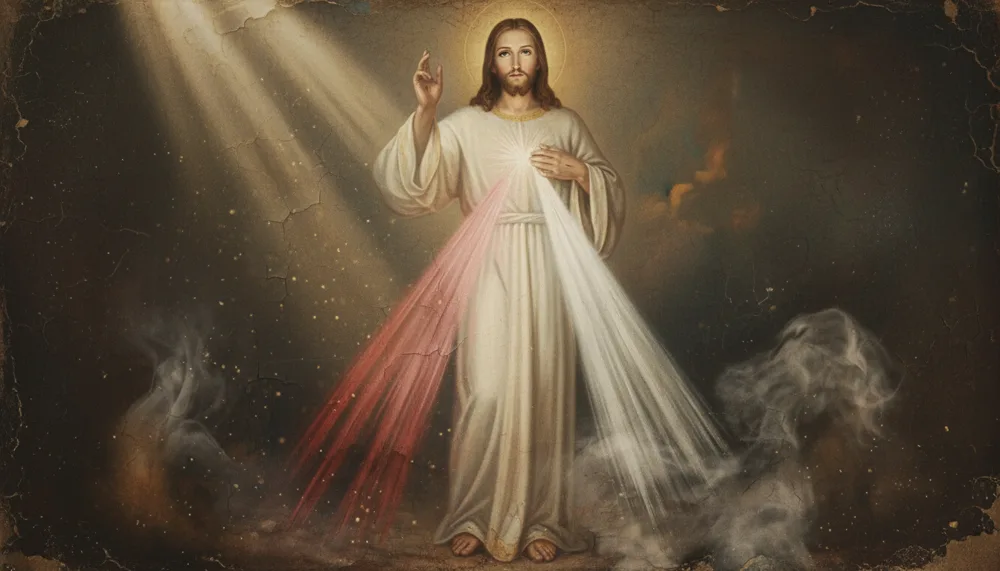
The Divine Mercy Chaplet is a short vocal prayer, said on ordinary Rosary beads, that offers the Father the Passion of His Son and begs mercy "on us and on the whole world". It comes from the Diary of St Faustina Kowalska, a Polish sister who died in 1938. Below we give the full text and the way it is prayed, then the history of the devotion, which belongs to the twentieth century and not to the liturgy of 1962, and the older prayers by which the Church has always pleaded the mercy of God.
How to pray the Divine Mercy Chaplet
The chaplet follows a simple, repeating shape on the five decades of the Rosary:
- Begin with the Sign of the Cross, one Our Father, one Hail Mary and the Apostles' Creed.
- On the large bead before each decade, say:
Eternal Father, I offer You the Body and Blood, Soul and Divinity of Your dearly beloved Son, Our Lord Jesus Christ, in atonement for our sins and those of the whole world.
- On the ten small beads of each decade, say:
For the sake of His sorrowful Passion, have mercy on us and on the whole world.
- Repeat the offering and the ten invocations for all five decades.
- Conclude, three times:
Holy God, Holy Mighty One, Holy Immortal One, have mercy on us and on the whole world.
This is the form recorded in the Diary (nos. 475-476). The closing words echo the ancient Trisagion, the Agios o Theos that the Roman rite sings at the Reproaches of Good Friday. The heart of the prayer is the offering of the Passion of Christ to the Father, which is the doctrine of the Mass itself.
On which beads?
It is said on the ordinary five-decade Rosary; no special beads are needed. The large beads carry the offering to the Eternal Father, the small beads the plea for mercy. For the wider family of prayers said on beads, see what is a chaplet.
Is it a "Divine Mercy Rosary"?
Many call it the "Divine Mercy Rosary", because it uses the same beads. Strictly it is a chaplet: the Rosary is the Marian prayer in which the Hail Marys accompany meditation on the Mysteries of Our Lord's life, Passion and glory, while this chaplet says other words on the same beads and has no Mysteries. The Sorrowful Mysteries of the Rosary plead the very Passion the chaplet invokes.
Aloud, sung or with audio
Because the prayer is short and repetitive, it is often said aloud in common or sung to a simple tune. The words do not change with the melody. The Church's own sung plea for mercy is the Kyrie eleison of every Mass, older than any chaplet.
The Divine Mercy Chaplet as a novena
The Diary also records a nine-day novena, from Good Friday to the Saturday after Easter, in which the chaplet is said each day with a different intention. Its full text is in our article on the Divine Mercy Novena.
Divine Mercy Chaplet PDF
We do not offer a PDF file: the whole text is above and prints as it stands. A sheet of paper gets lost; the Iter Fidei rosary keeps the beads and their prayers on your phone, offline, with a daily reminder. Join early access here.
The view of tradition
The chaplet is a private devotion of the twentieth century, and it has no place in the liturgy of 1962. The facts, in order:
- St Maria Faustina Kowalska, of the Congregation of Our Lady of Mercy, died in Kraków on 5 October 1938. Her Diary records the private revelations she believed she received from 1931; the chaplet was set down there in September 1935.
- On 19 November 1958 the Supreme Sacred Congregation of the Holy Office, having examined these alleged revelations, decided that their supernatural character was not evident, that no feast of Divine Mercy was to be instituted, and that images and writings spreading the devotion "in the forms proposed by Sister Faustina" were forbidden. The notification was published on 6 March 1959 in the Acta Apostolicae Sedis (vol. 51, p. 271).
- On 15 April 1978 the Sacred Congregation for the Doctrine of the Faith declared those prohibitions no longer binding, citing original documents unknown in 1959.
- St Faustina was beatified on 18 April 1993 and canonised on 30 April 2000. By a decree of 5 May 2000 the Congregation for Divine Worship gave the Second Sunday of Easter the added name "Divine Mercy Sunday", without changing its Mass.
In the Missal and Breviary of 1962 that Sunday is Low Sunday, Dominica in Albis, and there is no feast of Divine Mercy. Private revelations, even when the Church later permits their devotion, never bind the faithful; the Church judges them and approves only what is sound in them by her own authority. We give the chaplet because it is so widely sought, and because its words plead the Passion; we give it as a private devotion, not as part of the traditional rite. More on her life is in our novena to St Faustina.
The mercy of God in the older prayers of the Church
Confidence in the mercy of God is not a discovery of the twentieth century. It runs through the whole of Scripture and the liturgy, and the tradition offers it under forms the Church has prayed, tested and indulgenced for centuries.
The Kyrie eleison
At the threshold of every Mass the Church cries:
Kyrie eleison, Christe eleison, Kyrie eleison.
Lord, have mercy; Christ, have mercy; Lord, have mercy.
These Greek words, kept in the Latin rite, are the Church's oldest standing plea for mercy, repeated at every altar for well over a thousand years.
The Miserere and the De profundis
The penitential psalms are the Church's school of contrition. The greatest is the Miserere, Psalm 50 in the Vulgate:
Have mercy on me, O God, according to thy great mercy. And according to the multitude of thy tender mercies blot out my iniquity. (Psalm 50:3, Douay-Rheims)
And from the depths the Psalmist cries:
Out of the depths I have cried to thee, O Lord: Lord, hear my voice. (Psalm 129:1, Douay-Rheims)
With them stands the prayer of the publican, who went home justified: "O God, be merciful to me a sinner" (Luke 18:13). In Lent the Church adds the antiphon Parce, Domine, parce populo tuo: "Spare, O Lord, spare Thy people."
The Sacred Heart, the Holy Wounds and the Precious Blood
Whoever wishes to plead the Passion of Christ for mercy, which is what the chaplet does, has in the devotion to the Sacred Heart a form the Church set at the centre of her teaching. Leo XIII consecrated the human race to the Sacred Heart in 1899; Pius XI wrote on reparation in Miserentissimus Redemptor (1928) and Pius XII on the devotion itself in Haurietis aquas (1956). It has its chaplet of the Sacred Heart, its Litany of the Sacred Heart and the reparation of the First Fridays. Close to it stand the chaplet of the Five Wounds and the chaplet of the Precious Blood, whose feast falls on 1 July in the 1962 calendar.
The Mother of Mercy and the works of mercy
The Mother of God is hailed as Mater misericordiae in the Hail Holy Queen, and implored in the Rosary. And mercy is not only asked but practised: the Catechism of St Pius X teaches the seven corporal and seven spiritual works of mercy, from feeding the hungry to forgiving injuries and praying for the living and the dead. Above all, mercy is given in the sacrament of Penance, prepared by a sincere act of contrition.
For a chaplet of older and approved form, see the Chaplet of St Michael, indulgenced by Pius IX; for the wider treasury, our guide to Catholic devotions and our collection of Catholic prayers.
Frequently Asked Questions
How do you pray the Divine Mercy Chaplet?
On ordinary Rosary beads. After the Sign of the Cross, an Our Father, a Hail Mary and the Creed, say on each large bead "Eternal Father, I offer You the Body and Blood, Soul and Divinity of Your dearly beloved Son, Our Lord Jesus Christ, in atonement for our sins and those of the whole world", and on each of the ten small beads "For the sake of His sorrowful Passion, have mercy on us and on the whole world". After five decades, say three times "Holy God, Holy Mighty One, Holy Immortal One, have mercy on us and on the whole world".
How long does the chaplet take?
About seven to ten minutes, said at an ordinary pace.
What is the Divine Mercy Chaplet?
A vocal prayer said on Rosary beads that offers the Father the Passion of His Son and begs mercy for the whole world. It comes from the Diary of St Faustina Kowalska (1905-1938). It is a private devotion of the twentieth century and not part of the traditional liturgy.
Was the Divine Mercy devotion ever forbidden?
Yes. A notification of the Holy Office, decided on 19 November 1958 and published on 6 March 1959, forbade the spread of images and writings presenting the devotion in the forms proposed by Sister Faustina. The Congregation for the Doctrine of the Faith declared those prohibitions no longer binding on 15 April 1978.
When is the feast of Divine Mercy?
The name "Divine Mercy Sunday" was given to the Second Sunday of Easter by a decree of 5 May 2000. It is not in the 1962 calendar, where that day is Low Sunday, Dominica in Albis, with its own Mass and Office.
Why is the chaplet prayed at three o'clock?
The Diary asks that the hour of Our Lord's death, three in the afternoon, be honoured in prayer for mercy. There is no obligation in this. The Church's own commemoration of that hour is None in the Divine Office, and every Friday recalls the Passion.
Can a traditional Catholic pray the Divine Mercy Chaplet?
Since 1978 the devotion is permitted, and its words plead the Passion of Christ, so a Catholic may pray it as a private devotion. It is not part of the 1962 liturgy, and no one is bound to it. The older prayers of the Church, from the Kyrie to the Sacred Heart, plead the same mercy with the warrant of centuries.
What is the difference between the chaplet and the novena?
The chaplet is the short prayer on the beads, which may be said on any day. The novena is a nine-day cycle, from Good Friday to the Saturday after Easter, in which the chaplet is said each day with a particular intention.
The Iter Fidei app carries the Missal and the Breviary of 1962, the Rosary, the chaplets and the litanies, in Latin and English, with audio. Join early access here.
Sources. Diary of Saint Maria Faustina Kowalska, nos. 475-476 (the chaplet); Supreme Sacred Congregation of the Holy Office, notification of 6 March 1959, Acta Apostolicae Sedis 51 (1959), p. 271; Sacred Congregation for the Doctrine of the Faith, notification of 15 April 1978; Congregation for Divine Worship, decree Misericors et miserator (5 May 2000); Leo XIII, Annum sacrum (1899); Pius XI, Miserentissimus Redemptor (1928); Pius XII, Haurietis aquas (1956); Catechism of St Pius X, on the works of mercy; Missale Romanum (1962), Ordinary of the Mass and Good Friday; Holy Bible, Douay-Rheims version (Psalms 50 and 129; Luke 18).