Devotions
The Chaplet of the Holy Face of Jesus
The Chaplet of the Holy Face of Jesus is a devotion of reparation, prayed on 39 beads, that offers the wounded Face of Christ to the Father in atonement for blasphemy and the profanation of Sundays — revealed at Tours to Sister Marie de Saint-Pierre and spread by the Venerable Leo Dupont.
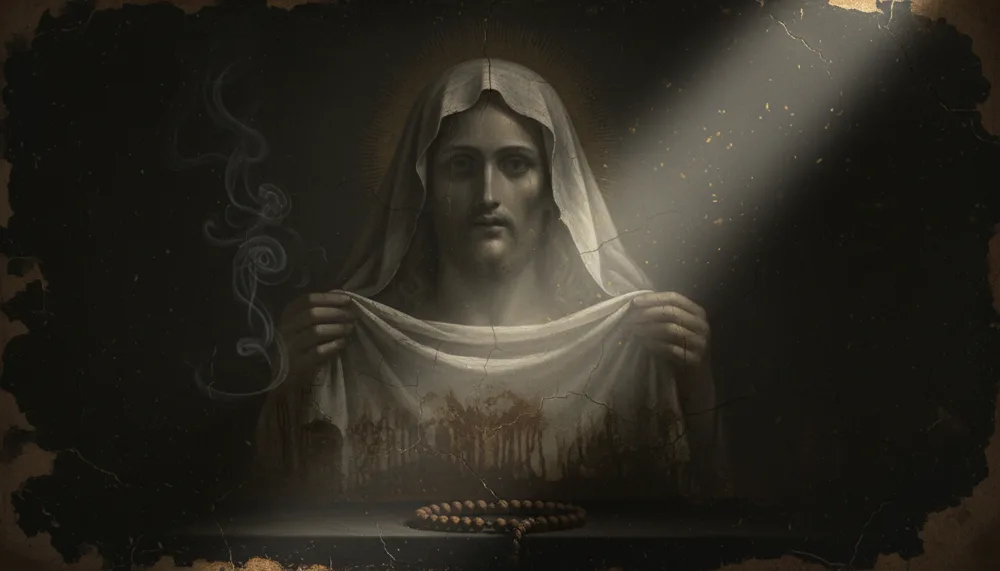
The Chaplet of the Holy Face of Jesus is a devotion of reparation, prayed on a string of thirty-nine beads, that offers the disfigured Face of Christ to the Father in atonement for the sins of blasphemy and the profanation of Sundays and holy days. It rose in the nineteenth century from Tours, where it was made known to the Carmelite Sister Marie de Saint-Pierre and carried to the world by the layman Leo Dupont, called the Holy Man of Tours. Below we explain what the devotion to the Holy Face is, where it came from, and exactly how the Holy Face chaplet is prayed.
What the devotion to the Holy Face is
The Holy Face devotion honours the sacred countenance of Our Lord as it was made ugly in His Passion — spat upon, struck, crowned with thorns, and at last wiped onto the veil of Veronica. Where the Sacred Heart of Jesus is venerated as the symbol of His love, the Holy Face is venerated as the visible bearing of our sins: the Face whose "look was as it were hidden and despised, whereupon we esteemed him not" (Isaias liii). To gaze on that Face is to see what blasphemy does, and to wish to make it good.
The chaplet, then, is not first a prayer of petition but of reparation. Reparation means making amends for offences against God — not because His glory can be diminished, but because justice and love demand that the wrong be acknowledged and the honour be restored. The Church orders our whole worship to this end; the devotion to the Holy Face simply fixes it upon two precise wounds of the age.
The two sins it repairs: blasphemy and the profanation of Sundays
The devotion answers directly to the Second and Third Commandments. The Second Commandment forbids us "to blaspheme against God, against the Most Blessed Virgin, and against the Saints," blasphemy being "a horrible sin which consists in words or acts of contempt or of malediction against God, the Blessed Virgin, the Saints, or against holy things" (Catechism of St Pius X, On the Commandments which regard God). The Third Commandment commands us to keep holy the feast days and "forbids us servile works and every other occupation which turns us away from divine worship" (ibid.).
These are exactly the two offences the Holy Face devotion sets itself against — the dishonouring of the Name of God, and the trampling of His day. The prayers given at Tours name them as the "first table" of the Law, the commandments that touch God Himself. The chaplet was framed as a weapon against them, in an age when public blasphemy and the abandonment of the Lord's Day were spreading. It remains a fitting answer in ours.
Tours: Sister Marie de Saint-Pierre and the Golden Arrow
The devotion in its modern form was made known to Sister Marie de Saint-Pierre (1816–1848), a Discalced Carmelite of the monastery of Tours. In the communications she reported and submitted entirely to her superiors and the Church, she was given to understand that the offences of blasphemy and of Sunday profanation pierced the Heart of God, and that He willed a work of reparation through the honouring of His Holy Face. From this came the short ejaculatory prayer known as the Golden Arrow, a prayer of praise meant to "wound" the Heart of Jesus with love as blasphemy wounds it with malice:
May the most holy, most sacred, most adorable, most incomprehensible and unutterable Name of God be for ever praised, blessed, loved, adored and glorified in Heaven, on earth, and under the earth, by all the creatures of God, and by the Sacred Heart of Our Lord Jesus Christ, in the Most Holy Sacrament of the Altar. Amen.
Sister Marie de Saint-Pierre died young and unknown. The devotion would almost certainly have died with her but for a layman of Tours.
The Venerable Leo Dupont, the Holy Man of Tours
Leo Dupont (1797–1876) was a Catholic gentleman of independent means living in Tours. Drawn to the message of the Carmel, he kept a lamp burning before an image of the Holy Face in his own home and prayed there with whoever would come. Cures and conversions were reported in such number that his house became a place of pilgrimage, and he was called the Holy Man of Tours.
He spent his fortune and his life propagating the devotion, and the Archconfraternity of the Holy Face grew from his work. He died with the reputation of sanctity and the Church later declared him Venerable. Through one cloistered nun and one layman, then, the Holy Face devotion passed from a hidden cell into the universal Church — a reminder, like so many of the Catholic devotions, that the tradition is carried as much by faithful obscurity as by office.
How to pray the Holy Face chaplet on its 39 beads
The Holy Face chaplet has its own beads: thirty-nine in all — six groups of five beads, plus nine beads set apart. The numbers are not arbitrary. The thirty beads of the six groups honour the five wounds of Our Lord through each of the six senses by which He suffered and we sin; the nine beads honour the nine months He dwelt in the womb of the Blessed Virgin, by whom He took the Face that was wounded for us. If this fixed structure of distinct beads and invocations is new to you, see what is a chaplet for the genre.
The chaplet is prayed thus:
On the medal or crucifix, begin:
O God, come to my assistance. O Lord, make haste to help me. Glory be to the Father, and to the Son, and to the Holy Ghost; as it was in the beginning, is now, and ever shall be, world without end. Amen.On each of the thirty beads (the six groups of five), honouring the five wounds through the senses, say:
Arise, O Lord, and let Thy enemies be scattered, and let them that hate Thee flee from before Thy Face.After each group of five, say:
My Jesus, mercy.On each of the nine remaining beads, honouring the nine months in the womb of the Virgin, say:
Eternal Father, I offer Thee the adorable Face of Thy beloved Son, for the honour and glory of Thy Name, for the conversion of sinners, and for the salvation of the dying.To conclude, say:
O Lord, show us Thy Face, and we shall be saved.Then the Golden Arrow prayer above, in reparation for blasphemy.
The repeated cry Arise, O Lord, and let Thy enemies be scattered (Psalm lxvii) sets the whole chaplet under its true aspect: it is a militant prayer, raised against the dishonouring of God, asking that His Face — once hidden in shame — be shown again to a world that has forgotten it.
Holy Face chaplet beads: what the string looks like
Because its structure is unlike the Rosary, people often ask what a set of Holy Face chaplet beads actually is. It is a single loop of thirty beads divided into six groups of five, with each group separated by one larger or differently coloured bead on which "My Jesus, mercy" is said; then a short pendant of nine beads leading to a medal of the Holy Face or a crucifix from which the chaplet begins. That is thirty-nine in all. Some strings carry a Veronica's-veil medal at the centre; many are made simply, in line with the poverty of the devotion as it was first prayed at Tours.
You do not, however, need a purpose-made set to pray it. The chaplet can be counted on ordinary Rosary beads, on the fingers, or from a printed card — what matters is the order of the invocations, not the material of the beads. The proper Holy Face beads simply make the six-and-nine pattern easier to hold without losing your place, and they keep the devotion visibly distinct from the Rosary. If the idea of a fixed bead count and set of invocations is new to you, what is a chaplet explains the genre as a whole.
When to pray the Chaplet of the Holy Face
The devotion has no obligatory day, but two times are traditional. The first is Tuesday, the day long associated with the Holy Face by the Archconfraternity of Tours, kept in memory of the Passion. The second is Shrove Tuesday and the days of Carnival, when the world gives itself most openly to the excess and blasphemy the chaplet repairs — the message at Tours pressed reparation precisely for those days. It is also fittingly prayed on Fridays with the Sacred Heart of Jesus, and at any time one wishes to make amends for a blasphemy heard or for the profanation of the Lord's Day. There is no superstition in choosing a day: the day adds nothing of itself, but orders our reparation to the seasons in which it is most needed.
Where the Holy Face chaplet stands among our devotions
The Holy Face chaplet belongs to the same family of reparatory devotions the Church has long given us, and it sits well beside them. It answers the same impulse as the Divine Mercy Chaplet in pleading the Passion of Christ, though it is far older in form and squarely fixed on reparation; it complements the first Fridays and the consoling of the Sacred Heart of Jesus; and it is at home among the wider body of Catholic prayers, beside the chaplet of the Sacred Heart and the Litany of the Sacred Heart that the faithful have always loved. Pray it for the conversion of those who curse, and for the sanctification of the Lord's Day.
Frequently Asked Questions
What is the Chaplet of the Holy Face of Jesus?
The Chaplet of the Holy Face of Jesus is a devotion of reparation, prayed on a string of thirty-nine beads, that offers the disfigured Face of Christ to the eternal Father in atonement for the sins of blasphemy and the profanation of Sundays and holy days. Where the Sacred Heart is venerated as the symbol of His love, the Holy Face is venerated as the visible bearing of our sins — the Face whose "look was as it were hidden and despised" (Isaias liii). It is a prayer not first of petition but of reparation, making amends for offences against God.
How do you pray the Chaplet of the Holy Face?
It is prayed on thirty-nine beads — six groups of five, plus nine set apart. After an opening "O God, come to my assistance" and Glory Be, on each of the thirty beads of the six groups you say, "Arise, O Lord, and let Thy enemies be scattered, and let them that hate Thee flee from before Thy Face," with "My Jesus, mercy" after each group of five. On each of the nine remaining beads you say, "Eternal Father, I offer Thee the adorable Face of Thy beloved Son... for the conversion of sinners, and for the salvation of the dying." It closes with "O Lord, show us Thy Face, and we shall be saved," and the Golden Arrow prayer.
How many beads does the Holy Face chaplet have?
Thirty-nine in all: thirty beads in six groups of five, and nine beads set apart. The thirty honour the five wounds of Our Lord through each of the six senses by which He suffered and we sin; the nine honour the nine months He dwelt in the womb of the Blessed Virgin, by whom He took the Face that was wounded for us.
Can I pray the Holy Face chaplet on regular rosary beads?
Yes. Proper Holy Face chaplet beads — a loop of thirty in six groups of five, plus a pendant of nine to a Holy Face medal — make the pattern easier to keep, but they are not required. The chaplet can be prayed on ordinary Rosary beads, on the fingers, or from a printed card. What matters is the order of the invocations, not the material of the beads.
When should the Chaplet of the Holy Face be prayed?
There is no obligatory day. Tuesday is traditional, the day the Archconfraternity of Tours associated with the Holy Face in memory of the Passion, and the chaplet is especially prayed on Shrove Tuesday and during Carnival, when the blasphemy it repairs is most public. It is also fitting on Fridays with the Sacred Heart, or whenever one wishes to make amends for a blasphemy or for the profanation of Sunday.
What is the Golden Arrow prayer?
The Golden Arrow is the short ejaculatory prayer of praise given at Tours to Sister Marie de Saint-Pierre, meant to "wound" the Heart of Jesus with love as blasphemy wounds it with malice: "May the most holy, most sacred, most adorable, most incomprehensible and unutterable Name of God be for ever praised, blessed, loved, adored and glorified in Heaven, on earth, and under the earth, by all the creatures of God, and by the Sacred Heart of Our Lord Jesus Christ, in the Most Holy Sacrament of the Altar. Amen." It is said at the close of the chaplet in reparation for blasphemy.
Where did the devotion to the Holy Face come from?
It rose in nineteenth-century Tours. It was made known to the Discalced Carmelite Sister Marie de Saint-Pierre (1816–1848), who reported that the offences of blasphemy and Sunday profanation pierced the Heart of God, who willed a work of reparation through the honouring of His Holy Face. After her early death the devotion was carried to the world by the layman Leo Dupont, the Venerable "Holy Man of Tours," from whose work the Archconfraternity of the Holy Face grew.
The Iter Fidei app carries the novenas, chaplets, litanies and prayers in Latin and your own language, with audio. Join early access here.
Sources. Catechism of St Pius X (1908), Part III, "The Commandments which regard God" — the Second Commandment (on blasphemy and the irreverent use of the Name of God) and the Third Commandment (on keeping holy the feast days and the forbidding of servile works); Isaias liii (Douay-Rheims); Psalm lxvii (Douay-Rheims); the Golden Arrow prayer and the Chaplet of the Holy Face as propagated from the Carmel of Tours through the Venerable Leo Dupont and the Archconfraternity of the Holy Face.