Prayer
The Parts of a Rosary: How Many Beads and What Each One Is For
Rosary parts explained: the crucifix, the centerpiece, the beads, and the decades — how a Rosary is structured, how many beads it has, and which prayer is said on each one.
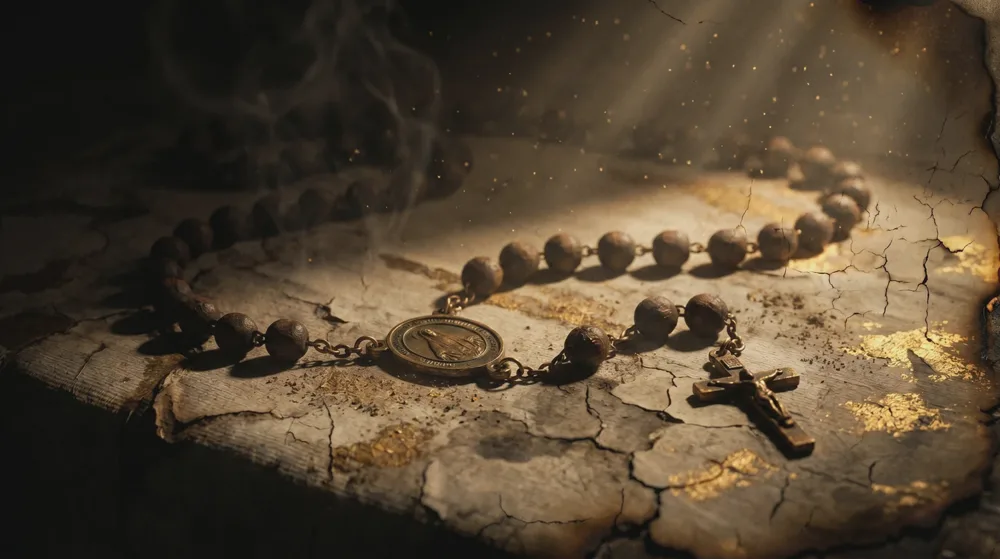
A Rosary is more than a string of beads — it is a small instrument of prayer, and every part of it has a purpose. The parts of a Rosary are simply this: a crucifix, a short lead-in strand of beads, a centerpiece medal, and a loop of fifty beads divided into five sets of ten. Each bead marks one prayer to be said, so the fingers always know where you are while the mind rests on the mysteries. Below is the full anatomy — how many beads a Rosary has, what each part is for, and which prayer maps onto it. (For praying it, see How to Pray the Rosary.)
How is a Rosary structured? (the quick answer)
Read from the crucifix, a Rosary is structured like this:
- Crucifix — Sign of the Cross, then the Apostles' Creed
- 1 large bead — one Our Father
- 3 small beads — three Hail Marys (for faith, hope, and charity)
- 1 large bead — one Glory Be
- Centerpiece medal — where the strand joins the loop
- The loop: 5 decades. For each decade: 1 large bead (Our Father) + 10 small beads (ten Hail Marys) + a Glory Be (often with the Fatima prayer)
That is the whole map. Ten Hail Marys and one Our Father, five times around the loop, with the Creed on the crucifix to begin — that is the heart of the Rosary.
How many beads are on a Rosary?
A standard Rosary has fifty-nine beads in all, plus the crucifix. They are arranged in two parts: a short straight strand that leads in, and a loop that you pray around. The fifty-nine break down as:
- 1 large bead after the crucifix (Our Father)
- 3 small beads together on the lead-in strand (three Hail Marys)
- 1 large bead before the loop (Glory Be)
- 5 sets of 10 small beads — the decades — that make up the loop (50 beads)
- 4 single large beads separating the five decades within the loop (the Our Father of each decade after the first; the fifth Our Father bead is the same one that ends the lead-in strand)
That is fifty-nine, and it never changes from one Rosary to the next.
A Rosary diagram in words
Picture it laid flat in the shape of a key. At the bottom hangs the crucifix. Above it, a short tail of beads rises: a single large bead, a cluster of three small beads, then one more large bead. That tail ends at the centerpiece medal, from which springs the great loop — a circle of fifty small beads broken into five groups of ten, with a single large bead before each group. You begin at the crucifix, climb the tail, pass through the centerpiece, travel around the loop, and arrive back at the centerpiece to finish.
The parts of a Rosary, one by one
The crucifix. The Rosary begins and ends here. On the crucifix you make the Sign of the Cross:
In nomine Patris, et Filii, et Spiritus Sancti. Amen.
In the name of the Father, and of the Son, and of the Holy Ghost. Amen.
Then you say the Apostles' Creed:
Credo in Deum, Patrem omnipotentem...
I believe in God, the Father Almighty, Creator of heaven and earth...
It is the anchor of the whole prayer, the Cross from which everything else literally hangs.
The lead-in beads (one, then three, then one). On the first large bead you say an Our Father:
Pater noster, qui es in caelis...
Our Father, who art in heaven...
On the three small beads, three Hail Marys — by ancient custom one each for faith, hope, and charity; then a Glory Be on the last large bead:
Gloria Patri, et Filio, et Spiritui Sancto...
Glory be to the Father, and to the Son, and to the Holy Ghost...
The centerpiece (or "center"). Where the lead-in strand meets the loop sits a small medal — the centerpiece. It joins the two parts of the Rosary and very often bears an image of Our Lady or a saint. It carries no prayer of its own; you simply pass through it as you move into the decades, and again at the end. Its meaning is quiet but real: Mary stands at the center, leading us to her Son.
The beads of a decade. Each of the five decades is a single large bead followed by ten small beads. On the large bead you announce the mystery and say an Our Father. On the ten small beads you say ten Hail Marys, each a meditation on the mystery:
Ave Maria, gratia plena, Dominus tecum...
Hail Mary, full of grace, the Lord is with thee...
After the tenth you say a Glory Be and — following the request of Our Lady at Fatima in 1917 — the Fatima Prayer:
O my Jesus, forgive us our sins, save us from the fires of hell, lead all souls to Heaven, especially those most in need of Thy mercy.
The decades as a whole. Five decades make the daily Rosary; fifteen (three turns of the loop) make the full traditional Rosary of one hundred and fifty Hail Marys — the "Marian Psalter," echoing the one hundred and fifty psalms. The complete set is laid out in The Mysteries of the Rosary.
After the fifth decade, with the beads at rest, the Rosary closes with the Hail Holy Queen (Salve Regina) and a final prayer:
Salve Regina, Mater misericordiae; vita, dulcedo, et spes nostra, salve...
Hail, holy Queen, Mother of Mercy; our life, our sweetness, and our hope...
(See The Hail Holy Queen and The Hail Mary for the full texts.)
What a Rosary is made of
Rosaries are made in every material — wood, seeds (the traditional "Job's tears"), glass, bone, semi-precious stone, and metal. The material does not change the prayer; a humble knotted-cord Rosary and a fine silver one are prayed in exactly the same way. The large and small beads may differ in size or color so the fingers can feel the change from an Our Father bead to a Hail Mary bead, but this is a convenience, not a rule. What matters is that the Rosary be blessed — an ancient custom that sets it apart for sacred use.
Why the parts matter
The genius of the Rosary is that the hand keeps the place while the mind is free to meditate. Each bead is a prayer already assigned, so you never have to count or wonder where you are — the fingers move, the lips pray, and the mind rests on the mystery. This is why the Rosary has been the prayer of saints and of unlettered peasants alike: it asks nothing of the memory and everything of the heart. Mary herself foretold:
all generations shall call me blessed (St. Luke 1:48, Douay-Rheims)
The Rosary is one humble way each generation keeps that word. Knowing the parts is simply knowing the map of the prayer — and once you know it, you are free to forget the map and pray.
Frequently Asked Questions
How many beads does a Rosary have?
A standard five-decade Rosary has fifty-nine beads plus a crucifix: one large bead, three small beads, and one large bead on the lead-in strand, then five decades of ten small beads each (fifty), with a large bead before each decade.
What is the centerpiece of a Rosary for?
The centerpiece is the small medal that joins the lead-in strand to the loop. It carries no prayer of its own; it simply ties the Rosary together and usually bears an image of Our Lady or a saint, a reminder that Mary leads us to Christ.
What prayer is said on the crucifix of the Rosary?
On the crucifix you make the Sign of the Cross and then say the Apostles' Creed (Credo in Deum, Patrem omnipotentem...). The crucifix both begins and ends the Rosary.
What are the large beads on a Rosary for?
The large beads mark the Our Father. There is one before each decade (and one near the start of the lead-in strand). The smaller beads, grouped in tens, mark the Hail Marys. The difference in size lets your fingers feel where each prayer changes.
Is a five-decade Rosary the whole Rosary?
The five-decade loop is the daily Rosary. The complete traditional Rosary is fifteen decades — three full turns of the loop, one hundred and fifty Hail Marys — covering all the Joyful, Sorrowful, and Glorious mysteries. Most people pray one set of five each day. See How to Pray the Rosary and Catholic Prayers.
(Iter Fidei serves the full traditional Rosary — every prayer in Latin and English, with audio for each bead, so you can pray along without losing your place — in the app.) Download it here.
Sources. The traditional Holy Rosary and its prayers (Apostles' Creed, Pater noster, Ave Maria, Gloria Patri, the Fatima prayer of 1917, and the Salve Regina); the Roman custom of blessing the Rosary; St. Luke 1:48 (Douay-Rheims).